
Daina Janitis previews The Jeffery Concerts: TSO Chamber Soloists Play Bach, November 23.
Full disclosure, I took piano lessons without whimpering – but even if I put on a scruffy coat, hunched over, and had unravelling gloves on my hands – I never got into a Glenn Gould state of mind to understand the lure of JS Bach.
But then I found the confession of a man who stuck with music teaching and performance – and explained the appeal of Bach to people with souls!
Ethan Hein is a music technology and music education professor- somewhere – and his personal admission hits the right note. Here’s what he has to say about Bach and his music:
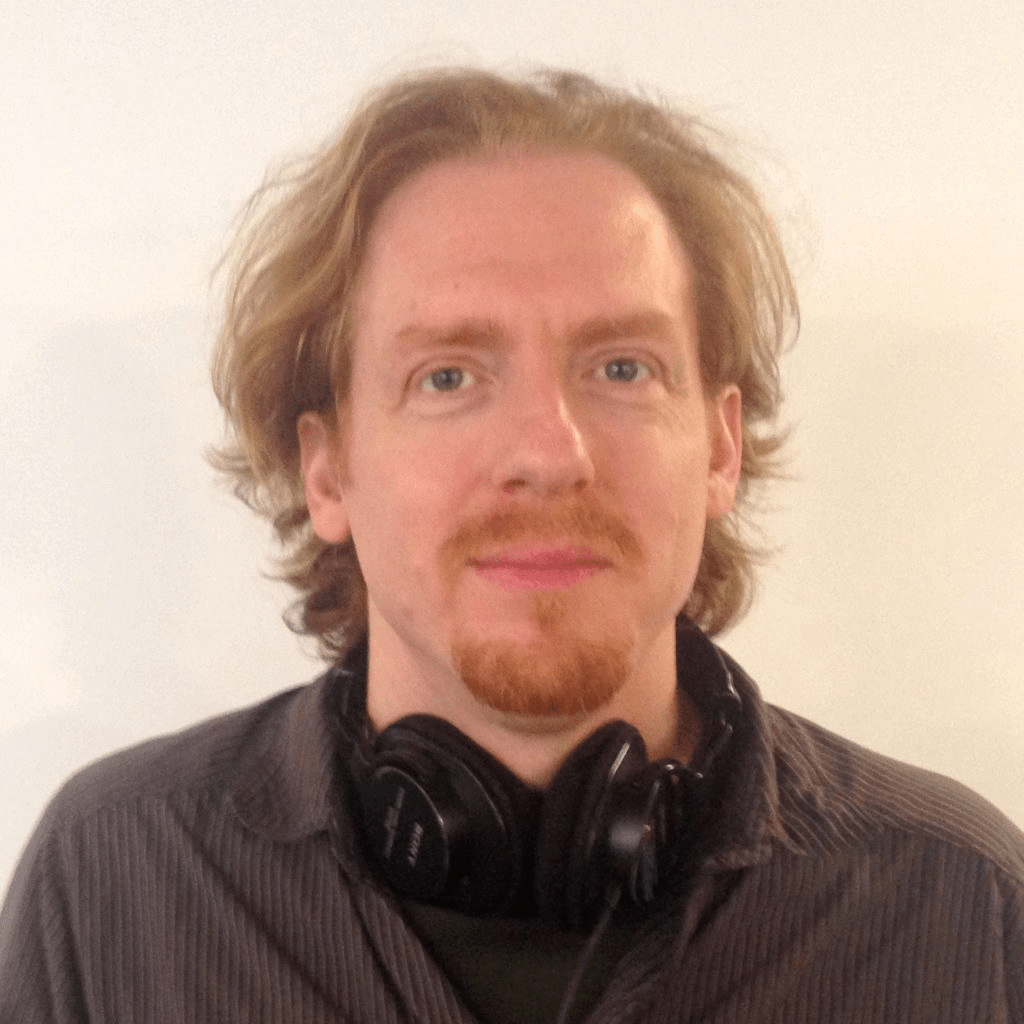
(Pictured: Ethan Hein, The Ethan Hein Blog)
“I’m not a big classical music guy for the most part, but I never get tired of Bach. This stodgy eighteenth-century Lutheran doesn’t seem a likely inspiration for a hipster electronica producer like me. There aren’t too many other wearers of powdered wigs in my record collection, and Bach is the only one in the regular rotation.
Why? When I studied jazz guitar, I was encouraged to learn some Bach violin and cello music. I learned a lot about music theory that way, but I had a surprising amount of fun, too.
Why is Bach’s music so much cooler than anything else of his time and place? There are plenty of beautiful melodies and interesting thematic developments in other Baroque music, but they’re usually buried under tweedly curlicues. I get exhausted from all the jumping up and down between adjacent scale tones.
You never get the sense that Bach is just throwing notes at you to fill the space between ideas. This spare, economic quality shows most clearly in his solo instrument stuff. The single lines spell out both the melodies and the chord progressions clearly, using the spaces between the melody notes to deploy fragments of basslines or arpeggios. Bach gives your imagination just enough data to easily fill in the rest. Leaving notes out is a great way to draw in the listener. It invites us to participate in our heads.
Bach has huge geek appeal. He favored puzzle-like musical forms, canons and fugues, where the melody gets repeated as its own accompaniment. Bach’s music is dense with references and quotations of other works, and of itself. Bach’s love of recursion inspired Douglas Hofstadter to write a whole computer science book about him (and Gödel and Escher.)

Bach was a great quoter of the popular music of his time and place: hymns and regional dances. Since most of the music he was paid to write was for church services, it’s no big surprise that Bach did so much reworking and embellishing of hymns.
You couldn’t ask for a better education in what it means to embellish a theme than to hear Bach’s lines superimposed on the simple hymns. No wonder jazz musicians love him so much; the effect is similar to the way Charlie Parker sounds improvising on a showtune. (Bach was known in his lifetime as an improviser, which adds to his jazz cred.)
There’s something very algorithmic about the rule-oriented forms he wrote in, the canons and fugues, all that complex counterpoint. Every note that Bach ever wrote is on the web in MIDI format. http://www.jsbach.net/midi/index.html His music sounds pretty decent when played by robots (though it’s livelier when it’s played by humans.)
Bach wasn’t very highly regarded in his lifetime outside of a small, devoted circle of groupies. He didn’t hit the cultural big time until a hundred years after his death. He’d probably be amazed now at his elevated stature.” (Ethan Hein)
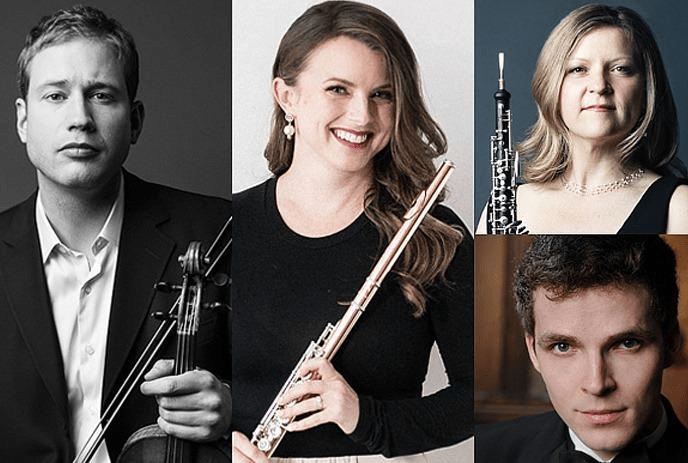
(Pictured: TSO Chamber Soloists)
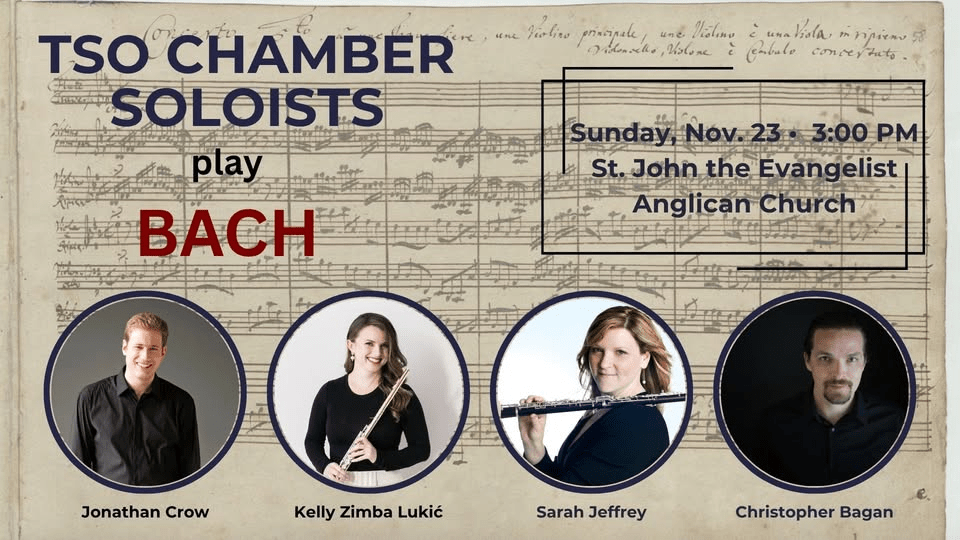
And who are the musical powerhouses that will be playing Bach on Sunday afternoon?
Their bios with details of performances, awards, and recordings can be found on websites- but what do you NEED to know?
Jonathan Crow is their “curator.” He’s also been the concertmaster of the TSO since 2011, but travels the world concertmastering for other orchestras. He teaches violin at the University of Toronto and is an avid chamber musician – a founding member of the Orford String Quartet.
What is it with oboes and London, Ontario? Sarah Jeffrey is a London girl who plays that instrument superbly. You’ve heard the oboe jokes, haven’t you?
Oboist: Did you hear my last recital?
Friend: I hope so.
Oboe: “An ill wind that no one blows good.”
Sarah, however, has been praised for her “exquisite solo work,” her “luscious tone,” and her sensitive musicianship. She’s Principal Oboe of the TSO, a teacher at the Royal Conservatory, and mom of two kids.
Kelly Zimba Lukic joined the Toronto Symphony Orchestra as Principal Flute in 2017 – but leaves a trail of US orchestras in her debt. She’s celebrated as an innovative and inspiring teacher as well as a performer. Previously a flute fellow at the New World Symphony, she has performed with the Chicago, Pittsburgh, and Detroit Symphony Orchestras.
And Christopher Bagan? He’s another tough one to squeeze into an X (formerly Twitter) post. He’s a Doctor of Musical Arts (specialising in Schonberg) who performs baroque with equal fluency. If you’ve heard the tinkle of a harpsichord at the Canadian Opera Co., it was Christopher.
Is there anything else you should know before you get to the church, on time at 3:00 p.m.? Visit: https://youtu.be/IunEDER6Mws
Only that the Brandenburg Concerto #5 – the piece that will feature the whole ensemble – is incredibly beautiful. The link above leads to a Chicago Symphony chamber performance- but T-Rex Hand Position Up – our Canadian musicians will dazzle!
IF YOU GO:
What: The Jeffery Concerts: TSO Chamber Soloists Play Bach.
When: Sunday, November 23, 2025, at 3:00pm.
Where: St John the Evangelist Church, 280 St James Street, London, ON
Tickets: Single Ticket Price: $40. Online at https://www.grandtheatre.com/event/toronto-symphony-orchestra-chamber-soloists? or at the door
Student tickets: Available for free with a valid ID by emailing jefferyconcerts@gmail.com
For more information about The Jeffery Concerts, visit https://www.jefferyconcerts.com/season2526/index.html
Follow on Facebook: https://www.facebook.com/thejefferyconcerts
Previewed by Daina Janitis


 The Beat Magazine 2025