A retired History and Politics high school teacher (1978-2008). Former Publisher/Managing Editor of The Beat Magazine (2009-2014). Freelance Writer. Proud Grandfather.
Each week The Beat Magazine highlights selected events – concerts, theatre productions, art exhibits, film screenings, etc. – featuring local creatives.
The inaugural Forest City Irish Fest is this week’s selected event.
IF YOU GO:
What: Forest City Irish Fest. A 2-day celebration of Irish arts and culture in the London area.
When: Friday September 18 and Saturday September 19.
Where: Various locations in Wortley Village including the Village Green, Landon Public Library, Hyland Cinema, Wortley Roadhouse, Sagi of Wortley, Old South Village Pub, Plant Matter Kitchen, and the German Canadian Club.
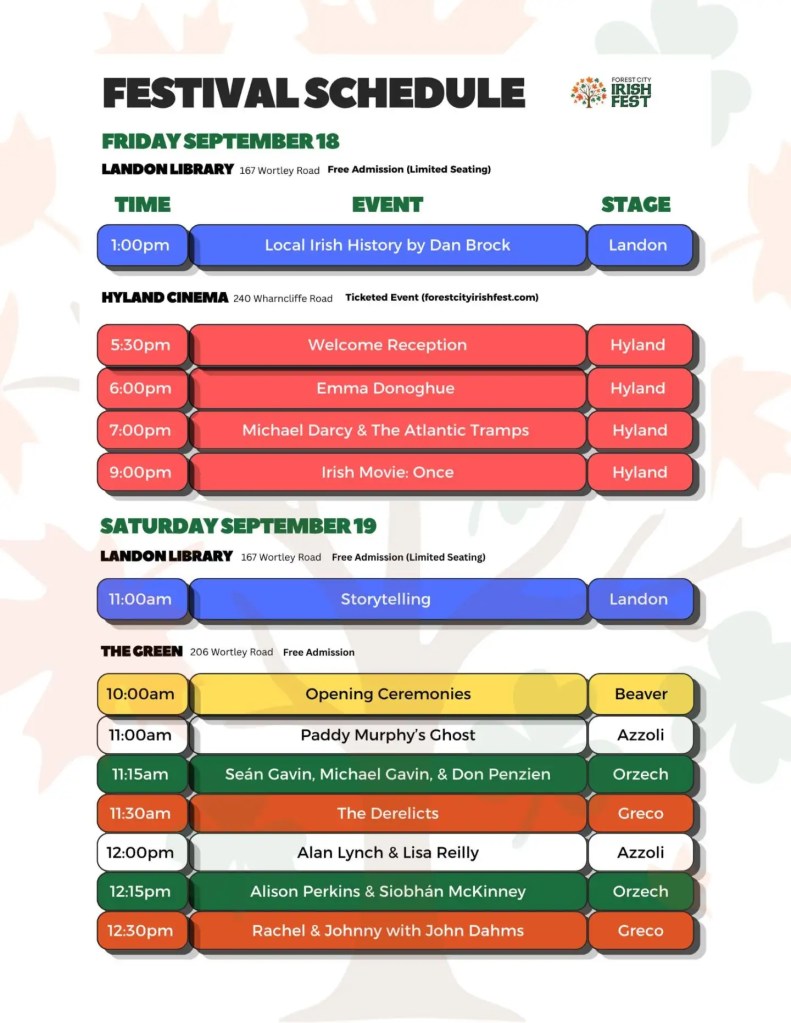
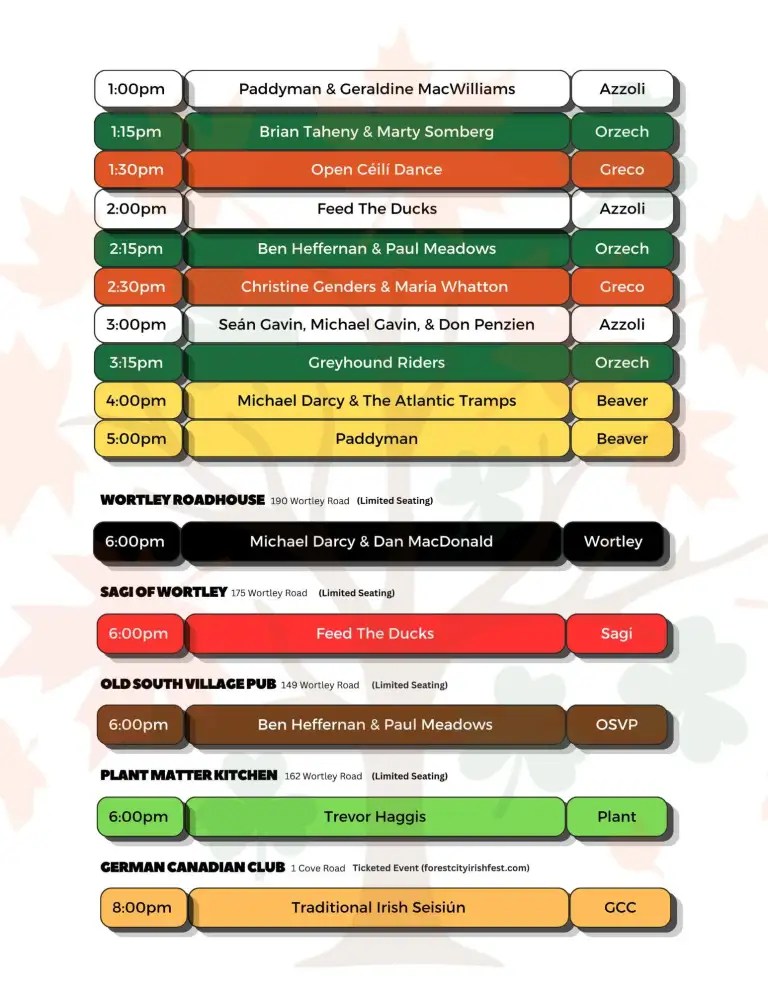
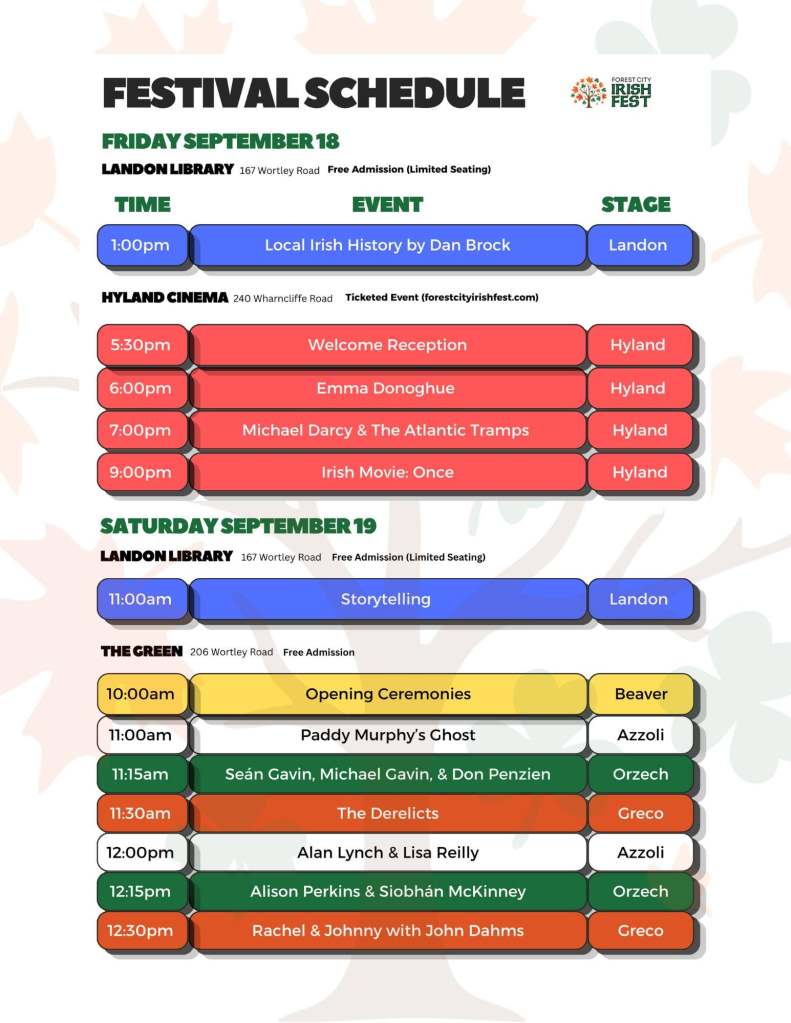
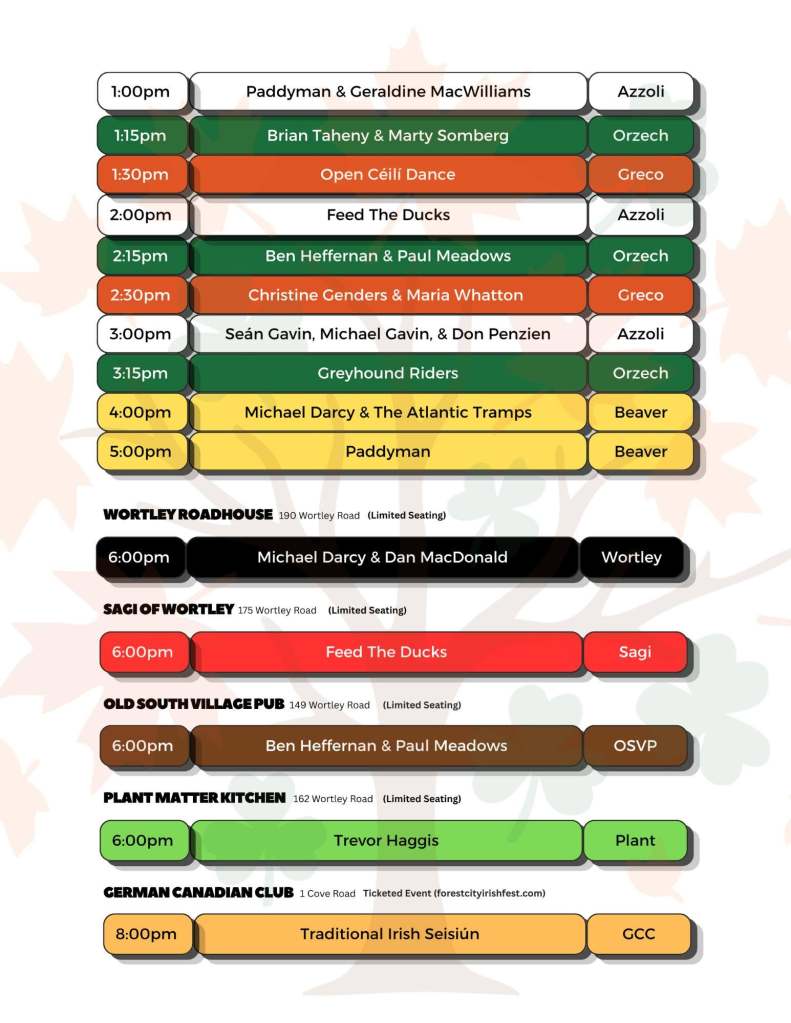
Schedule of Events:
What They’re Saying:
“There is already a lot of Irish culture here in London, but not out in the open. Seisiúns [informal gatherings at which people play traditional Irish music] happen every Tuesday at Scott’s Corners and have been going on for decades. There is so much Irish music and dance in London, but much of it is under the radar, so we thought it was time to get it out in the open and get people excited about it. London and the local region has had a major influence from the culture of Ireland,” says Rachel Genders Boyd, Forest City Irish Fest co-artistic director.
For more information about the Forest City Irish Fest, visit their website www.forestcityirishfest.com and check out their Facebook and Instagram pages for updates.
This is the thirteenth in an ongoing series in which The Beat Magazine 2025 takes readers “Behind The Scenes” to meet the talented creative individuals who make the London area such a vibrant arts and culture community.
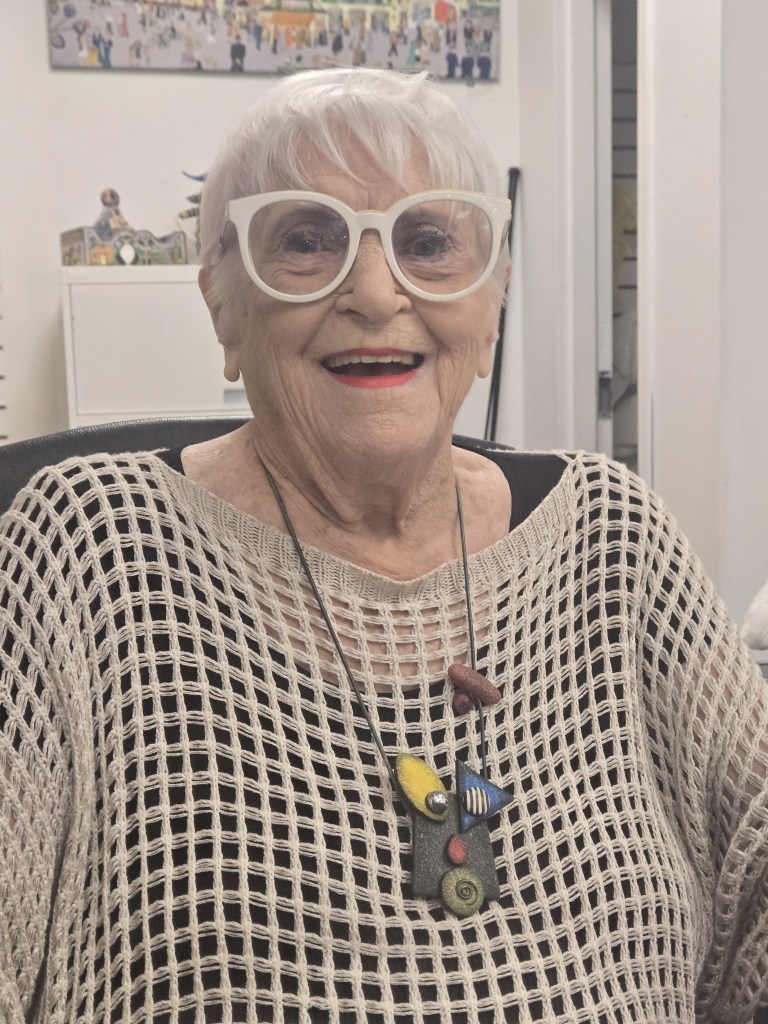
In this segment, Beth Stewart profiles Audrey Cooper, founder and owner of Art with Panache, on the eve of her 99th birthday.
(Audrey Cooper. Photo by Beth Stewart.)
Audrey Cooper moved to London in 2003 to be closer to family and, in 2005, with little prior experience, she began painting.
Cooper was inspired to capture in acrylic on canvas her experience of growing up in the Danforth area of Toronto in the 30s and 40s after seeing school children of this century idling during recess. She recalls, “They were standing in the school yard, on their phones, not playing games or even talking to each other.” She wanted to show how different it was when she was in school.
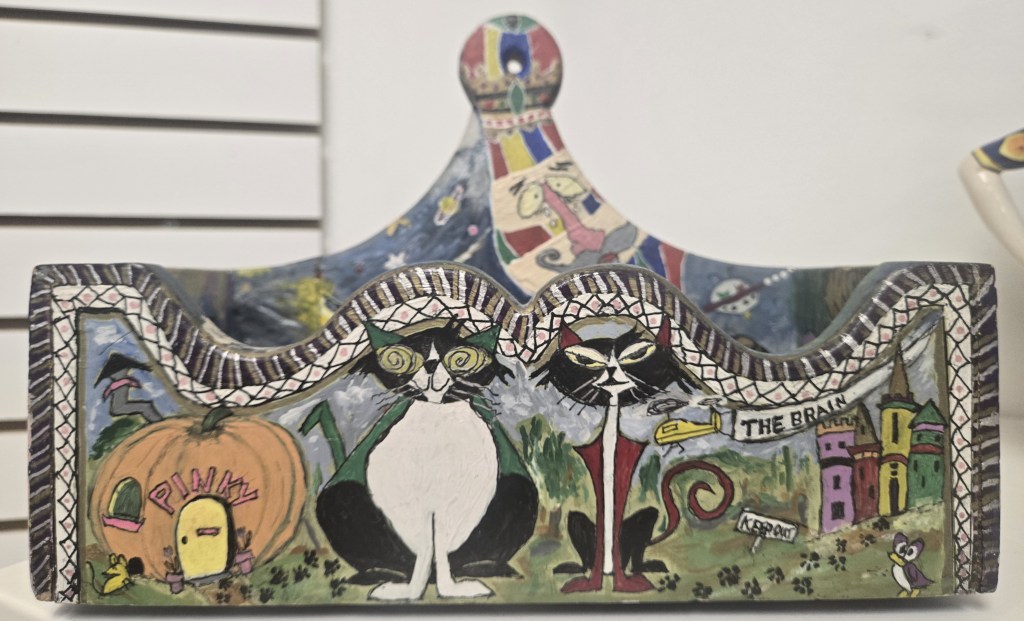
(One of Audrey Cooper’s earliest pieces. Acrylic on wood. NFS. Photo by Beth Stewart.)
“I didn’t want that time to be forgotten. We would skip double Dutch and play ball. We would play Red Rover, hopscotch, and have lots of fun,” says Cooper.
Then, she went further and showed her life from approximately nine years of age until age sixty. She captured carnivals, family outings, coffee klatches and Tupperware parties.
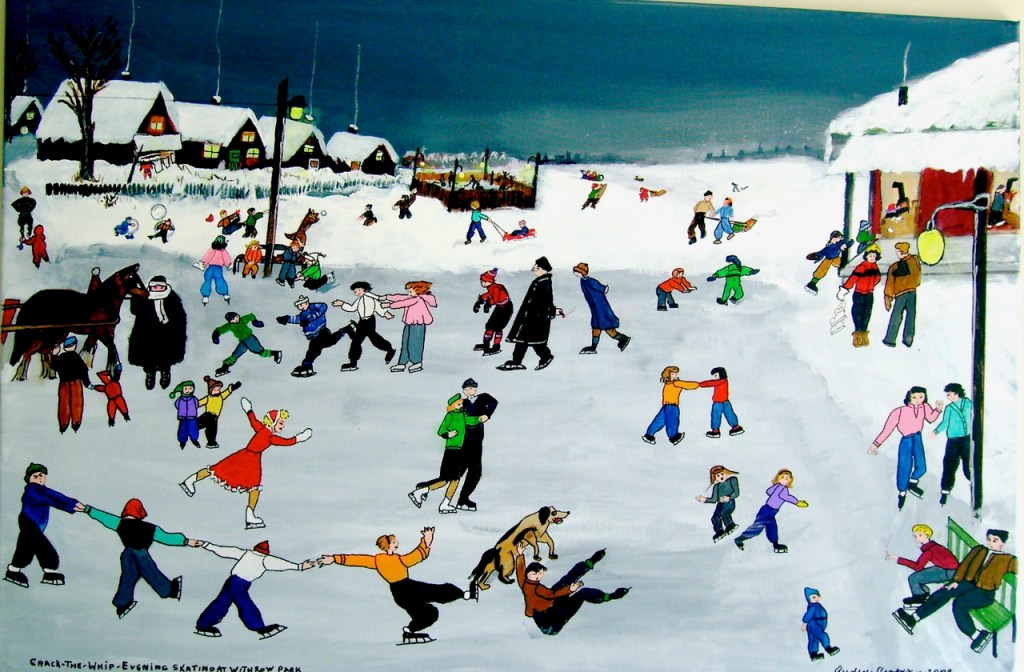
(Audrey Cooper’s acrylic painting “Crack the Whip (Evening Skating at Withrow Park)” depicts the park’s role as a vital winter gathering place for generations of families. Photo courtesy of Audrey Cooper.)
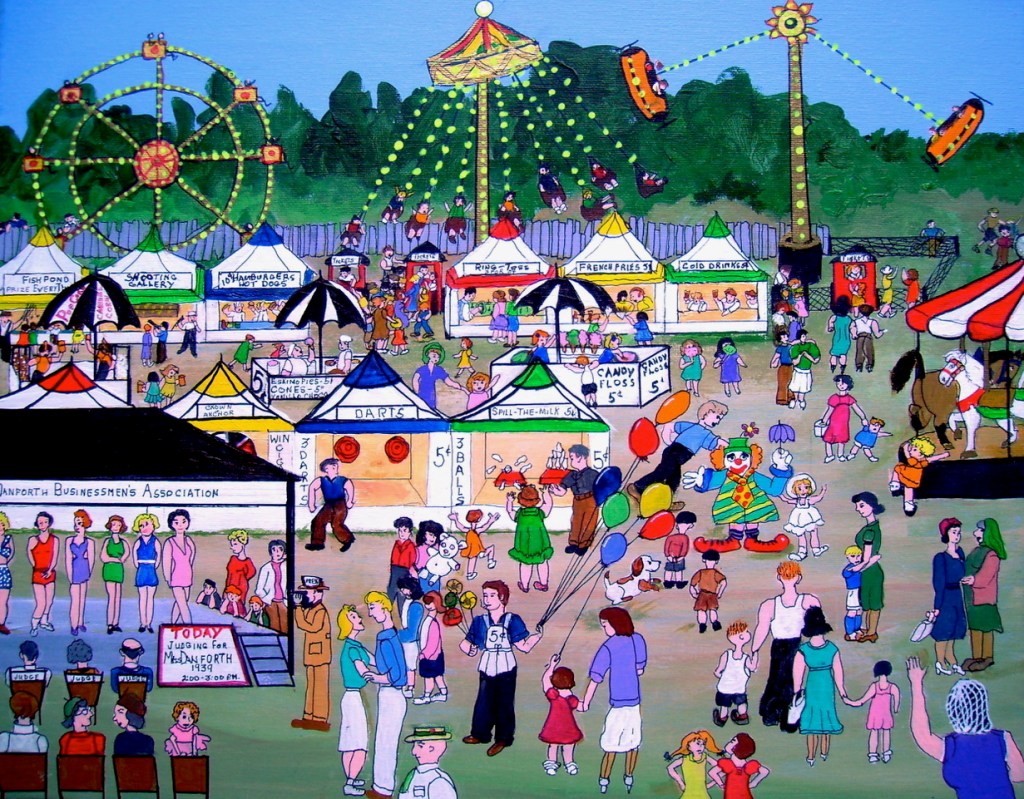
A self-described “city person”, Cooper classifies her own work as “Urban Folk Art”. Her vibrant cityscapes are chock-a-block with people and things. Her crowded canvases boast meticulous detail and spin rich narratives with their deeply personal mix of realism and nostalgia.
(Audrey Cooper’s acrylic painting “Carnival (Judging for Miss Danforth 1939)”, captures the excitement of small travelling carnivals that rotated through vacant east-end lots near her home. Photo courtesy of Audrey Cooper.)
Much to her surprise, Cooper discovered London did not have a gallery that would show the artworks of emerging artists such as herself.
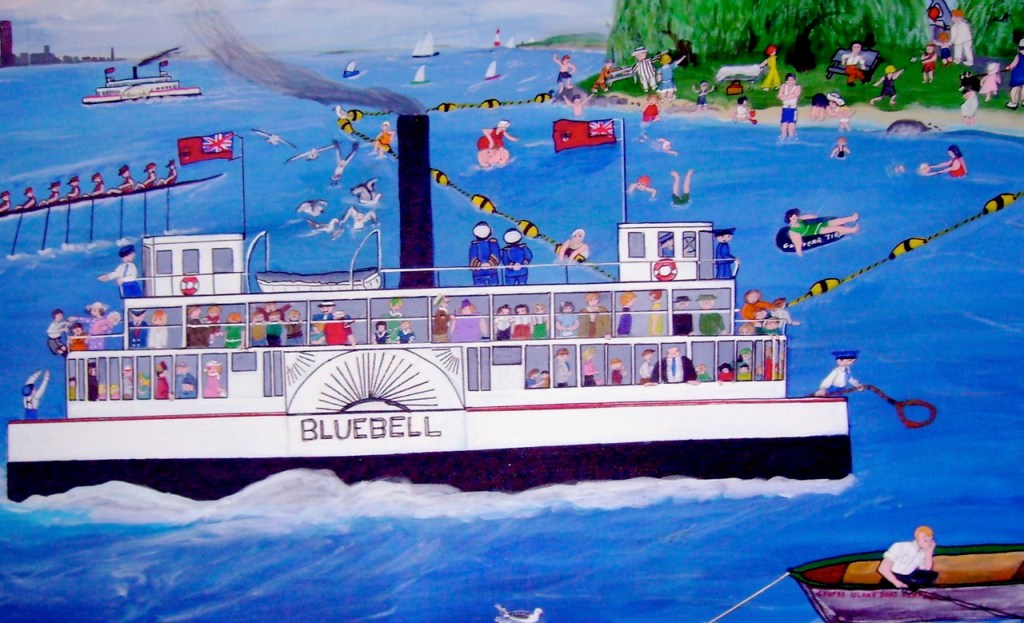
(Audrey Cooper’s 2008 acrylic painting “The Bluebell” shows the steam-powered sidewheel ferry that carried passengers between downtown Toronto and the Toronto Islands from 1906 until 1955. Photo courtesy of Audrey Cooper.)
Then, she happened upon an empty space in downtown London’s Talbot Centre and fell in love with its potential. “Its purpose was clear to me,” she says. “It was the perfect venue to show everyone what a talented and creative community of local artists we have in London”.
So, in 2013, at the age of 86, Cooper founded Art with Panache, and a dream was born.
People began to drop in, and Cooper soon recruited a roster of talented artists.
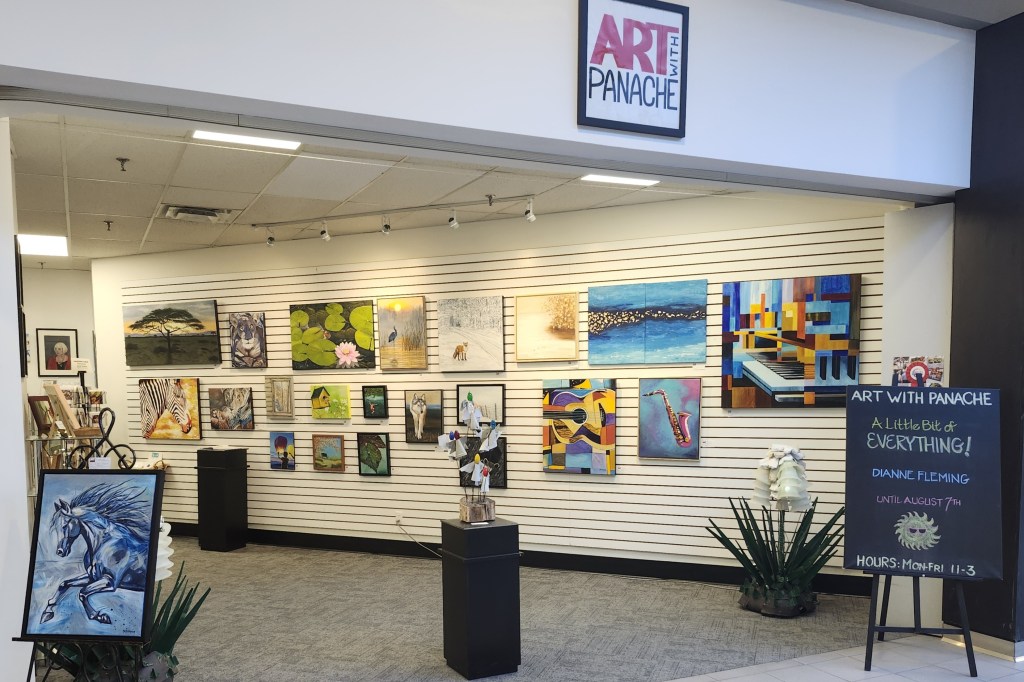
Art with Panachenow boasts 20 local artists, including owner Audrey Cooper. Member artists have input into what goes on in the gallery. They sit the gallery a minimum of two times per month. In return, they have the opportunity to show and sell their work at the venue.
(Member artists are featured on the main wall on a rotating basis. This is a selection of work by Diane Flemming. Photo courtesy of Diane Flemming.)
Member artist Dianne Fleming, who has been with the group for three years, calls the gallery “a hidden gem”.
Cooper concurs and gives kudos to all the artists who have worked in the gallery, who have brought in their collections, and who have waited patiently to be recognized by the London arts community.
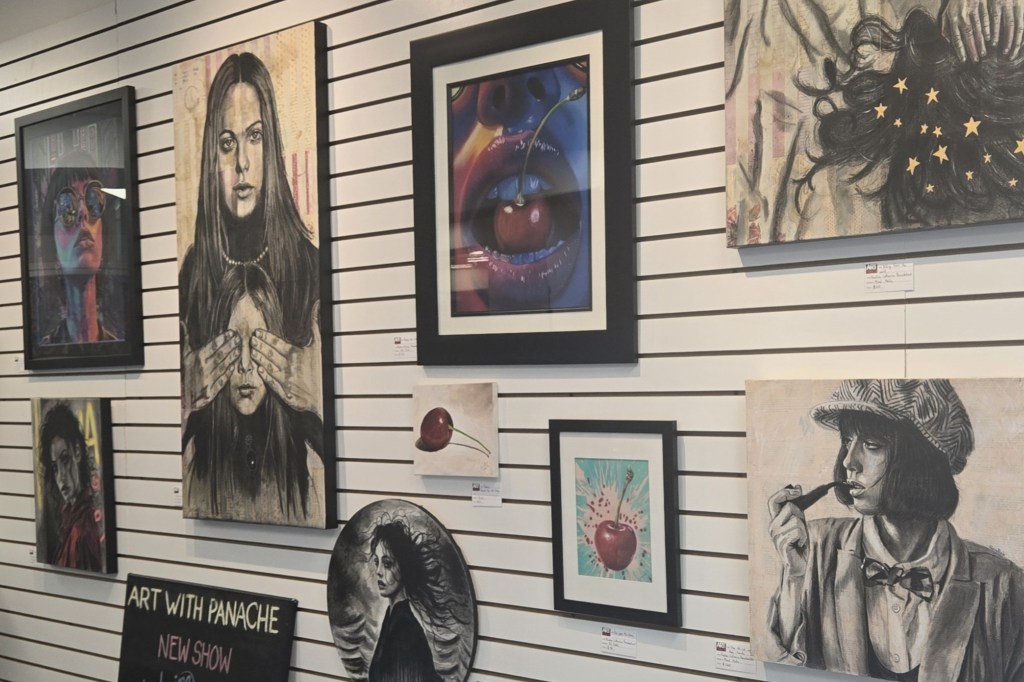
(A selection pf work by member artist Catarina Bezuidenhout. Photo by Beth Stewart.)
In 2024, Audrey was named to the City of London’s Mayor’s New Year’s Honour list in the category of arts. This list celebrates the diversity of philanthropic work taking place in the London community.
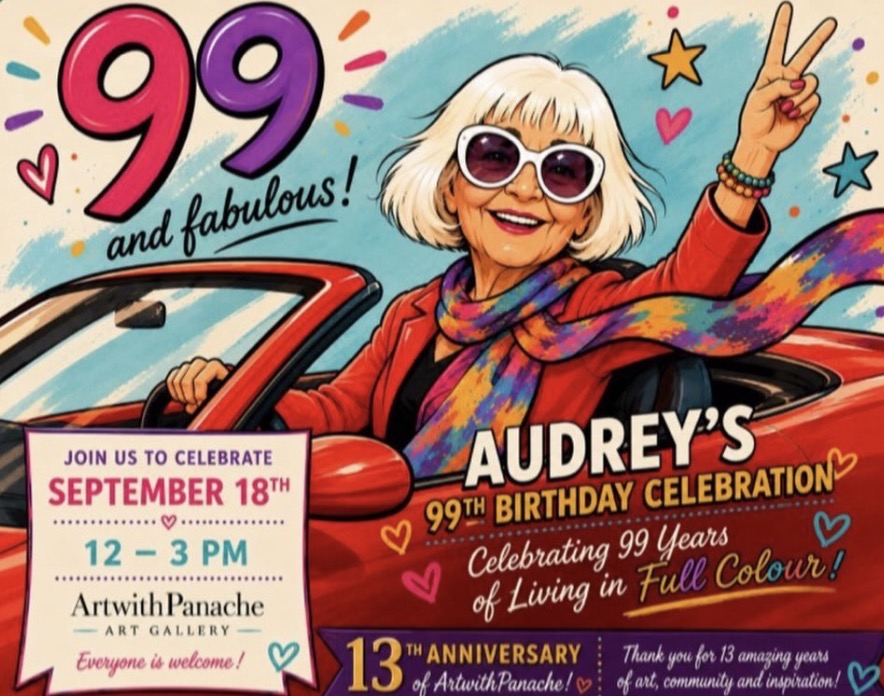
Audrey Cooper turns 99 years old on September 18, and still works in the gallery Monday through Friday. To celebrate, the gallery is planning a retrospective of Cooper’s work which will run September 14 to 18, 2026.
Cooper’s birthday coincides with the gallery’s 13th anniversary, and a party for both is planned on September 18 from 11 am to 3 pm.
Art withPanache will be putting out a Call for Artists in October. This is an opportunity for non-member artists to show their work and get a taste of what the gallery has to offer. The theme is still in flux.
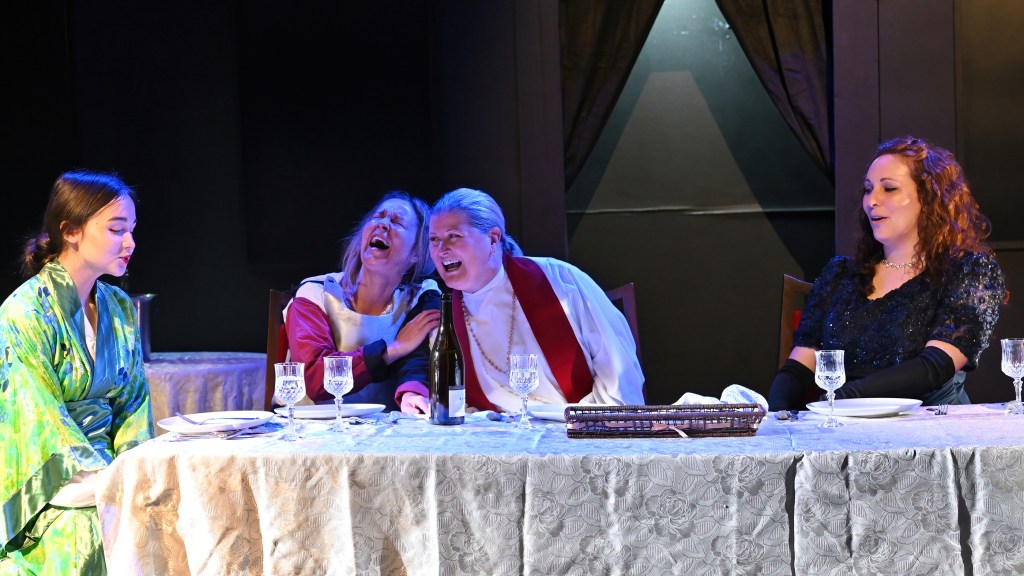
As I left the Princess Avenue Playhouse after seeing Top Girls, I overheard a few patrons trying to describe what they had just seen. The words I heard were “interesting,” “different,” and “heavy.” Honestly, I’m not sure I could have described it much better myself.
Caryl Churchill’s Top Girls, directed and produced by Timothy Hedden, is definitely not conventional theatre. It is subtle, unusual and, at times, deliberately confusing. It doesn’t simply hand you its themes and explain what you’re supposed to think. Instead, it asks you to piece together the connections between the women, their experiences, and the choices they have made. For some people, that will be exactly what makes it interesting. For others, it may make the play a little harder to connect with.
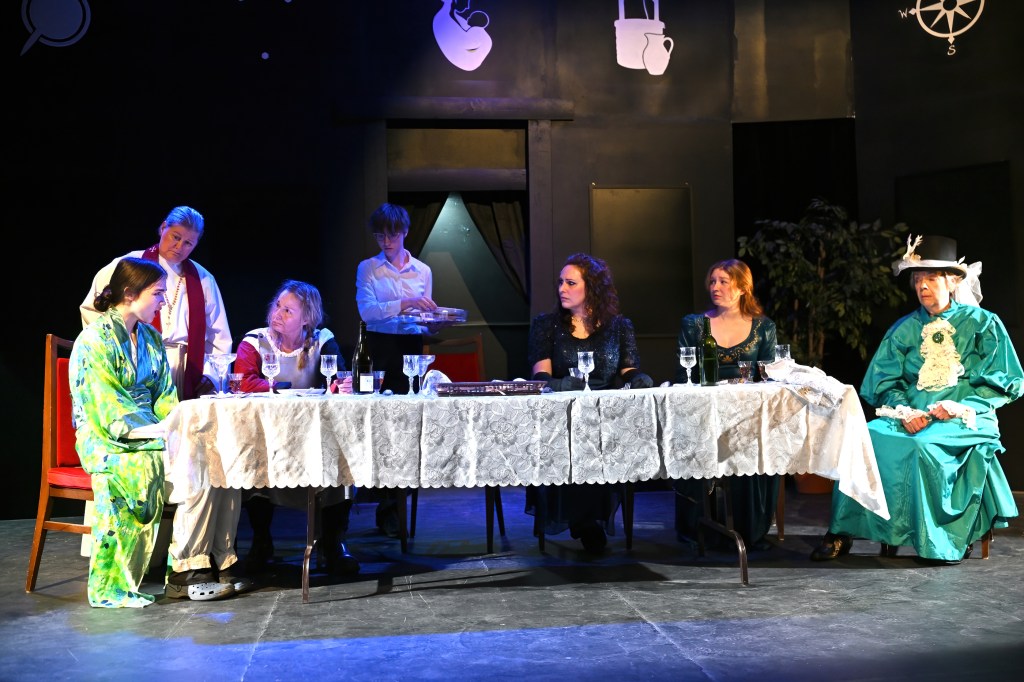
(Photo by Ross Davidson.)
The opening dinner-party scene was particularly challenging for me. Without giving away the premise, Marlene’s guests come from very different times and worlds, and their stories are used to explore the experiences of women throughout history. There is clearly a bigger purpose behind bringing these women together. Their stories reveal some surprisingly common themes of sacrifice, oppression, motherhood, sexuality, ambition, and survival.
Lala Edmunds, who played Marlene, brought a strong presence to the production, and her performance established the confidence and ambition at the heart of the character. Dinah Watts also stood out as Isabella Bird/Louise, bringing a memorable energy and individuality to both roles.
(Photo by Ross Davidson.)
Unfortunately, I struggled to find my way into the opening scene.
The dialogue is intentionally written with characters interrupting and speaking over one another, creating a frantic, almost feverish rhythm. That is part of Churchill’s style and is meant to give the dinner conversation an overlapping, chaotic quality. But I found it difficult to follow in this production. Between the overlapping dialogue, the pace and differences in volume, there were times when I simply couldn’t hear or understand what was being said. One character in particular was difficult to hear, and with the other conversations continuing around her, I sometimes lost the thread completely.
The lighting in the first act also created some very heavy shadows in a few scenes. While I’m sure there was a reason behind the choices, I found some of them distracting and combined with the dialogue, they made those moments even harder to take in.
I don’t know whether these challenges were primarily the writing, the direction, the performances, the acoustics of the space, or some combination of all of them. But the result was that the opening section largely lost me. And that’s unfortunate, because I suspect there was much more meaning in that scene than I was able to take away from it.
The production became much more accessible for me once it moved into the contemporary story.
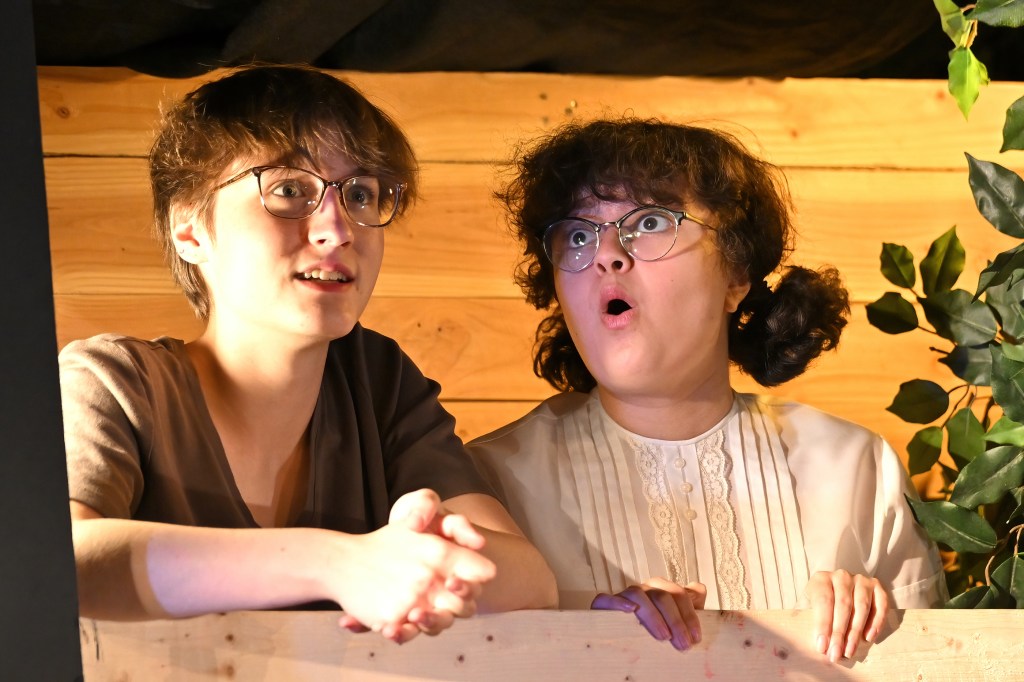
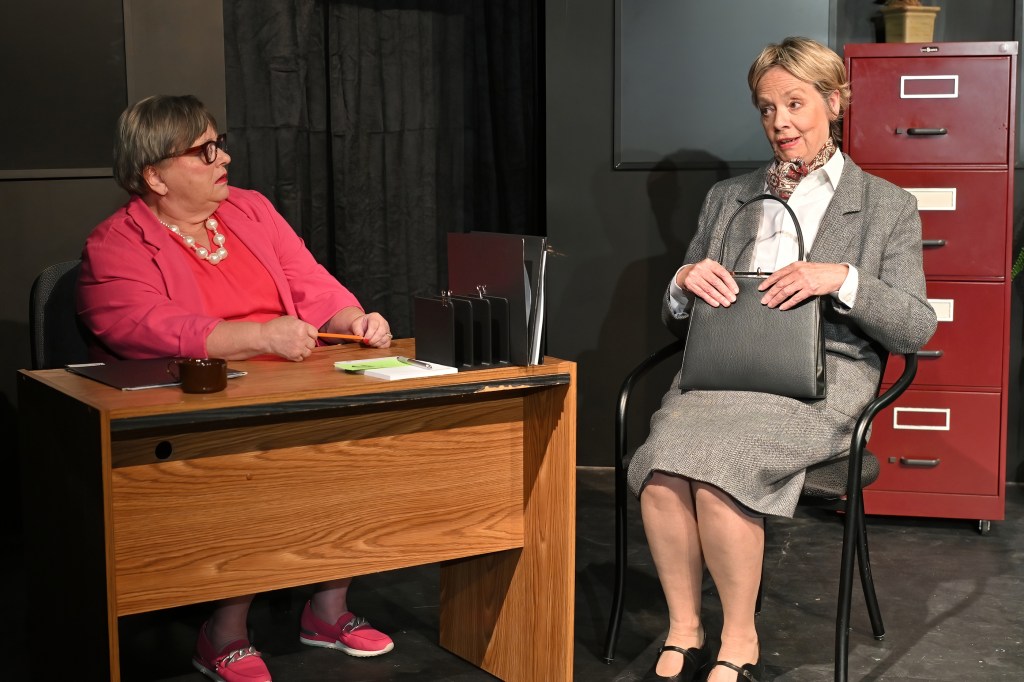
The scenes involving Angie and Kit were a particular highlight. Avery McLaughlin brought a wonderful naturalness to Angie, making her believable, endearing, and completely engaging. Amélie Merchant was equally strong as Kit, and together the two young actresses created a relationship that felt spontaneous and genuine. I found myself hanging on their every word.
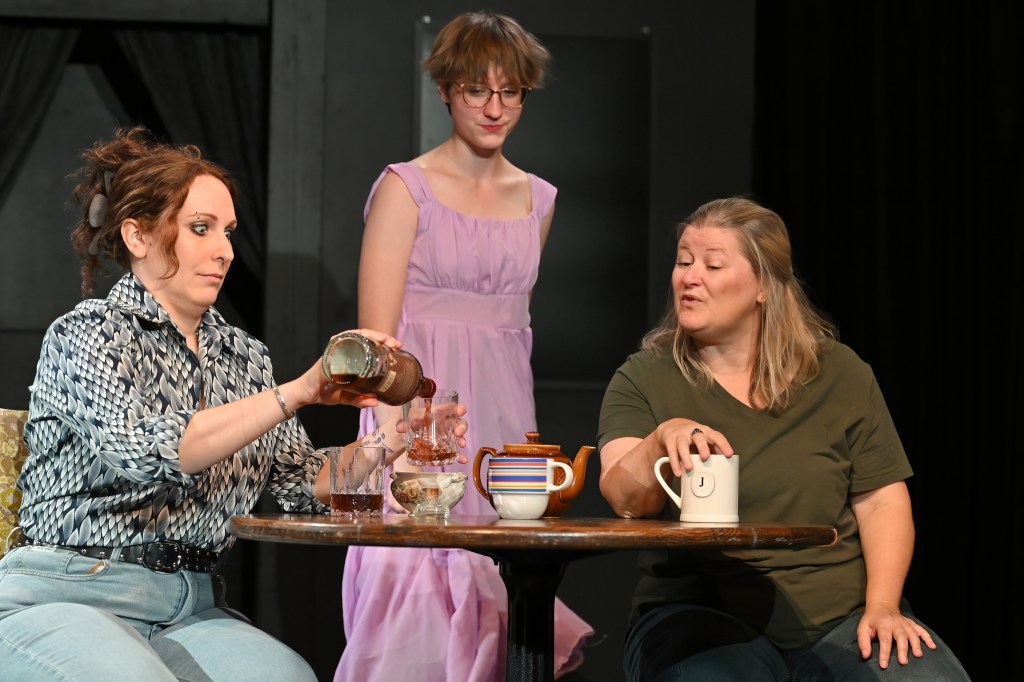
(Photo by Ross Davidson.)
Judy Cormier, who played Pope Joan/Joyce, was another standout. She brought an emotional weight and groundedness to the production that drew me further into the family dynamics and made the more personal moments especially affecting.
From there, the play’s exploration of ambition, family, motherhood, class, and the sacrifices women make in pursuit of success became much clearer. Top Girls is ultimately asking some pretty heavy questions about what women are expected to give up in order to succeed, and whether reaching the top is necessarily the same thing as winning. Marlene embodies that conflict particularly well.
(Photo by Ross Davidson.)
Edmunds’ performance captured that tension effectively. Marlene is ambitious and self-assured, but the play gradually reveals the personal costs beneath that confidence. Her success is never presented as simple or uncomplicated, and Edmunds gave the character enough strength and complexity to make that conflict interesting.
I did, however, find the overall story difficult to connect with at times. The structure is deliberately non-linear, moving between different points in time and different aspects of Marlene’s life. It’s an interesting theatrical choice, but I sometimes found myself wondering where the story was going and what I was ultimately supposed to take from it.
And then there was the ending.
When I left the theatre, I’ll admit I wasn’t entirely sure what I had just watched. I understood the themes, but I felt like something was missing. Perhaps that was intentional. Perhaps the ending was meant to leave the audience sitting with it rather than neatly tying everything together.
It actually took me almost 24 hours to figure out what the ending meant to me.
I was driving today, thinking about this review, when suddenly I had my aha! moment. Something clicked, and I understood the ending in a completely different way. I actually found myself thinking that perhaps the ending would have landed sooner for me if the opening had been a little stronger and easier to follow. If I had been able to take more from those early conversations, maybe some of the connections would have been clearer by the time we reached the end.
And perhaps that is part of the point. The fact that I was still thinking about the play almost a day later says something. It certainly made me think, even if I didn’t always enjoy the process of getting there.
That doesn’t mean I regret seeing it. Quite the opposite.
There is something valuable about theatre that challenges an audience, even when it doesn’t completely work for every person in the room. Top Girls tackles some difficult realities women have faced—and continue to face—and it does so in a way that is thoughtful, unusual and, at times, uncomfortable.
(Photo by Ross Davidson.)
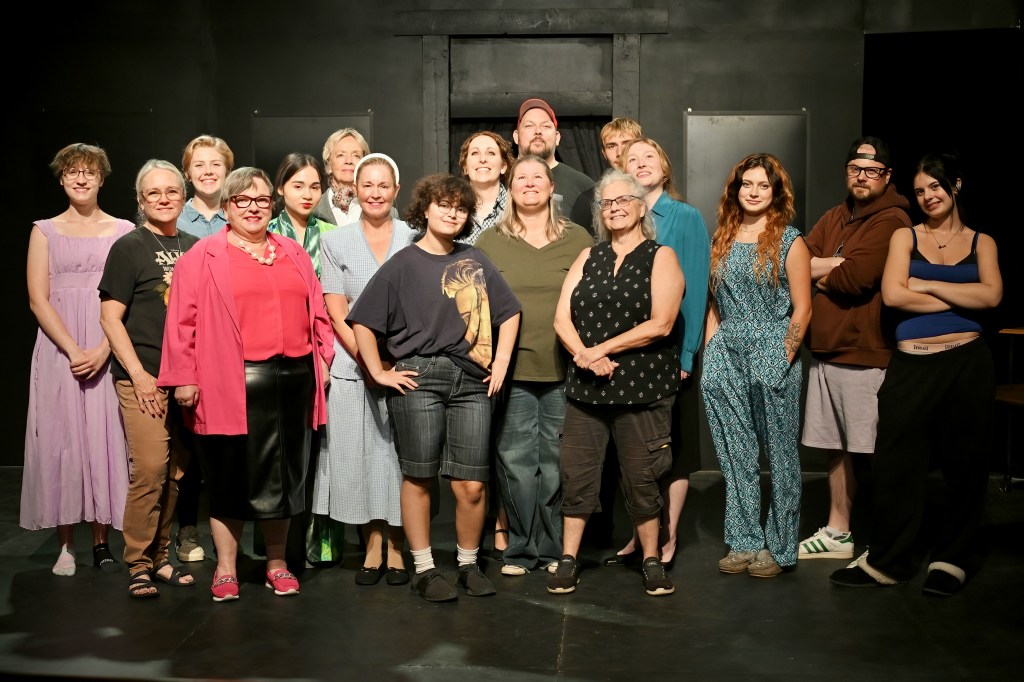
For me, the strongest parts of this production were the performances and the moments when the human relationships came into focus. McLaughlin and Merchant were especially engaging as Angie and Kit, while Cormier brought a strong emotional centre to the family scenes. Watts also made a memorable impression as Isabella Bird/Louise, and Edmunds gave Marlene the confidence and complexity the role demands.
The weaker moments were those where the experimental structure, overlapping dialogue, volume and, at times, lighting became barriers to understanding rather than helping draw me further into the story.
Would I tell someone not to see Top Girls? Absolutely not.
I think theatre is worth seeing even when it isn’t necessarily your cup of tea. Storytelling needs audiences who are willing to take a chance on something different, and Top Girls certainly gives you something different.
But I would say this: Top Girls is not going to be a show for everyone. It is dark, unconventional and, at times, difficult to follow. Go in expecting to work a little harder as an audience member, and don’t expect everything to make sense right away.
Because sometimes the meaning doesn’t arrive until you’re already on your way home.
Interesting. Different. Heavy.
And sometimes, I suppose, that’s exactly what theatre is supposed to be.
(Photo by Ross Davidson.)
IF YOU GO:
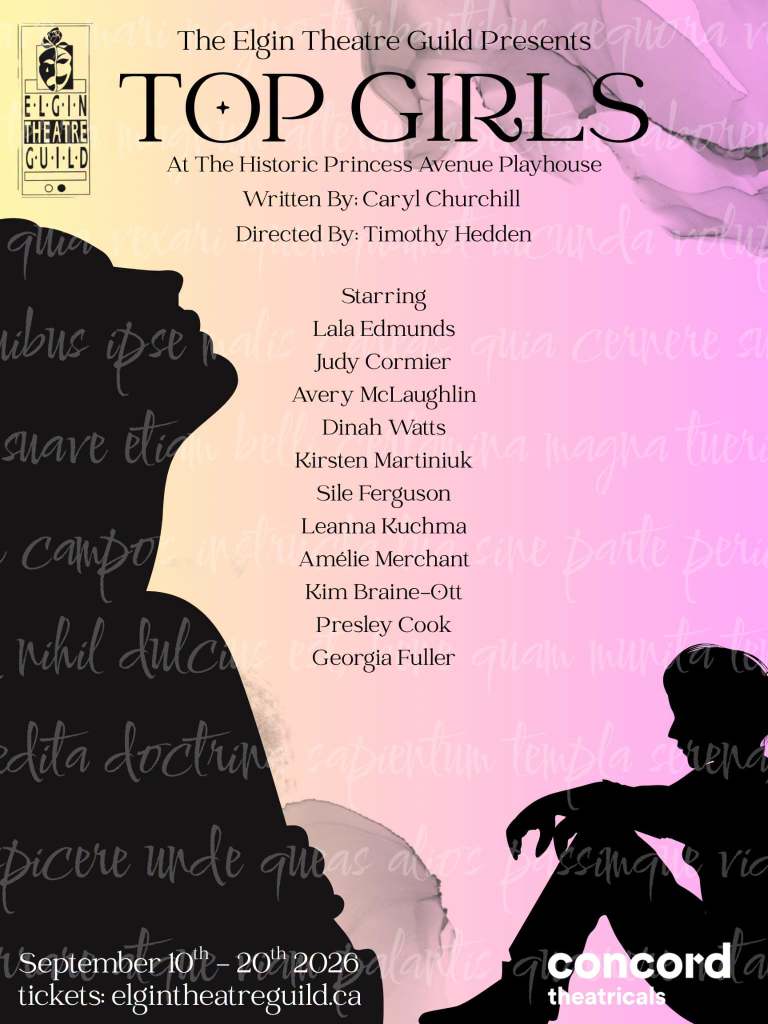
What: Top Girls by Caryl Churchill, Directed By Timothy Hedden
Where: Elgin Theatre Guild, Princess Ave Playhouse, 40 Princess Ave, St. Thomas
Winners of the 2025 Robinson Emerging Artist Showcase at the Goderich Celtic Roots Festival, award-winning UK folk duo Arthur Coates & Kerran Cotterell bring their high-energy live show to London, combining fiddle, guitar, foot percussion, rich vocal harmonies, humour, and storytelling. Drawing on the traditions of Scotland, England, Shetland, Ireland, and Québec, the duo have developed a powerful sound that can feel more like a full band than two musicians.
Arthur Coates, a fiddler raised in Aberdeenshire, builds rolling, riff-heavy tunes grounded in his family’s musical traditions and shaped further by studies with Jonny Hardie (Old Blind Dogs). Kerran Cotterell, a melodic schemer from Cumbria, draws on pop and choral training to weave in crisp harmonies and satisfying twists. Since first meeting at Sidmouth Folk Week (England) in 2018, Arthur and Kerran have grown from pub jam sessions to becoming festival favourites across the UK.
As broadcaster Mike Blackburn put it: “One of the very best live acts I’ve ever seen – and I’ve seen a lot!”
IF YOU GO:
What: Cuckoo’s Nest Folk Club presents Arthur Coates & Kerran Cotterell.
When: Friday, September 11, 7:30 pm.
Where: German Canadian Club, 1 Cove Road, London, ON
Tickets: $25 Advance / $30 at the Door – Advance tickets available at Grooves (Wortley), Long & McQuade North (725 Fanshawe Park Rd W) and online https://ticketscene.ca/events/62439/
This is the twelfth in an ongoing series in which The Beat Magazine 2025 takes readers “Behind The Scenes” to meet the talented creative individuals who make the London area such a vibrant arts and culture community.
In this segment, Bob Klanac profiles Tami Kegley and Page Graham, co-founders of the popular Inside Outside recurring “salons” that bring together the music and visual art communities in a common setting.
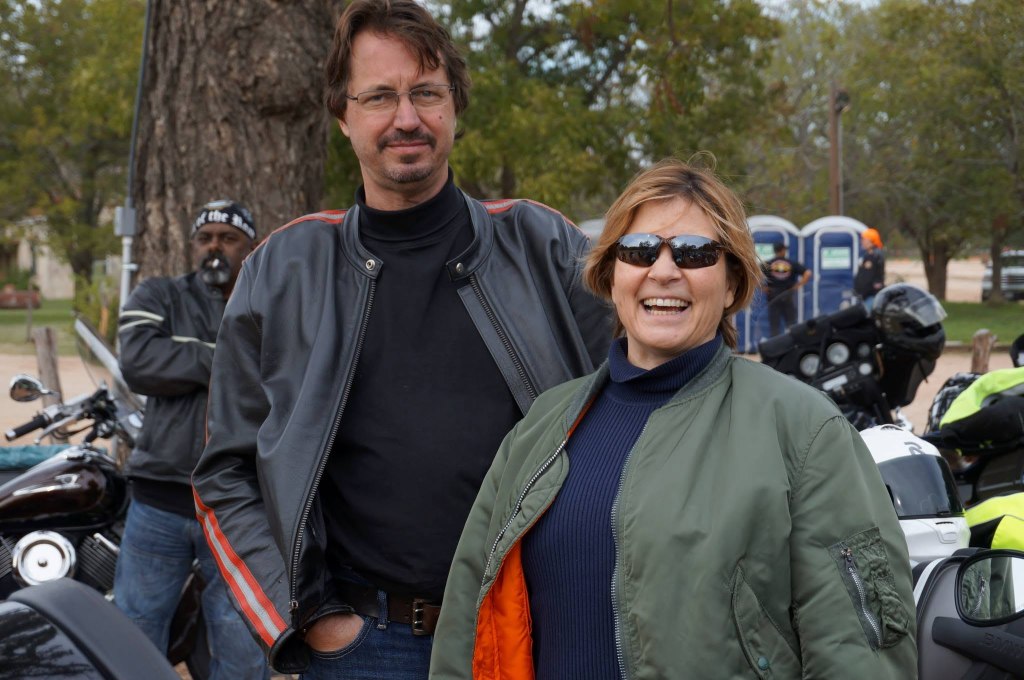
(Pictured: Page Graham and Tami Kegley. Photo provided by Page Graham.)
It took a couple of Texas-based outsiders to spot a need in London’s cultural landscape.
Tami Kegley and Page Graham, expats 40 years living in San Antonio, Texas made their home in London a few years ago and knew they wanted to be involved in London’s growing arts and music scenes.
“When I came back, it felt like the visual arts were playing a secondary role in our community” says Kegley “and there is so much emphasis being placed upon music.
“It seemed like there was no intermingling between the visual arts and the music communities in the city.”
Graham observed in San Antonio a very vibrant arts scene intertwined with the music community.
“I really missed those wonderful artist talks. I would go to a show, and invariably there would be an artist panel discussion.”
Both Kegley and Graham came by their various passions honestly. Kegley is an acclaimed jewelry artist and Graham, a onetime CHRW 80s-era radio host had a long career in television production in San Antonio. Both were very involved in their San Antonio community and came to London looking to do the same.
“Page and I moved to London and became enchanted with the community,” Kegley explains. “We volunteered for the Close to the Edge Festival and things like that and just found ourselves wanting to be more involved.
“My career is as an artist. Page and I have both done arts journalism. That was in our tool kit, and we were looking at how we can make a positive impact on London. It occurred to us that real life conversations were important and had been left by the wayside because of COVID.
“It seems like people are more in their silos here. There are efforts that are facilitated by the city and other groups to try to break out of that but we really wanted to have an arts conversation.”
So Kegley and Graham batted some ideas around their dining room table and decided on something they would call the Inside Outside.
Kegley would be the host of the event interviewing the artists and Graham the producer, ensuring the music and staging goes according to plan.
It would meld music with discussions on the arts in a kind of colloquium setting with one crucial difference from other events of that type.
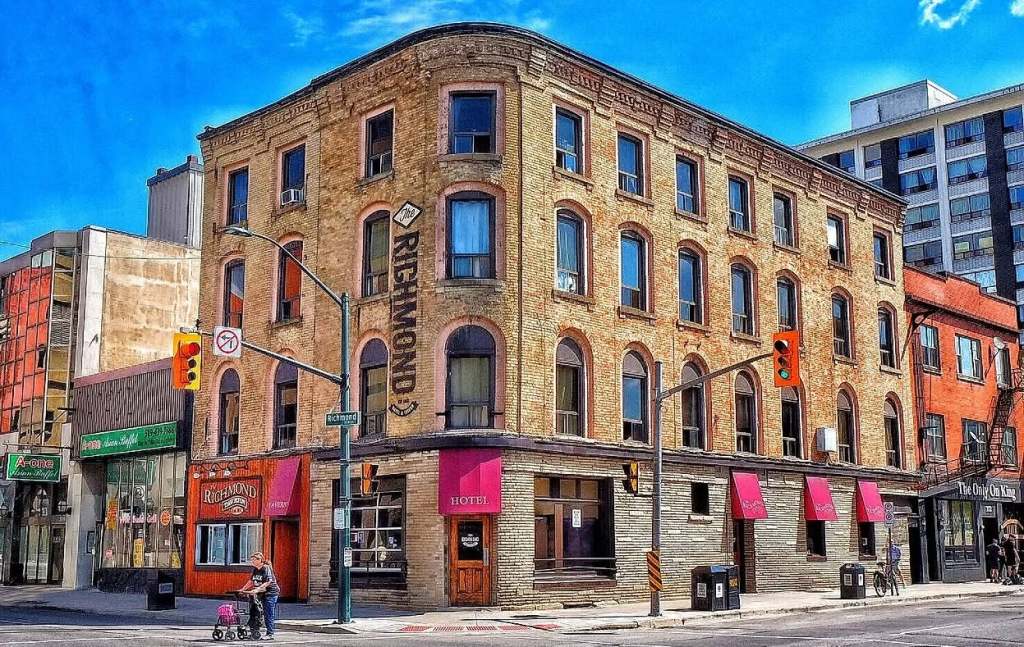
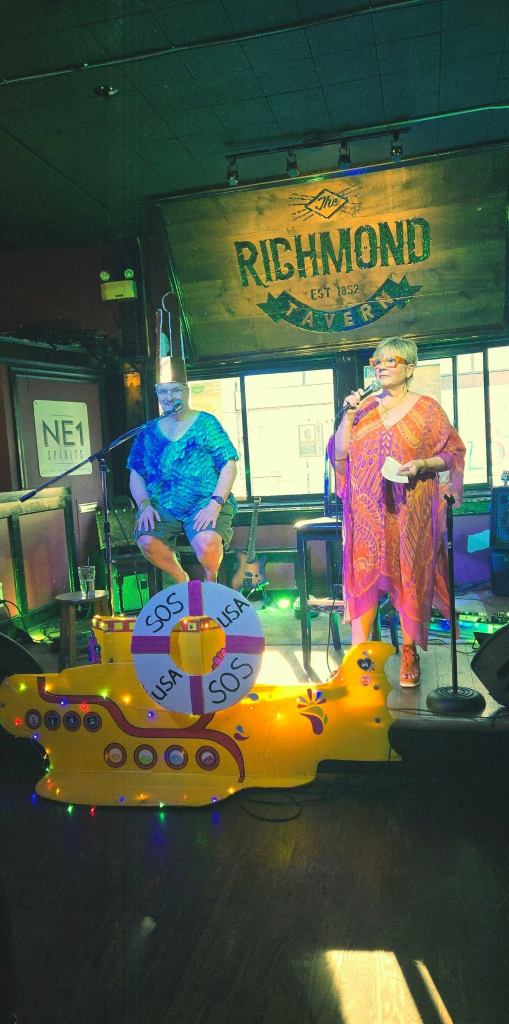
Key to the concept of the event is that it would take place in a bar, London’s legendary Richmond Tavern.
Why the gritty Richmond Tavern? To listen to Graham the answer is a resounding ‘why not’.
“It’s so cool and so real,” he says with a chuckle. “It’s like our version of the Horseshoe Tavern and that’s what makes it so special. You got the regulars in the back room around the round table, so to speak. It’s not exactly the Algonquin Hotel.
“The authenticity of that place makes it special. And that’s why, for us, it’s the venue of choice. It’s intimate. And intimacy is part of the basis of our concept.”
Kegley agrees, adding “It’s a non-intimidating space. It’s not a rarified space.”
Since it bowed in on May of 2025, Inside Outside has hosted talks by Jamie Fenton of Museum London, Graham Henderson, CEO of the London Chamber of Commerce, gallerist Jonathan Bancroft-Snell, local raconteur / legendary dancer Bev Camp, Jim Capel the former co-owner of City Lights Bookstore, artist Jim Telfer, as well as readings by Pete Tangredi and Howie Kittleson.
(Pictured: Tami Kegley with local performance artist John Erb at a recent Inside Outside. Photo by Vera Kittleson.)
Musicians featured have included Steve Sinclair, Jaron Camp, Galea and the Galvanizers, Anne Moniz with Daniel Oniszeczko, Brent Jones, Adam McNeill, Carol MacQuarrie with Chris Mittleholz, Jeffrey DP and Jordan Buck.
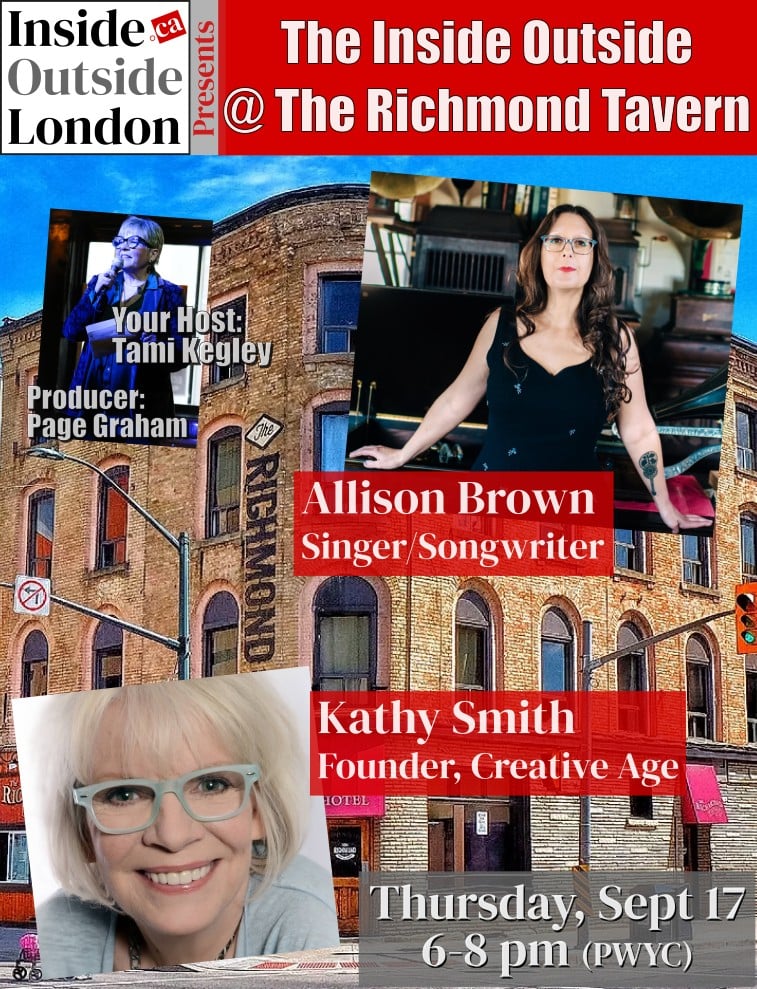
For the next edition taking place Thursday, September 17, Kegley will be interviewing Kathy Smith, the creator of an Over 55 visual arts, dance and writing program called Creative Aging executed in conjunction with the London Public Library.
Allison Brown will also take the stage celebrating her return to London after stints in other Ontario locales.
“Allison Brown is a fantastic singer songwriter,” Graham says excitedly, “she’s just recently come back to London, and we thought she’d be a fantastic choice.”
Kegley beams as she describes the sight of “a crowd of people sitting in there listening and taking it in and focusing.
“And sometimes the best part of the show is after it’s over, because people hang around and chat, and they’re energized intellectually.
“The Inside Outside is an attempt to bring the two scenes together, which is really something new. Absolutely, one feeds the other. It’s really kind of a nice symbiosis I think we’ve landed on. And people seem to like it.
“And so, we keep doing it!”
By Bob Klanac
Bob Klanac is a London-based music journalist who has penned hundreds of reviews and interviews. He was a juror for the Polaris Music Prize, a member of the Slaight Family Polaris Heritage Prize Jury and a Juno Awards juror. Bob has also penned two books, Promo Man about London’s late music legend Nick Panaseiko and Shooting Stars, Telling Tales, about photographer to the stars photo-journalist John Rowlands.
This is the first in a new weekly series in which The Beat Magazine highlights selected events – concerts, theatre productions, art exhibits, film screenings, etc. – featuring local creatives.
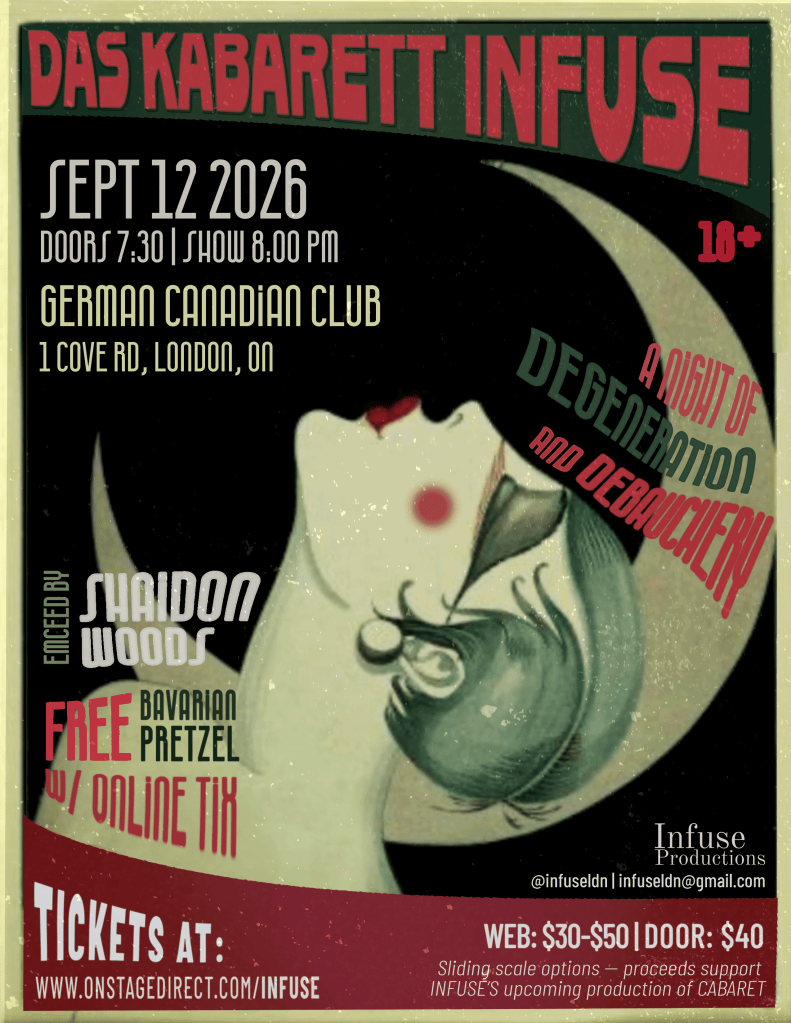
Das Kabarett Infuse: A Night of Degeneration and Debauchery is this week’s selected event.
IF YOU GO:
Who: Infuse Productions
What: Das Kabarette Infuse: A Night of Degeneration and Debauchery. An 18+ variety show featuring live music, dancing, burlesque, firebreathers, hula hoops, drag performances, and more. Emceed by Shaidon Woods.
Why: A Fundraiser for Infuse Productions’ Broadway musical, Cabaret, November 5 to 15.
When: Saturday, September 12, Doors Open at 7:30 pm, Show at 8:00 pm.
Where: German Canadian Club, 1 Cove Road, London, ON.
Tickets: Online: $30, includes a free Bavarian Pretzel. OnStage Direct: Infuse Productions At the Door: $40, Bavarian Pretzel not included.
More Information: For more information about Infuse Productions, Das Kabarett Infuse, and Cabaret, visit Infuse Productions Follow Infuse Productions on Facebook and Instagram for updates.
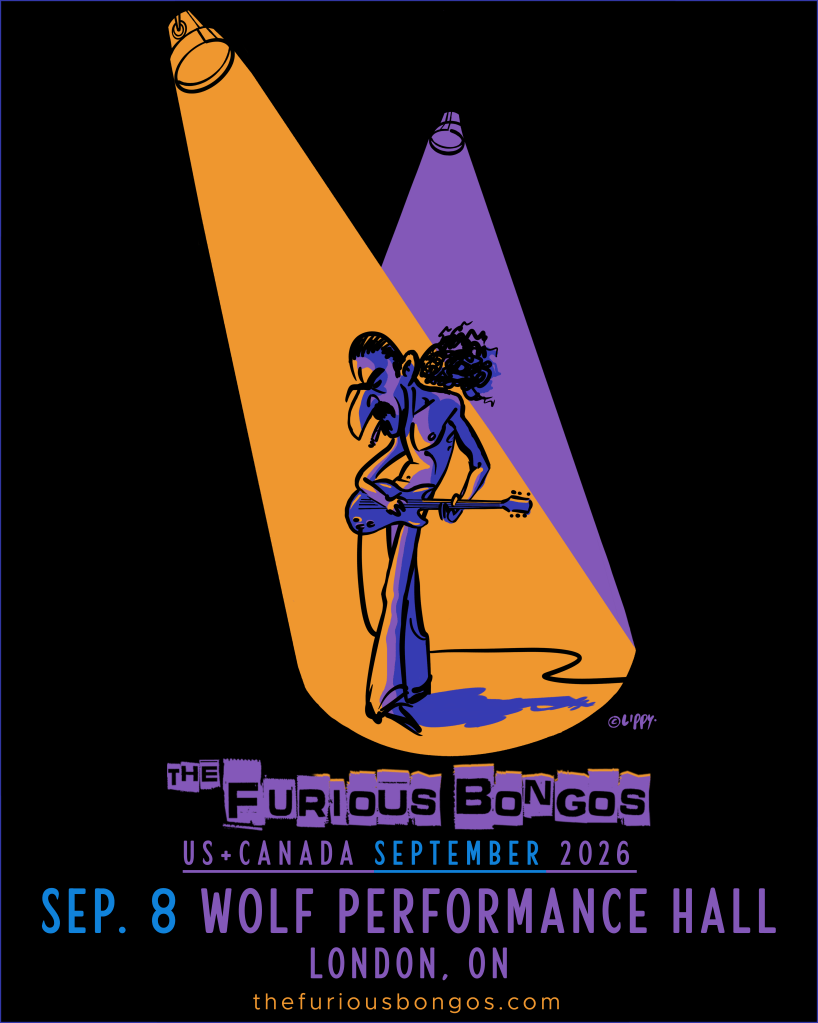
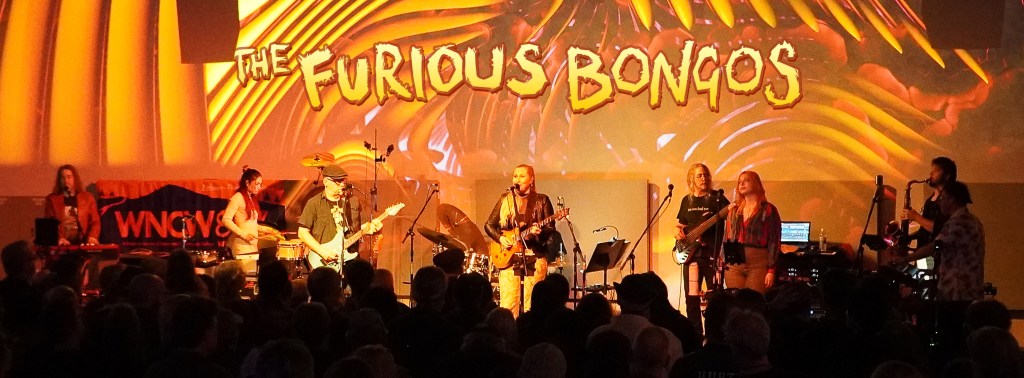
The Furious Bongos bring their Get on the Bus Tour, featuring the music of Frank Zappa, to London’s Wolf Performance Hall on Tuesday. September 8.
Join them for an evening of musical plooking, rhythmic gymnastics, and musical mischief. No prior knowledge of Frank’s catalog is required. Ponchos are optional.
The Furious Bongos are a bunch of professional musicians with pretty diverse backgrounds who decided to take on a pretty big challenge and have some fun in the process.
Now, you might ask, “Oh yeah? ‘Professional’ musicians, eh? What makes you think they can play Frank’s music as well as Terry Bozio?”
Well, maybe you haven’t heard of them individually, but they’re pretty good musicians and you probably have heard of the folks on their resumes.
People like BB King, Mick Fleetwood, Jacob Collier, James Taylor, Yo Yo Ma, Barbara Streisand, Arthur Barrow, Munich Philharmonic, Bryan Beller, Andy Summers, and others. Well, you get the idea.
As for Frank’s music, he was constantly changing things, both for his own creative choices and to adapt to the different musicians he had over the years. He also understood that his live performances were entertainment. It’s supposed to be a rock show, not a piano recital.
With all that in mind, The Furious Bongos don’t think playing Song X from Album Y note-for-note while staring at their shoes is the proper way to go about it.
The result of that approach, combined with a lot of homework, is a show that pays respect to Zappa’s legacy, but is also new and different and dangerous and fun, with lots of eyebrows.
Kinda like Frank.
IF YOU GO:
What: The Furious Bongos Play Zappa
When: Tuesday, September 8 at 7:30 pm.
Where: Wolf Performance Hall, 251 Dundas St., London, ON.
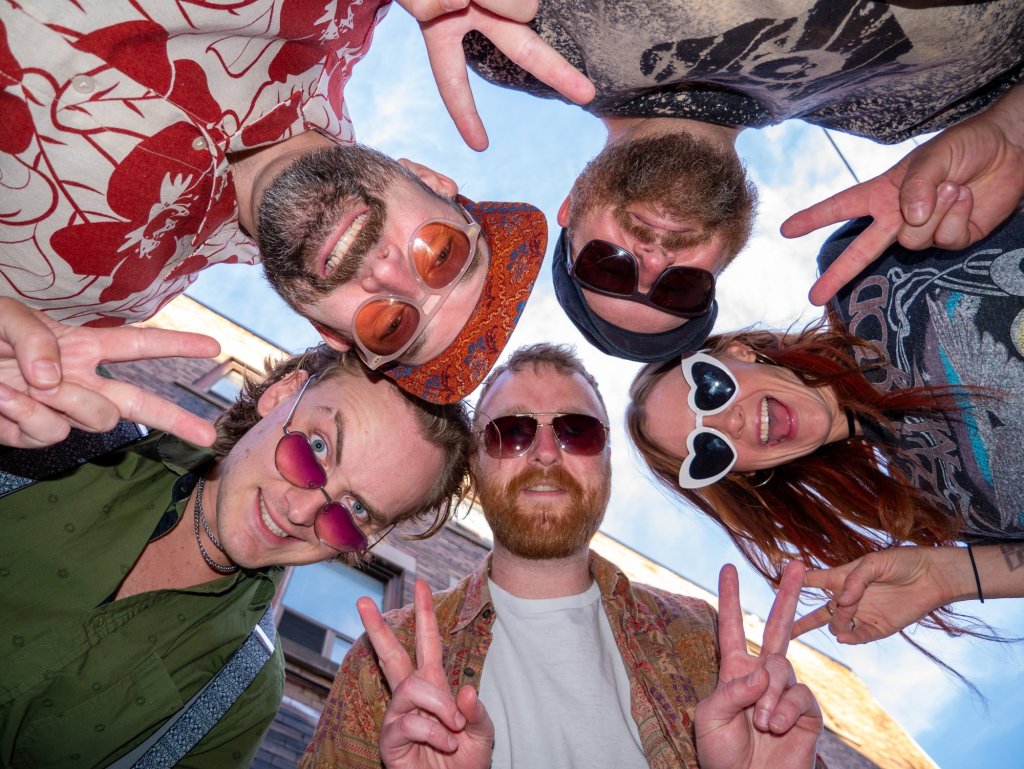
London’s own, Sunshine Makers, return with their new single, The Love We Give, out via Lovetown Records. This marks their first new music since returning from Hollywood this past spring where they recorded at Killion Sound with producer Sergio Rios (Orgone, Say She She, Neal Francis). The track is drenched in lush harmonies and fuzzed bass guitar that drives with a rockin’ groove, drawing from R&B, jazz, funk and 70s West Coast soul influence which contributes to the group’s signature warm vintage sound. At the root of their music, and this single in particular, there is also the clear message of choosing unity and love and projecting those feelings and vibes back into the world. Listen to it here.
Accompanying the single is a music video from the band. Every single from the upcoming album will have its own video and once they are all released, will together create a short film. It serves as an opportunity to showcase each band member and the joy they experience performing for their listeners. Directed by Sean Stanley and Sunshine Makers, each video will promote a message of peace, love, and unity while highlighting a specific band member’s journey to a show, whether that be driving, running, cycling, skateboarding, or otherwise. It’s a fast moving time-lapse from morning until performance on a rooftop in the downtown core in full sunshine. Watch it here.
“The Love We Give promotes the act of giving to recognize the love we have within ourselves, and to project that love back into the world,” share Sunshine Makers. “It is a message for us all to hold hope and keep believing in life. Though the world can feel out of control, we must not forget that we have the control within to choose how we wish to be. If we believe that love will prevail, then it will.”
The single was recorded in April 2026 in North Hollywood with producer Sergio Rios (Orgone, Say She She, Neal Francis) at Killion Sound. The band tracked and played live to analog tape to capture their warm vintage sound while also masterfully capturing the energy of the room which brought the band an incredible amount of joy, as Sergio was the perfect wizard to catch and craft their magic. They used the same recording room, instruments and gear that were used to record Say She She albums Silver and Cut & Rewind, as well as Neal Francis’ Return to Zero, adding to the band’s warm, vintage sound.
“The song and its message bring us joy. As musicians, we are in an intimate relationship with our listeners. The joy imbued in the songs’ message of reciprocity and our performance is our heartfelt contribution to this relationship,” adds the band. “The song is written for the listener. Its intention is to empower, and to encourage people to lead with love in order to manifest a positive outcome in life, overcome self-doubt, and live our fullest potential. Shine a light from within.”
In addition to the new music, Sunshine Makers will also be playing a slew of shows this month and season across Ontario. For a full show listening, see below and for more information, visit sunshinemakersmusic.com, and read more in their BIO.
Stay tuned for more new music as the Sunshine Makers adventure unfolds in the coming months. Adds the band: “The love we give back is what we get back my friends.”
TOUR DATES:
September 9 – Toronto, ON – Dance Cave (with Jembaa Groove)
September 18 – London, ON – London Brewing Co-operative (Peace, Love & Sunshine Festival)
September 24 – Windsor, ON – Meteor (with Dark Dazey)
September 25 & 26 – Toronto, ON – Second Summer Festival
Prepared with files provided by the Grand Theatre.
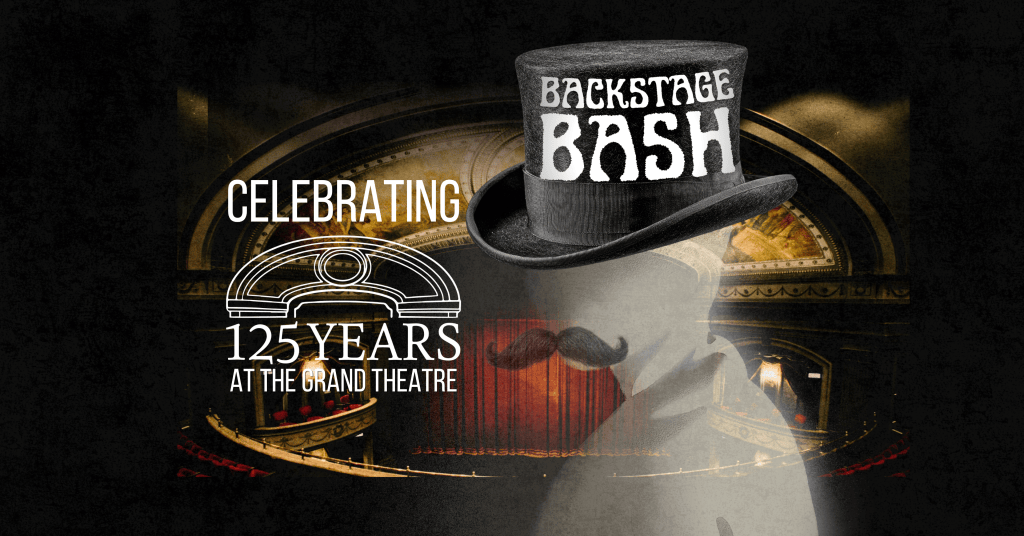
One hundred and twenty-five years later to the day, the Grand Theatre will mark the anniversary of its first opening night and the first performance with a Backstage Bash on Wednesday, September 9.
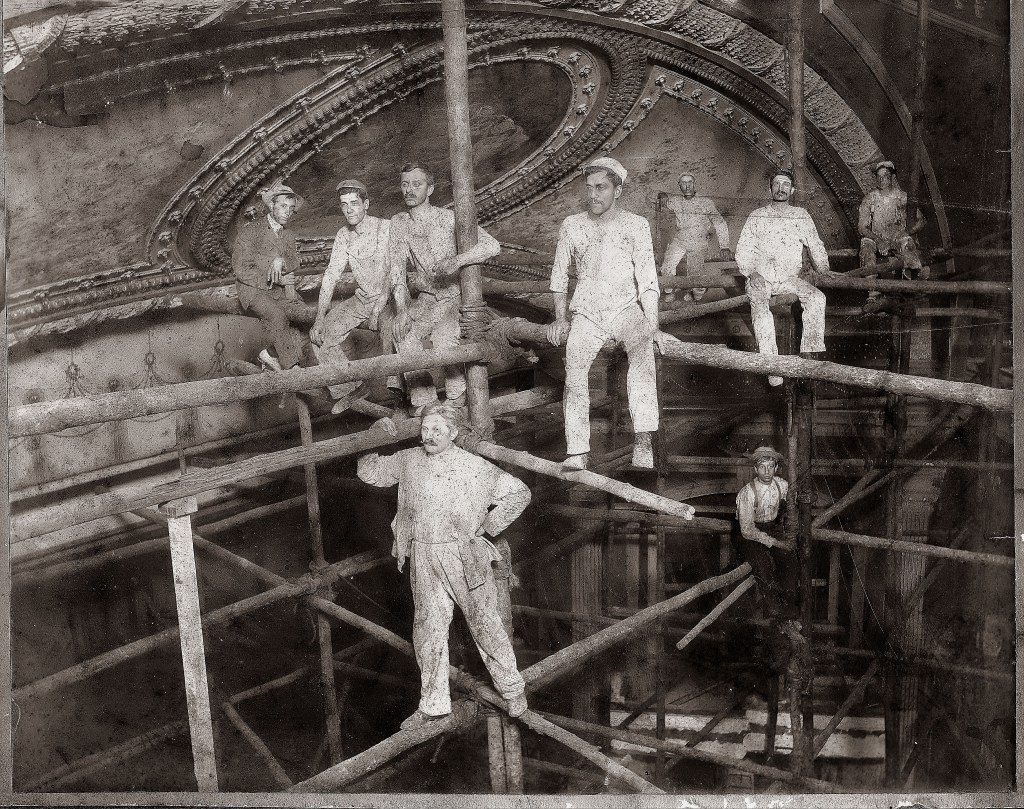
The New Grand Opera House at 471 Richmond Street opened on September 9, 1901 with a performance of Way Down East. In the 125 years that have followed, the Grand has been a home for community and culture in the heart of Downtown London.
(Building the New Grand Opera House, 1901. Photo Supplied by the Grand Theatre.)
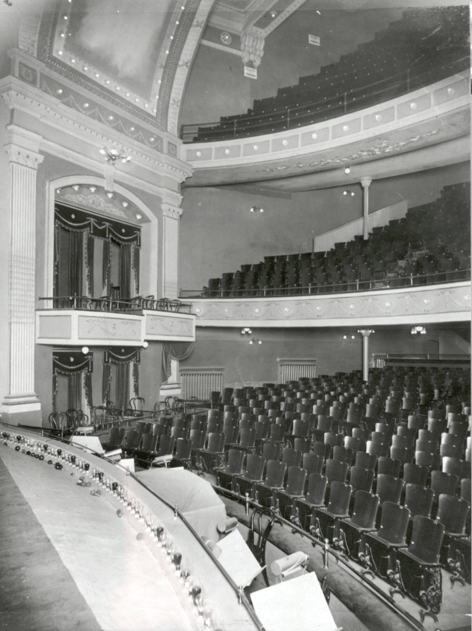
A symbol of London’s growing confidence, the New Grand Opera House could house up to 1,850 patrons, had its own phone number, and boasted a striking proscenium arch, painted by muralist Frederick S. Challener. Equipped with electricity and impressive stage technology, the Grand attracted the finest touring productions from across North America.
(The New Grand Opera House c. 1911. Photo Supplied by the Grand Theatre.)
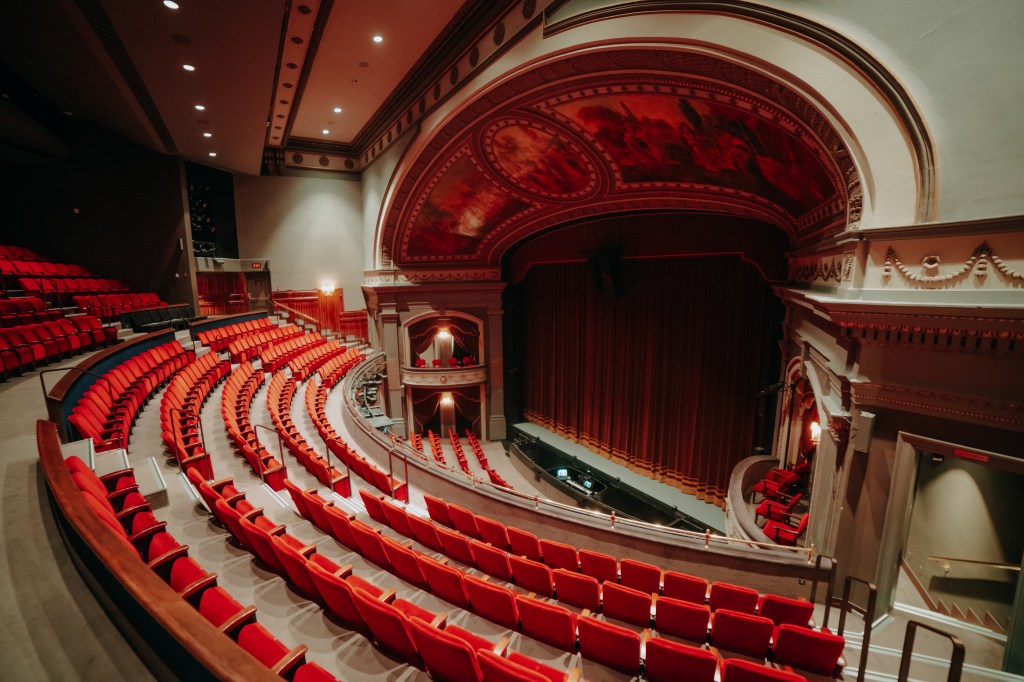
Today, the original stage, arch, and mural still stand – untouched by transformational renovations to the building itself. More than 125 years later, the building continues to welcome audiences through the same doors, reminding us that great theatres are built not only of brick and stone, but of the people who fill them.
(The Grand Theatre’s Spriet Stage Today. Photo Supplied by the Grand Theatre.)
The Backstage Bash will welcome Londoners through the theatre’s backstage access and then directly onto the stage to celebrate. Audiences can stand on the 125-year-old stage while enjoying live music by KJ and Motones and Mark Swan’s GOOD HANG. Youth Opportunities Unlimited will be on site serving up BBQ favourites, and the Grand’s lobby bars will be open for the occasion.
Between bands and BBQ, guests are invited to explore three levels and more than a century of history on display throughout the theatre’s lobby spaces. The exhibition, Grand: 125 Years of Live Performance, will be open to the public for the first time at Backstage Bash and will remain on display for audiences throughout the Grand Theatre’s upcoming 2026/27 Season. The exhibition was curated by local historian and communicator, Jo Jennings, and features the work of Research Assistants Meghan Falco and Kira McCallum, students at Western University’s Faculty of Arts & Humanities.
The London Public Library joins the Grand in marking this milestone anniversary, with the Ivey Family London Room mounting a commemorative display featuring original artifacts throughout the month of September.
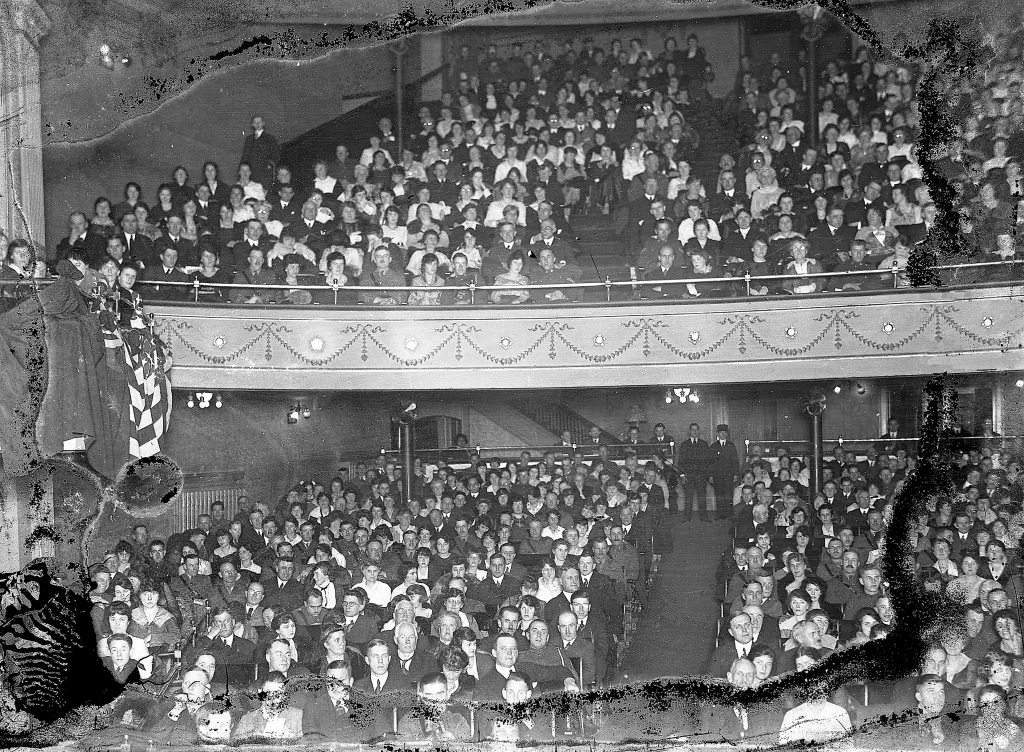
Londoners are invited to join the storytelling of the Grand’s 125th. The theatre is gathering its shared history, bringing together the stories of all those who have been part of the New Grand Opera House, London Little Theatre, Theatre London, the Grand Theatre – and all of the moments in between. Audiences, neighbours, artists, and staff are invited to share memories, moments, photos, and artifacts with the Grand on social media, via email to socialmedia@grandtheatre.com, or through the 125th anniversary website at grandtheatre.com/125.
(Grand Theatre Audience, c. 1918-1928. Hines’ Studio Collection. AFC341-51-19. Courtesy of Western Libraries – Archives and Special Collections, London, ON.)
London has a rich musical heritage with an abundance of musical venues hosting live bands as well as a variety of annual music events. Sunfest, now in its thirty-second year, and the Home County Music & Art Festival in its fiftieth year, helped put us on the musical map, as has the Aeolian Hall, an historic music venue which presents both national and international talent. In 2021, London was designated as Canada’s first UNESCO City of Music.
In the late 1980s, a musical genre dubbed Celtic punk crept into London bars. It was a blend of Irish traditional music, beefed up by electric guitars, bass and drums. Nationally, we had Great Big Sea and in London, we had Uisce Beatha, fronted by brothers John and Alan Glen. Back in the 1990s, I was thirty-something and faithfully followed them about town, always getting a front seat when they performed at places like the Electric Banana and the Brunswick. The band would cover the likes of the Irish band, The Pogues, as well as their own compositions, which honored their Irish heritage. Paul Meadows, fiddler for this band, still performs locally.
There was an indelible stamp of Irish heritage and culture in the music of bands such as Uisce Beatha, as well as The Gurriers and many others but you had to seek it out.
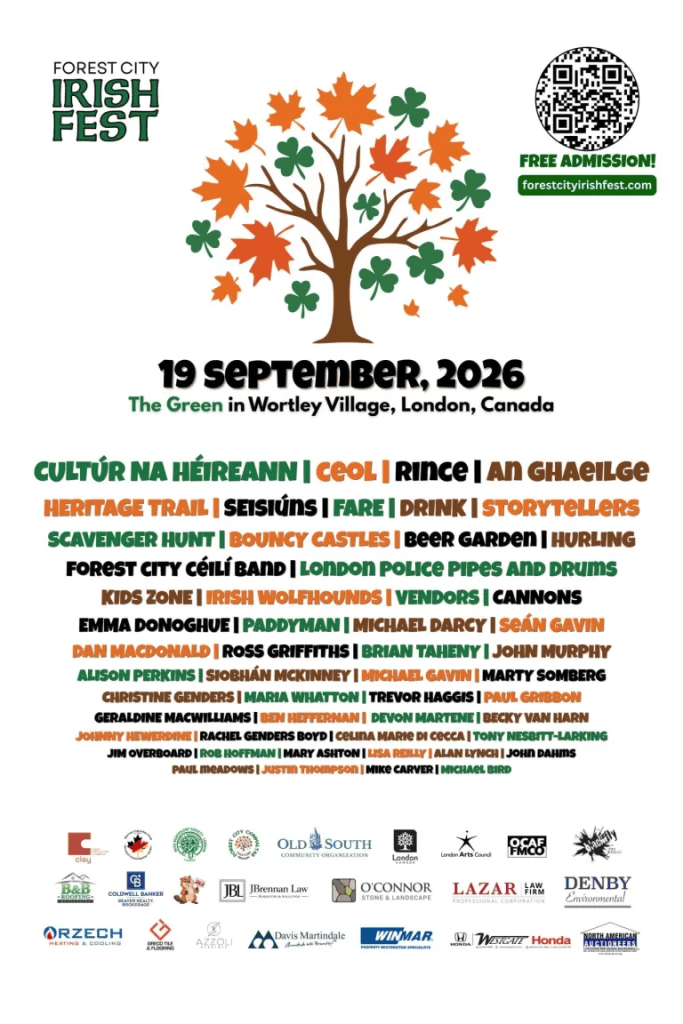
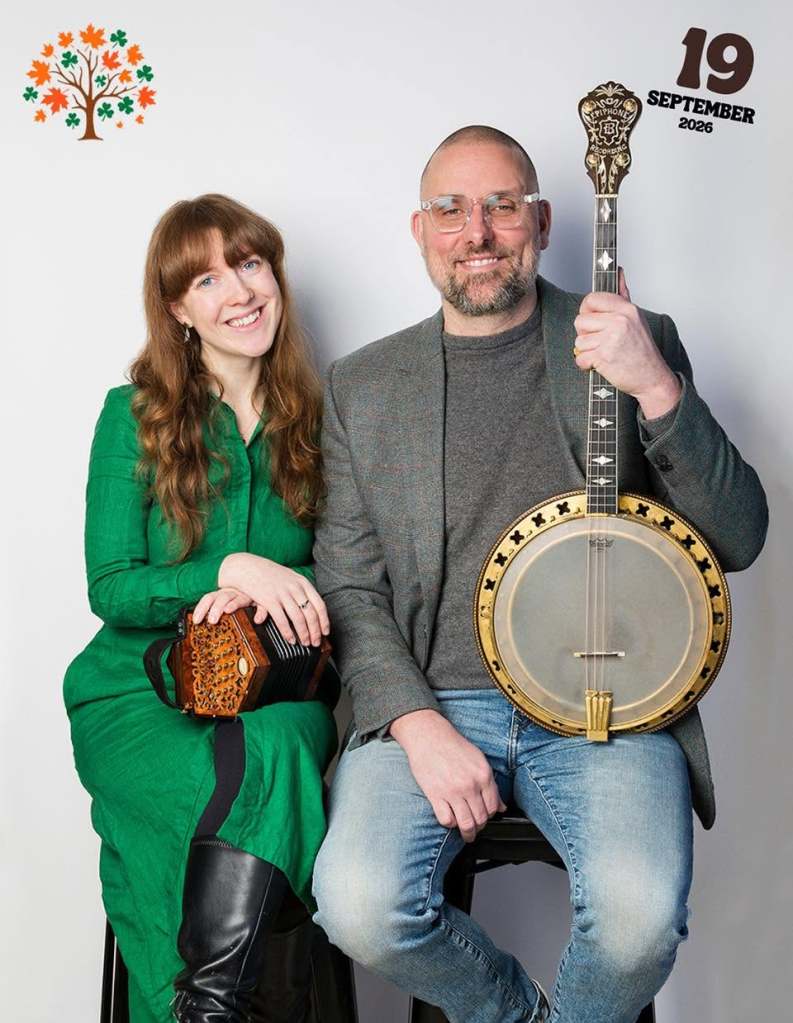
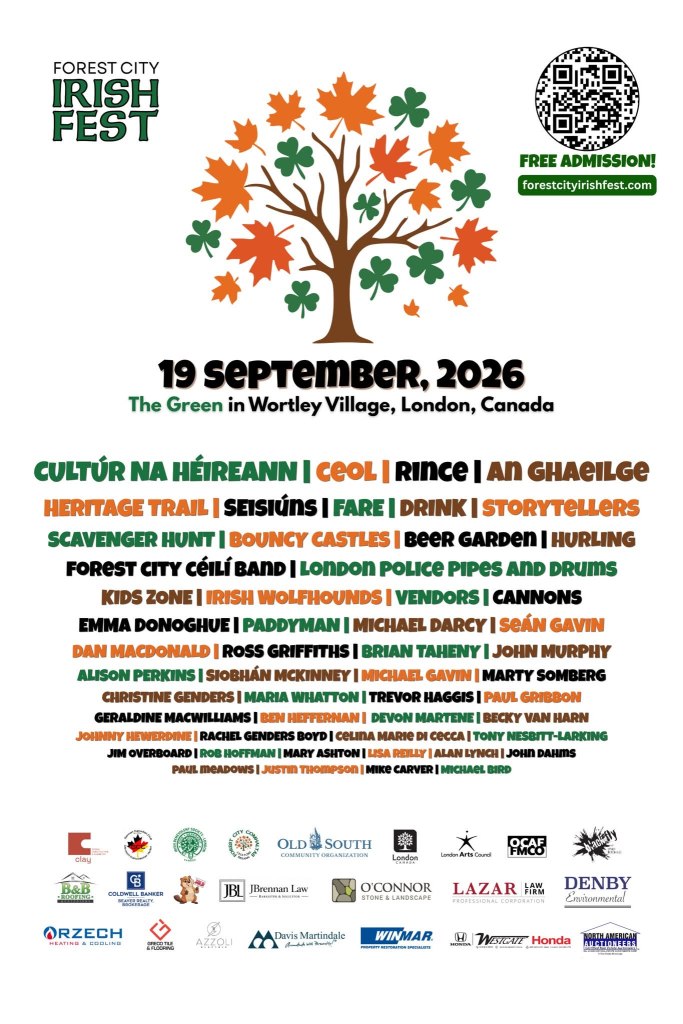
The inaugural Forest City Irish Fest, inspired by the 90,000 Londoners claiming Irish ethnic or cultural ancestry, takes place on Friday, September 18 and Saturday, September 19 on the Village Green in Wortley Village, as well as other local venues.
I had the opportunity to talk with Rachel Genders Boyd, co-artistic director of the event.
(Pictured: Forest City Irish Fest co-artistic directors Rachel Genders Boyd and Johnny Hewerdine.)
Q. Can you tell me a bit about yourself?
I’m actually from England but my father is Irish, so as a kid I went to Ireland every single summer. I have a great love of Ireland and Irish culture. I am also an Irish traditional musician. I am a singer and play the concertina. We have a regular Irish seisiun in London which I attend most weeks. We are starting an Irish comhaltas (pronounced cultus) which is a community coming together to nurture Irish culture.
Q. Did the idea of an Irish festival come from that?
Yes, definitely. This festival is part of that. It fits into the overall puzzle of us trying to promote Irish culture in London and the surrounding area of Southwestern Ontario.
Q. The music of our East Coast has a strong influence from Ireland. Will that be included?
At the festival, we will have East Coast style music and Ontario style which has been very influenced by the music of Ireland.
Q. How difficult was it to put the event together?
We have a small committee, so I wear many hats. Getting the bands together took about an afternoon but everything else took much longer in the organizing.
Q. Why is an Irish festival important for London right now?
There is already a lot of Irish culture here in London, but not out in the open. The seisiuns happen every Tuesday at Scott’s Corners and have been going on for decades. There is so much Irish music and dance in London, but much of it is under the radar, so we thought it was time to get it out in the open and get people excited about it. London and the local region has had a major influence from the culture of Ireland. This includes the Lucan Area Heritage and Donnelly Museum as well as London’s Irish Benevolent Society.
Q. Can you tell me about the various venues incorporated for the event?
The festival itself is taking place on the Village Green in Wortley Village. That is the main event but there are lots of performances happening elsewhere in the village. On Friday, September 18, we will have a local history talk about the Irish at Landon Public Library. In the evening, we will have a ticketed event at the Hyland Cinema featuring a Q&A with well-known London author, Emma Donoghue. On Saturday, the opening ceremonies begin on the green at 10:00 am, with a variety of bands performing throughout the day. This will be a licensed event. From 6:00 to 8:00 pm, various bands will perform at four of the local pubs. In the evening, there is an event which I am excited about as a musician. It is a traditional Irish seisiun, which is a jam or sort of improvisational event, combining many of the musicians from the day’s performances. It will be held at the German Canadian Club.
Q. So, it is not just a musical event?
Definitely. Along with the music, there will be storytelling and dance, demonstrations of the Irish sports of hurling and Gaelic football as well as a Kids Zone. We will even have Irish Wolfhounds demonstrating their talents. We are very ambitious with our ideas and hopefully the Forest City Irish Festival will become an annual event.
More information can be found on the Forest City Irish Fest website www.forestcityirishfest.com Check out their Facebook and Instagram pages for updates.
Be ready when Wortley Village’s Village Green becomes Kelly green on September 18 and 19.
Slainte!
By J Bruce Parker
J Bruce Parker is a retired oncology nurse. As an avid cyclist, he crossed the country by bicycle in 1991 and still explores Ontario’s north via canoe trips. He has published a short story based on his camping experiences.
For over 20 years, as a citizen scientist, he was involved with Monarch Watch, an organization that monitors the annual migration of the Monarch butterfly. He has written about this species and other articles on nature for The Cardinal, Nature London’s quarterly magazine.







 The Beat Magazine 2025