
Previewed by Daina Janitis
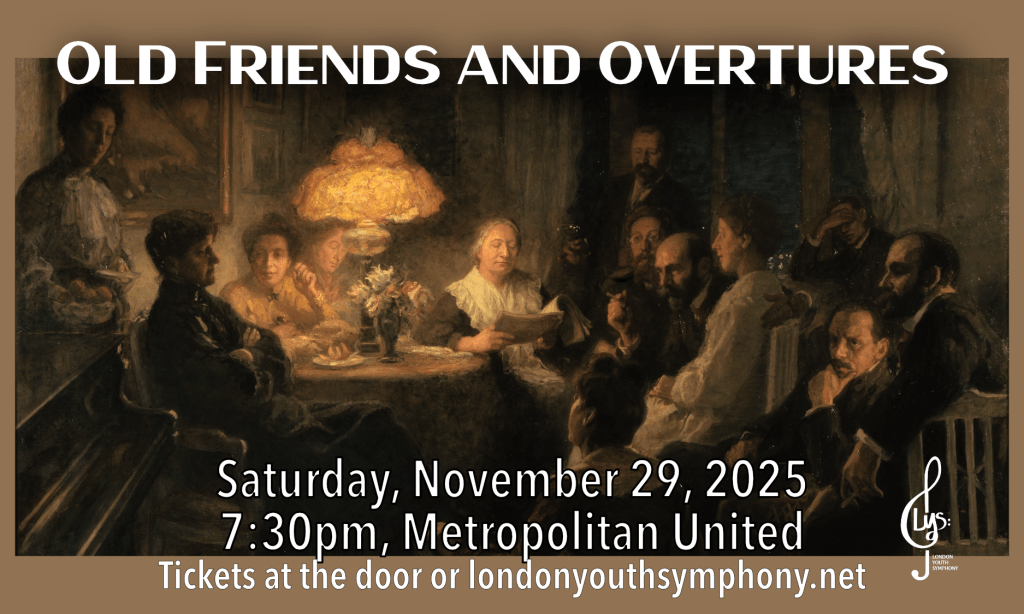
“In an orchestra, the whole is greater than the sum of its parts. Together, we can create something truly extraordinary.” – Yo-Yo Ma
And looking at this recent photo of the London Youth Symphony on that beautiful stage at The Met below, these words resonate.

(Pictured: London Youth Symphony.)
They bring back sweet memories: Taking my stoic 12-year-old son and his bassoon to an audition with conductor Jerry Summers over 30 years ago. Wondering how he’d get through the chosen piece, some scales on that gigantic piece of pipe, and then a piece of sight-reading. When he was accepted, there were cheers from his nerdy parents and a chocolate cake at Sebastian’s on Richmond.
And then his mom started over 30 years of volunteering for London’s youth orchestra, thankful for what orchestra playing provided for her own kids.
Oh, the Londoners in LYS whose performances continued to enrich our lives ~
String players like Alex, who went on to Montreal’s Symphony.
Andrea, who is now part of the Montreal ensemble she created: collectif9.
Susan, who left London to study at Oberlin and was principal cello in Louisiana before returning to London to teach and inspire.
Becky, who played in a Polish salt mine- and the Krakow Cathedral – but now delights audiences in Kitchener-Waterloo.
But equally inspiring- the LYS musicians who used their talents in other fields ~
Steve, who adds fire to the local community orchestra while completing his epidemiology degree.
Sharon, who started her own Suzuki school to help generations of little ones flourish.
Ana, a dedicated therapist who also plays her violin in LCO.
Mary, the oboist- member of the first LYS over 60 years ago, still sets that tuning A for the community orchestra.
So why am I indulging in personal memories as the first LYS concert of Season 2025-26 begins?
Because I find the power of the music these young people rehearse, the energy that their conductors and mentors provide their efforts, and the willingness of the audience- even non-family members – to offer them applause, one of the most powerful beacons of hope in a world that is showing the distressing speed at which values can be lost.
Only this past weekend, some of you might have seen this demonstration by some gentlemen across the Wortley Road Bridge in London.

This group announces on its website that The Second Sons is a men-only, Canadian white nationalist group. The group operates chapters throughout Canada, using gyms as meet-up spots and to train their fitness via martial arts. The group appears publicly in white masks and sunglasses, similar to the Patriot Front, and has adopted a modified version of the Red Ensign as its logo.
What would they and their “Remigration Now” banner make of the LYS kids (and their supportive families), whom you can hear this Saturday night? What would they learn from the Kims, Lees, Sanatanis, Wongs, and Smiths who create beautiful harmony and stirring rhythms with notes put together by composers around the world?
Overall, the discipline and collaboration required in classical music ensembles nurture well-rounded individuals who are socially aware, emotionally mature, and cognitively equipped, qualities that are invaluable for sustaining democracy and community life. This makes the London Youth Symphony’s first concert not only a musical event but a celebration of these deeper civic and personal benefits.
But as Daniel Barenboim reminded us, “An orchestra is not an orchestra without the musicians, but the musicians are not an orchestra without the audience.”

(Pictured: Argentine-Israeli classical pianist and conductor, Daniel Barenboim.)
Among a gazillion other accomplishments, Daniel Barenboim worked with the late Palestinian scholar to create a youth orchestra of young Israeli and Arab musicians. This ensemble was created to show that music can break down barriers once thought insurmountable. Their commitment is to showing that bridges can be built if we listen to each other’s narratives. You won’t be hearing the West-Eastern Divan Orchestra on Saturday night, but you WILL be part of building bridges and bearing witness to young people merging their right and obligation to create something exquisite for each other and for you.
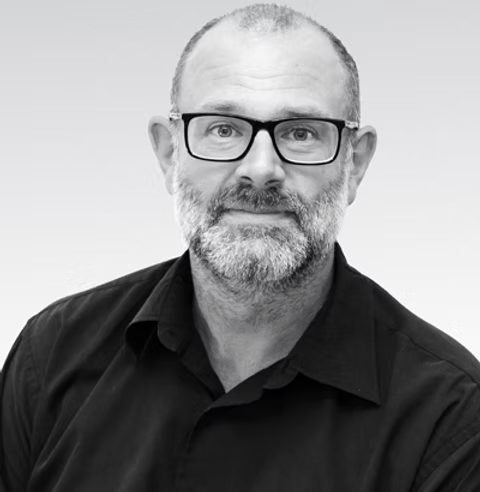
(Pictured: LYS Conductor, Ben Bolt-Martin.)
And what scores will LYS Conductor Ben Bolt-Martin be bringing to life with his baton- and his dedication to London’s musicians? Some of them will be familiar to you – and I’ll even add some links to previous performances if you’d like to get your expectations ready:
There’s “Nimrod” from Enigma Variations — Elgar
Elgar’s “Enigma Variations” began almost as a private joke at the piano, when he started improvising little musical caricatures of his friends to amuse his wife after a long day of teaching and routine work. Each variation is a musical “portrait gallery,” where you can actually hear personalities, inside jokes, and even remembered conversations, yet the whole piece is wrapped around a secret hidden theme that Elgar claimed, “goes through and over the whole set, but is not played” and that he took to his grave without ever explaining. The “Nimrod” was written about a friend, but its slow, gentle start and rise to glorious sound have made it a favourite selection for funerals!
And what about Capriccio Italienne -Tchaikovsky?
Peter Ilyich’s love life was the pits at that time, but Tchaikovsky’s Capriccio Italienne was composed during that dark and turbulent time in his life, bursting with the vibrant energy of the Roman Carnival he witnessed firsthand. The piece captures the bright colours and lively folk tunes of Italy as Tchaikovsky absorbed local street music and dances, creating a joyful, almost theatrical celebration of a city that stirred something vital in his sensitive soul.
And are you ready for Academic Festival Overture – Brahms?
Will you catch its irony? He offered it as a thank-you for a new degree – an honorary doctorate- and gave the bigwigs a rousing potpourri of boisterous student drinking songs rather than a solemn academic piece. He used four drinking songs and ended with “Gaudeamus igitur,” a centuries-old student anthem meaning “Let us rejoice, therefore, while we are young,” capturing the mischievous, playful spirit of youth amid a formal academic celebration.
I‘m sure we’ve all heard this one, too – Overture to Der Freischütz – von Weber
Are you ready to take the risk of Weber’s overture to “Der Freischütz”? It stands out for how it dramatically sets the scene for the opera’s dark romantic tale of supernatural bargains and moral struggle, weaving together actual themes and motifs from the opera—especially the eerie diminished seventh chord associated with the devil figure Samiel and the lyrical hunting horn calls—into a vivid musical narrative.
Your openness of mind, your willingness to learn, and your celebration of some of London’s most inspiring young artists are gifts that you have the power to give and receive by your presence. An orchestral performance is a collaboration between the conductor, the musicians, and the audience. It is a shared experience where everyone involved becomes a part of something greater than themselves. It is a connection of souls, united by the power of music.
IF YOU GO:
What: London Youth Symphony presents Old Friends and Overtures.
When: Saturday, November 29, 7:30pm.
Where: Metropolitan United Church, 468 Wellington Street, London, ON.
Tickets: At the Door or https://lys.ticketspice.com/old-friends
Previewed by Daina Janitis


 The Beat Magazine 2025