
Reviewed by Beth Stewart
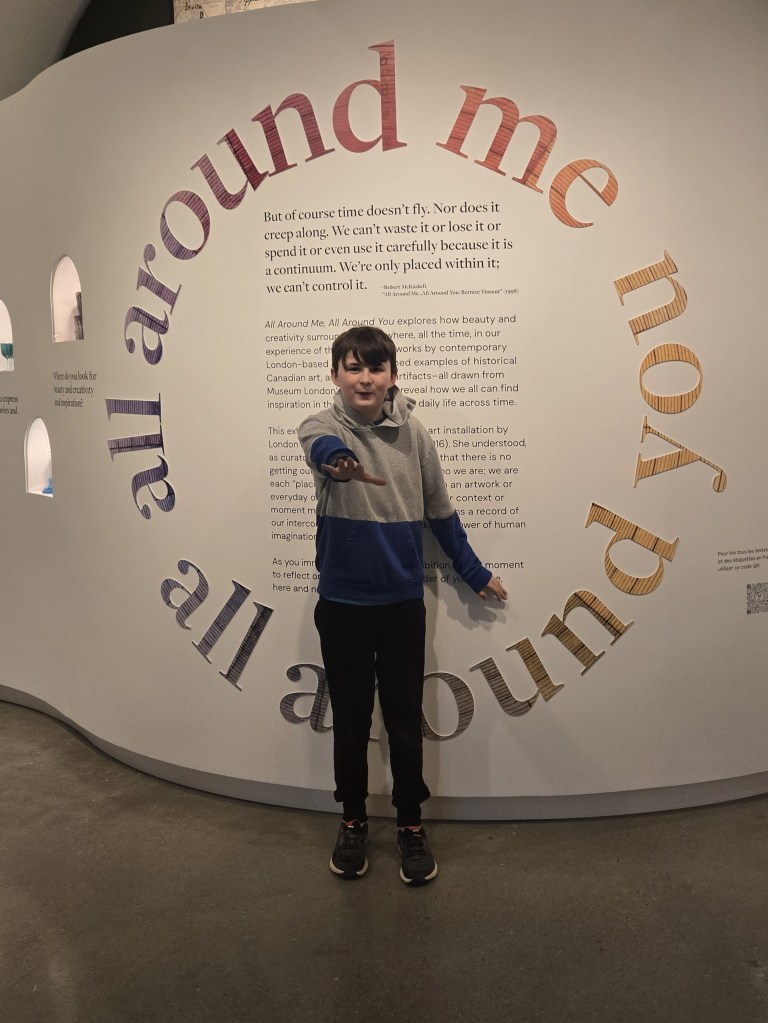
(Arrival at Museum London’s All Around Me, All Around You. Photo: Beth Stewart.)
During March break week, I revisited Museum London’s All Around Me, All Around You and experienced, for the first time, Tropi-X: Brazilian Art in Canada, 1970s-Now. I was accompanied by my eleven-year-old grandson Hunter.
All Around Me, All Around You features artworks and artifacts from Museum London’s permanent collection with an emphasis on the creative spirit of regional artists. It invites viewers to explore art at a sensory level as well as through memory, language, and symbols.
Hunter’s eye view was vastly different from mine, and I dutifully followed his lead.
We began with the “All Around Me, All Around You” exhibition, and the first piece that grabbed Hunter’s attention was Raymond Boisjoly’s text-based “As it Comes (Started Singing).”
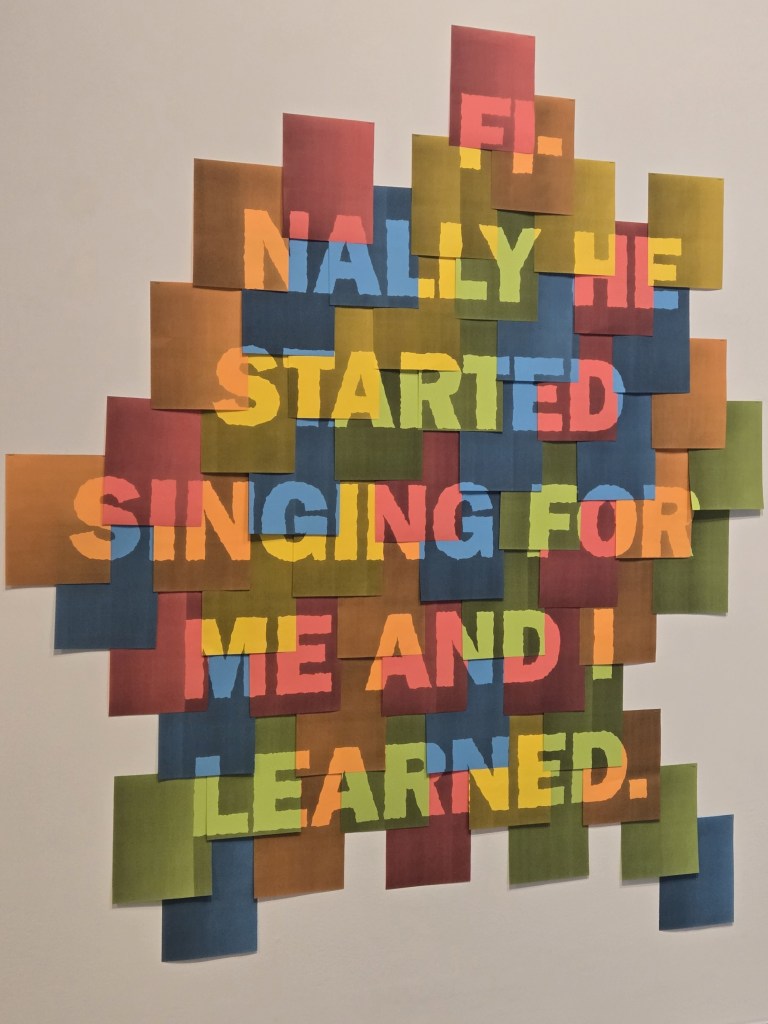
(Raymond Boisjoly’s “As it Comes (Started Singing)”, inkjet prints and staples on stock paper, 2023. Photo: Beth Stewart.)
Next, he gravitated towards an interactive projection of Bernice Vincent’s “All Around Me, All Around You,” a piece that also gives the exhibition its name and embraces its joie de vivre.
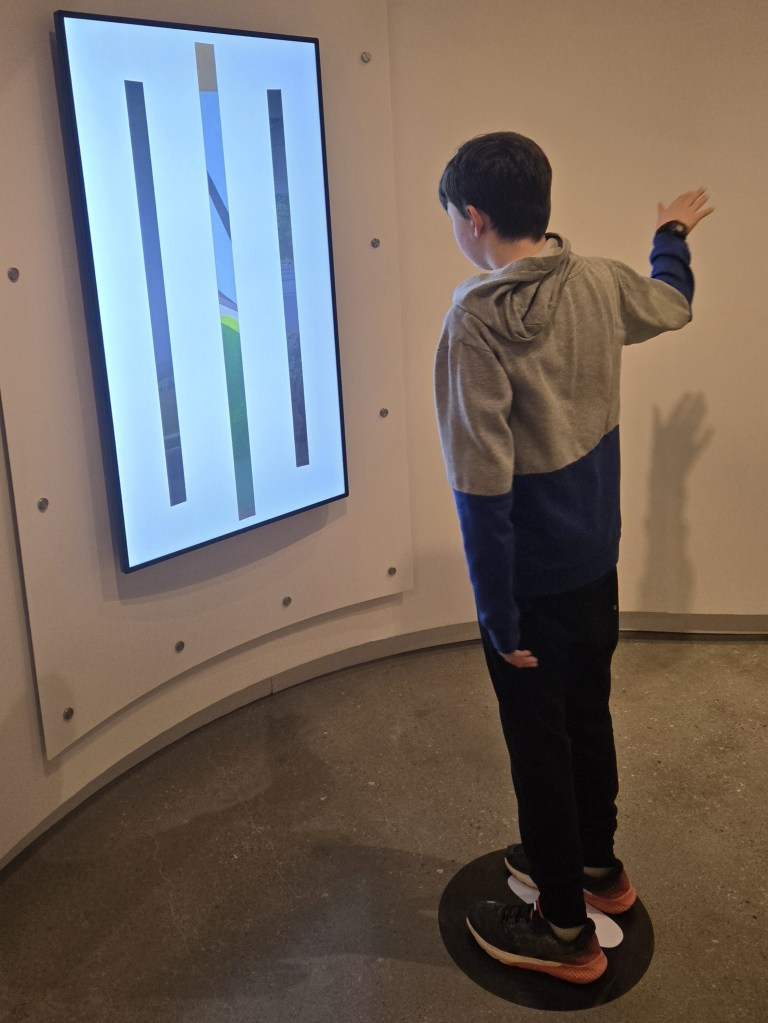
(Hunter interacting with the projection of Bernice Vincent’s “All Around Me, All Around You”. Photo: Beth Stewart.)
Hunter spent a great deal of time exploring it and following the instructions (“Wave arm right, left below waist to navigate between individual pieces. Raise arm up/ down to show or hide accompanying artist note. Wave arm in either direction to dismiss instructions and explore the artwork.”) and concluded, with much satisfaction, “The pictures are good, and you can move the thing by just moving your hand.”
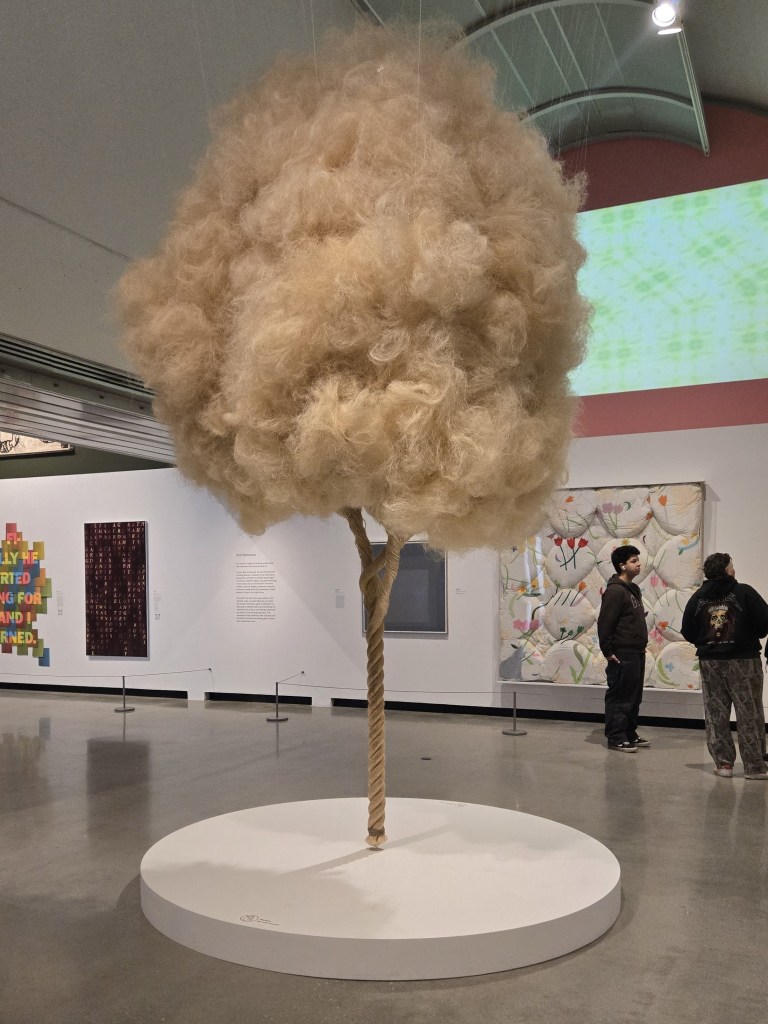
(David Merritt’s “Untitled (rope)”, sisal rope fibre, 2010. Photo: Beth Stewart.)
David Merritt’s “Untitled (rope),” was the next attention grabber. Hunter said, “It reminds me of The Lorax by Dr. Seuss because it looks like his fluffy trees. It also looks like chimney smoke that is going up in the air or like an explosion.”
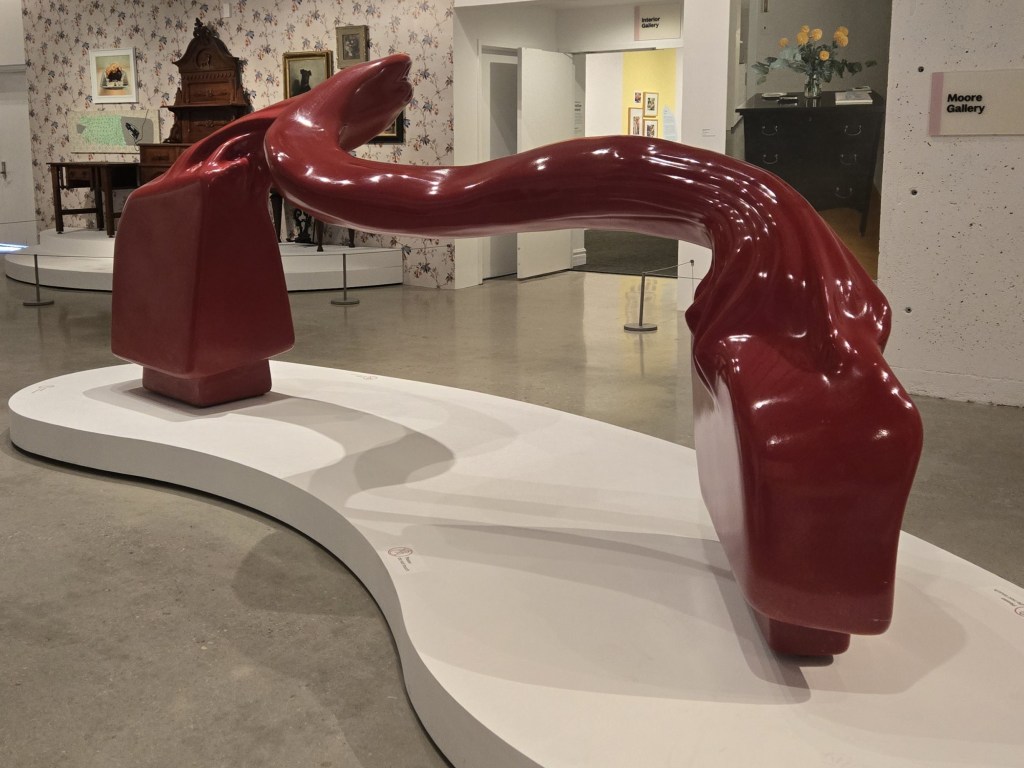
(Walter Redinger, “Snake” cast fibreglass with steel armature, automotive paint, 2001. Photo: Beth Stewart.)
Next, Hunter was able to satisfy his tactile urges, a rare opportunity in most galleries, at a designated touch station. Each of the six displays is connected to pieces on display. Hunter was drawn to David Bobier’s “Parable Hands,” which uses articulated wooden hands to explore gestures and language.
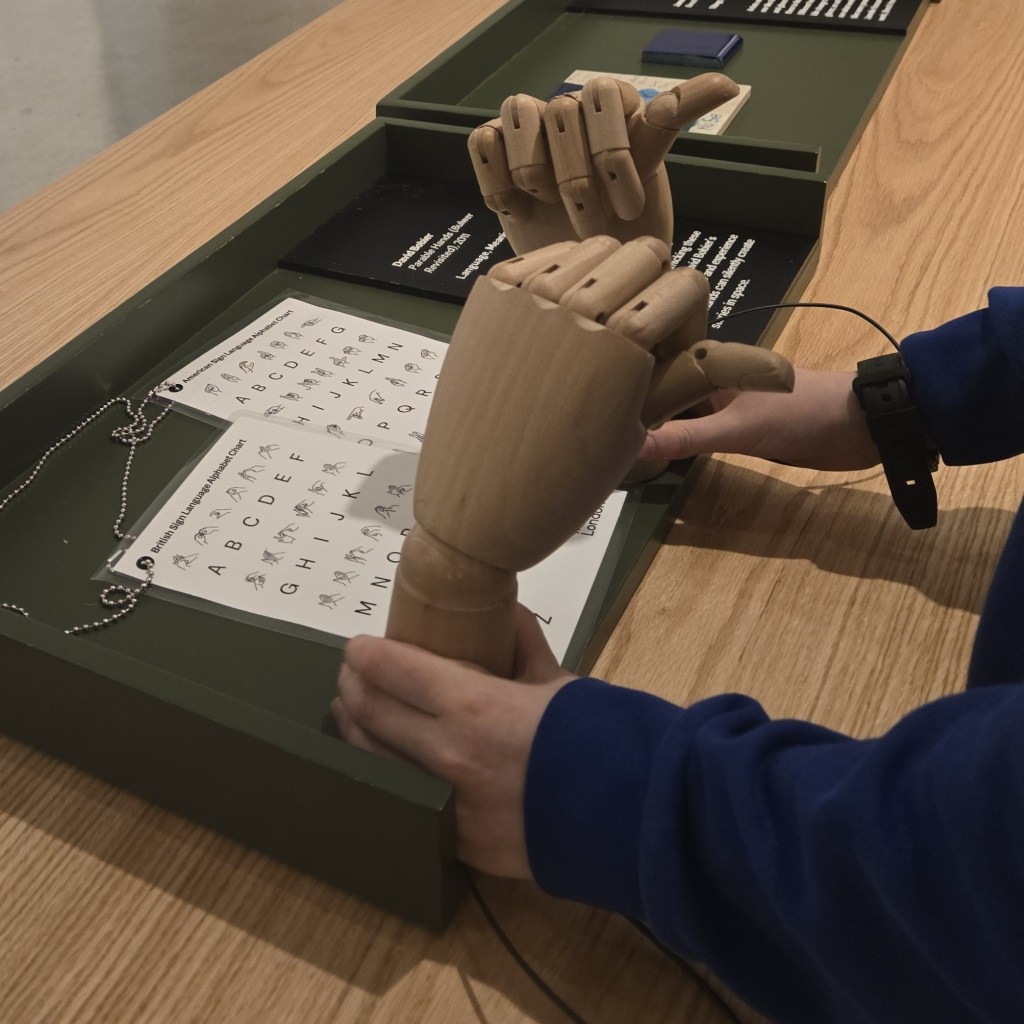
(David Bobier’s “Parable Hands,” Photo: Beth Stewart.)
He then examined ceramic test tiles related to Jamelie Hassan’s “Bench from Cordoba.”
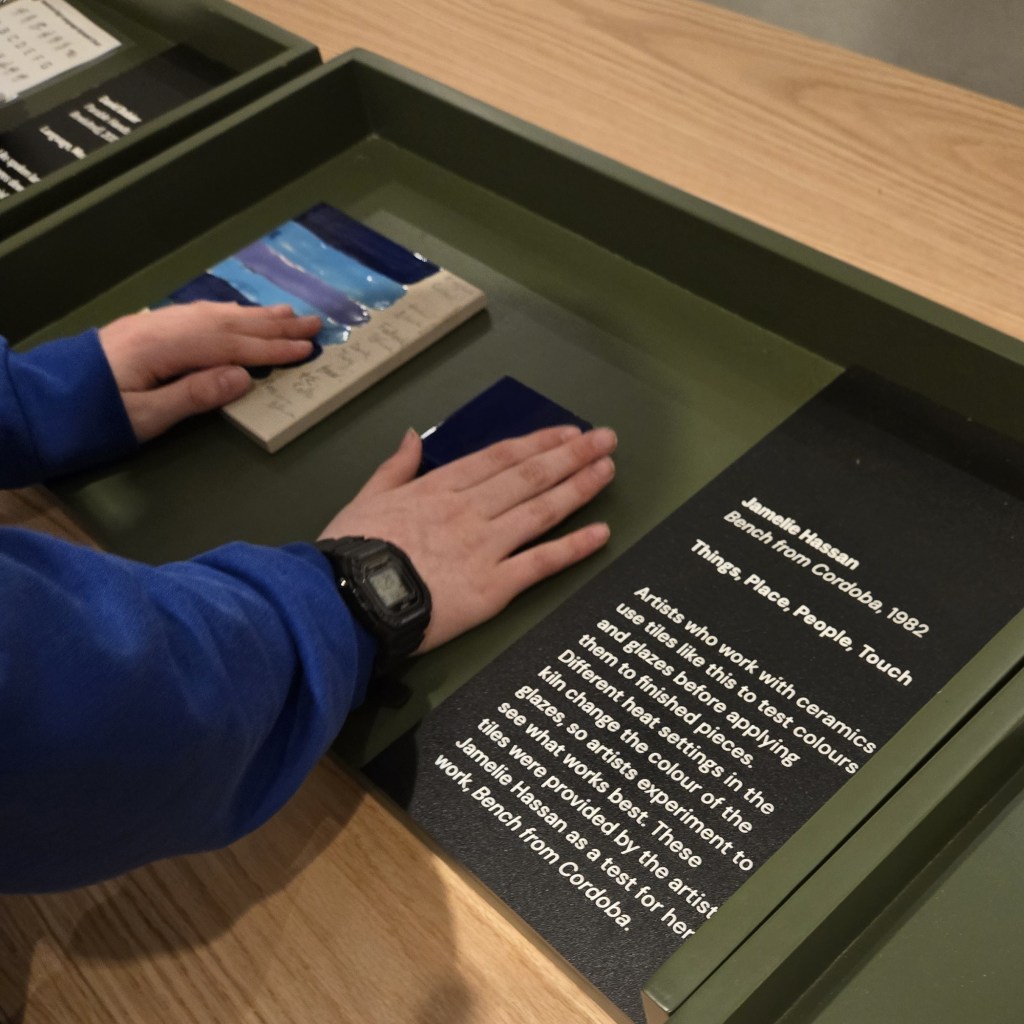
(Jamelie Hassan’s trial tile from “Bench from Cordoba”. Photo: Beth Stewart.)
Finally, Hunter explored the texture of sisal, which was used in David Marritt’s “Untitled (rope).”
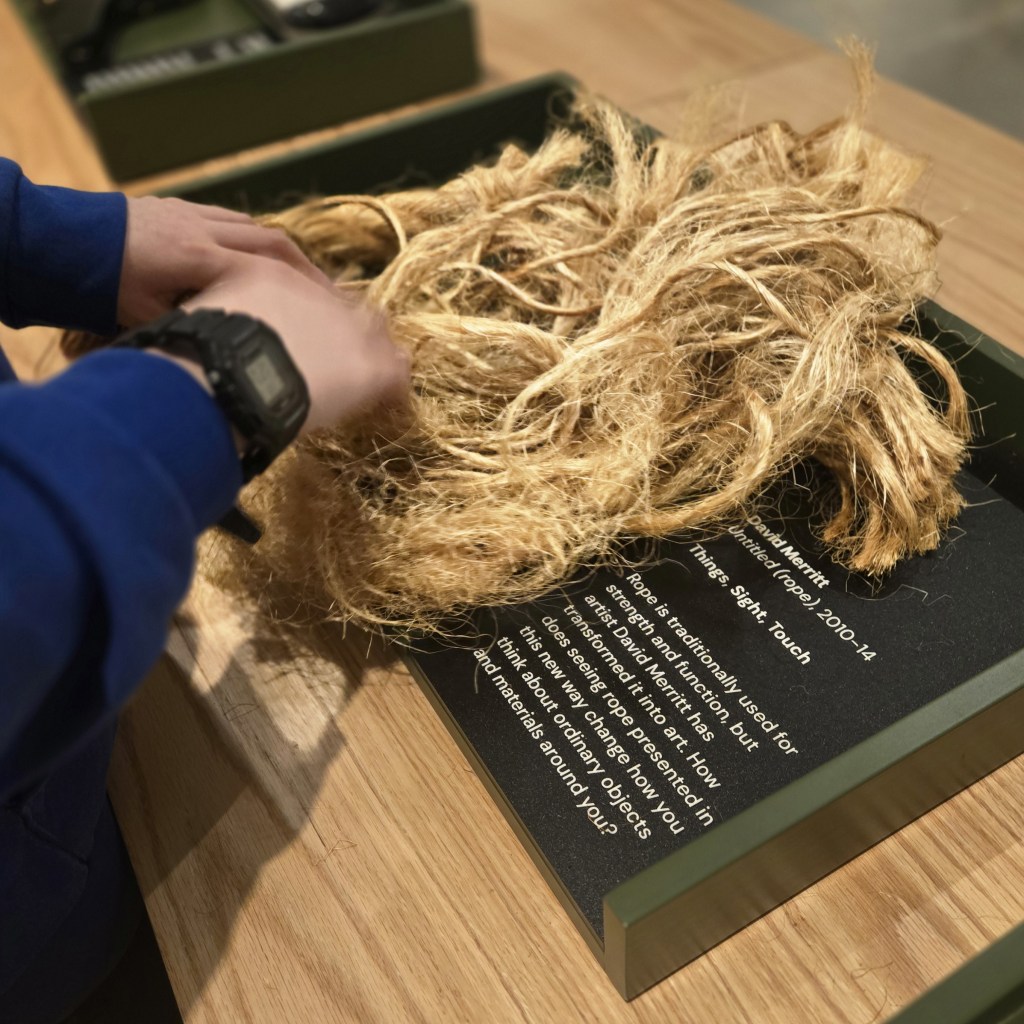
(David Marritt’s “Untitled (rope).” Photo: Beth Stewart.)
Upon encountering Kent Monkman’s mixed media installation “Nativity Scene”, Hunter immediately asked, “Why does the baby have a grown-up head?”
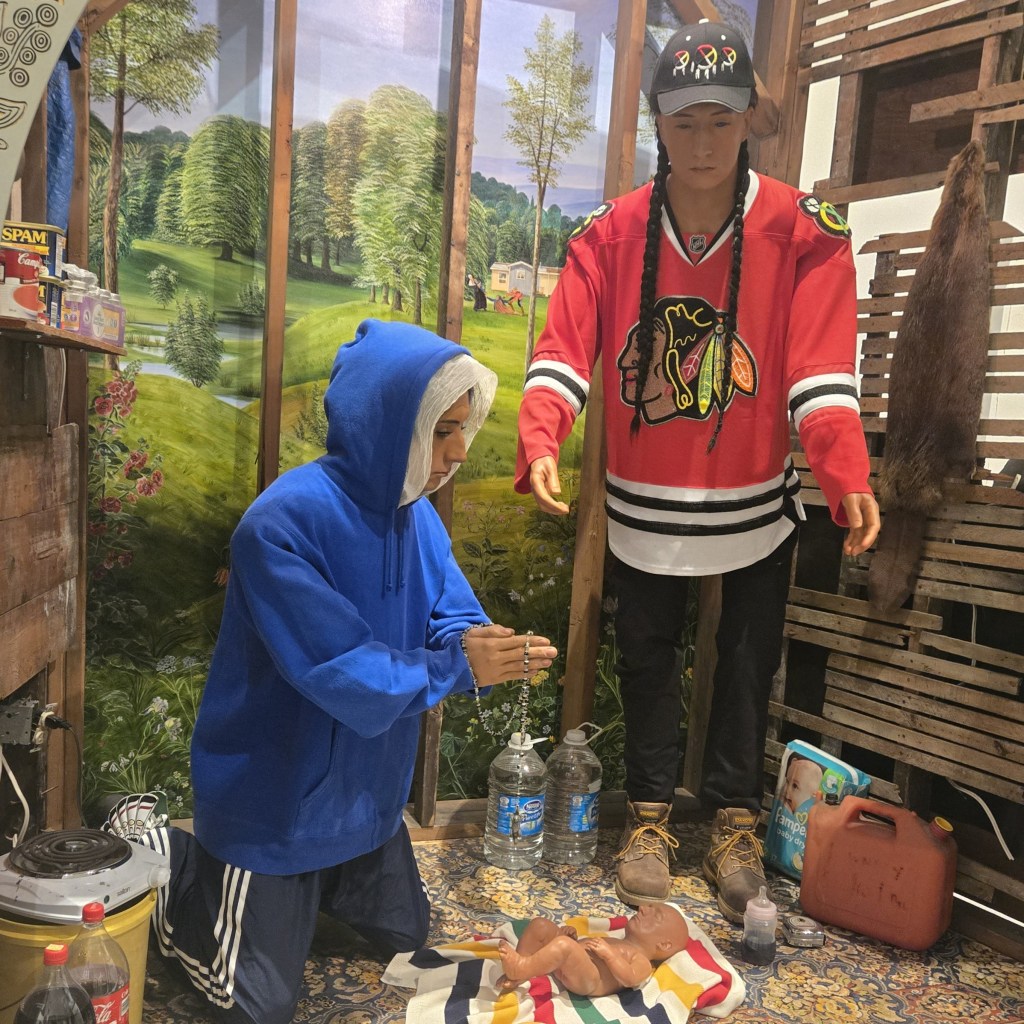
(Kent Monkman’s “Nativity Scene”, mixed media installation, 2017. Photo: Beth Stewart.)
While he recognized some kind of Indigenous connection, Hunter didn’t see a “remagined Christian holy family”; he saw something else entirely. He observed, “Maybe it [the head] grew because of the enchanted necklace above it,” and concluded, “they are doing some kind of ritual.”
Leaving All Around Me, we entered Tropi-X: Brazilian Art in Canada and exhibit comprised of 70 pieces that explore the preservation of Brazilian culture in Canada. It juxtaposes paintings, sculpture, and textile pieces from the 70s with contemporary pieces.
First up was Vinicius de Agular Sanchez’s “The Power of Speech (Shock),” a stop motion film that Hunter described as “fascinating because it combines music and art.”
His attention then went to a textile piece called “The Jaguar.” He said, “I think the cat is cool – it looks very soft – I want to touch it.”
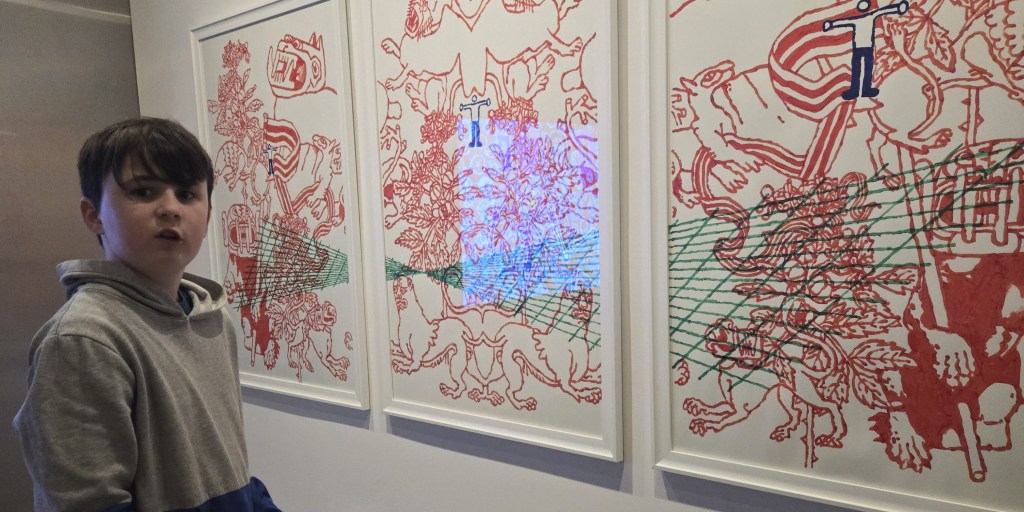
(Ian Indiano, “Between here and there”, acrylic on paper, 102 by 122 cm, 2019. Photo: Beth Stewart.)
Three large acrylic-on-paper panels, “Between Here and There,” were next. Hunter liked that they seemed to tell a “continuing story,” and I introduced him to the word triptych. He noted there were three people, one inside each painting, and that the center panel was symmetrical (kudos to his art teacher). He liked how the side panels were mirror images of each other.
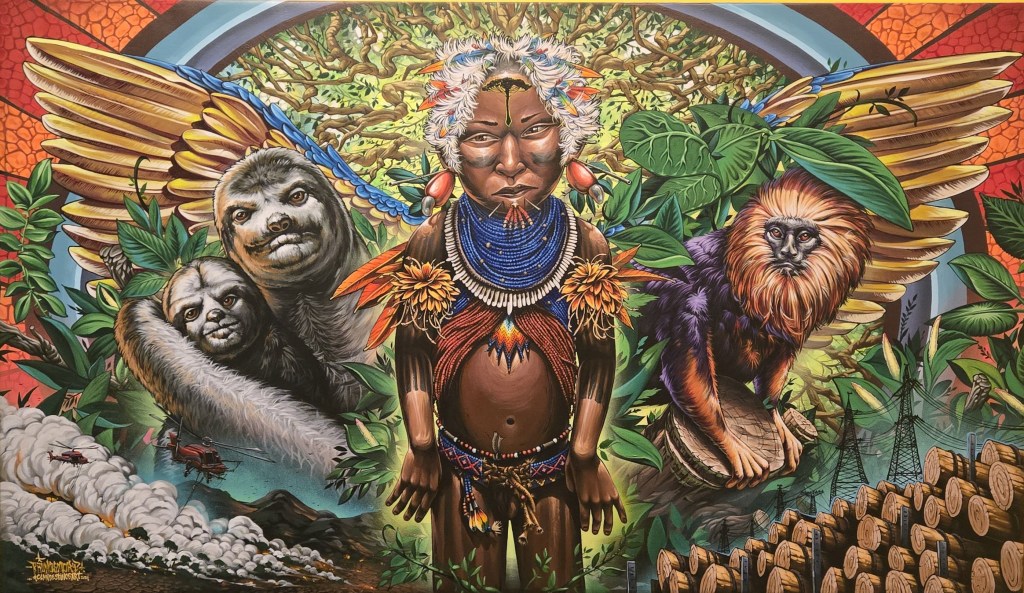
(Bruno Smoky, “Protect What We Have Left”, spray paint, acrylic, and airbrush on canvas, 165 by 287 cm, 2023-25. Photo: Beth Stewart.)
Bruno Smoky’s spray paint, acrylic, and airbrush on canvas painting “Protect What We Have Left” was a definite attention-grabber. Hunter liked that it had lots of colours and that it was so realistic. His favourite part was the two sloths. He commented on the solitary human: “I think it shows people rule; they are above everything else,” but then decided, “the person might be stranded and living with the animals.”
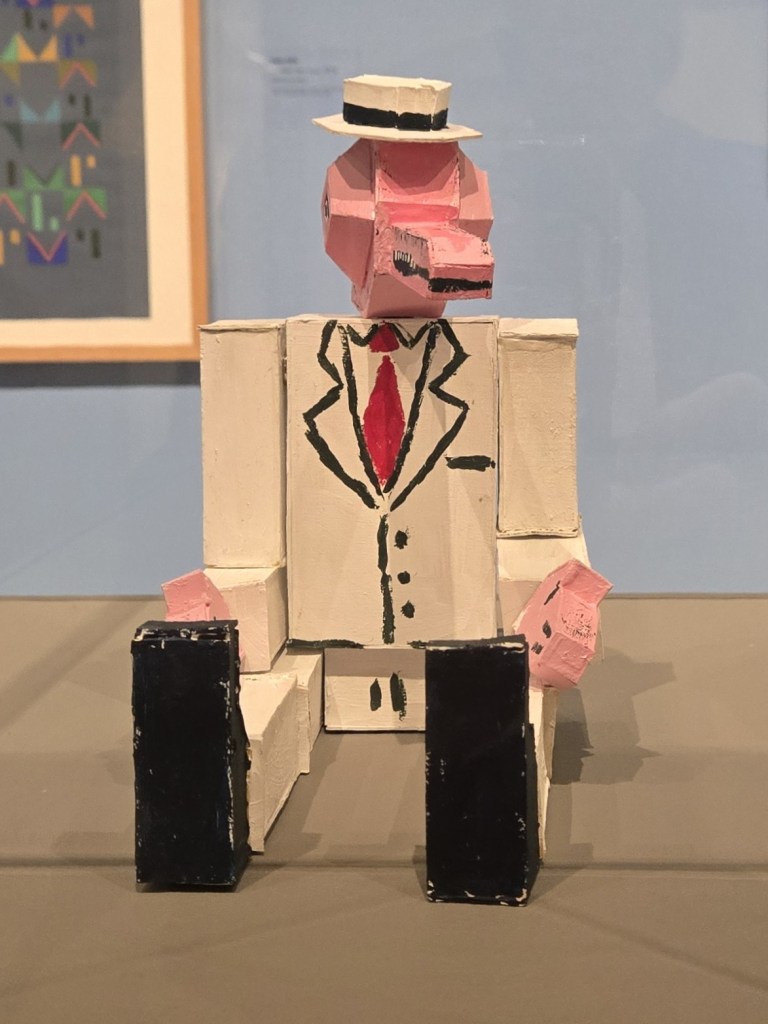
(Vinicius de Aguiar Sanchez, “Pink Dolphin”, balsa wood and wood paint, 2023. Photo: Beth Stewart.)
Vinicius de Aguiar Sanchez’s “Pink Dolphin” sculpture earned much admiration. Said Hunter, “I can relate to it because it looks similar to the stuff that I draw … really crazy things.”
Our last piece of the day was Hélio Eudoro’ s mixed media installation “Mantle N° 5 – Battle Against Destiny – Moirai’s Fate Armour”. Hunter commented that it was “colourful and probably very heavy.” He liked that the artist had used a combination of “clothing, money, buttons, shiny stuff, and necklaces” in the piece.
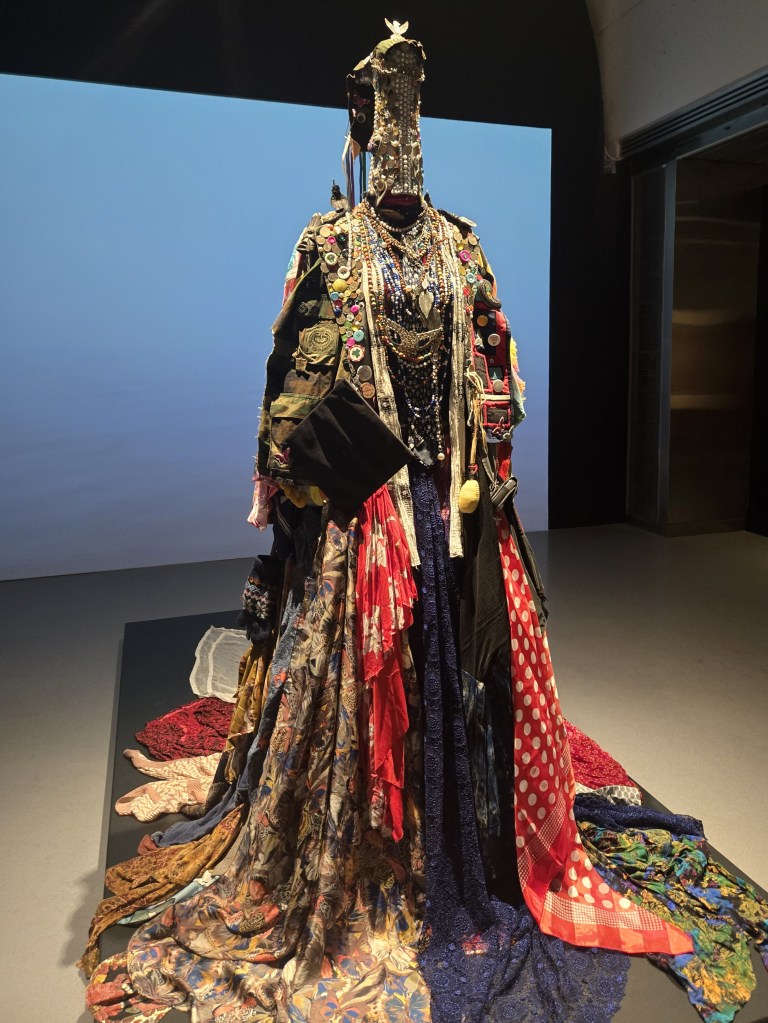
(Hélio Eudoro, “Mantle N° 5 – Battle Against Destiny – Moirai’s Fate Armour”, mixed media, 2022. Photo: Beth Stewart.)
Hunter said, “I first looked at the head, because someone’s head doesn’t look like that. I then noticed that the heart from the movie Moana is on it, so I think it might be a god.
Visiting an exhibition with someone else adds another layer of exploration and understanding. Visiting with an eleven-year-old art enthusiast led me to look at pieces I might otherwise have passed and introduced me to unique interpretations. All in all, time well spent.
All Around Me, All Around You is located on the second level in the Volunteer/Moore Galleries and is ongoing. Tropi-X: Brazilian Art in Canada, 1970s-Now is also on the second level in the Ivey Galleries. It runs to April 19, 2026, so time is of the essence if you don’t want to miss it.
For more information about Museum London, visit Home | Museum London
Reviewed by Beth Stewart.

Beth Stewart is a writer, educator, and visual artist. She has a B.A. and a B.Ed. from the University of Windsor and a Diploma in Art Therapy from Western University. Beth has worked as an Art Therapist with Canadian war veterans and as a Secondary School Teacher of art and English for the TVDSB. She retired in 2024.
Beth was the arts editor at Scene Magazine from 2004 to 2006. She founded Artscape Magazine in 2006 and served as its editor until 2008. In addition, Beth wrote on the arts for Lifestyle Magazine from 2006 to 2017 and served as the copy editor for The Beat (in print) from 2009 to 2013.
As a visual artist, Beth works mainly in dry media and favours coloured pencil. Over the past decade, Beth’s focus has been on wild and domestic birds. Beth is a member of the Coloured Pencil Society of America, the Gallery Painting Group, the Eclectic Collage Collective, the Lambeth Art Association, and a founding member of the Coloured Pencil Artists of Canada group.
Facebook: https://www.facebook.com/profile.php?id=100009620916363

 The Beat Magazine 2025