
The topic of Medical Assistance in Dying (MAID) is in the news again. The expansion of MAID is set to take effect on March 17, 2027, unless Parliament intervenes. On Tuesday, June 16, a special parliamentary committee recommended that the federal government indefinitely pause the expansion of medical assistance in dying for people whose sole underlying condition is a mental illness.
The Beat Magazine’s J Bruce Parker recently interviewed London author Kevin Heslop about his new book, The Writing on the Wind’s Wall: Dialogues about Medical Assistance in Dying.
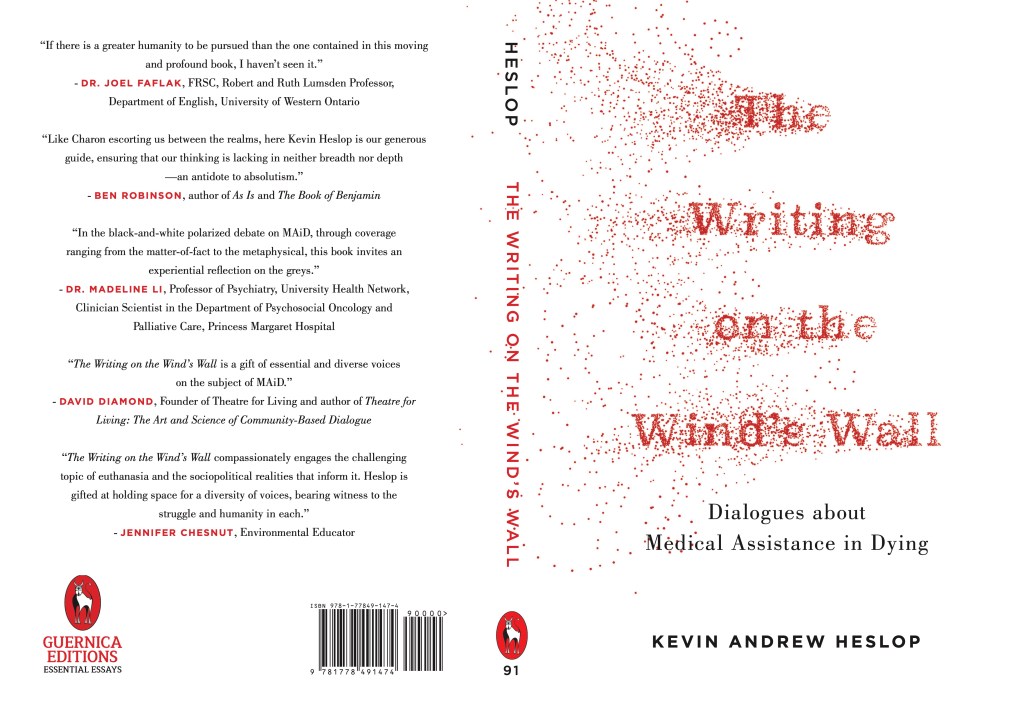
In 2016, Canada’s federal government passed Bill C-14, allowing the terminally ill to choose the time of their death. Medical Assistance in Dying or ‘MAiD’ is a legal, regulated process where a physician or nurse practitioner assists an eligible person in ending their life, either by directly administering a substance or by providing a medication for the person to self-administer. It is a topic which is challenging, polarizing, and up for review by our federal government in 2027.
Former Londoner Kevin Heslop is a poet, author, curator, playwright, and filmmaker who has had a personal experience with physician-assisted death owing to his own father’s terminal illness. It inspired him to seek out and interview 17 people, all Londoners who also have had an experience with the MAiD process. This included one of the first physicians in Canada, a London doctor who administered MAiD, |spouses of those who chose MAiD, politicians who dealt with the political issue in parliament, those who suffer from chronic diseases, a death doula, as well as those who profoundly disagree with euthanasia in all forms. I spoke with Kevin Heslop at his current residence in São Paulo, Brazil.

Q. It appears your work has allowed you to travel quite extensively.
“I lived in London, Ontario in Wortley Village until the spring of 2023, at which point, informed by a one month residency that I had taken in December prior in Costa Rica, I left for a succession of artist residencies called for three or four weeks at a time to Belgrade, then to Finland and then to France; with a bit of Denmark between France and Finland. That period lit my fuse, as that could be a meaningful and worthwhile way to get around for the next couple of years. I later took a residency in Brazil that resulted in my being here for five and a half months, and when I came back in 2024, I shortly left for Europe and spent another few months there, then back to São Paulo, where I have spent the better half of the last two years. I have been living out of a backpack for the last three years now, but my origin point is London, Ontario”.
Q. Tell me about your education in London?
“I went to Banting High School as well as Orchard Park. After high school, not having graduated despite having gone back for a thirteenth year and having failed English twice in the process, I took a year off, introspecting and then was thrown on a construction crew by a family friend and in relatively short order I was doing what I could to get back to school as I recognized that it was going to be a pen rather than a spade. I found a program which just begun called ‘School Within A University’ whereby students could work in a small class with a single teacher to improve any classes they needed to improve in order to boost their marks so they could apply to university the following year. I did one course and entered Western with a high 90’s average. I proceeded part-time through classes at Western but getting more out of the extracurricular than the classes. I published regularly, published poetry, acted in plays and aside from school, facilitated and participated in poetry open mics and other cultural events comprising the rich cultural scene in London. I guess you could say I was mostly auto didactic in my education”.
Q. When did you first become aware of MAiD?
“It wasn’t something of which I remember myself being explicitly aware until the request was made. I am still not sure about the extent to which I want to detail the particulars. What happened in my father’s case is not atypical of those who receive MAiD. He was no doubt eligible when he made the request. He had an aggressive cancer which metastasized. Its aggression coincided with the pandemic, having occurred between March and July of 2020. This meant that he had, up until the point where he began chemo, no in-person contact with any care providers. It was all done over the phone and done scarcely. His decision to request MAiD was made at a time when the assessors could not be mustered on such short notice, and so the options were to persist in his state for an indefinite period until assessors could be provided or receive palliative sedation. The pain was so much that he opted for the latter. He succumbed four days with my brother and me and his mother (our grandmother) at his bedside. For me, that experience was singularly painful and complex and that provoked curiosity that led me to conversations with my neighbours as well as independent reading and research on what MAiD is.
Q. Why does your research and dialogues involve only people from London?
Yes, most of them were from London, and everyone I spoke with was from London. It was the only constraint that I worked with. A simple Google search brought me to the more vocal members of the community about MAiD”.
Q. Is there any one conversation that was unexpected, surprising and stayed with you more than the others?
“I am reluctant to isolate anyone amidst the field of those conversations, if only because I feel that part of the work that the book is doing is to provide the field rather than the individual. I want the book to provide the context that occurs rather than those who are mostly associated with it”.
Q. Why is MAiD important for you?
“My interests have been keen in the last twenty years and will remain indefinitely in culture, and it seems to me that culture is our response to awareness of our own death. It seems to me that death is an important subject, as it raises awareness of our own mortality. In some way, death is the subject of the arts. MAiD is of particular importance at this moment, of course, because the subject has hounded me between adjustments to federal legislation which has now been in place for about a decade, which has changed once and is set to change perhaps, again next year”.
Q. With MAID being reassessed next year, how would you like to see it evolve?
“I take no position. I have really meditated on this and introspected on whether if it is possible for me to sustain a position of agnosticism with regard to MAID, or frankly, with regard to virtually any subject. That is the ideal that I aspire to, and to the extent that I can, I will maintain that, and so I exert no preference on the evolution or de-evolution. I wouldn’t even render it in those terms because that suggests that an adjustment or broadening might confer some benefit, and I am not sure that is the case. However, I would say that my role is to continue to facilitate the conversation in a debate-oriented public square”.
Q. Part of the review and possible expansion of MAiD in 2027 includes mental illness as the sole underlying condition. Would you like to speak about that?
“I can speak about it to the extent that I am familiar with the facts of the case. The consideration has been going on for several years. There have been presentations to a special advisory council in parliament by a variety of experts who are of different positions about the possibility of MAiD for people whose sole underlying criterion is mental illness. And rather than an action being taken next year in March, there is a suspension of effectiveness of legislation that would afford MAiD to people of no pre-existing condition apart from a grievous irremediable mental illness, which is to say if parliament was to do nothing, that on the seventeenth of March 2027, then that would become the new law. So, what is being done in the interim is determining whether or not there would be legislation to meet that or perhaps whether or not the can will be kicked further down the road. From my perspective, which I have to underline is humble and not expert, because my focus on this has been more on the almost theatrical facilitation of a variety of points of view rather than on the legislative evolution and statistics, although it is necessary for me to do some of that work to frame the book. It would be a broadening of eligibility that we would be looking at, so it is not for me to say that it is good or bad”.
Q. What would you like readers to take away from your book?
“I would say that my job is not to seek what people will take away. My job was to present a sort of buffet; a variety of points of view, established in facts, in law and in statistics and in compassion and admiration for all of the people who contributed to the book. And what people will find in the book to a significant extent reflects them, rather than a reflection of the book or my will. I think that is generally true of the arts, which is what I aspire to be doing with this book. I am thinking of this as more of a work of art, if I can be so hideously hubristic as to invoke that phrase, than a work of journalism. So, I invite the breath of the subjectivities that will come to this book, I hope”
The Writing on the Wind’s Wall can be purchased online through Guernica Editions
You can learn more about Kevin Heslop at www. Kevinandrewheslop.com.
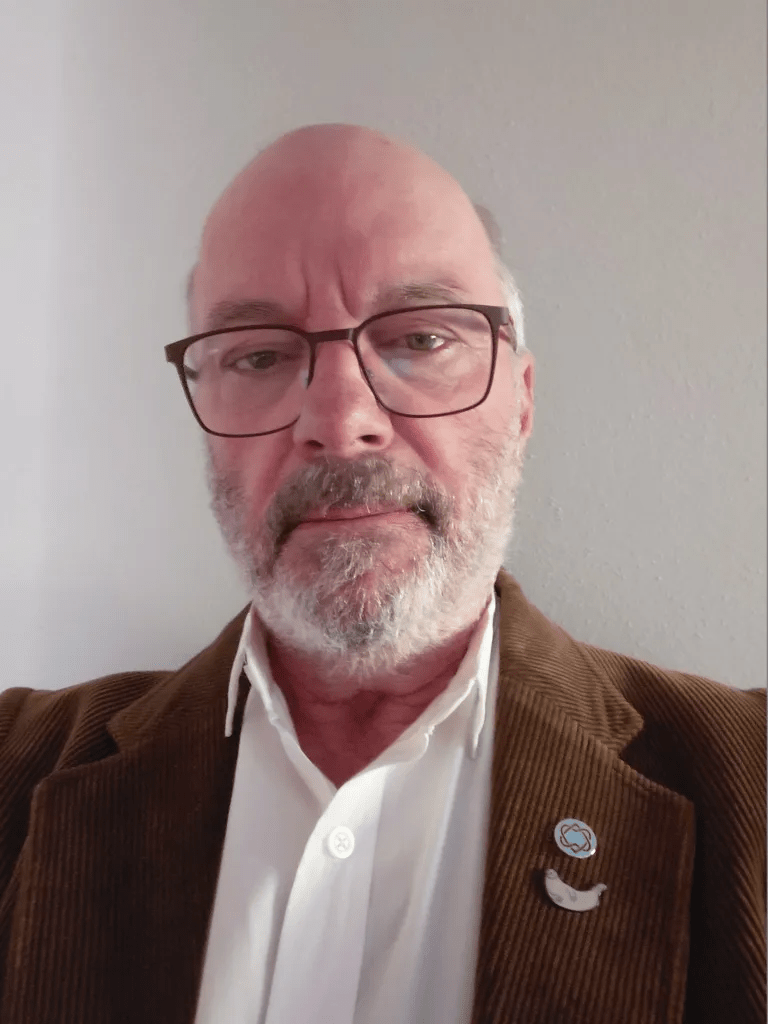
Interview conducted by J Bruce Parker.
.
J Bruce Parker is a retired oncology nurse. As an avid cyclist, he crossed the country by bicycle in 1991 and still explores Ontario’s north via canoe trips. He has published a short story based on his camping experiences.
For over 20 years, as a citizen scientist, he was involved with Monarch Watch, an organization that monitors the annual migration of the Monarch butterfly. He has written about this species and other articles on nature for The Cardinal, Nature London’s quarterly magazine.
For more information about Nature London and The Cardinal, visit https://www.naturelondon.com/the-cardinal/
He is documenting his ongoing friendship with Canadian poet bill bissett, which he hopes to eventually publish.
Bruce has been writing articles for Villager Publications since 2022. To read samples of Bruce’s writing, visit https://www.villagerpublications.com/

 The Beat Magazine 2025