Ethel: You look distraught. Whatever is the matter?
Maud: Have you SEEN the chamber group The Jeffery Concerts has brought to London for Friday, March 13th? AAAAARGH!!!
Previewed by Daina Janitis
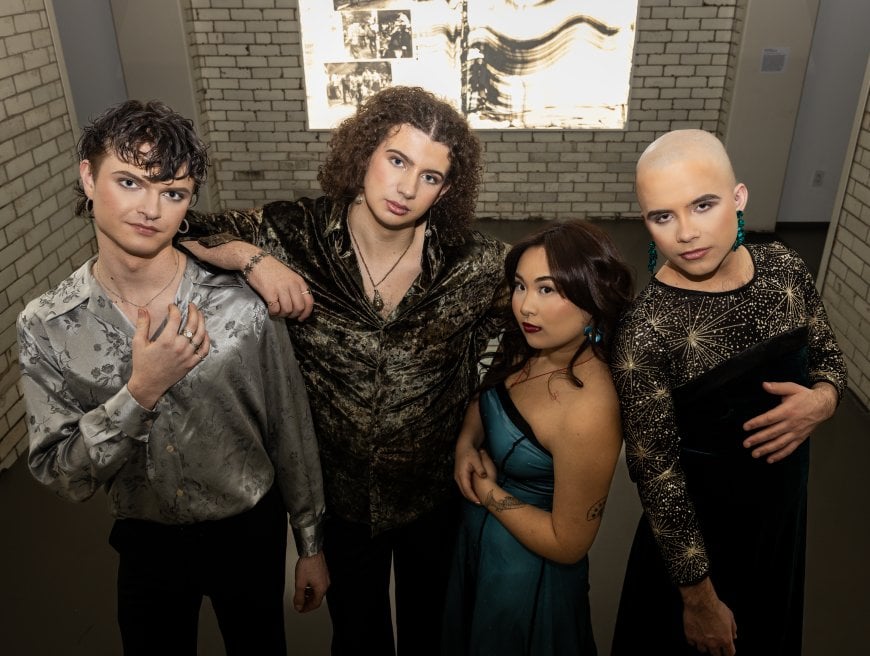
(Pictured: The Poiesis Quartet.)
Ethel: Yes, Maud- and how lucky are we in London to have this Jeffery Foundation board of music lovers, music teachers, and music performers bringing amazing talents that we’d otherwise have to travel to see and hear. That’s the Poiesis Quartet. As the newly crowned winners of the 2025 Banff International String Quartet Competition, the Poiesis Quartet’s arrival in London is a momentous point in their career, bringing the kind of risk-taking, collaborative artistry that keeps chamber music alive for new generations.
Their Jeffery debut at Metropolitan United Church is not our grandmothers’ “subscription” recital, but a chance for Londoners of all ages to encounter four young musicians who treat the string quartet as a living laboratory for sound, story, and social connection.
Maud: But just LOOK at their outfits and piercings- and their use a mixed bag of pronouns. And the program? Chamber concerts are for the B’s- Bach and those other gentlemen of classical music! What kind of name is Jerod Impichchaachaaha’ Tate?
Ethel: I don’t know where he was born- but the Jeffery Foundation bringing that music and those musicians to London, Ontario is enacting Canadian core values: public access to culture, support for emerging talent, and a belief that serious art belongs not in gated institutions but in the shared spaces of a city. In a world where U.S. arts centres are increasingly entangled with partisan politics and boycotts, the Jeffery series offers something different: a locally rooted, not-for-profit platform where excellence is measured in artistic integrity and community impact, not donor glamour.
Maud: Are they at least going to dress up in dignified concert black as they play?
Ethel: Oooh- I doubt it. And I hope they let their freedom in concert dress reflect the freedom in bending and improving traditions of all kinds, bring that beautiful stage at The Met to new life! Try meeting some of them first … look up their own website: Poiesis Quartet
Or, let’s let one of them tell us about him/her/they!
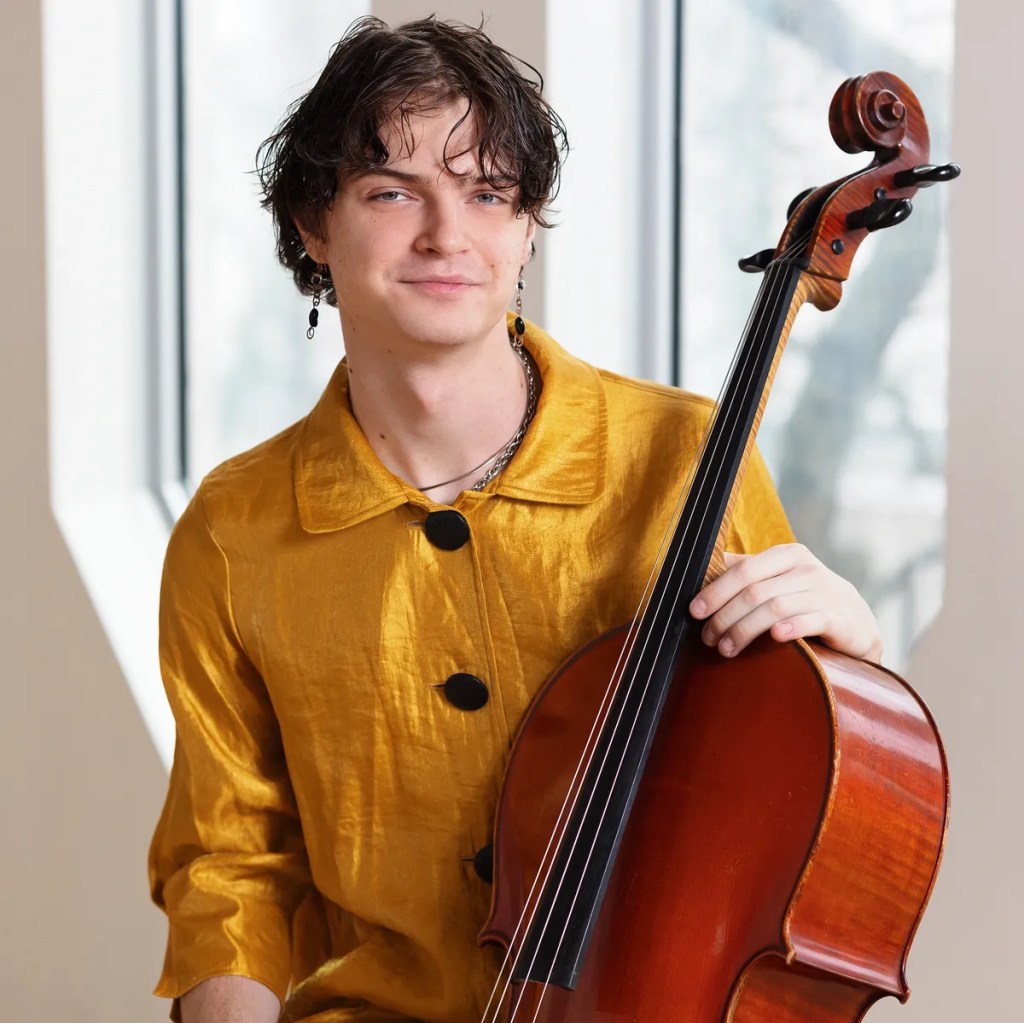
(Pictured: Drew Dansby.)
Drew Dansby, cello, Drew Dansby(he/him) is a recent double-degree graduate of Oberlin College and Conservatory, with degrees in cello performance under Darrett Adkins and chemistry with minors in Comparative American Studies and sociology. Drew joined the cello section of the Cincinnati Symphony Orchestra full-time beginning in the 2023-24 season, becoming the youngest member of the orchestra at 22. He has served as an acting cellist in the Charlotte Symphony, associate principal cellist of the New York String Orchestra, and principal cellist of the Verbier Festival Orchestra. Originally from Charlotte, NC, Drew made his solo debut with the Charlotte Symphony at age 15. Drew is also a founding member of the Charlotte Piano Trio, which has performed 14 concerts over 5 years across North Carolina, and was the founder and director of the 2022 Myers Park Summer Series. Drew has been recognized as a National YoungArts winner and gold medalist in the Cleveland Cello Society competition. Drew was a member of the National Youth Orchestra of the USA for three summers, including as a violinist in 2018 and as principal cellist in 2019, and he was the first member in the history of the orchestra to be accepted on two instruments. As a winner of Oberlin’s concerto competition, he performed David Baker’s Concerto for Cello and Jazz Band with the Oberlin Jazz Ensemble in April 2024.
And the rest of them are just as impressive in their achievements – so with the Poesis Quartet, we are getting a quadruple whammy of inspiration!
Maud: But the music? Will I be able to tolerate any of it?
Ethel: Listening to music of any era should not be centred on your pain threshold, honey. You may have to adjust your hearing aids and your expectations a bit, but the piece that won THE 2025 Banff Festival prize certainly didn’t scare those judges!
Maud: I didn’t know about that Banff Festival. Is it a big thing???
Ethel: A biggie, indeed. The Banff International String Quartet Competition was organized in 1983. It is now recognized as one of the world’s major string quartet competitions.
Ten quartets from around the world are selected to take part in the semi-final competition. All members of the quartets must be under the age of 35. After playing various styles of both traditional and modern chamber music before audiences over a period of several days, three finalist groups are chosen. After further performances, these are judged and a winner chosen.
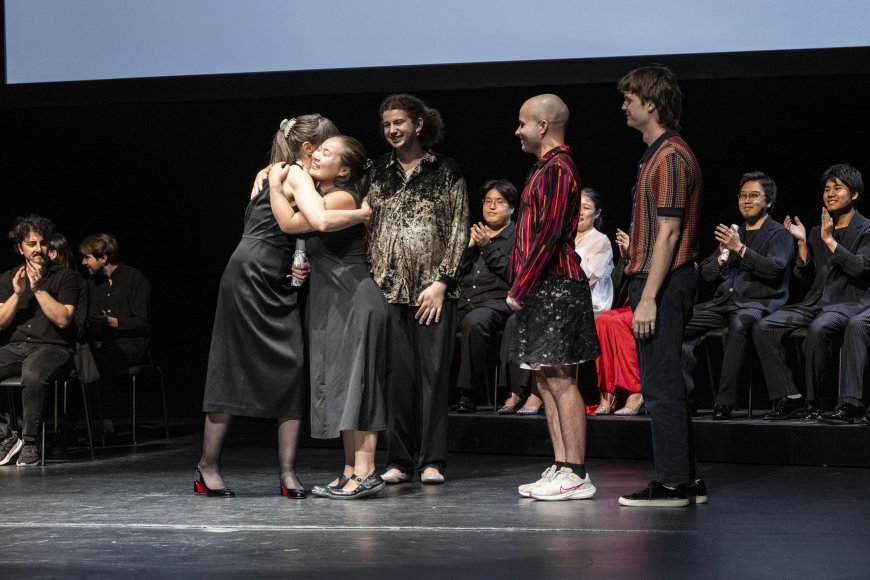
And here’s a photo of them receiving the 2025 Banff award.
As arts reporter Keith Powers said about the 2025 competition, “Each repertoire choice had a tell: of a quartet’s confidence, technique, history — all subtle, all different. For the Poiesis Quartet, this competition was not only a test of mettle, but it was also a forum for identity. The eventual competition winner cemented a place in the finals with a spectacular performance at the conclusion of the open competition: Bartók’s String Quartet No. 5 (the first work the group ever learned!). Then Poiesis stole the finals with royally inclusive and distinctive choices: quartets by Jerod Impichchaachaaha’ Tate, Brian Raphael Nabors, Ken Hisaishi, and Kevin Lau.
“The final round presents our ensemble, our values,” cellist Drew Dansby said. “We feel like everything we’ve done is being fulfilled with this.”
Want to hear the piece they played in the final round, Maud? Get ready …
Maud??? Maud??? Maud???
IF YOU GO:
What: The Jeffery Concerts presents the Poiesis Quartet
When: Friday, March 13, at 7:30pm.
Where: Metropolitan United Church, 468 Wellington Street, London, ON.
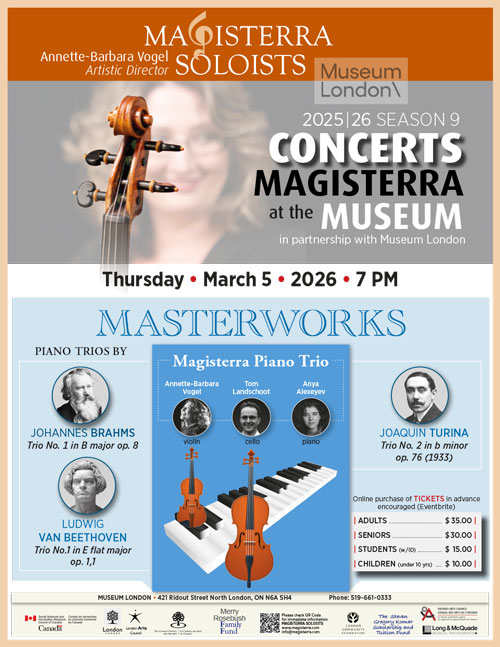
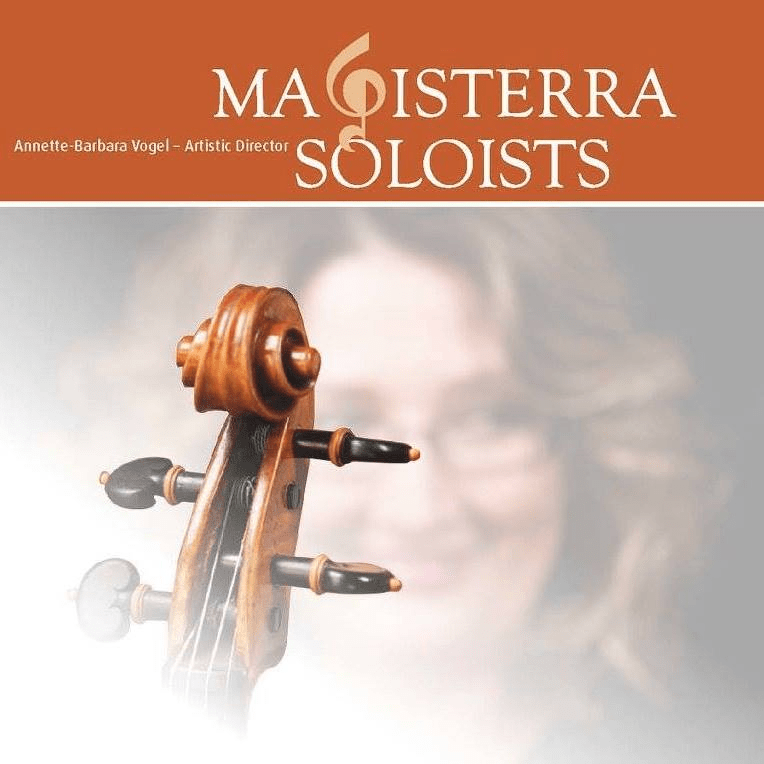
Here is the poster for Thursday night’s Magisterra Concert. So, you already know lots about it- but I’ll tell you more!!!
First, though, I’m going to come clean about what may keep people from flocking to some exquisite chamber music- and in THIS city, that is one opportunity among a flood of riches.
It’s PARKING, isn’t it???
Almost sixty years ago, when we came to London, I was vaguely amused by the horrified mentions of PARKING in the city- the warnings about downtown dying if those malls were built in the suburbs offering free space for cars. And now- I’ve also become the kind of Aged Karen who would hurl epithets at City Council from the gallery, bewailing what I must pay to park my Mazda close to the classical music event I want to attend.
I’m going to offer a few suggestions for the similarly enraged:
Point your car to Fullarton St. between Talbot and Ridout. Use the street- it’s after 6:00 p.m. and barely a block from Museum London
Make an evening of it. Yaya’s Café has replaced the Rhino- and offers an intriguing Thursday night African meal until 7:00 p.m.
Ask someone under 40 in your home about Uber. I watched the young’uns in my extended family use it all over Boston, Detroit, Toronto … and their summoning and paying for the service did not seem to impoverish them.
So, what else do you need to know?
Piano trios? Three pianos on that small auditorium stage?
Au contraire, mon frere… as famous poet George Carlin used to say.
A piano trio is a small chamber group of three musicians – piano, violin, and cello – playing together as equal musical partners. In a piano trio, each instrument has its own voice: the piano provides richness and colour, the violin often sings the melody, and the cello adds depth and warmth. Composers have admitted they love writing for piano trio because this intimate setting lets listeners hear every musical “voice” clearly, like three characters in a vivid, wordless conversation.
And the ones chosen for Thursday night are masterpieces:
Beethoven’s Piano Trio in E‑flat major is an early piece from his “new kid in town” years in Vienna. It’s bright and energetic, with clear tunes that bounce quickly between piano, violin, and cello, plus a gentle, slow movement and a witty, fast finish.
Brahms’s Piano Trio in B major is big, warm, and emotional. It opens with a long, singing melody, then moves through music that can feel stormy one moment and comforting the next, always with rich, lush harmonies.
Turina’s Piano Trio No. 2 is a short, colourful work with a strong Spanish flavour. In just three movements, it shifts between dreamy, atmospheric writing and lively, dance‑like rhythms that give the trio a vivid, distinctive character.
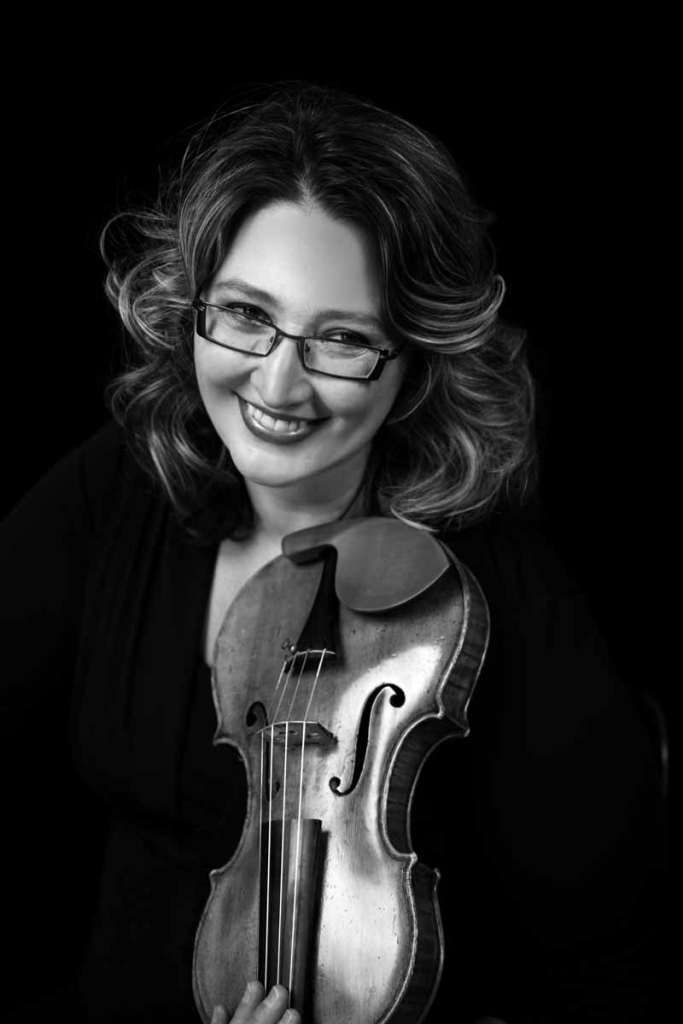
(Pictured: Magisterra Solists violinist and music director, Annette-Barbara Vogel.)
You know that violinist and music director, Annette-Barbara Vogel, is brilliant- but her guest musicians are certainly no slouches!
Anya Alexeyev, born in Moscow into a family of concert pianists, trained at the prestigious Gnessin School and Moscow Tchaikovsky Conservatory before earning a scholarship to the Royal College of Music in London, where she won major prizes. She has appeared as a soloist with leading orchestras, including the Royal Philharmonic, BBC Philharmonic, Moscow State Symphony, St. Petersburg Philharmonic, and Quebec Symphony.
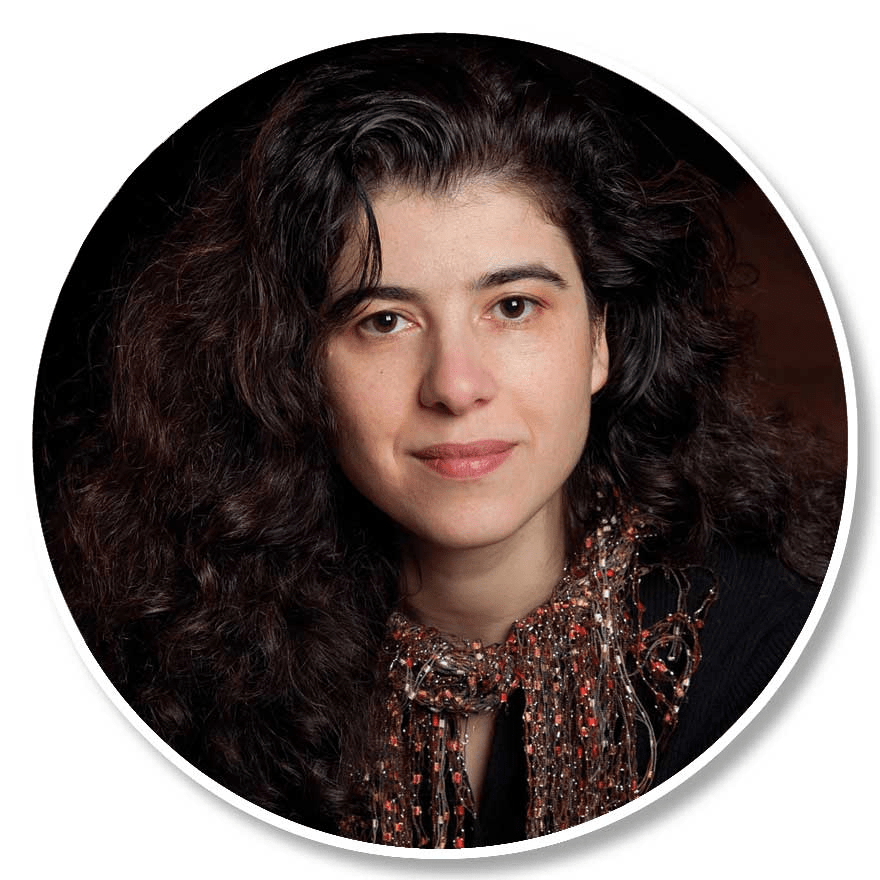
(Pictured: pianist Anya Alexeyev.)
She is a genuine musical explorer who has recorded widely for international labels, yet she is equally passionate about unearthing hidden gems of the piano repertoire. In Magisterra’s trio, she brings the depth of a truly global career together with a restless musical curiosity.
Three things about Belgian cellist Tom Landschoot are especially intriguing for concertgoers: he has an international solo career, is a sought‑after teacher, and he has a deep chamber‑music pedigree.
Landschoot has appeared as a soloist with orchestras across Europe, North and South America, and Asia, including the National Orchestra of Belgium, the Frankfurt Chamber Orchestra, and symphonies from Taiwan to Ecuador, with performances broadcast on radio and television worldwide.
He has held a leading professorship at Arizona State University, is on faculty at elite summer institutions such as Meadowmount, and will join the Cleveland Institute of Music as Professor of Cello in 2026
And … be still my heart … Tom Landschoot has been involved in interdisciplinary public service projects through his music, such as raising funds and awareness for the need of building an orphanage and hospital in Tamil Nadu, India. As part of this humanitarian project, Landschoot was featured in a documentary film of a cellist performing across India, integrating photography, culinary, journalism and original music compositions.
(Pictured: cellist Tom Landschoot.)
And on this day, when wars are beginning yet again, when there is so much to mistrust and fear in our world, let’s be grateful for the wonderful people who bring us music in this chaos
IF YOU GO:
What: Magisterra Soloists present Masterworks featuring the Magisterra Piano Trio.
When: Thursday, March 5, at 7:00pm.
Where: Museum London, 421 Ridout St. North, London, ON.
“In an orchestra, the whole is greater than the sum of its parts. Together, we can create something truly extraordinary.” – Yo-Yo Ma
And with the London Community Orchestra, you get COOKIES!!!
No, not the kind you have to accept, reject, or manage, the kind you can share with musicians and audience members at Dundas Street Centre United Church after each concert. Because, as all great musical experiences are, it’s a community event, one in which we are participants, even if we sit on the church benches and applaud our hearts out while some of London’s good people enrich our lives with exquisite music.
WE ALL share in the opportunity to quicken our minds and deepen our emotions.
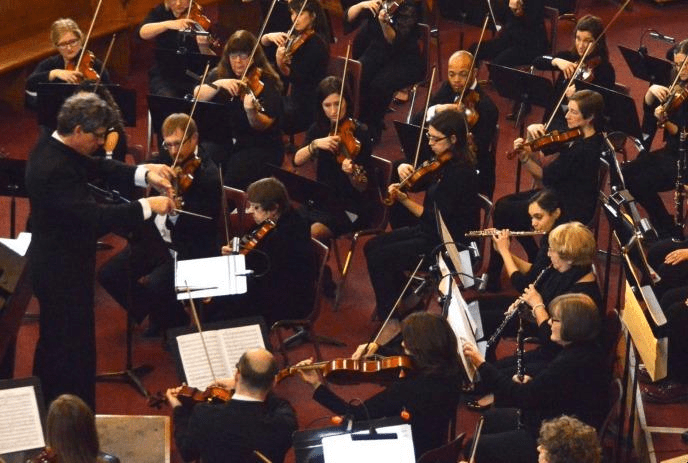
Yes, this organization has been around for fifty-two years, encouraging talented non-professionals to endow their busy lives with the discipline and rewards of symphonic music. And in those fifty-two years, most of the faces have changed, but the quality of performance has evolved to make every season better than the last.
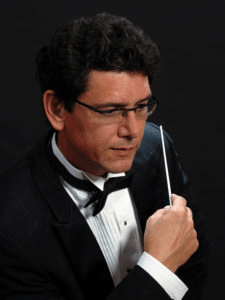
Len Ingrao has conducted LCO since 1998 and has built this city’s large symphonic ensemble to take on artistic challenges and share them graciously with Londoners- for a very reasonable ticket price.
(Pictured: London Community Orchestra Conductor, Len Ingrao,)
I’ll bet you know many of them.
Carolyn Martinelli, who has taught generations of young people at Catholic Central High School, has been a lovely concertmaster since 2005.
(Pictured: Carolyn Martinelli, London Community Orchestra, Concertmaster.)
Steve, who adds fire to the local community orchestra while completing his epidemiology degrees.
Ana, who is a dedicated therapist but still plays her violin in LCO.
Mary, the oboist and member of the FIRST London Youth Symphony over 60 years ago, who still often sets that tuning A for the community orchestra.
Some local music teachers and profs, continuing to aspire and learn with material they love.
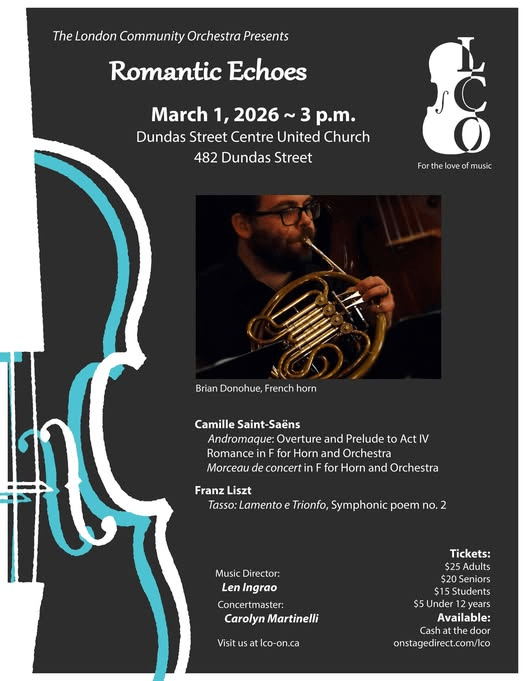
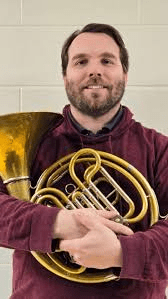
And one of those teachers will be the soloist for the March 1st program – Brian Donohue.
(Pictured: Brian Donohue, London Community Orchestra Soloist.)
Brian is the kind of teacher who does the profession proud:
He’s been a member of LCO for twelve years, while teaching at Sir Frederick Banting High School, conducting bands, starting a French horn choir, and teaching the board’s first Music and Math combo course.
He’s always ready to help other musical ensembles with coaching and standing in when he’s needed- and devotes time to raising his three kids with his wife, Christine.
To keep his musical skills growing, he has long-standing involvement in London community ensembles, including playing French horn with the London Community Orchestra and Encore: The Concert Band.
He has taught private horn through Western University’s New Horizons Band program, which focuses on adult and lifelong learners returning to music—he really believes that music is for everyone.
No, no gold medal in hockey – but he has won the Dawson Memorial Award in Music Education, Western Music Award in his final undergraduate year. Chamber of Commerce Award for excellence in Western’s Wind Ensemble, Kiwanis Music Award (festival recognition).
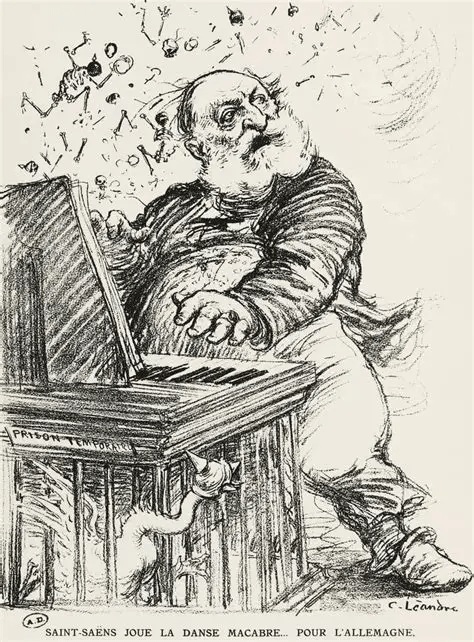
And he is performing music that he LOVES, from the “easy listening” Camille Saint-Saens.
(Pictured: Caricature of Camille Saint-Saens.)
Andromaque: Overture and Prelude to Act IV is a film score before there were films! S-S wrote it in 1902 for Sarah Benrhardt to bring the Trojan War story to life, politics, grief, unwanted suitors – daily stuff in Troy, 17th-century France, and in our current relationship with the US.
And the Morceau de Concert is going to be a showstopper. S-S originally wrote it for a horn that is no more … the “cor omnitonique,” with four pistons that promised to play easily in any key. The gadget did not survive, but the virtuoso showpiece it gives to a great horn player – with lots of dazzling acrobatics – will hold your attention on Sunday.
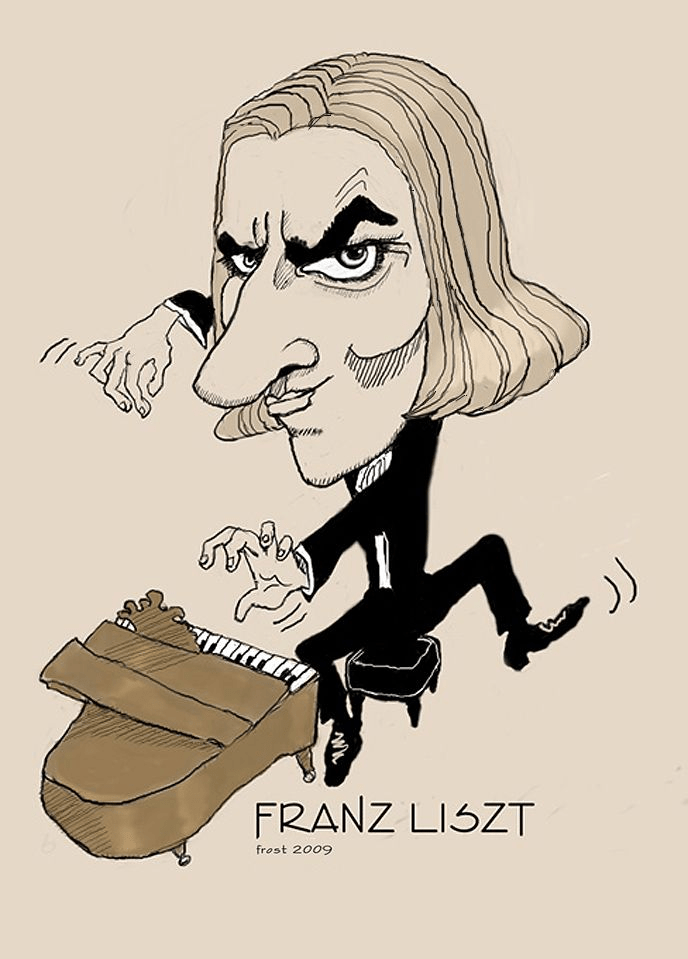
Speaking of virtuosi, the full orchestra will be giving us Franz Liszt and his Tasso: Lament and Triumph. Liszt was pioneering the symphonic poem by 1849 – telling a story in a single, continuous movement (so no more worries about when to clap!).
(Pictured: Caricature of Franz Liszt.)
The poem is apparently based on the tortured life of Torquato Tasso in the 16th century as he goes through instability in Ferrara, wanders – in a boat, I presume – on the lagoons of Venice, and finally receives recognition in Rome after his death. All of this tumult is conveyed by the constant transforming of a gondolier’s song that Liszt once heard in Venice.
And after the concert? COOKIES and the chance to tell the musicians what generous, inspiring Londoners they are!
IF YOU GO:
What: London Community Orchestra presents Romantic Echoes.
When: Sunday, March 1, at 3:00pm.
Where: Dundas Street Centre United Church, 482 Dundas Street, London, ON.
My first problem is the fabulous team that works for, loves, and supports London Symphonia. Look at their website – https://www.londonsymphonia.ca/event/love-and-romance-denise-pelley, where you’ll find everything you wanted to know – and more – about the creator of the program and the soloists.
And then it’s Black History Month, and here we are in Canada creating a musical program featuring two black soloists. Haven’t we heard that our more powerful neighbour has done away with DEI – and isn’t it embarrassing that we still toe the line for that acronym? And is it pointless virtue signalling that seems to praise London for being aware of our People of Colour?
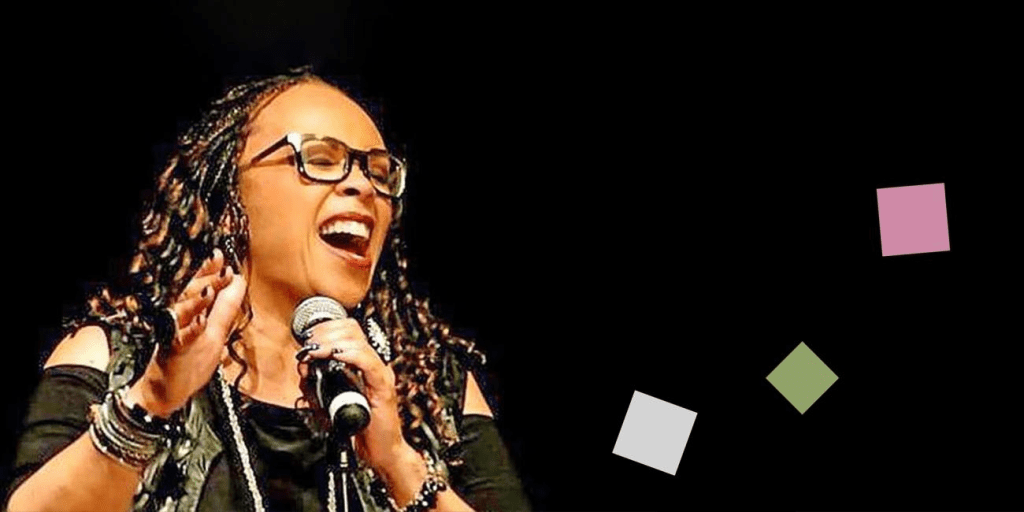
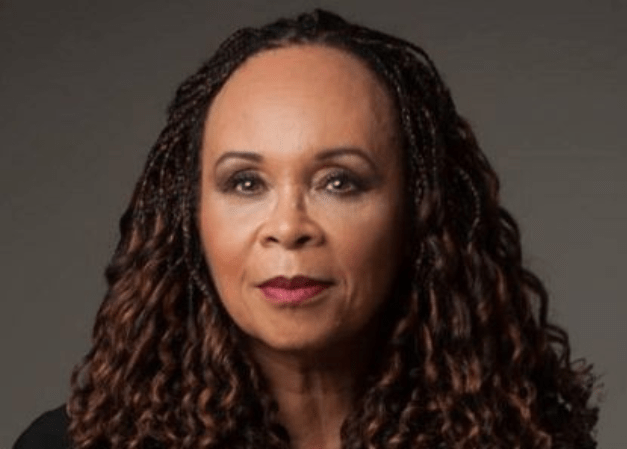
(Pictured: London vocalist Denise Pelley.)
And, finally, am I being condescending to point out the achievements of our program originator and soloists as though Londoners needed educating about them? We know about Scott Good’s composing career, we know about Denise Pelley’s medals and her opening for Aretha Franklin, and her YM-YWCA Woman of Distinction award. If we’ve been to Stratford in the last 16 years, we know that Roy Lewis is a 16-year veteran of the Festival stage.
But here’s the thing, and it’s raw right now. I admit to everyone that I have too much time, doubt and fear on my hands right now to ignore the horrors of authoritarianism, ignorance, and greed that are happening in our neighbourhood. At 80, I’m not going to run for office, but I want to reveal that London’s live art music scene has been my harbour of hope.
Sitting in those Met pews – no cushion, I get the cheaper seats – and watching the faces of our Symphonia musicians and their featured guests renews hope. The evidence of their work and commitment, and the joy they show in bringing them to us in live performance, is something that no recording can do. I multiply the effect by chatting to strangers beside me, to students at the reception (who can attend for FREE, for God’s sake) and hugging the performers afterwards (very few have pushed me off). Those are gifts I never expected to receive in life.
Because we are in the presence of souls who have battled racism and every kind of insidious discrimination, have given up lucrative jobs for their art, and have honed their talents to the utmost just for US. Bearing witness to their courage as well as their art makes US better!
(Conductor Scott Good and guest artist Denise Pelley share their insights into the upcoming February 14th performance.)
Do you know that Denise Pelley has inspired young people in Junior Achievement for 19 years, has performed at the Grand in musicals, and has travelled to Sudan twelve times to establish a music and arts camp for 400 kids? Did you know that her son, Jason Edmonds, was killed in a road rage accident, and she created a Foundation to tell young people about that rage as one of the many dangers facing them?
Did you know that Roy Lewis is from the UK, came to Canada, and founded the Obsidian Theatre (focusing on Black Canadian stories) – as well as painting, sculpting, teaching Elizabethan Literature at several universities, and co-founding “Shakespeare in the Rough”? His poetry tackles the death of love, the struggle for understanding, and redemption in the face of grief.
(Pictured: Roy Lewis, Poet and Narrator)
Conductor Scott Good is not Black, but he’s a genius of music with a soul that encompasses the rhythms, aspirations, and hopes of all humanity. I can only hope that London hears more of his oratorios, symphonies, jazz masterpieces and chamber music. He is a creator of music and of bridges that support our shared humanity.
Being in the very presence of artists like this is a privilege and a healing.
(Pictured: London Symphonia Conductor, Scott Good.)
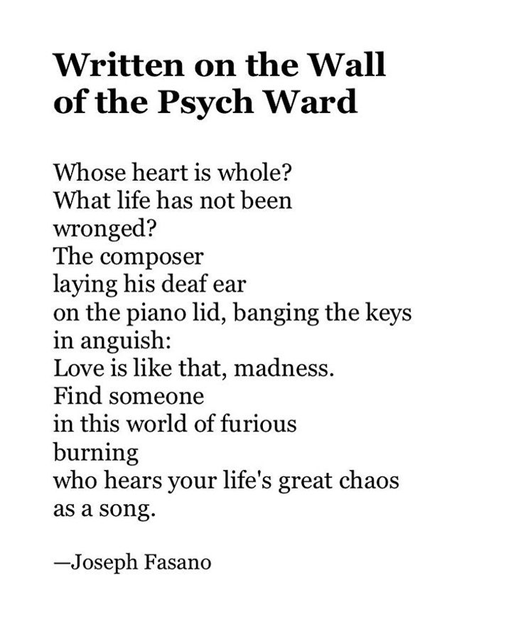
I can only ask you to read, before you attend the concert, the words of an American poet, Joseph Fasano, whose word-compositions are as powerful as the music of our London performers this weekend:
(Pictured: American poet and novelist, Joseph Fasano.)
“How does Authoritarianism happen? It starts slowly, in slogans and small acts. It starts in the eroding of decency and empathy.
It starts with a “Leader” undermining faith in any “Truth,” the deliberate disorientation of the citizen’s mind.
And then? It stirs in the heart of the common man, whose world has become too complex for him. He looks around and finds a world that is frightful, complicated, new. He sees his falling bank account. He loses his job. New media bombards him with changes he cannot understand. He despairs. He is filled with an unnameable terror.
When he can take the fear no longer, he abandons his reason. He hands his mind over to a Leader—a Fü*rer, a Chairman, a Figure He Never Had—who promises to simplify his thoughts, his feelings, his life; to tell him the one, concocted, state-sponsored Truth he wants to hear. And that Leader will do exactly that.
Authoritarianism, therefore, thrives on the one-sided mind: the individual, and ultimately the group, that has become alienated from, or has repressed, a part of itself, usually in an attempt to avoid feeling what it is terrified to feel. The one-sided person seeks to control the ways in which others express themselves, and he does so for precisely this reason: he unconsciously envies those who can feel what he cannot feel.
Authoritarianism always begins with a reductive philosophy that despises empathy, that views tenderness as a weakness, that seeks to police how others love. Dostoevsky once wrote that hell is nothing other than the state of being unable to love. Authoritarianism is nothing but the small mind’s fear of the myriad beauties of this world. Even as its rulers acquire material wealth, they wish to deprive the world of the spiritual riches they cannot have.
Thus, as a movement, the ultimate unconscious wish of Authoritarianism is always destruction, self-destruction, s*icide. It longs for stillness, not growth; its nationalistic fervor is a not-so-hidden desire to be alienated, to sever its bonds with other nations and peoples. It ends as H*tler did in Berlin: alone, isolated, taking everyone with it into the dark.
It is predicated, always, on a false nostalgia: a longing for an ideal, imagined past. Its slogans are vague enough to inflame the fantasies of the one-sided mind be great again, blame others, your life is hard because of Someone Else. Most catastrophically, then, the one-sided mind projects its repressed half (its shadow or its tenderness, its darkness or its heart) into this Other, and seeks to oppress it, then ultimately to destroy it. Genocide, tyranny, oppression: these are acts of the fractured, one-sided mind, afraid of encountering and experiencing the other side, the other opinion, the Great Other, in whose presence it would be challenged to face the whole of what it means to be human.
Art, mystery, poetry, education: these things reconnect us to our wholeness, to the varied voices within us. When we act from that grace, that state of openness, of listening, of synthesis and integration, we practice the lost arts, the arts that all power structures inherently desire to devalue and repress empathy, compassion, creativity, love.
Where is the wise way between societal extremes? Where is the movement that supports the worker, the common citizen, without stoking his deepest fears and using them to divide society and conquer it? Where is the form of government that wishes for its citizen to be whole?
A fractured, one-sided mind is a mind that can be controlled, sold reductive narratives, induced to want and to purchase any artificial fulfillment. A whole mind, even a mind that strives for impossible wholeness, is free. And that is why real, radical wholeness is a threat to the status quo, to tyranny, to propaganda.
As is art. As is grace. As is empathy. And that is why love, radical love, common love, even in the darkness between two bodies, is a revolution that can bring kings to their knees.”
— Joseph Fasano
IF YOU GO:
What: London Symphonia presents Love and Romance with Denise Pelley.
When: Saturday, February 14, at 7:30pm.
Where: Metropolitan United Church, 468 Wellington Street, London, ON.
Here’s a recent Facebook post about the concert by conductor Scott Good, shared with his permission:
“Dear friends,
On February 14 at 7:30 PM at Metropolitan United (London, ON), I’ll be joined by my colleagues at London Symphonia, R&B/Jazz vocalist Denise Pelley, and poet/actor Roy Lewis to present Love and Romance.
Yes — it’s Valentine’s Day, and we are going deep!
The seed for this concert was planted almost two years ago when I noticed Valentine’s Day landing on a Saturday evening. As a concert designer, I love an occasion — a focal point that shapes an evening’s arc. Valentine’s Day is ideal: music across all styles is saturated with romantic passion, longing, joy, and vulnerability. It’s an excuse for genres to mix and make sense together, and for audiences to encounter both the familiar and the unexpected. I like to think of occasion concerts as community-oriented — something many can enjoy.
I knew early on the program had to include Mahler’s Adagietto from his Fifth Symphony. I remember the first time I heard it; I’ve never known a piece of music to evoke the sensation of a loving, gentle touch quite like it. Later, I learned it was written as a love letter to his wife. It had to be here.
Around that time, I had recently worked with Denise at the Forest City London Music Awards, where we presented Stevie Wonder’s You and I. It went beautifully. Denise brings such generosity and depth to performance, and the song – with its tender, yet vulnerable lyric – aligns perfectly with this theme. The following year we returned with You Don’t Know Me, this time with horns, strings, and rhythm section. That collaboration allowed me to shape the orchestration around her expressive vocal language, and it became clear we had the beginnings of something larger.
Roy’s role in guiding the evening through poetry and poetic prose became unexpectedly profound. After a remarkable performance with Symphonia last year, he joined us with poems written specifically for Valentine’s Day — fourteen of them. As I read through his work, I realized something deeper was at play: these poems weren’t only about love found, but love lost. With great love comes great grief, and the concert gradually reshaped itself around that truth.
Nine of Roy’s poems ultimately frame the program, each leading into a song or instrumental work — the pain of Cupid’s arrows illustrated by Ellington’s Good Morning Heartache, a thrilling glance explored in Bacharach’s The Look of Love, the electricity of being with the one you adore caressed by Carmichael’s The Nearness of You. Instrumental moments include Ravel’s sensuously flirty “Pantomime” from Daphnis et Chloé, featuring Laura Chambers on flute, and the king of romance, Barry White’s orchestral hit Love’s Theme.
As the concert turns toward loss and reflection, we arrive at Autumn Leaves, performed without rhythm section, just orchestra and voice – followed by an up-tempo moment of melancholy in an orchestral rendering of Radiohead’s Weird Fishes I created for the concert, a song that aptly describes, through driving rhythm, evocative chords, and a spacious yet unrelenting melody, a feeling of loss and the difficulty of moving on.
We close with Here’s to Life, in the Shirley Horn arrangement — a true bucket-list piece for Denise, and the perfect sentiment to end the evening:
“May all your storms be weathered.
And all that’s good gets better.
Here’s to life, here’s to love, here’s to you.”
With solos from Nevin Campbell, Joe Phillips, Rob Stone, and Shawn Spicer, and an orchestra navigating classical lyricism, jazz harmony, and blues grit, + original arrangements alongside renditions made classic by Ella Fitzgerald, Dianna Krall, and Matt Monro, this promises to be a rich, emotionally charged night of music. Join us if you can!”
On the eve of the 1980 referendum, (PET) Pierre Eliott Trudeau (not PP, that’s for sure) reminded Canadians that they were facing a tipping point: “We must now establish the basic principles, the basic values and beliefs which hold us together as Canadians so that beyond our regional loyalties there is a way of life and a system of values which make us proud of the country that has given us such freedom and such immeasurable joy.”
A quarter-century later, it’s not Quebec making secession noises- it’s Alberta. But if you seize the opportunity to be in the presence of some Alberta talent – certain to bring you immeasurable joy – maybe you can be part of some Canadian culture that keeps Canada together for another twenty-five years.
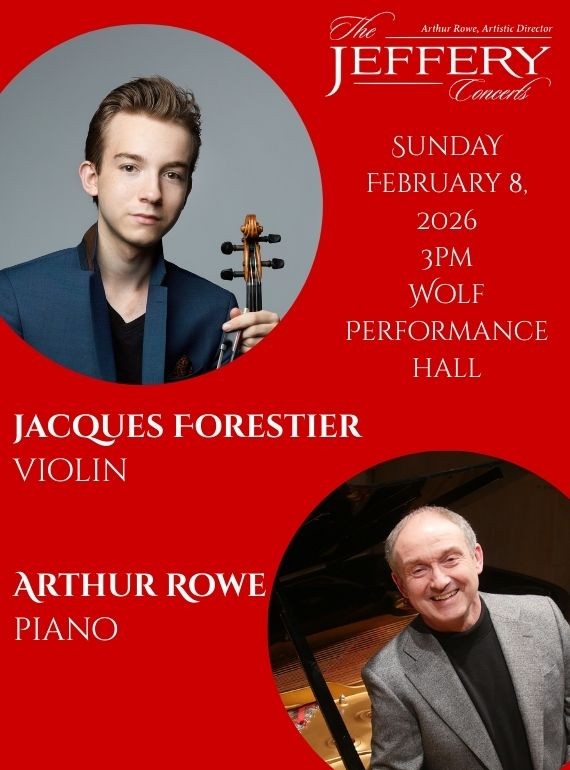
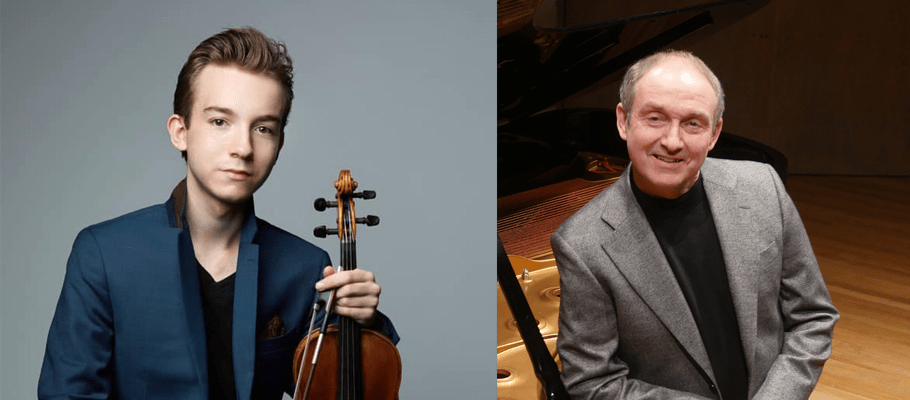
The Jeffery Concerts on Sunday, February 8, at the Wolf Performance Hall, at a comfortable 3:00 in the afternoon, features two icons of Canadian music – the young violinist Jacques Forestier and seasoned pianist Arthur Rowe. The CBC has already included Jacques in its “Top 30 Hot Canadian Classical Musicians under 30” – and Arthur is …uh …slightly older and already loved by London audiences.
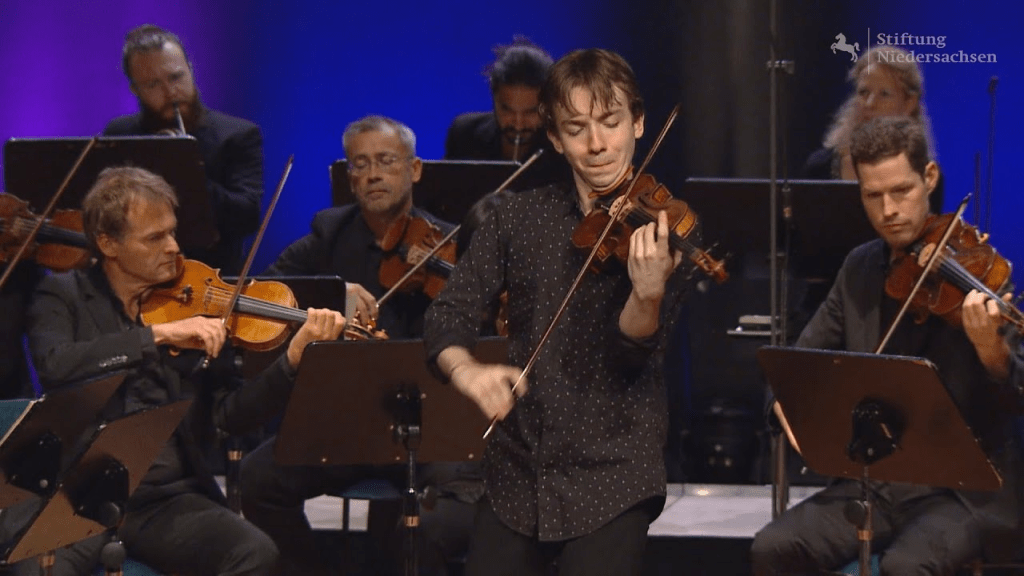
So, who is this Forestier chap? I was about to credit his musical vibe to Montreal – but he’s an Alberta kid, born in Edmonton in 2004 and already starting to learn the violin at age TWO. By the age of 11, he made his debut with the Edmonton Symphony at the Winspear Centre – and remains one of their favourite soloists. I’ll place-name-drop a bit: He’s been at the Curtis Institute on full scholarship since 2022, picked up some pointers at the Mount Royal Conservatory, and been a student-artist at Juilliard.
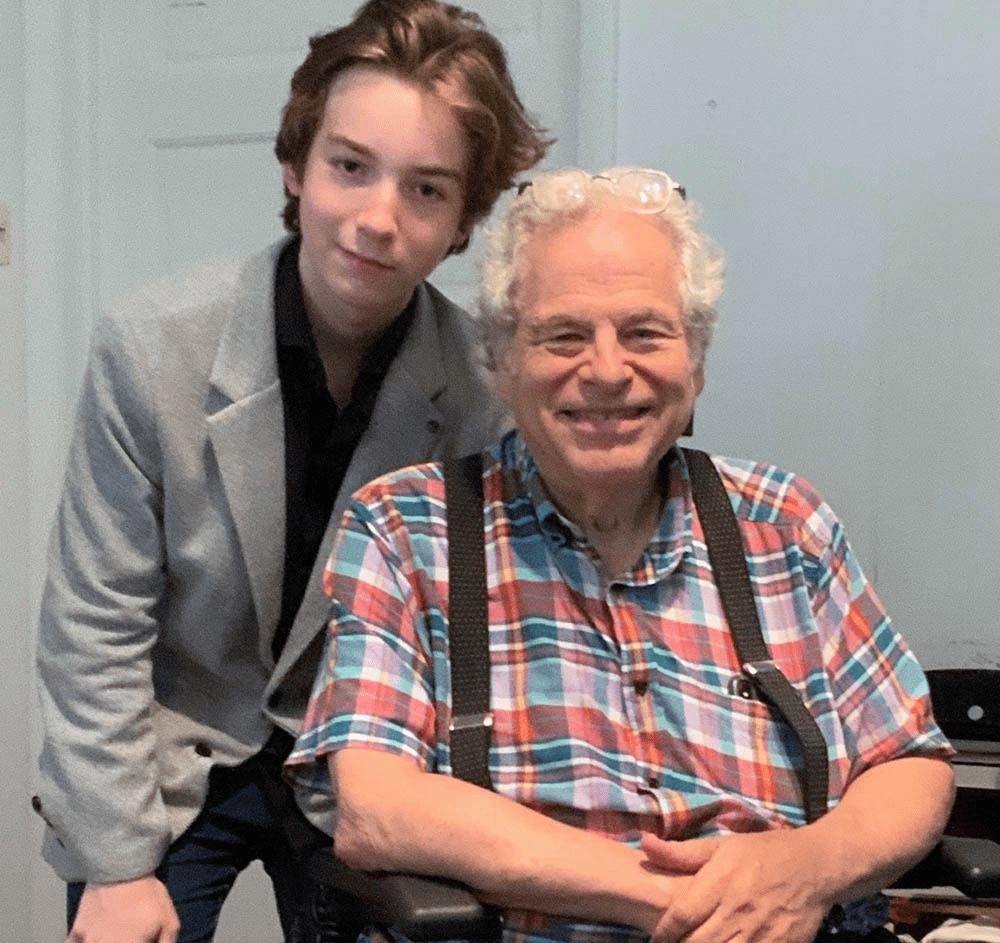
(Pictured: Jacques Forestier with violinist Itzhak Perlman.)
His parents’ home in Edmonton must be bursting with prizes ~
From the “Olympics” of violinists, the 2018 Yehudi Menuhin International in Geneva (the only Canadian to qualify)
A multitude of medals from major competitions in Canada
Winner of the Joseph Joachim Violin Competition in Germany
And Arthur? He’s my age.
Just kidding. He’s also a world-class talent, Professor and Inspiration Manager at The University of Victoria. But BC is not seceding, so you can be nice to him after the concert- no need to go overboard.
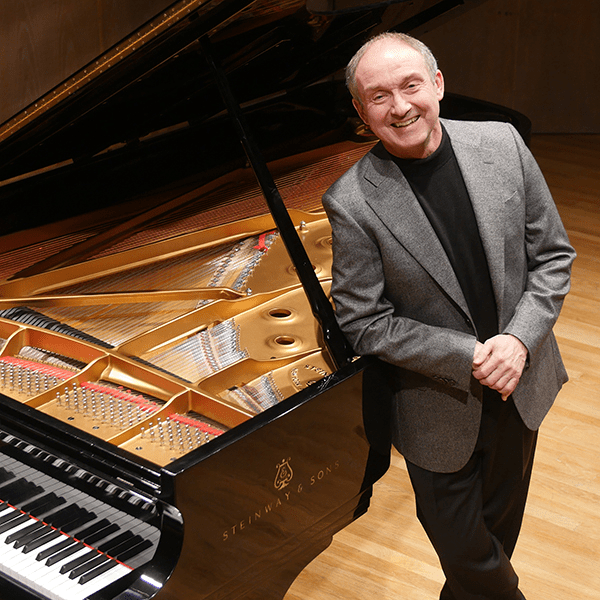
(Pictured: Pianist Arthur Rowe.)
And if you’re new to this classical music thing – and you don’t want to appear like a thickie-thickie dumb-dumb in front of the mates on either side of you – here are a few elitist phrases you can share about the program.
When the Dvorak Sonata in G Major begins, you can ask, “That sounds familiar. Didn’t that performance win Jacques the Joachim competition?” or “I can hear the influence of Dvorak’s American sojourn, can’t you?” Or, “It’s all I can do to keep from humming along with those Bohemian folk melodies.” Don’t forget to mention it’s “intimate and dazzling – I’m going to hold my breath for all 18 minutes of it”
As for the Brahms Sonata in A Major, try this: “Isn’t it amazing- that young man received the Joachim prize – and Brahms actually wrote this sonata for his FRIEND, Joseph Joachim.” (Chuckle warmly at this point). Or involve your seatmate with “I can hardly wait for the Allegro Grazioso of the finale- those Hungarian dance rhythms make me want to kick my red leather boots while holding a perfect squat.”
If you’re not confident in the Strauss Sonata in E-flat Major, you can express relief that Strauss was in his post-Wagnerian phase. You can say, “This is going to be a thrilling capstone for this recital” and poke him or her in the ribs when you hear the “stormy passion” of the Allegro molto appassionato. Or you can just sigh deeply when the final Allegro begins, recognizing aloud the “dazzling runs and double-stops.” Don’t ask me what double-stops are. Google it.
Each of the sonatas Jacques and Arthur are performing is considered a gem of late nineteenth-century Romanticism. Perhaps you can only play them brilliantly when you are young and brilliant.
Don’t miss this opportunity to bear witness to the early career of a Canadian phenomenon. And tell him after the concert that you don’t want a Canada without Jacques Forestier – and Alberta- in it.
IF YOU GO:
What: The Jeffery Concerts presents violinist Jacques Forestier and pianist Arthur Rowe.
When: Sunday, February 8, 3:00pm.
Where: Wolf Performance Hall, 251 Dundas Street, London, ON.
“Music doesn’t lie. If there is something to be changed in this world, then it can only happen through music.” – Jimi Hendrix
The concert I want to tell you about won’t involve rock, open rebellion, or active protest. It involves Lara St. John, a brilliant violinist, a Londoner, a personality who fills a concert hall, and a champion of honesty whose very presence is a gift to London this Saturday evening at Metropolitan United Church.
Sometimes we just NEED great music.
“Your brain responds to music like it’s a survival tool. When music plays, almost the entire brain ignites. The motor cortex drives your body to the beat. The hippocampus ties melodies to memories. The amygdala unleashes waves of feeling. And in the orbitofrontal cortex—the brain’s reward and decision hub—the same circuitry that flares in OCD lights up with music’s cycles of tension and release.” (Attributed to Harvard Medicine: The Magazine of the Harvard Medical School.)
Listen to Lara and Matt Herskowitz in this video from her Shiksaalbum. It’s not on Saturday night’s program- but her passion for truth and music will be.
Meanwhile, what has the London kid who picked up a violin and joined her older brother Scott in playing done with all of that talent?
As for most musicians’ bios, you’ll need an atlas and incredible patience to follow the list:
She debuted with an orchestra at age 4 – and with Lisbon’s Gulbenkian when she was 10.
AT 12, she toured Spain, Greece, Portugal, and Hungary
She’s studied at Curtis, the Moscow Tchaikovsky Conservatory, the Guildhall, Mannes College, and the New England Conservatory
She has been a soloist with the major orchestras of every continent.
She created her own label – Ancalagon – in 1999
She received the Order of Canada in 2021 – for “service to society and innovations that ‘ignite our imaginations’.”
It was Sting who said, “The truth is like a sword. You have to hold it with an open hand.”
And Lara St. John’s devotion to truth has been as inspiring as her music. In 2019, she told a Philadelphia newspaper that she had been abused and raped as a student at Curtis Institute of Music in 1985. That distinguished school had covered up the crime when she reported it. She is currently finishing a documentary film about the abuse of young music students. Read about the documentary here: https://theviolinchannel.com/lara-st-john-to-release-documentary-about-sexual-abuse-in-classical-music-industry/
Her hope for the documentary, Dear Lara, is not a selfish one: “They need to admit to wrongdoing and take every possible precaution to never let these things happen again. Predator Whack-A-Mole (my term for allowing depraved men to quietly resign, enabling them to simply take their behavior elsewhere) must stop. It’s unconscionable, and it’s everywhere,” Lara appealed.
Saturday’s Program:
Lara’s chosen concerto to perform with London Symphonia is Avner Dorman’s Concerto No.2, which premiered in 2018 when it won the Azrieli Prize. The composer tells an intriguing tale about the piece. The 92nd Street Y (and Gil Shaham) approached him to write a piece for their Jewish Melodies program. He admits his research surprised him in finding common modes and melodies in Jewish music from various parts of the world. One of these, he said, is the Nigun – a melody that can be sung in Yiddish and understood by an Arabic speaker: “The Nigun has no beginning and no end and is eternal.”
Lara discusses Avner Dorman’s Violin Concerto No. 2, “Nigunim,” with Andrew Chung, Artistic Producer, London Symphonia, in this Behind The Music video clip: https://youtu.be/t6FuSbI_5fw
On Saturday night, London Symphonia will also perform Mendelssohn’s Midsummer Night’s Dream Suite and Aaron Copland’s Appalachian Spring.
It’s January – the month of miserable weather, broken resolutions, and depressing realizations. This year, the news from our neighboring country shatters our trust and brings even more dismay into our lives. And January 27th is the annual International Day of Commemoration in memory of the victims of the Holocaust. Each year, Canadians and individuals all over the world take this opportunity to remember the victims of the Holocaust and to reflect on the dangers of anti-Semitism.
Sometimes, just being in the presence of truth-tellers and creators of incredible beauty can remind us of our power to change the world. Lara St. John and London Symphonia will be at Metropolitan United on Saturday night to keep us from forgetting.
IF YOU GO:
What: London Symphonia presents Lara St. John: The Ancient Flame.
When: Saturday, January 17, at 7:30pm.
Where: Metropolitan United Church, 468 Wellington Street, London, ON.
Magisterra Soloists are honoured to begin 2026 with their annual Holocaust remembrance concert, dedicated to commemorating the victims of the Holocaust and honouring the survivors on Sunday, January 11, at Museum London.
—
Nine years ago, I picked up the phone. When the call comes from a former student (and former member of the London Youth Symphony), I’m curious to see where innate talent and hard work have taken a person like this. It was a request: “Daina, my Western professor is starting up something unique. She’s brilliant, and the idea is great. Can you help?”
An irresistible request. Through months of meetings with Annette-Barbara Vogel and some of the most brilliant young people in London, Magisterra Soloists International acquired the documentation to become a non-profit charitable organization, with the mission of playing a significant role in invigorating and enriching the local artistic experience.
And what has happened in the last ten years?
Magisterra at the Museum: An annual series of accessible, educational chamber music experiences that strengthen community ties in London.
Sensory Concerts: Inclusive shows for those with sensory sensitivities, led by emerging Magisterra Fellows to promote disability awareness in the arts.
Magisterra in Schools: Outreach reaching thousands of youth, especially in underprivileged and rural areas, with live classical music exposure.
Fellows Mentorship: Trains nearly two dozen young artists in performance and operations for professional careers.
Young Performer’s Award: Annual auditions for local string players, offering stipends and solo spots at events like the Christmas Baroque concert.
What makes a Magisterra chamber concert unique? I’d have to credit that to Annette-Barbara Vogel’s amazing vision and circle of friends in the varied professions of music. Each program is assembled from a trove of world literature, and the performers are assembled for intense days of rehearsal before the concert. The result is a freshness, energy, and connectedness that is breathtaking.
This year’s program for the annual Holocaust Remembrance Concert brings together some chamber musicians you will long remember.
Joining Magisterra’s Artistic Director Annette-Barbar Vogel will be:
Brett Kingsbury: Dr. Kingsbury is a Canadian classical pianist and educator known for his work as a soloist, chamber musician, and professor. He serves as pianist for the Madawaska Chamber Ensemble and holds the position of assistant professor at Western University’s Don Wright Faculty of Music, teaching studio piano, Performance Research, and Piano Literature
Vera Sherwood: Vera is a Russian-Canadian violinist and educator active in the classical music scene, particularly in Ontario. She began her violin studies at the Perm Music School in Russia, continued at Moscow Gnessin High College, and completed her education at the M. Glinka Nizhny Novgorod Conservatory. Her work includes recitals and concerts in Canada, reflecting her transition from Russian training to a prominent role in North American classical music circles.
Jutta Puchhammer: Let me try to condense her bio! Jutta Puchhammer-Sédillot is a Viennese-born violist renowned for her exceptional performances and dedication to the viola repertoire, now residing in Canada. She has served as a full professor of viola and chamber music at the Université de Montréal since 2002, with prior teaching at institutions like Juilliard, Curtis Institute, and international festivals including Orford Music and Sarasota. Puchhammer-Sédillot has also led masterclasses worldwide and held leadership roles such as president of the Canadian Viola Society (2006-2014) and the International Viola Society since 2020.She earned the International Viola Society’s Silver Alto Clef Award (2019), the highest honor from IVS, where she has served as president since 2020, plus the Maurice Riley Prize (2006) and Canadian Life Achievement Award (2022).
Miriam Stewart-Kroeker: The versatile Canadian cellist from Hamilton, Ontario, is known for her work with regional orchestras and chamber ensembles. A graduate of Wilfrid Laurier University (Honours BMus in Cello Performance and Chamber Music Diploma) and McGill University (MMus with Matt Haimovitz), she studied under Paul Pulford and the Penderecki String Quartet. Founding cellist of the Andromeda Piano Trio and Kestrel String Quartet, she performs regularly in prominent Southern Ontario series, including Kitchener-Waterloo Chamber Music Society, Guelph Connections, and Toronto Chamber Players. Her Banff Centre residencies, chamber awards, and innovative events like “Yoga with Cello in the Park” highlight her engaging, community-focused artistry that resonates locally.
THE PROGRAM:
Blues for piano by Simon Laks
Simon Laks (1901–1983), known for surviving Auschwitz as conductor of the prisoners’ orchestra, composed this likely in the interwar period amid his Parisian output of chamber works and songs. The “Blues” evokes a moody, syncopated idiom fitting his blend of Polish lyricism and French elegance.
Sinfonia Concertante op.68 by Walter Braunfels
The piece spotlights virtuosic interplay among the soloists against a string backdrop, evoking a “curmudgeon grotesquery” alongside hearty peasant vigor and high emotional torque. Its edginess and folk-lyric passages reflect Braunfels’ influences from Berlioz, Mahler, and Schoenberg, while rooted in his conservative tonal world.
Quintet No. 1 by Ernest Bloch
The opening Agitato surges with a gruff motto theme amid whirling rhythms and anxious microtonal shadings, cycling Brahmsian motifs into thorny, powerful exchanges. A haunting Andante mistico offers lyrical respite with long-breathed lines, flowing into the Allegro energico finale’s rippling currents and consoling C-major close. Extended techniques like harmonics, sul ponticello, and col legno amplify its raw, visceral string writing.
Every time I attend a Magisterra concert myself, I thank the fates for that phone call nine years ago.
What Magisterra has developed in our relatively small “City of Music” is a testament to the incredible powers of music. I was going to quote Martin Luther about those powers, but Billy Joel fits the bill about Magisterra: “I think music in itself is healing. It’s an explosive expression of humanity. It’s something we are all touched by.”
Yes, I know The Beat Magazine publisher has dubbed me a local scribbler about “classical music” – but the London Symphonia concert on Saturday night doesn’t look as though it fits into that niche until you read about the organizer, the soloists, and the choir and orchestra players who will bring that stage alive with an authentic greeting of the season!
Care to glance at The Sounds of Home program?
Snow (from White Christmas) Music and lyrics by Irving Berlin. A Place Called Home (from A Christmas Carol) Music by Alan Menken. Lyrics by Lynn Ahrens. On the Street Where You Live (from My Fair Lady) Music by Frederick Loewe. Lyrics by Alan Jay Lerner. It All Fades Away (from The Bridges of Madison County) Music and lyrics by Jason Robert Brown. I Love the Way (from Something Rotten). Streets of Dublin (from A Man of No Importance), and many more classic selections from the stage and celebration.
“Classical”- I don’t know- but I DO know that this is ART MUSIC with roots in church choirs, jazz clubs, and musical theatre, carried by the colours of a live orchestra. It challenges, delights- and empathizes – and it’s brought to you by magnificent performers with roots in this community.
(Pictured: Alexandra Kane.)
Do you know Alexandra Kane? She’s a Music graduate of Western University, but also holds degrees in Communication from Fanshawe and in DEI from Cornell (I wonder if that program still exists in Trumpland?). She is a music director, singer, activist, TV producer- and you already may have witnessed her incredible work at the Grand Theatre.
If you’ve lived in this area for a while, you know Olivia Sinclair-Brisbane. Born and raised in London, Olivia began her career at the Grand Theatre in Annie at the age of 12. From Original Kids and Amabile Youth Choir to attending H.B. Beal Secondary School and participating in the Grand Theatre’s High School Project, Olivia went on to Sheridan College for Musical Theatre Performance. From there, four seasons at Stratford in Cabaret, Mamma Mia, and Something Rotten.
(Pictured: Olivia Sinclair-Brisbane and Henry Firmston.)
Henry Firmston grew up in London, where he performed in four seasons of the Grand Theatre’s High School Project (2011-2015) and for two years in Beal Musical Theatre. He’s spent the last seven seasons performing at Stratford, in shows like The Music Man, Rocky Horror, Billy Elliot, Little Shop of Horrors, Chicago, Spamalot, Annie, and Dirty Rotten Scoundrels.
(Pictured: Tiffany Deriveau.)
Tiffany Deriveau All right- not a Londoner but a Windsor-born performer of Afro-Haitian and Indo-Guyanese heritage. She has over twenty-five professional credits across stage, film, and television. She’s appeared in productions with Mirvish, Stratford, Soulpepper, Charlottetown Festival, Drayton Entertainment, and the Grand Theatre – and her screen credits are from Disney, Netflix, NBC, and MTV.
(Pictured: Trevor Patt.)
Trevor Patt is another Londoner who has been in professional theatre now for over fifteen years after his start in London with Original Kids, The Grand Theatre High School Project (‘06,’07), and Beal Music Theatre. He then went on to graduate from George Brown College’s ballet program and Sheridan College’s Music Theatre program. His versatility has amazed audiences from coast to coast and during six seasons in Stratford – Spamalot, The Rocky Horror Show, and the North American premiere of Shakespeare in Love.
And there’s a choir too – the London Gospel Collective!
Who are they? Let’s ask them:
We are a diverse, spiritual community uniting through the power of worship and gospel music.
We arrange and perform gospel songs which inspire others through messages of hope and thanksgiving. We sing to worship and connect spiritually with the City of London, particularly its Black communities. The people in the choir and the songs we sing emphasize hope and unity through faith.
Our city’s symphony, some of the brightest performing stars London has nurtured, and a cultural tapestry that will make you even prouder of being a Londoner, will be on stage at the Metropolitan Church on Saturday night. Be part of it!
IF YOU GO:
What: London Symphonia presents The Sounds of Home.
When: Saturday, December 6, 2025, at 7:30pm.
Where: Metropolitan United Church, 468 Wellington Street, London, ON.
“In an orchestra, the whole is greater than the sum of its parts. Together, we can create something truly extraordinary.” – Yo-Yo Ma
And looking at this recent photo of the London Youth Symphony on that beautiful stage at The Met below, these words resonate.
(Pictured: London Youth Symphony.)
They bring back sweet memories: Taking my stoic 12-year-old son and his bassoon to an audition with conductor Jerry Summers over 30 years ago. Wondering how he’d get through the chosen piece, some scales on that gigantic piece of pipe, and then a piece of sight-reading. When he was accepted, there were cheers from his nerdy parents and a chocolate cake at Sebastian’s on Richmond.
And then his mom started over 30 years of volunteering for London’s youth orchestra, thankful for what orchestra playing provided for her own kids.
Oh, the Londoners in LYS whose performances continued to enrich our lives ~
String players like Alex, who went on to Montreal’s Symphony.
Andrea, who is now part of the Montreal ensemble she created: collectif9.
Susan, who left London to study at Oberlin and was principal cello in Louisiana before returning to London to teach and inspire.
Becky, who played in a Polish salt mine- and the Krakow Cathedral – but now delights audiences in Kitchener-Waterloo.
But equally inspiring- the LYS musicians who used their talents in other fields ~
Steve, who adds fire to the local community orchestra while completing his epidemiology degree.
Sharon, who started her own Suzuki school to help generations of little ones flourish.
Ana, a dedicated therapist who also plays her violin in LCO.
Mary, the oboist- member of the first LYS over 60 years ago, still sets that tuning A for the community orchestra.
So why am I indulging in personal memories as the first LYS concert of Season 2025-26 begins?
Because I find the power of the music these young people rehearse, the energy that their conductors and mentors provide their efforts, and the willingness of the audience- even non-family members – to offer them applause, one of the most powerful beacons of hope in a world that is showing the distressing speed at which values can be lost.
Only this past weekend, some of you might have seen this demonstration by some gentlemen across the Wortley Road Bridge in London.
This group announces on its website that The Second Sons is a men-only, Canadian white nationalist group. The group operates chapters throughout Canada, using gyms as meet-up spots and to train their fitness via martial arts. The group appears publicly in white masks and sunglasses, similar to the Patriot Front, and has adopted a modified version of the Red Ensign as its logo.
What would they and their “Remigration Now” banner make of the LYS kids (and their supportive families), whom you can hear this Saturday night? What would they learn from the Kims, Lees, Sanatanis, Wongs, and Smiths who create beautiful harmony and stirring rhythms with notes put together by composers around the world?
Overall, the discipline and collaboration required in classical music ensembles nurture well-rounded individuals who are socially aware, emotionally mature, and cognitively equipped, qualities that are invaluable for sustaining democracy and community life. This makes the London Youth Symphony’s first concert not only a musical event but a celebration of these deeper civic and personal benefits.
But as Daniel Barenboim reminded us, “An orchestra is not an orchestra without the musicians, but the musicians are not an orchestra without the audience.”
(Pictured:Argentine-Israeli classical pianist and conductor, Daniel Barenboim.)
Among a gazillion other accomplishments, Daniel Barenboim worked with the late Palestinian scholar to create a youth orchestra of young Israeli and Arab musicians. This ensemble was created to show that music can break down barriers once thought insurmountable. Their commitment is to showing that bridges can be built if we listen to each other’s narratives. You won’t be hearing the West-Eastern Divan Orchestra on Saturday night, but you WILL be part of building bridges and bearing witness to young people merging their right and obligation to create something exquisite for each other and for you.
(Pictured: LYS Conductor, Ben Bolt-Martin.)
And what scores will LYS Conductor Ben Bolt-Martin be bringing to life with his baton- and his dedication to London’s musicians? Some of them will be familiar to you – and I’ll even add some links to previous performances if you’d like to get your expectations ready:
There’s “Nimrod” from Enigma Variations — Elgar
Elgar’s “Enigma Variations” began almost as a private joke at the piano, when he started improvising little musical caricatures of his friends to amuse his wife after a long day of teaching and routine work. Each variation is a musical “portrait gallery,” where you can actually hear personalities, inside jokes, and even remembered conversations, yet the whole piece is wrapped around a secret hidden theme that Elgar claimed, “goes through and over the whole set, but is not played” and that he took to his grave without ever explaining. The “Nimrod” was written about a friend, but its slow, gentle start and rise to glorious sound have made it a favourite selection for funerals!
And what about Capriccio Italienne -Tchaikovsky?
Peter Ilyich’s love life was the pits at that time, but Tchaikovsky’s Capriccio Italienne was composed during that dark and turbulent time in his life, bursting with the vibrant energy of the Roman Carnival he witnessed firsthand. The piece captures the bright colours and lively folk tunes of Italy as Tchaikovsky absorbed local street music and dances, creating a joyful, almost theatrical celebration of a city that stirred something vital in his sensitive soul.
And are you ready for Academic Festival Overture – Brahms?
Will you catch its irony? He offered it as a thank-you for a new degree – an honorary doctorate- and gave the bigwigs a rousing potpourri of boisterous student drinking songs rather than a solemn academic piece. He used four drinking songs and ended with “Gaudeamus igitur,” a centuries-old student anthem meaning “Let us rejoice, therefore, while we are young,” capturing the mischievous, playful spirit of youth amid a formal academic celebration.
I‘m sure we’ve all heard this one, too – Overture to Der Freischütz – von Weber
Are you ready to take the risk of Weber’s overture to “Der Freischütz”? It stands out for how it dramatically sets the scene for the opera’s dark romantic tale of supernatural bargains and moral struggle, weaving together actual themes and motifs from the opera—especially the eerie diminished seventh chord associated with the devil figure Samiel and the lyrical hunting horn calls—into a vivid musical narrative.
Your openness of mind, your willingness to learn, and your celebration of some of London’s most inspiring young artists are gifts that you have the power to give and receive by your presence. An orchestral performance is a collaboration between the conductor, the musicians, and the audience. It is a shared experience where everyone involved becomes a part of something greater than themselves. It is a connection of souls, united by the power of music.
IF YOU GO:
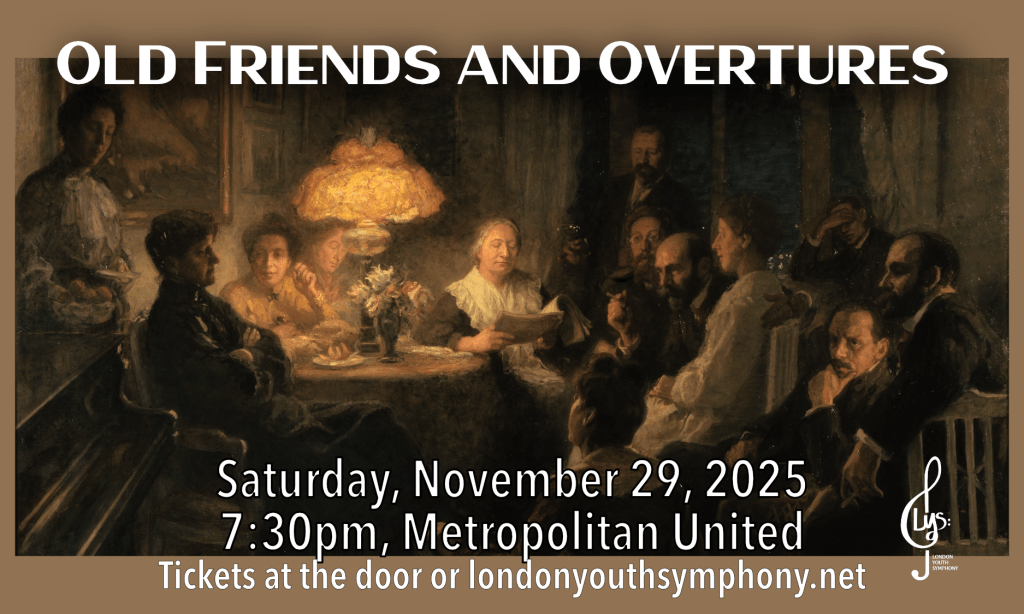
What: London Youth Symphony presents Old Friends and Overtures.
When: Saturday, November 29, 7:30pm.
Where: Metropolitan United Church, 468 Wellington Street, London, ON.
Full disclosure, I took piano lessons without whimpering – but even if I put on a scruffy coat, hunched over, and had unravelling gloves on my hands – I never got into a Glenn Gould state of mind to understand the lure of JS Bach.
But then I found the confession of a man who stuck with music teaching and performance – and explained the appeal of Bach to people with souls!
Ethan Hein is a music technology and music education professor- somewhere – and his personal admission hits the right note. Here’s what he has to say about Bach and his music:
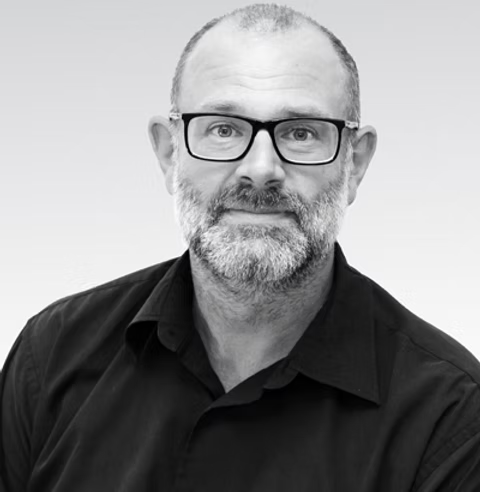
(Pictured: Ethan Hein, The Ethan Hein Blog)
“I’m not a big classical music guy for the most part, but I never get tired of Bach. This stodgy eighteenth-century Lutheran doesn’t seem a likely inspiration for a hipster electronica producer like me. There aren’t too many other wearers of powdered wigs in my record collection, and Bach is the only one in the regular rotation.
Why? When I studied jazz guitar, I was encouraged to learn some Bach violin and cello music. I learned a lot about music theory that way, but I had a surprising amount of fun, too.
Why is Bach’s music so much cooler than anything else of his time and place? There are plenty of beautiful melodies and interesting thematic developments in other Baroque music, but they’re usually buried under tweedly curlicues. I get exhausted from all the jumping up and down between adjacent scale tones.
You never get the sense that Bach is just throwing notes at you to fill the space between ideas. This spare, economic quality shows most clearly in his solo instrument stuff. The single lines spell out both the melodies and the chord progressions clearly, using the spaces between the melody notes to deploy fragments of basslines or arpeggios. Bach gives your imagination just enough data to easily fill in the rest. Leaving notes out is a great way to draw in the listener. It invites us to participate in our heads.
Bach has huge geek appeal. He favored puzzle-like musical forms, canons and fugues, where the melody gets repeated as its own accompaniment. Bach’s music is dense with references and quotations of other works, and of itself. Bach’s love of recursion inspired Douglas Hofstadter to write a whole computer science book about him (and Gödel and Escher.)
Bach was a great quoter of the popular music of his time and place: hymns and regional dances. Since most of the music he was paid to write was for church services, it’s no big surprise that Bach did so much reworking and embellishing of hymns.
You couldn’t ask for a better education in what it means to embellish a theme than to hear Bach’s lines superimposed on the simple hymns. No wonder jazz musicians love him so much; the effect is similar to the way Charlie Parker sounds improvising on a showtune. (Bach was known in his lifetime as an improviser, which adds to his jazz cred.)
There’s something very algorithmic about the rule-oriented forms he wrote in, the canons and fugues, all that complex counterpoint. Every note that Bach ever wrote is on the web in MIDI format. http://www.jsbach.net/midi/index.html His music sounds pretty decent when played by robots (though it’s livelier when it’s played by humans.)
Bach wasn’t very highly regarded in his lifetime outside of a small, devoted circle of groupies. He didn’t hit the cultural big time until a hundred years after his death. He’d probably be amazed now at his elevated stature.” (Ethan Hein)
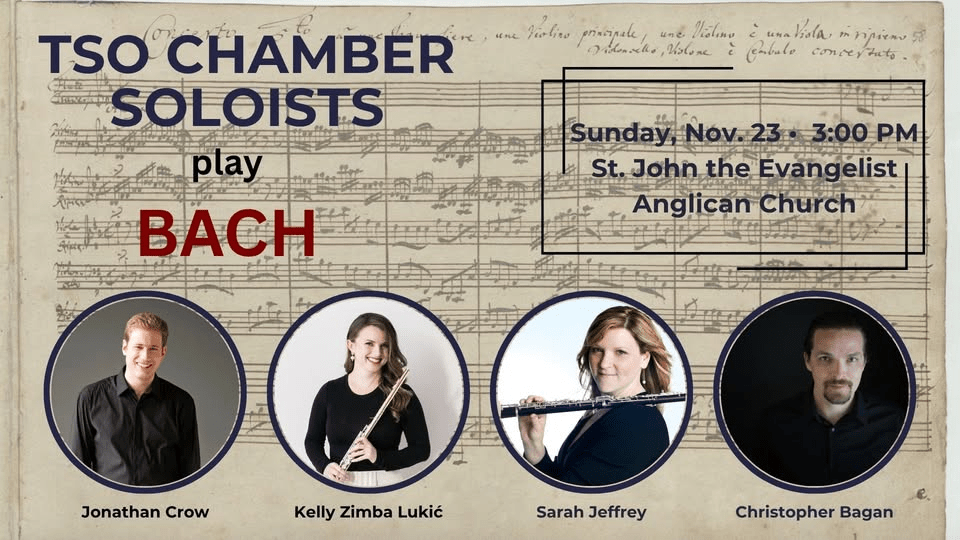
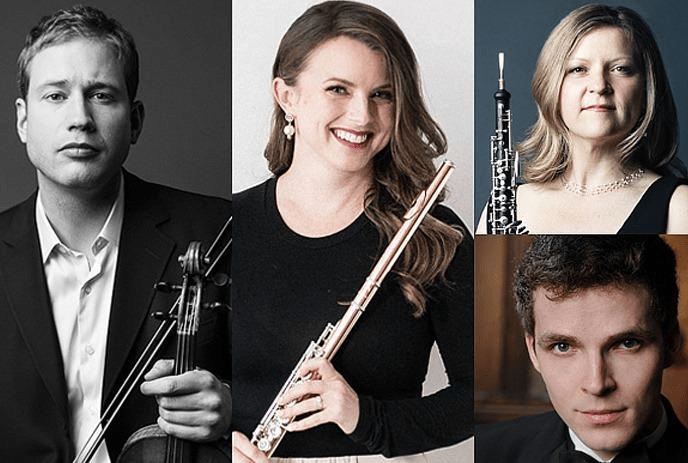
(Pictured: TSO Chamber Soloists)
And who are the musical powerhouses that will be playing Bach on Sunday afternoon?
Their bios with details of performances, awards, and recordings can be found on websites- but what do you NEED to know?
Jonathan Crow is their “curator.” He’s also been the concertmaster of the TSO since 2011, but travels the world concertmastering for other orchestras. He teaches violin at the University of Toronto and is an avid chamber musician – a founding member of the Orford String Quartet.
What is it with oboes and London, Ontario? Sarah Jeffrey is a London girl who plays that instrument superbly. You’ve heard the oboe jokes, haven’t you?
Oboist: Did you hear my last recital?
Friend: I hope so.
Oboe: “An ill wind that no one blows good.”
Sarah, however, has been praised for her “exquisite solo work,” her “luscious tone,” and her sensitive musicianship. She’s Principal Oboe of the TSO, a teacher at the Royal Conservatory, and mom of two kids.
Kelly Zimba Lukic joined the Toronto Symphony Orchestra as Principal Flute in 2017 – but leaves a trail of US orchestras in her debt. She’s celebrated as an innovative and inspiring teacher as well as a performer. Previously a flute fellow at the New World Symphony, she has performed with the Chicago, Pittsburgh, and Detroit Symphony Orchestras.
And Christopher Bagan? He’s another tough one to squeeze into an X (formerly Twitter) post. He’s a Doctor of Musical Arts (specialising in Schonberg) who performs baroque with equal fluency. If you’ve heard the tinkle of a harpsichord at the Canadian Opera Co., it was Christopher.
Is there anything else you should know before you get to the church, on time at 3:00 p.m.? Visit: https://youtu.be/IunEDER6Mws
Only that the Brandenburg Concerto #5 – the piece that will feature the whole ensemble – is incredibly beautiful. The link above leads to a Chicago Symphony chamber performance- but T-Rex Hand Position Up – our Canadian musicians will dazzle!
IF YOU GO:
What: The Jeffery Concerts: TSO Chamber Soloists Play Bach.
When: Sunday, November 23, 2025, at 3:00pm.
Where: St John the Evangelist Church, 280 St James Street, London, ON






















 The Beat Magazine 2025