
By J. Bruce Parker
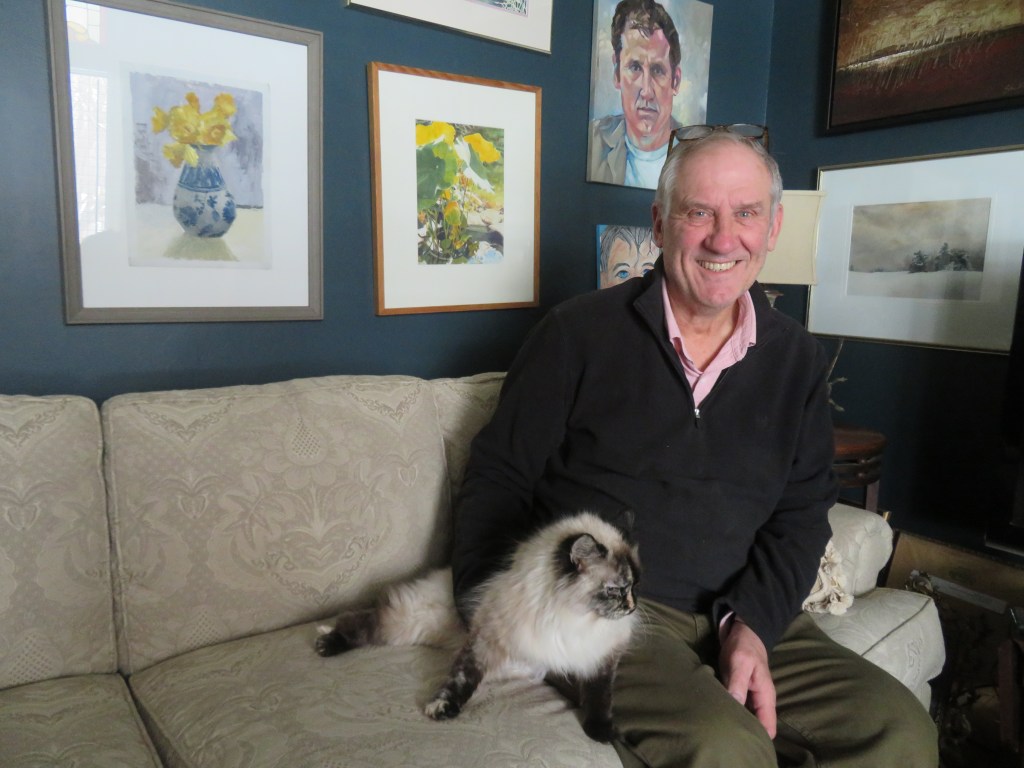
(Pictured: The Palace Theatre’s David Long.)
The Palace Theatre, constructed in 1929 as a venue for silent movies and designated by the City of London in 1991 for its historic or architectural value or interest, remains a focal point in London’s Old East Village for quality theatre. It is the home of London Community Players, London Youth Theatre Education & London Fringe.
This historic venue is divided into two stages, the 75-seat Procunier Hall and the 350-seat David Long Stage.
Often, a stage is named after a beloved but deceased benefactor, actor, producer, or director. However, David Long is still with us, with a 47-year history associated with the London Community Players.
I recently met up with David at his home in East London. Over coffee and banana bread and surrounded by a lifetime’s collection of artwork and plates, we discussed the trajectory of his life.
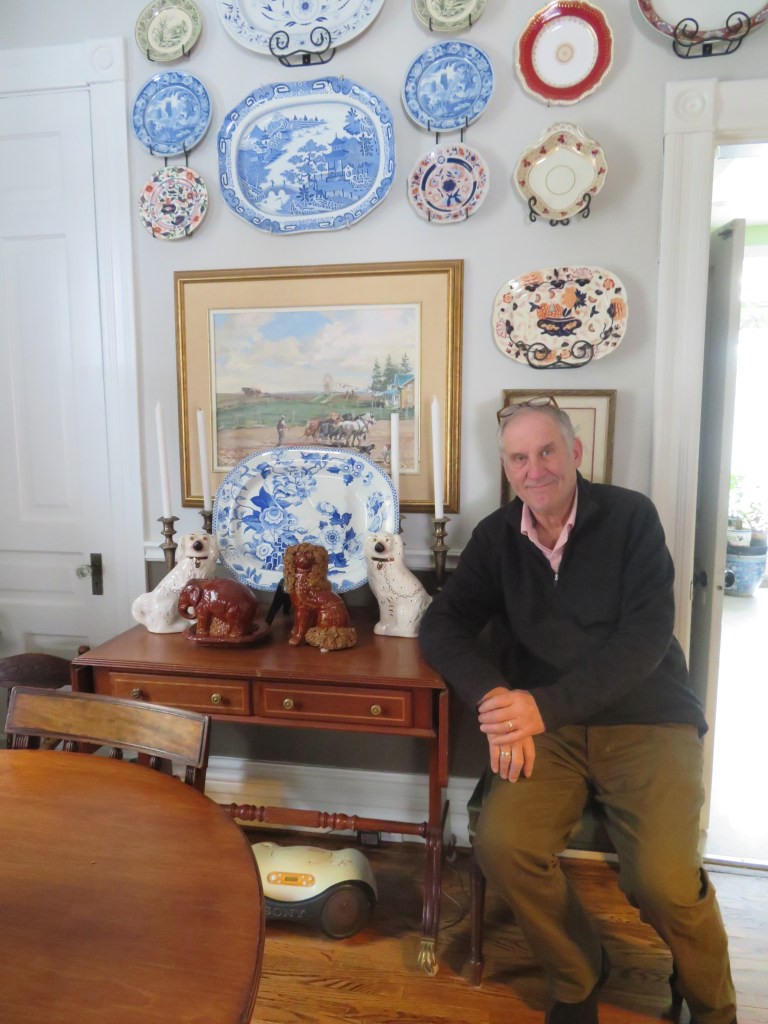
(Pictured: David Long.)
The Long family’s ancestry in London dates back to 1850. At some point, according to David, family members “dispersed around the city.” David’s great-grandparents purchased land in the vicinity of Commissioners Road and Andover Drive. His father established Wood Lynn Farm Market, with various venues in the city. The Longs owned 300 acres of apples alone.
Wood Lynn Farms would become the first ‘pick your own’ orchard in Ontario. A pre-teen David was conscripted to wait at the gate and hand out a flyer to incoming customers, offering smiles as well as both prices and the ‘rules’ of the orchard. No overfilling, and there were trunk checks. At the time, a bushel of apples cost $1.50. This was long before ‘controlled atmosphere storage’ of apples, and so three generations of the Long family were involved during the narrow apple picking season, which would run from September into the Thanksgiving weekend of October. David proudly adds, “They were lined up on Oxford Street.”
David Long stayed true to his original neighbourhood, where his family home was established in 1935, just three houses from the Brick Cemetery. In 2010, ‘Friends of Brick Street Cemetery’ was established to provide guardianship to the eternal home of over 750 souls, and David Long got on board. The first burial occurred in 1813, 13 years before the City of London was established.
The organization researched the names of those under the soil and began repairing and re-erecting tombstones. According to David, “one third of the stones were on the ground, one third were leaning, and one third were still standing.” David was dubbed with the nickname ‘Jigsaw’ as it was his task to reassemble broken tombstones with both cement and epoxy. There was also the painstaking effort to clean the fronts of the stones without diminishing the lettering.
It was at York University in the 1970’s that David enrolled in a theatre program. . His desire to study theatre was built upon his drama experience in high school, which included a role in a production of the classic “Arsenic and Old Lace.”
But a year in university was enough, and he eventually returned to London after a bit of a tenure working in a paint store in Stratford.
It may or may not have been a synchronistic moment, but David’s return coincided with the beginnings of the London Community Players. He had invested a year’s worth of training in drama, and now a new theatre back home was opening.
The genesis of the London Community Players began with former members of ‘London Little Theatre’ as well as some passionate and earnest local actors. Productions began at the Gallery Theatre established at 36 York St. Their focus was Canadian-written plays, and 35 were performed between 1974 and 1978.
David leapt in and was cast in “Norman, Is That You?’ London’s first ‘gay’ play, a work David regards as a “bit of fluff,” but an important piece of theatre in recognizing and accepting London’s gay community. This was 1977, and London Free Press theatrical reviewer, Doug Bale, who could run roughshod over a local production, answered the question “Is London ready for gay plays?” with a resounding “Yes”.
David’s talents were also recognized in his ability to design and create sets. “My one grandfather built houses, and my other grandfather painted houses. I think I get my building skills from one and my painting skills from the other. The theatre discovered that I could build sets, and so that was the end of my acting career.”
As David was settling back into the theatre in his hometown, ‘HALO,’ the Homophile Association of London, Ontario, was establishing itself as a community club at Colbourne and Pall Mall streets. When David came out as a gay man in the late 70s, he had the support of his family, specifically from one of his grandfathers, who stated, “I knew people like that at Beal in the 1920s, and it didn’t bother me then, and it doesn’t bother me now”.
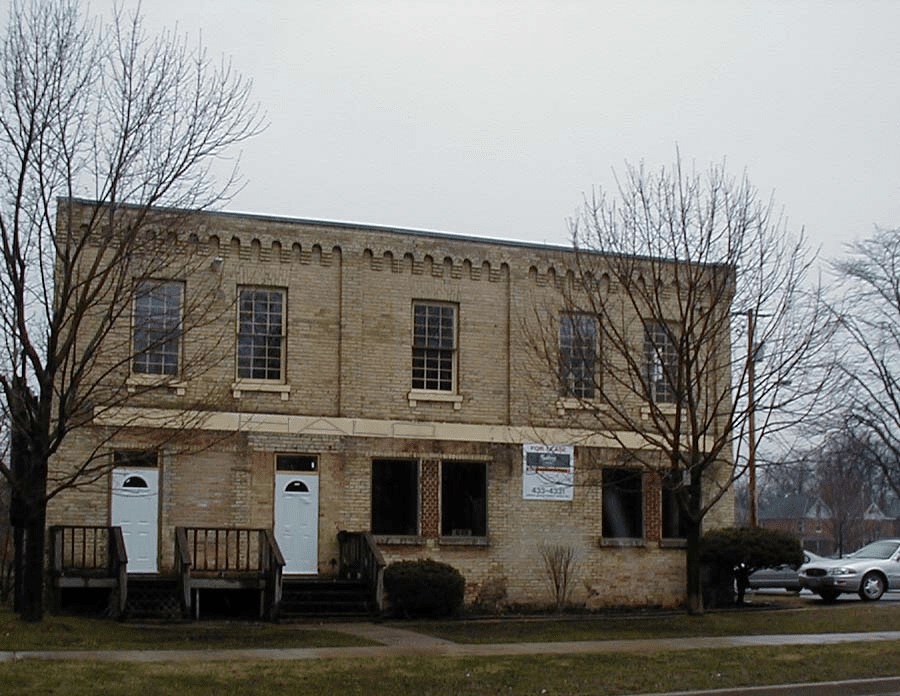
(Pictured: HALO Building, Colborne and Pall Mall Streets, London, ON.)
David eventually became president of the HALO club at a time of social intolerance of homosexuality. He was often the subject of homophobic slurs as he entered the front door, as well as dealing with vandalism in the form of broken windows, which were eventually boarded up. He recalls, “The music didn’t stop, and the dancing didn’t stop, so the club persevered and survived.”
This was a time when the former mayor of London, Diane Haskett, refused to proclaim ‘Gay Pride’ at City Hall as it was against her Christian values. She was eventually overruled by the Ontario Human Rights Tribunal, and the gay pride flag was flown over city hall. The HALO centre was the hub of the largest gay community in Canada, struggling yet surviving.
David recalls, “There were always lineups to get in. We had double-door security to protect our patrons. We always had Western (referring to the University of Western Ontario). The thing with the gay community at UWO was that everyone was here for four years. They would arrive, they came out, came to HALO, and they left when they graduated. There was always this kind of turnover.”
By the early 90s, within the gay community of London, HIV/AIDSwas creeping in. This disease was largely ignored by the media as well as American President Ronald Reagan. made its impact in London.
John Gordon was the first man in London to come out about his diagnosis of AIDS in South Western Ontario, and his death and legacy were the cornerstone of the creation in 1992 of the `John Gordon Home’, a Victorian-style residence on Dufferin Ave, which became a hospice. Tenants were cared for by a team of 30 volunteers (myself being one). The bedrooms of the building were remodelled, offering an individual design to each of the eight. David Long coordinated the renovation. He eventually found himself on the board of the John Gordon Home and was the representative of JGH to the Aids Committee of London. David knew the first residents, the first to arrive and the first to go to spirit.
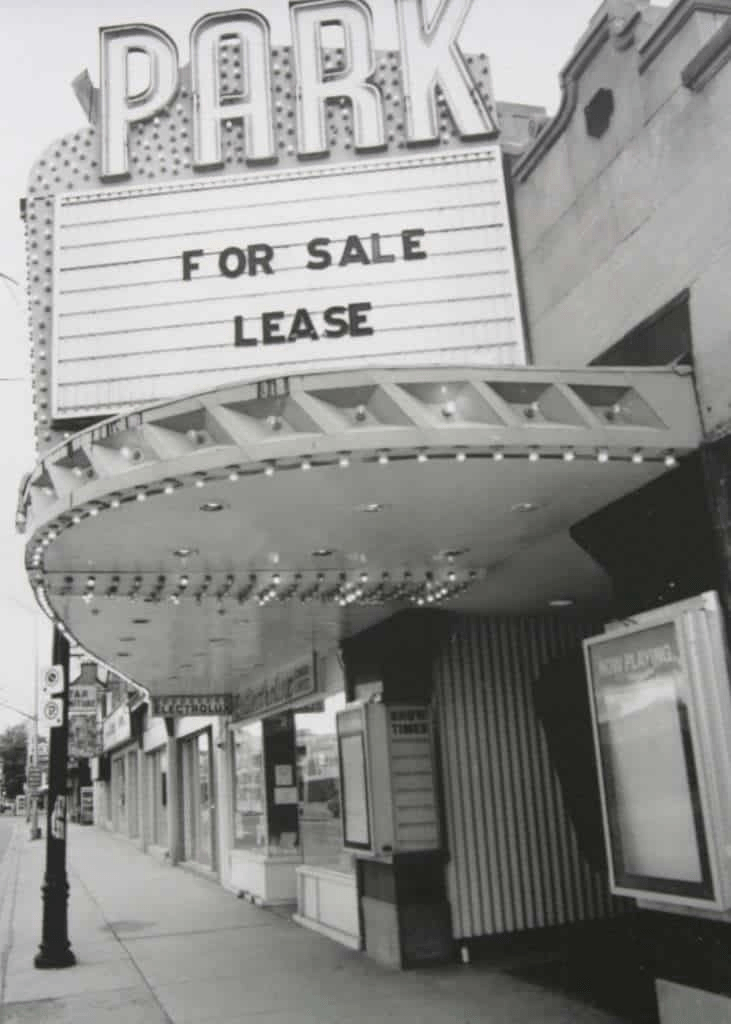
During the same period, the London Community Players were growing. With his long-standing work with the theatre, David became part of the Board of Directors. There was this notion to physically expand the theatre as it grew, but it was David Long who noticed the ‘For Sale’ sign at the Park Theatre in East London. There was an existing stage as well as seating for up to 400 people, and in short order, the deal was closed, and the Park Theatre was purchased in December of 1990.
Renovations happened quickly, with backstage areas including dressing rooms being constructed, with the first play opening in July of 1991.
David reflects. “Looking back over the years, some of the plays we have done there have been mind-boggling.’ He adds, “It is community theatre, but you balance the events. You have people who want the light entertainment, and you have people who want to be entertained, challenged, and educated.”
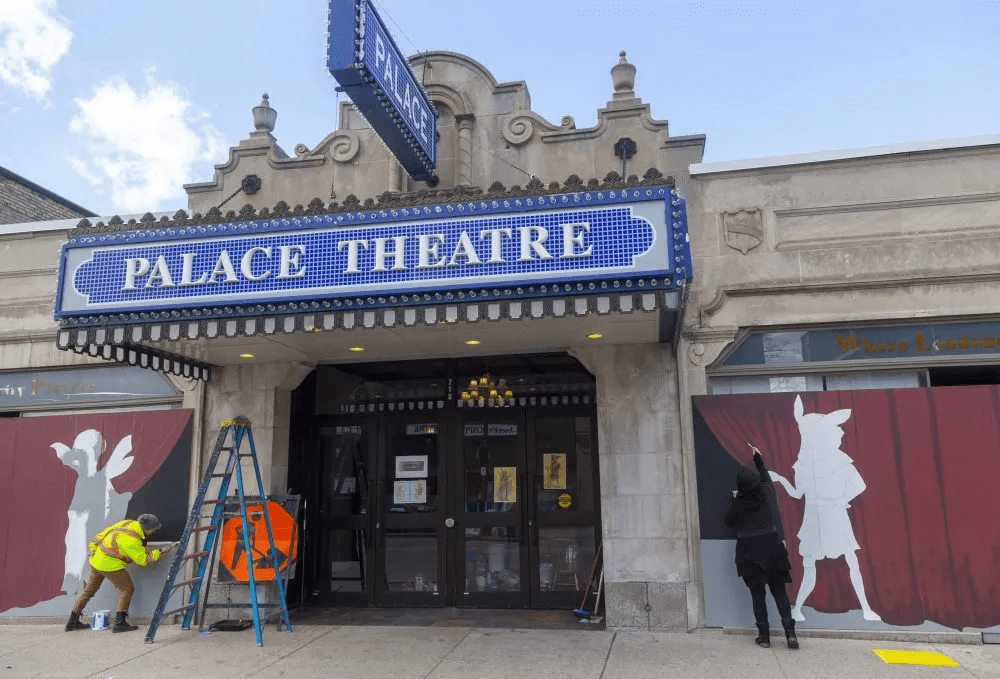
Now in its 51st season, The Palace Theatre continues to present engaging theatre to the London public. But community theatre has always had its challenges.
There is the issue of operating on tight budgets and high production costs. There is a reliance on volunteers, who may come and go. Casting actors has its own issues of scheduling conflicts as well as finding actors with the right skills. You also have to find a balance to produce safe and popular shows which guarantee the sale of tickets up against bringing in challenging and thought-provoking work. Every town and city which has a community theatre is always under this threat.
The Palace Theatre has had its share of added challenges. London has a homeless population of over 2000, and the 700 block of Dundas Steet as David Long calls it is ‘ground zero’ for the problem of homelessness. The plight of vagrancy in London carries the issues of addiction, mental health problems and vandalism, which directly affects the Palace Theatre.
Windows have been broken, as well as break-ins and theft. There is open drug use on the block, which is a deterrent to potential theatre goers.
Providing security is expensive, as hundreds of dollars are required to secure each production, protecting the building as well as safely ushering patrons in and out.
David adds, “The social services provided here are overwhelmed, and the foot patrol can only do so much,” adding, “Theatre used to be in the parks and on the streets, and we just can’t do that now.”
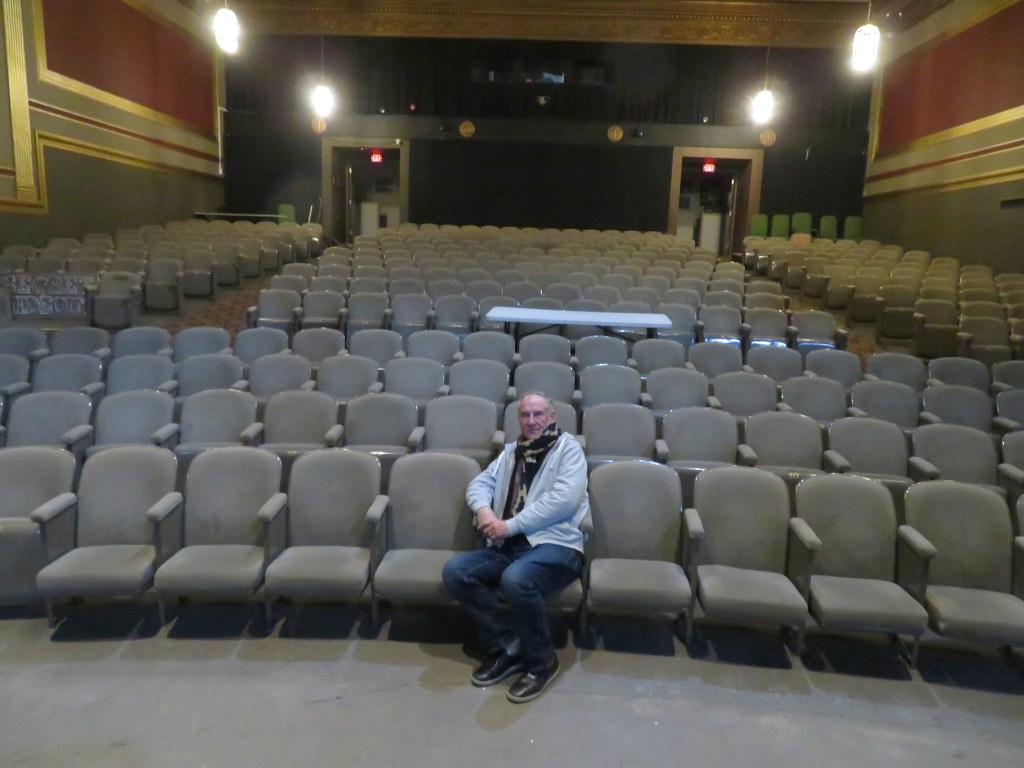
(Pictured: The Palace Theatre’s David Long.)
What is the future for Community Theatre?
“The future is challenging. There are theatre companies always closing down as they cannot adapt, change and survive. We need young people to get involved in theatre in multiple layers,” says David. He adds, “We used to sit and talk on breaks during rehearsals. Now everyone is on their phones. Cell phones are the worst invention which creates distractions from real communication.”
“There is this perception that we are an elite group of people. No, we are just trying to pay the rent and are open to any and all ideas for the stage. Give us something challenging, and we would love to do it. Let’s use Procunier Hall to do create something very ambitious.”
And what would be the ideal piece of theatre?
“Something in Procunier Hall, about 90 minutes long with no intermissions, no breaks, and no lapses with the actors and their connection to the audience”.
He slyly adds, “We shut the door for 90 minutes, and you can’t get out.”
David’s lifelong commitment to Community Theatre is reflected not only in the productions selected for the stage but also in the sets he thoughtfully designed and created. The David Long Stage that proudly bears his name stands as a fitting and enduring tribute to his dedication, creativity, and lasting impact.

To learn more about the Palace Theatre Arts Commons and its productions, visit Palace Theatre Arts Commons | London ON Community Theatre
By J. Bruce Parker
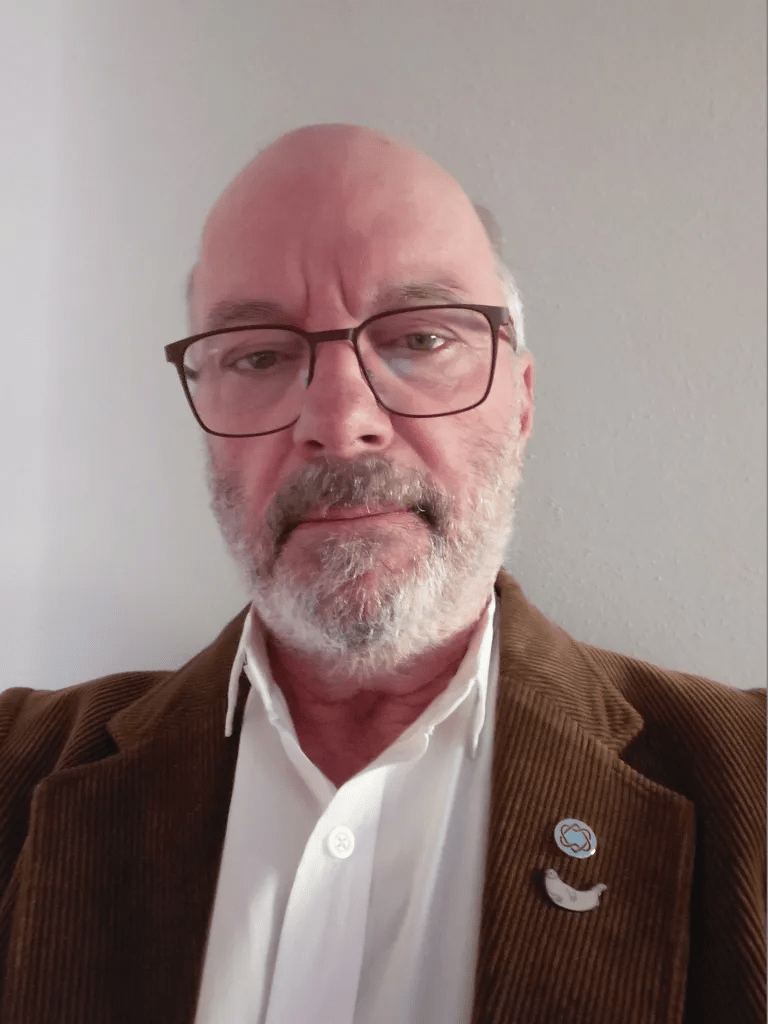
J. Bruce Parker is a retired oncology nurse. As an avid cyclist, he crossed the country by bicycle in 1991 and still explores Ontario’s north via canoe trips. He has published a short story based on his camping experiences.
For over 20 years, as a citizen scientist, he was involved with Monarch Watch, an organization that monitors the annual migration of the Monarch butterfly. He has written about this species and other articles on nature for The Cardinal, Nature London’s quarterly magazine.
For more information about Nature London and The Cardinal, visit https://www.naturelondon.com/the-cardinal/
He is documenting his ongoing friendship with Canadian poet bill bissett, which he hopes to eventually publish.
Bruce has been writing articles for Villager Publications since 2022. To read samples of Bruce’s writing, visit https://www.villagerpublications.com/

 The Beat Magazine 2025