
Previewed by Daina Janitis
The Brahms Effect with Tom Allen, London Symphonia, Saturday, April 18, 2026, 7:30 PM
At a time when the world can feel heavy with noise, how comforting it is to gather for an evening devoted to listening — not only to music, but to the stories that live inside it. The Brahms Effect brings together two artists who understand that sound and story are human languages made from the same yearning: the desire to be understood.
Storyteller, broadcaster, and master communicator Tom Allen has long revealed the hidden pulse beneath great music, helping audiences hear composers not as distant figures but as people alive with wit, frailty, and imagination. Alongside Graham Lord, London Symphonia’s principal clarinetist, Allen explores the clarinet as perhaps the most human of instruments — an instrument that can sigh, laugh, ache, and console, often within a single breath.

(Pictured: Tom Allen.)
Tom Allen is well known to Canadians through his CBC story broadcasts – but did you know?
- He planned to be a professional trombonist and worked hard at it into his late twenties
- By around age 30, he realized that, in his own words, “storytelling and language were where my greatest strengths were,” so his career began to pivot toward radio and narration rather than full‑time performance.
- A formative moment was a 1982 music history class at Boston University with John Daverio, whose vivid, funny stories about composers convinced Allen that classical music history could be anything but boring. That realization—that extraordinary music comes from very ordinary, messy human lives—became the core of his storytelling approach.
- Tom and harpist Lori Gemmell are life partners (married), living in Toronto; their personal partnership is the foundation for the artistic one. Around 2010 they began creating staged shows together that mix storytelling, history, and chamber music, which they themselves started calling “chamber musicals.”
So, the honest answer is he didn’t so much abandon the trombone as discover that his strongest instrument was language. The trombone training, the practicing, and the orchestra life became the soil out of which the storyteller grew.
A native of the Vancouver area, clarinetist Graham Lord has made Southwestern Ontario his musical home as principal clarinetist of both London Symphonia and the Windsor Symphony Orchestra. A sought‑after guest principal with orchestras from Toronto and Vancouver to Winnipeg, Edmonton, Kitchener‑Waterloo, Nova Scotia, and Thunder Bay, he brings a national Canadian perspective to the clarinet’s most human voice.
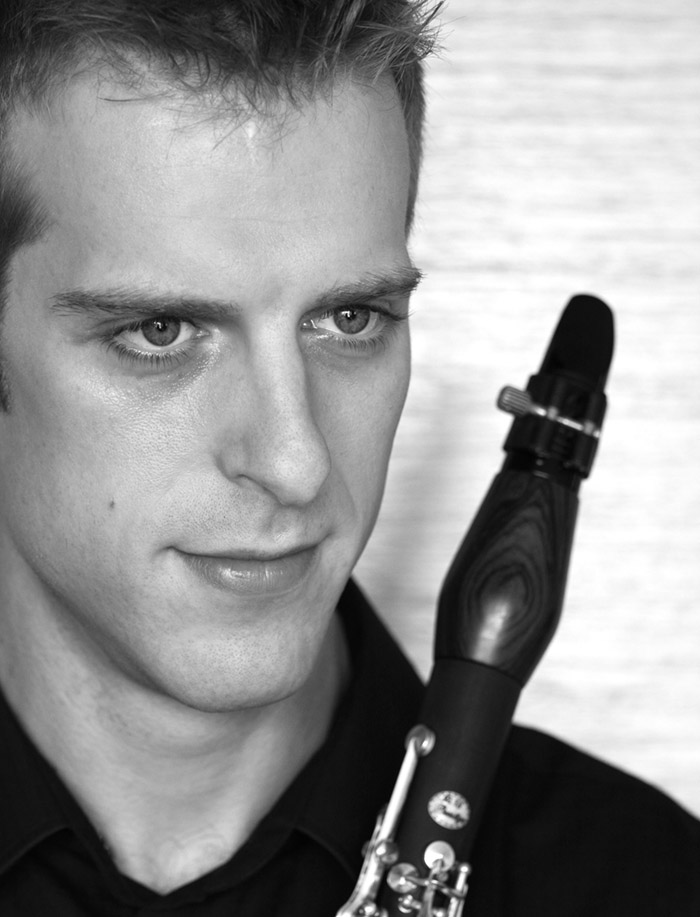
(Pictured: Graham Lord.)
For The Brahms Effect, Graham Lord not only performs but also curates the program, guiding listeners through music that has shaped his own artistry — from the intimacy of Finzi and Mozart to the shimmering urban chorus of Steve Reich and the deep, autumnal glow of Brahms’s Clarinet Quintet.
And what an uncanny gift for curating- as well as performing- Graham Lord has. Tom Allen will involve you in the music before the clarinet begins, and I hope he tells you that Gerald Finzi’s Five Bagatelles for clarinet and piano were composed initially in 1941 as Finzi was drafted into war service. He added to the composition in 1943 and premiered it in London’s (the Big One) National Gallery during the Blitz. The clarinet is heard at its most versatile here – nostalgic, playful, and intimate.
Their program is as emotionally varied as any engrossing story. You’ll be delighted by the lyrical ease of Mozart and the big-city tension of Steve Reich’s New York Counterpoint. Graham’s choices are a musical trip through history, genius, and feeling. Samuel Coleridge‑Taylor’s Clarinet Quintet sets the stage for Brahms’s late‑life masterwork — the Clarinet Quintet in B Minor, Op. 115 — music born from an unexpected friendship with a clarinetist that rekindled Brahms’s creativity and deepened his faith in beauty.
Graham Lord, principal clarinetist and curator of The Brahms Effect with Tom Allen and Andrew Chung, Artistic Producer of London Symphonia discuss why the clarinet is such a magical pairing with the string quartet, the genius of Brahms’ Clarinet Quintet, how Graham chose the repertoire for the concert, and Steve Reich’s rarely performed New York Counterpoint, which creates the texture of a clarinet choir of 11 voices: https://youtu.be/rlJgMLWSFX0?si=YE-TRUe7BtISTgBv
Through Lord’s expressive artistry and Allen’s narrative insight, the concert invites listeners to rediscover what music can do when it’s shared in real time — the way it draws us closer, reminding us of our capacity for empathy, wonder, and joy. By Saturday, April 18th, who can predict the noises of aggression, resentment, and hatred that will be filling our social media and news reports? What lies will we have to decipher and expose?
But in our London, a city that values its creators, The Brahms Effect will offer exquisite music and enchanting stories — a concert that reminds us that art, at its best, recalls to us our most human selves.
IF YOU GO:
What: London Symphonia presents The Brahms Effect with Tom Allen.
When: Saturday, April 18, 2026, at 7:30pm.
Where: Metropolitan United Church, 458 Wellington Street, London, ON.
Tickets: The Brahms Effect with Tom Allen | London Symphonia
Previewed by Daina Janitis.

Why I should NOT be writing about Classical Music for The Beat:
Well, judge for yourself from the photo. I’m 80. I took Latin in high school instead of keyboarding. I am not a performer or a specialist in classical music (a few curling RCM diplomas for Grade 8 and 9 Piano notwithstanding). I played Highwaymen CDs for my kids when they were in the bathtub, and I love Linda Ronstadt songs. I asked for a ticket to the Elvis Presley concert in Maple Leaf Gardens for my 12th birthday, and attended in my choir accompanist uniform, clutching my leather satchel of sheet music. A nerd.
Why I want to Write for The Beat Magazine 2025:
I miss it since the print version retired. I admire its hard-working, eclectic editor, Rick Young, and its many volunteer writers for the kind, informative, and enthusiastic pieces they wrote about our London arts scene.
What I Think I Can Bring:
I taught high school English for thirty-three years- and have been retired for over twenty. Because I was grateful for the people who provided my children experiences and adventures in school music- and in the London Youth Symphony and Amabile – I started volunteering for these heroic people with talents I couldn’t match. I’m on the board for LYS and Magisterra Soloists, I was on the AHMAA board for saving the Aeolian Hall, I assemble newsletters for my union and for the classical music events in London, and I attend every concert I can manage.
But to my mental peril, I have been caught up in the political turmoil of our time. In just the last few months, I’ve read in horror about the denigration of DEI, the turning of the Kennedy Center into a “massage music” emporium, the selling off of public education and public journalism, the incitement of hatred for immigrants, and the finest relief for this anger I feel is in classical music.
What is the source of that solace? It’s a living genius in the musicians who play classical music for us in London, Ontario. Attending a pop music concert is certainly enjoyable, but attending a classical concert is intellectually stimulating and emotionally immersive. It requires sustained focus, careful listening for structure and nuance, and an openness to delayed gratification and complexity. Your emotional responses can be profound and spiritual. The concert offers a contemplative experience, with less overt physical movement and a stronger emphasis on collective listening and silent appreciation. Thank you, London musicians, for the courage you put into your work.


