
Reviewed by Charlotte MacDonald.
“You are here,” and I was somewhere between pride and applause.
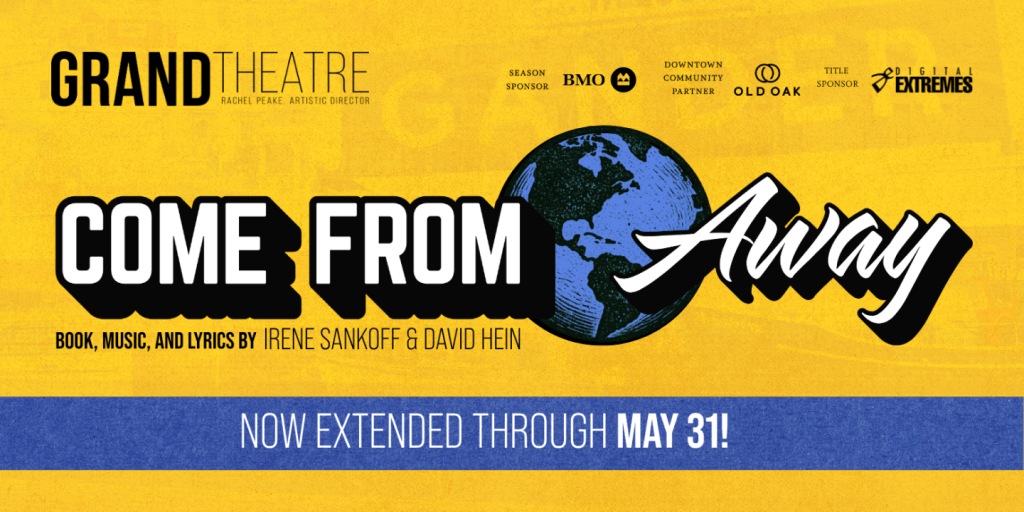
Bringing to life a true story of Canadian kindness and resilience in the aftermath of the devastating tragedy of 9/11, The Grand Theatre’s non-replica production of the Tony and Olivier Award-winning musical Come From Away, reimagined by Canadian director Julie Tomaino, is sure to steal your heart and leave you with a renewed sense of what it means to be Canadian.
The play opens by introducing the audience to the calm, quaint town of Gander, Newfoundland, and its cast of dynamic, unmistakably Canadian characters. Though described through modest landmarks, including a two-person police department, a local TV station and a hockey rink, the town feels small on paper, yet rich with personality on stage. Claude, played by Darrin Baker, the outgoing mayor, Beulah, played by Darlene Spencer, a devoted Royal Canadian Legion volunteer, and Bonnie, played by Denise Oucharek, the local SPCA manager, help bring the community to life on stage. Through natural dialogue, warm banter, and (of course) Newfoundland accents, it becomes clear within moments that these characters are what make Gander far greater than its size.

(Photo: Dahlia Katz.)
As the play enters into a rhythm, the characters move through their day, describing their routines as if reading from diary entries aloud. Everything unfolds as it always does, just another ordinary day in Gander. As an audience member, though, anticipation builds waiting for the moment the news breaks. There on the edge of the world in quiet Gander, it is clear nothing much seems to go on…queue one of the biggest catastrophes of the 21st century.
Suddenly, as news spreads of the attack on their neighbouring country, the locals are facing the order for thirty-eight planes to be diverted to their low-traffic airport. Overwhelmed by the prospect of thousands of people from around the world landing in their small town, with no word on how long they will be staying, the locals quickly spring into action to prepare for the fast-approaching and frenzied arrival ahead. In a flash of lightning, 7,000 displaced passengers begin to arrive on the doorstep of this small Canadian town, doubling its population overnight.
Filled with music and complex characters, Come From Away shows the world the power of kindness in times of tragedy. As a Canadian, you can’t help but feel pride for the glowing examples set for us by our own people, as they show more compassion than was ever asked of them and deeply alter the trajectory of thousands of people’s lives for the better, without ever expecting anything in return.

(Photo: Dahlia Katz.)
The cast remained fixed at 12 tightly knit actors, weaving in and out of each other’s stories as they played dozens of distinct characters, with many actors doubling or tripling their roles. Most frequently, the cast would switch back and forth between playing the locals of Gander and the “plane people” who have “come from away.” With the most minor costume changes, you would expect this back and forth to be confusing, and yet each actor’s rendition of their character was so distinct that following along felt completely intuitive. This was probably one of the most impressive aspects of the production to me, as the cast seamlessly transitioned between very distinct characters in a way that felt so natural and clear that you automatically knew who was who.
A standout in this regard to me was Izad Etemadi, a cast member who played two very distinct “plane people.” One of his characters was Kevin T., an eccentric and humorous gay man who had arrived in Gander with his partner Kevin J., played by Alex Wierzbicki (yes, they are both named Kevin). His other character was a quiet, serious, and aloof Muslim man who spent most of his time alone and distancing himself from the others. These two roles contrasted in performance so greatly that I did not even notice until a third of the way into the performance that the same actor played them. Etemadi’s performance as a Muslim man also brought forward serious topics of racial and religious discrimination, representing the realities many would have faced during this period.

(Photo: Dahlia Katz.)
Something I enjoyed about this performance was how it had constant contradictions. The play did not try to frame this as a perfectly happy and heroic story where kindness completely erased the horror and made it all okay. Instead, it allowed for nuance, showing that multiple experiences can be had at a single time. Rather than representing a linear story, it had a range of emotions where fear turned into gratitude and happiness bled to guilt as people grappled with the rawness of their emotions in the face of complex tragedy.
Touching on topics of loss, grief and identity, Come From Away’s message continues to ring through to today as people continue to grapple with these experiences. A beautifully true Canadian story, it reminds us that the only antidote to inhumanity is humanity itself.
Reviewed by Charlotte MacDonald.

Charlotte MacDonald is a Creative Writing and History student at Western University. She currently writes about theatre, pop culture, and campus life for The Western Gazette, works as a Digital Intern at The Walrus, and hosts a radio show at Radio Western. Growing up in Toronto, theatre has always been a staple part of Charlotte’s life, and she has come to greatly enjoy engaging and contributing to the theatre community through her writing.


