
by Richard Young
This is the fourth in an ongoing series in which The Beat Magazine 2025 takes readers “Behind The Scenes” to meet the talented creative individuals who make the London area such a vibrant arts and culture community.
In this segment, Richard Young conducts a Q&A Interview with London freelance writer Izzy Siebert.

Q. Could you provide me with some basic biographical information – Where were you born? Where did you go to school? Have you always resided in London?
I grew up north of London in the small town of Clinton. There isn’t a theatre scene in Clinton, but it’s close to Blyth and Goderich, so I was lucky enough to get involved in community theatre there, especially thanks to my Grandpa Siebert, who built sets, acted, and was my intro to the stage.
I came to London for university and got my undergrad in English and Psychology at Brescia University College (formerly a Western affiliate), plus a Marketing Diploma at Western Continuing Studies. I really liked London and had begun to take root in the creative community, so I decided to stay. Now, I work for Tourism London and promote the arts, culture, and events that I love about the city.
Q. What attracted you to a career in writing, especially as it relates to arts and culture?
I’ve been writing creatively for as long as I can remember, from short stories as a kid to longer works as a teenager and then poetry as my main creative form for the past several years. Capturing an experience or story and finding the best way to transmit that feeling to others is something that I don’t think will ever stop interesting me. In a way, I’ve always been a writer and an actor, so combining those passions by writing about art seems almost inevitable.
Q. What label best describes you – Part-time Freelance Writer, Full-time Freelance Writer or other?
I am a casual freelance writer, although my day jobs have always included lots of writing. I write creatively and about theatre on the side but wouldn’t be interested in pursuing it full-time since that feels like a recipe for burnout for me. Although I enjoy writing, I don’t always find it easy! It’s more enjoyable to keep it as something I do for fun, rather than something I have to do.
Q. What specific jobs have you held as a writer?
My first writing role was a co-op placement at Clinton’s little local newspaper. As high school co-op placements go, it was an exciting one. I spent my days writing stories about events and businesses in town and even a few features about local theatre productions. It was a thrill to see my writing published.
My first communications job was for the Municipality of Central Huron, where I continued submitting stories to Clinton’s newspaper about community projects. In London, I’ve worked for the Old East Village BIA, St. Joseph’s Health Care, and now Tourism London—all involving writing in various capacities. These days, it’s a lot of social media captions, email newsletters, and website blogs.
Q. Could you tell me about your role in ON Criticism: The 2025/2026 Theatre Critics Lab and Intermission Magazine?
Being part of Intermission Magazine’s ON Criticism 2025/2026 Theatre Critics Lab was such a neat opportunity. Led by Karen Fricker (Editorial Director) and Liam Donovan (Senior Editor), the cohort included emerging and established critics from throughout Ontario. For several months, we met to hear from guest speakers, gain insight into four feature productions, and discuss writing criticism. We had the opportunity to publish a few pieces on Intermission’s website, and these marked my first professional theatre coverage.
My participation encouraged me to become more serious about writing, since before that I sort of just fell into theatre writing. I decided to write a review blog after seeing The Game’s Afoot at the Palace in 2023, and that got me started on reviewing each of their seasons since, but I never had any formal criticism training or mentorship. Theatre writing had been a very solitary practice for me up until ON Criticism, so it was exciting to talk with others about their crafts. I especially appreciated our many discussions about the purpose and ethics of theatre criticism.

Q. I notice you write Reviews for professional and community theatre productions. Is there a difference in how you approach each review?
Reviewing professional productions is still very new to me. Experience, time, and budget give artists more room to play, so it’s important to engage with professional theatre as professional theatre and community theatre as community theatre, considering the capacity they have to create. Which isn’t to say I can’t be surprised by the quality and choices made at both levels!
In professional productions, I find that there can be rich material to dig into, especially on the design side of things, so I enjoy taking a more artistic and analytical perspective in those reviews. I also feel freer in being critical of professional productions since criticism can be valuable feedback as people seek to improve their creative craft.
Q. In a recent Facebook post you revealed that in addition to your writing, you are currently involved with a staged reading of Odesa Company’s Neon Gaslight, this year’s Western Summer Shakespeare’s production of Love’s Labour Lost, and dancing in the ensemble of the Palace Theatre’s production of The Great Gatsby in the fall. Can you tell me about each of these endeavours?
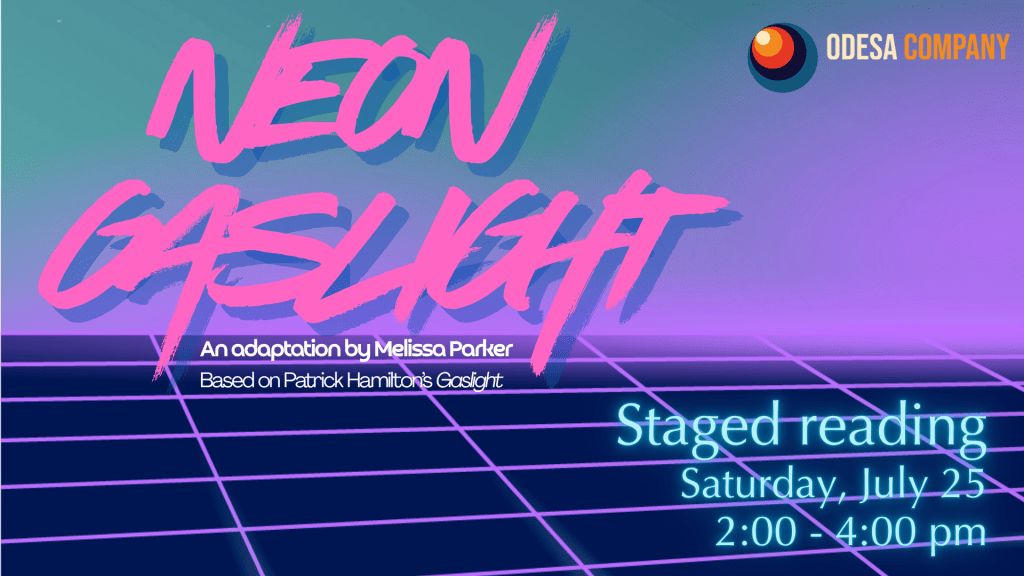
My friend Melissa Parker is reimagining Patrick Hamilton’s 1938 play as Neon Gaslight, putting an 80s twist on the story where the term ‘gaslighting’ originated. I play Liz, the main character’s daughter, in a staged reading on July 25. It’s been exciting as both a writer and a performer to peek into the process of reworking a script. It’s unsettling how much of the domestic horror in the story still feels relevant. Watching the script develop over several months has been a really interesting process, and we’ve been encouraged to add our own notes. I need to dig into the latest draft ASAP!
This is my fourth year being involved with Western Summer Shakespeare and it’s one of my favourite summer traditions in London. I love the whimsy and challenges that come with performing outdoors in a garden on campus. This is the first year I get to play a character with a ton of agency and confidence. Often Shakespeare’s women end up silenced, so it’s very fun to speak my mind as Francesca (originally the Princess of France) in Love’s Labour’s Lost.

For The Great Gatsby at the Palace Theatre, I’m in the ensemble where we’ll be partying and dancing at Gatsby’s house. I’ve never been involved in a show where I haven’t had lines to memorize, so it’s a different kind of homework. I wouldn’t consider myself the most coordinated dancer, but I’m looking to learn and excited to be a part of things.

Q. Obviously, you like to stay busy. What do you do in your spare time for fun?
I love London’s poetry scene. Theatre reviews magically combine my passions for writing and performance, but spoken word perfectly blends those loves too. Acting is about telling someone else’s story, and poetry, for a lot of people, including myself, is about telling your own story, so it’s a fun pairing.
Q. Who is the most famous person you have interviewed and/or written about?
I recently interviewed Sara Farb about her play Love Us Most, which premiered at Here For Now Theatre in Stratford! I had previously seen her act onstage at Stratford, and when the Festival screened Shakespeare plays during the pandemic, which really ignited my love for Shakespeare. It was nerve-wracking but also incredibly neat to speak with Sara about a show she had written.
Q. What is the most memorable performance you have reviewed?
This year so far, I really loved The Importance of Being Earnest at the Grand Theatre! It was just a phenomenally fun show. I was grinning the entire time, and as we left the theatre, all I could think of was how entirely fun the show was. But I can’t write a review just saying, “this was fun!!!” I have to dig into what exactly I liked about it. So, it was an enjoyable challenge to try to talk about a joyous feeling in a grounded way.
Q. Dog or Cat?
Dog!
Q. Beer, Wine, or Cocktail?
Cocktails, but I’m pretty picky with my drinks.
Q. How do you approach reviewing a show you disliked?
As someone personally involved in theatre, I have an immense amount of love for the people who create it and respect for the passion every artist has for their project. Sometimes this becomes a personal challenge when wanting to bring an authentic perspective to how I write about shows.
It’s something I wrestle with all the time, especially given how many theatres are struggling financially. It’s about finding balance and believing that there is something in every show worth celebrating. Then it’s about finding that thing and how to share it, while acknowledging aspects that might not have worked for you in the production. Sometimes what doesn’t work for me works for others.
Q. Are you a morning person or a nighthawk?
Night owl, which works well as a theatre reviewer. I can come home after the show and brain dump my initial thoughts before heading to bed and settling in to write the next day.
Q. Where do you see yourself ten years from now?
Even more deeply immersed in London’s theatre community! I’ve been publishing across various blogs for the past couple of years, but this summer I just started my own Substack (IzzaReview) so this coming theatre season I can dig even more seriously into review writing. It feels like a big step and one I’m excited about.
Q. How did you feel about answering these questions?
I’ve more often been the interviewer than the interviewee, so definitely a new experience!
Q. Is there anything else you think our readers should know about Izzy Siebert, the writer, and Izzy Siebert, the person?
Honestly, it can be hard to separate the two. I would say Izzy the writer ends up much more confident and eloquent than Izzy the person. I’m better with an editor… but aren’t we all!
Interview conducted by Richard Young, Publisher & Content Manager, The Beat Magazine 2025, July 8, 2026.


