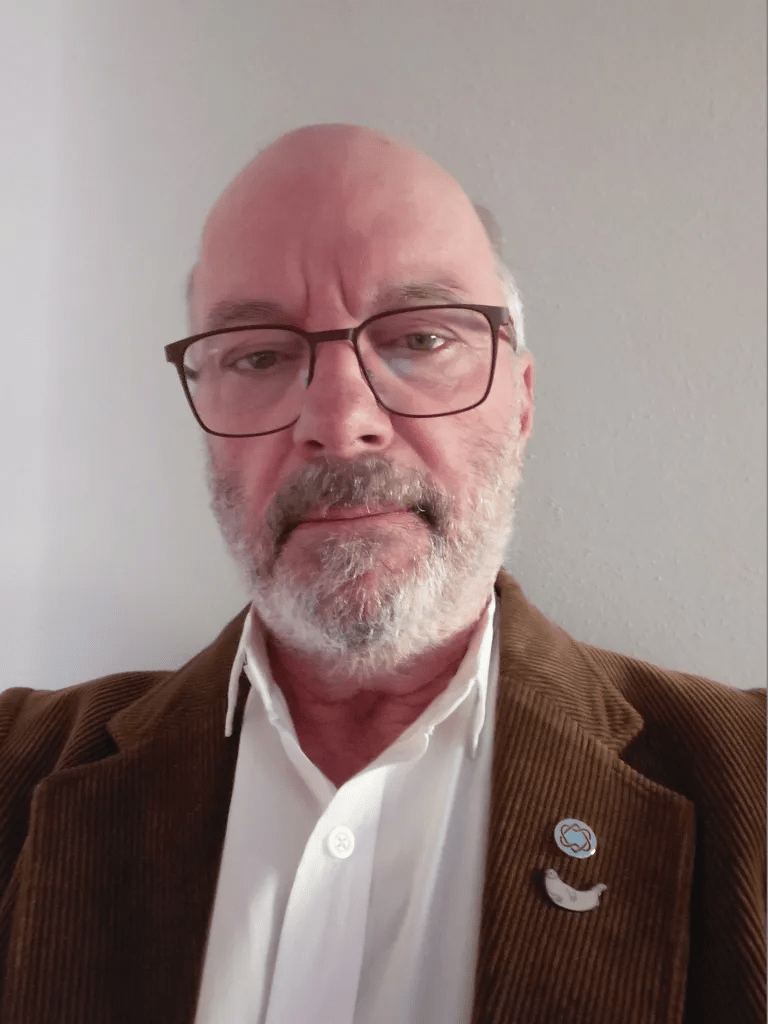
This is the first in an ongoing series in which The Beat Magazine 2025 takes readers “Behind The Scenes” to meet the talented creative individuals who make the London area such a vibrant arts and culture community.
Beth Stewart profiles visual artist Laura Woermke.
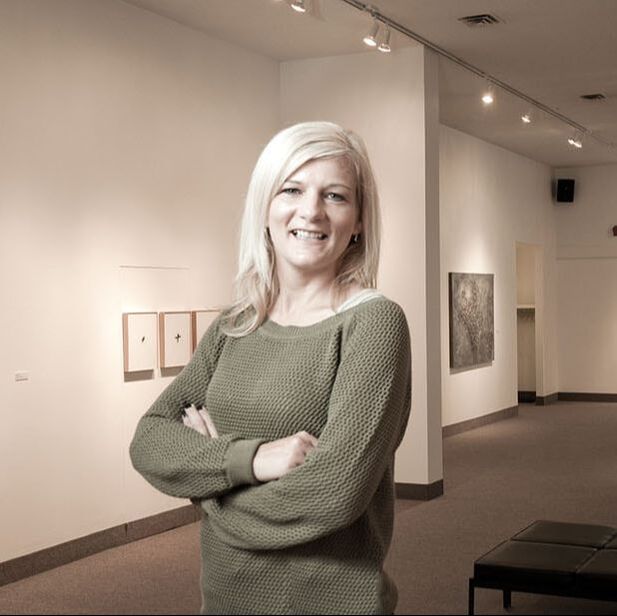
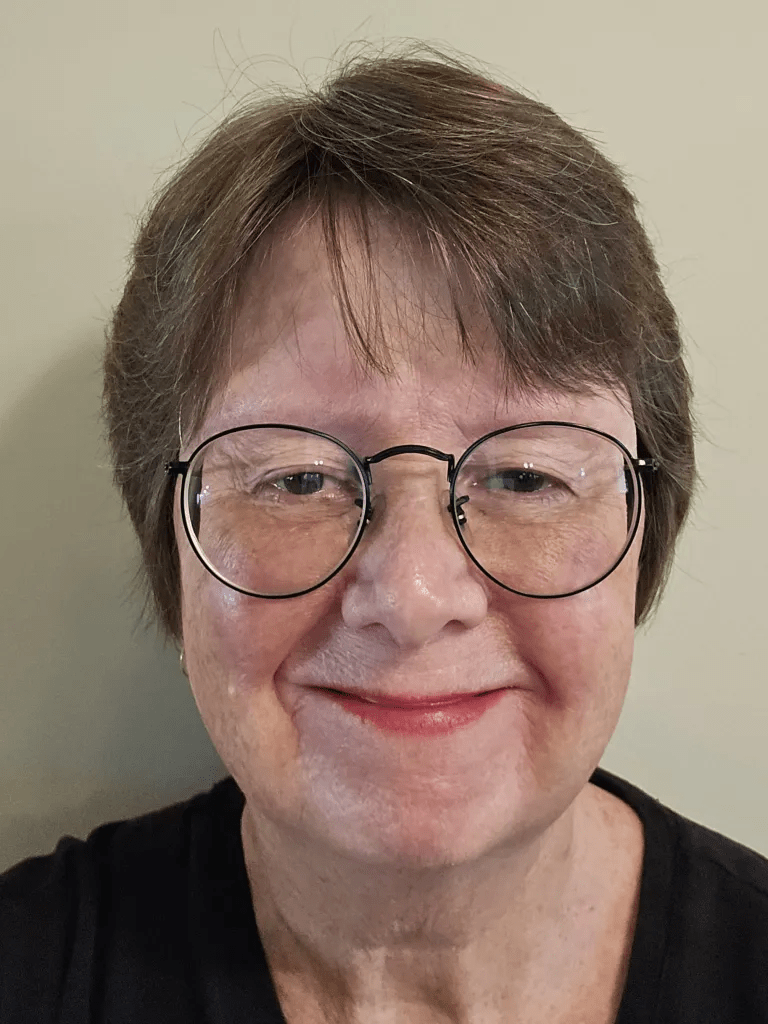
(Pictured: Visual Artist Laura Woermke.)
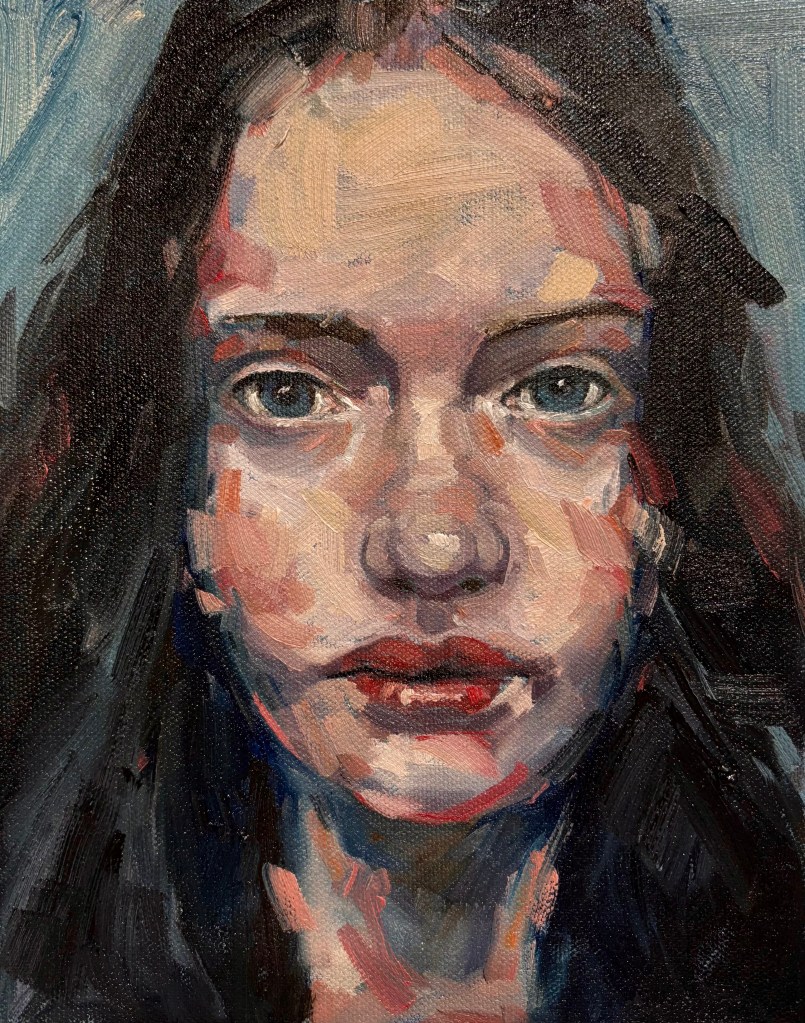
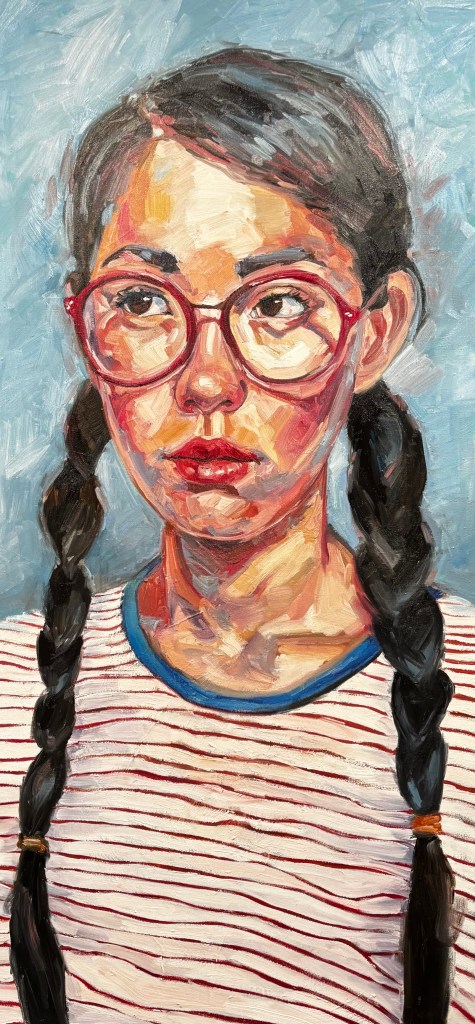
Laura Woermke is an artist who eschews traditional portraiture to capture on canvas what she describes as “moments of introspection, vulnerability, and resilience.” Her figurative works are immediately recognisable for their bold, expressive style.
(Laura Woermke, “Sarah”, oil on canvas, 10 by 8 inches, 2026.)
An intuitive painter, Woermke employs visible brushwork and layered colour to portray her subjects. It is an approach that solicits visceral connections from her viewing audience.
She says she is driven to create because painting is how she makes sense of the world. Woermke explains, “Every painting begins with a question rather than an answer, and the process itself becomes a form of discovery. Each painting is an opportunity to explore what it means to be human.”
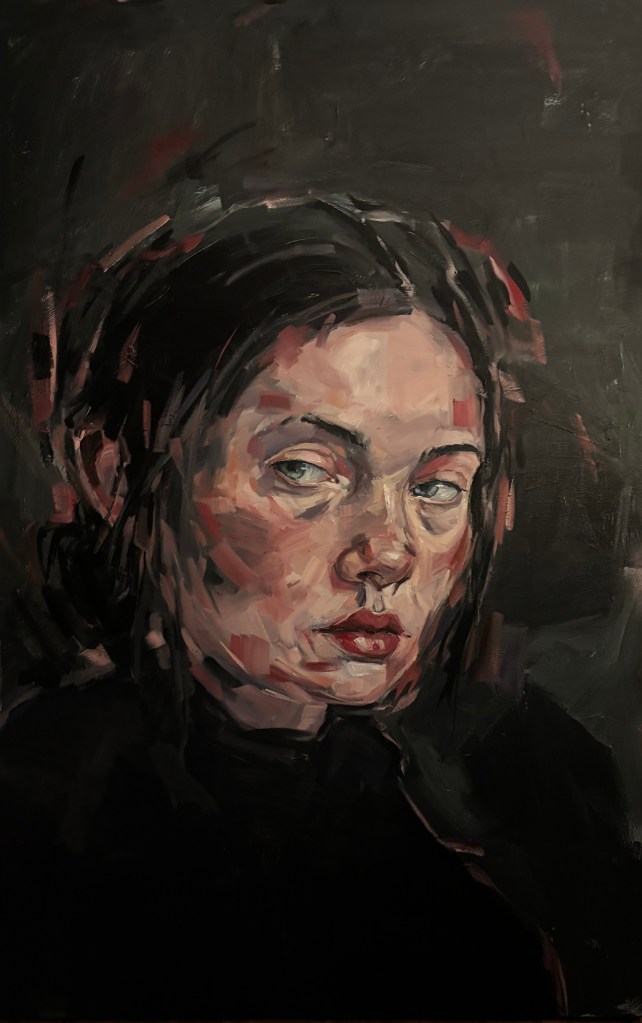
(Pictured: Laura Woermke, “Trapped”, oil on canvas, 48 by 24 images, 2026.)
Woermke’s artistic journey began at Fanshawe College and led to the University of Windsor, where she earned her Honours Bachelor of Fine Arts in Printmaking. This background is important as it is through printmaking that she learned the expressive value of mark-making and layering that is so evident in her paintings.
Laura Woermke’s painting “Soft Armour” is currently on display in the 2026 Kellogg’s Art Competition.
(Visit the 2026 Kellogg’s Art Competition to see Laura Woermke’s 48-by-30-inch oil on canvas, “Soft Armour”.)
In addition to her studio practice, Woermke is the Executive Director and Curator of the St. Thomas-Elgin Public Art Centre. She sees her own work and her role in the arts community as deeply connected. Whether in the studio or the gallery, her goal is to create meaningful experiences that encourage conversation, reflection, and connection.
To learn more about Laura Woermke, visit her online at www.laurawoermke.art or on Instagram @woermke
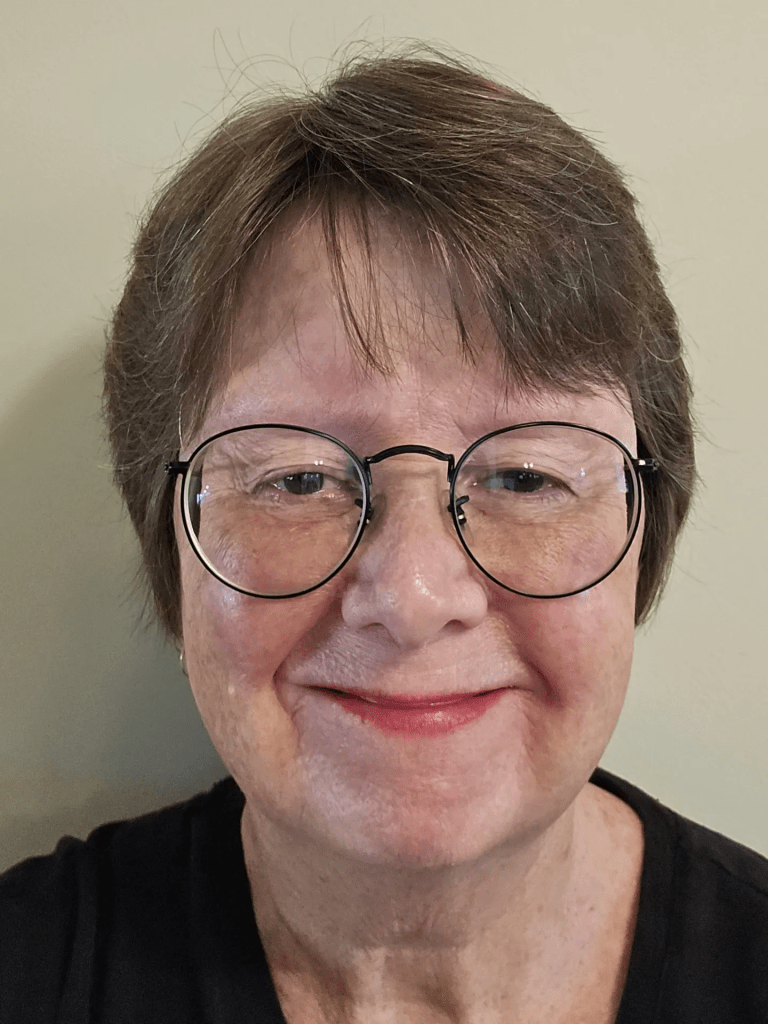
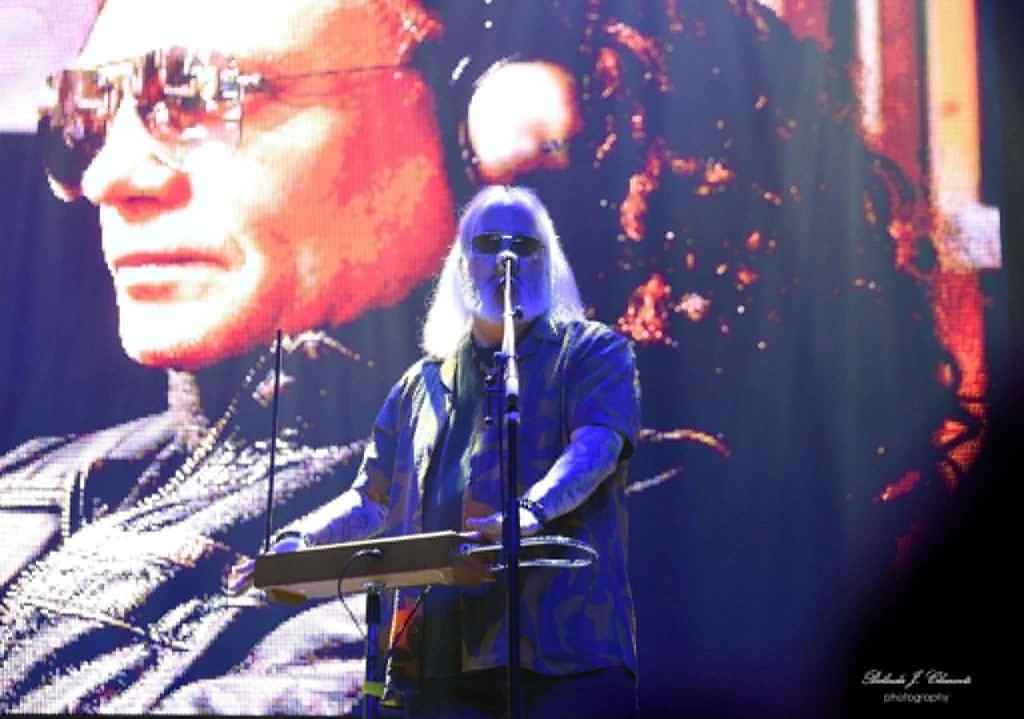
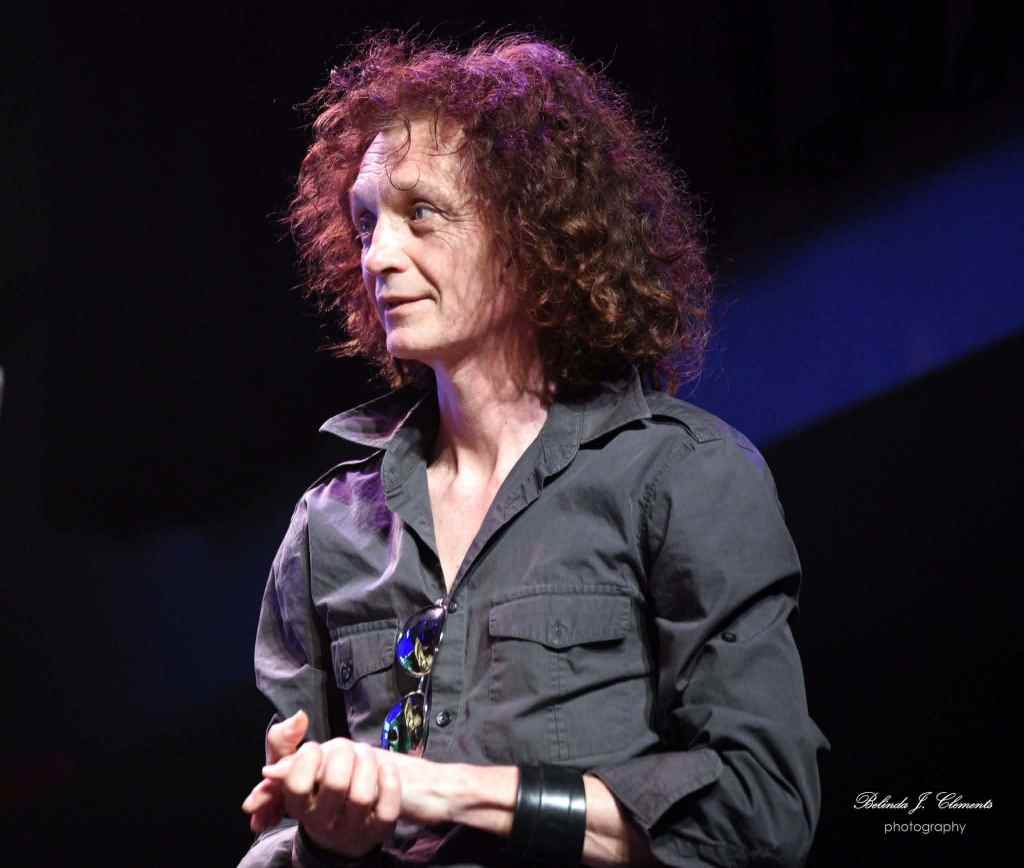
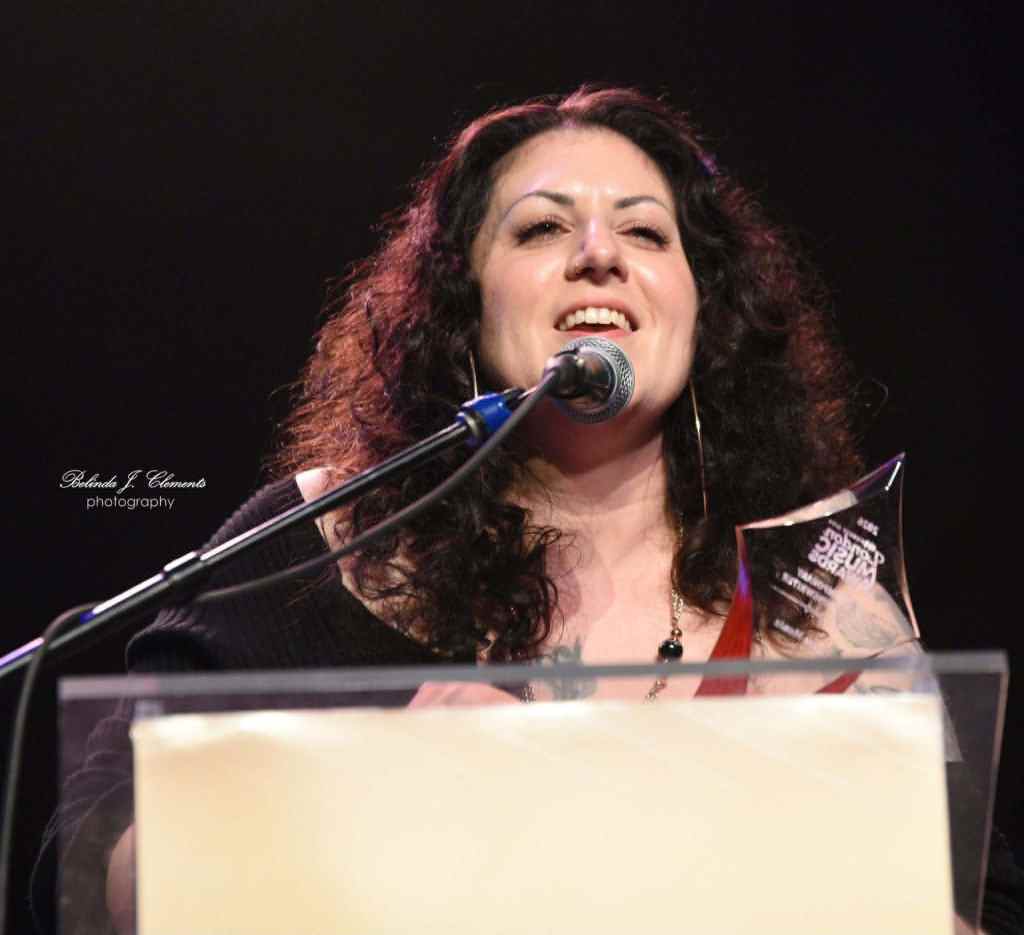
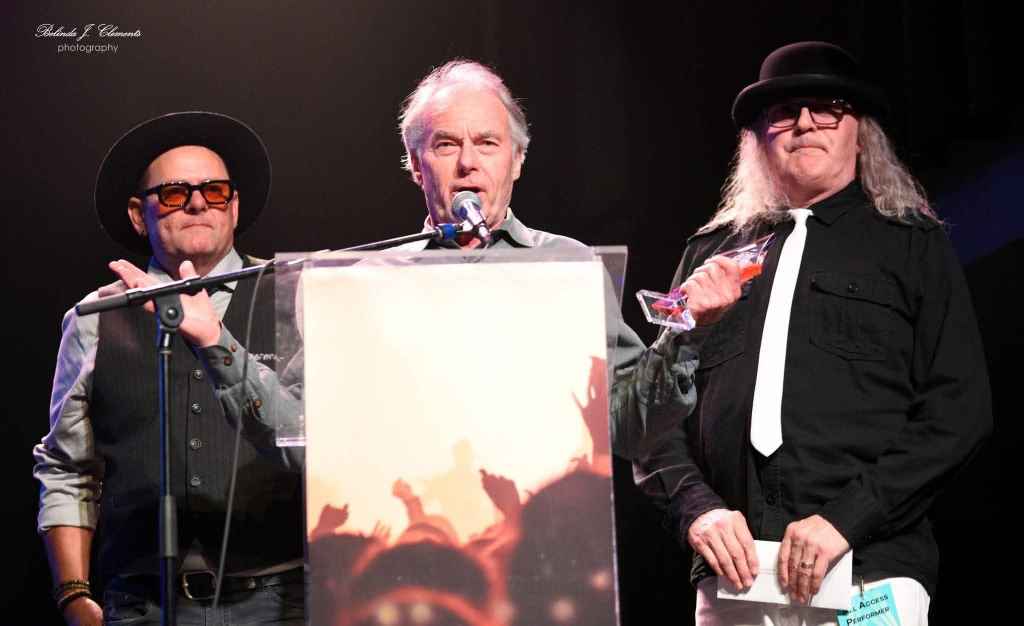
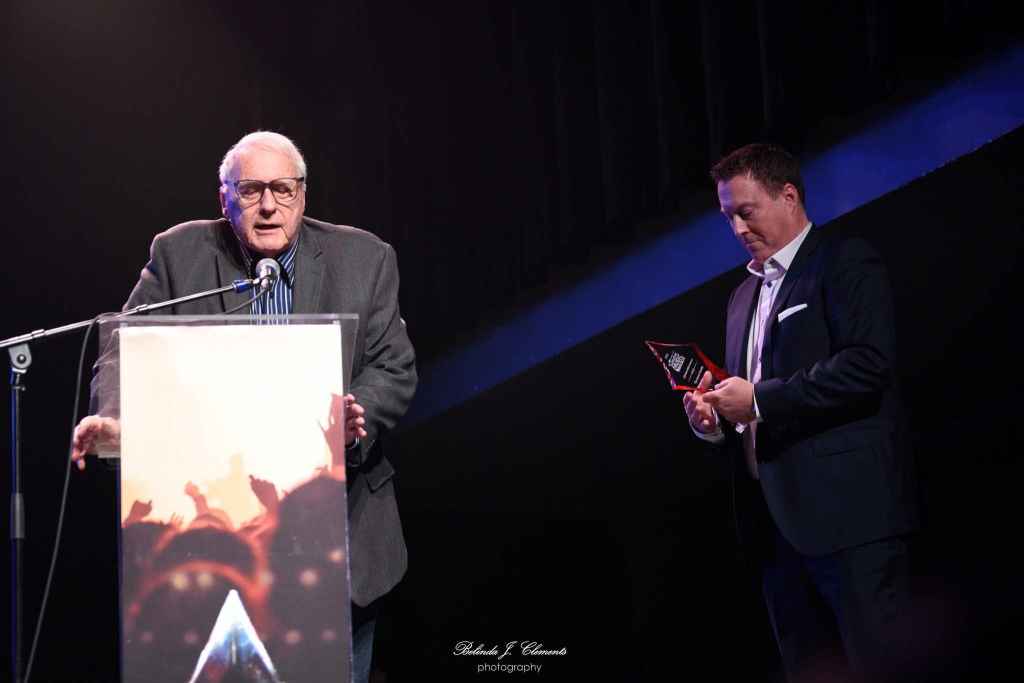
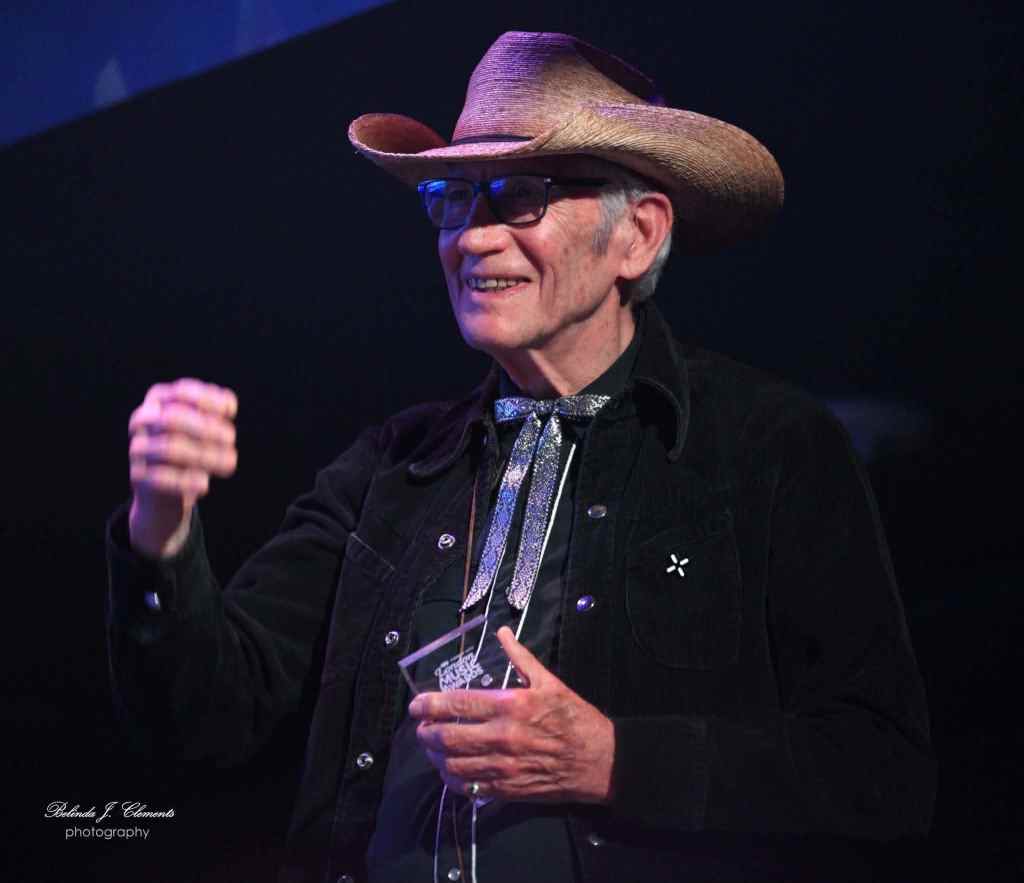
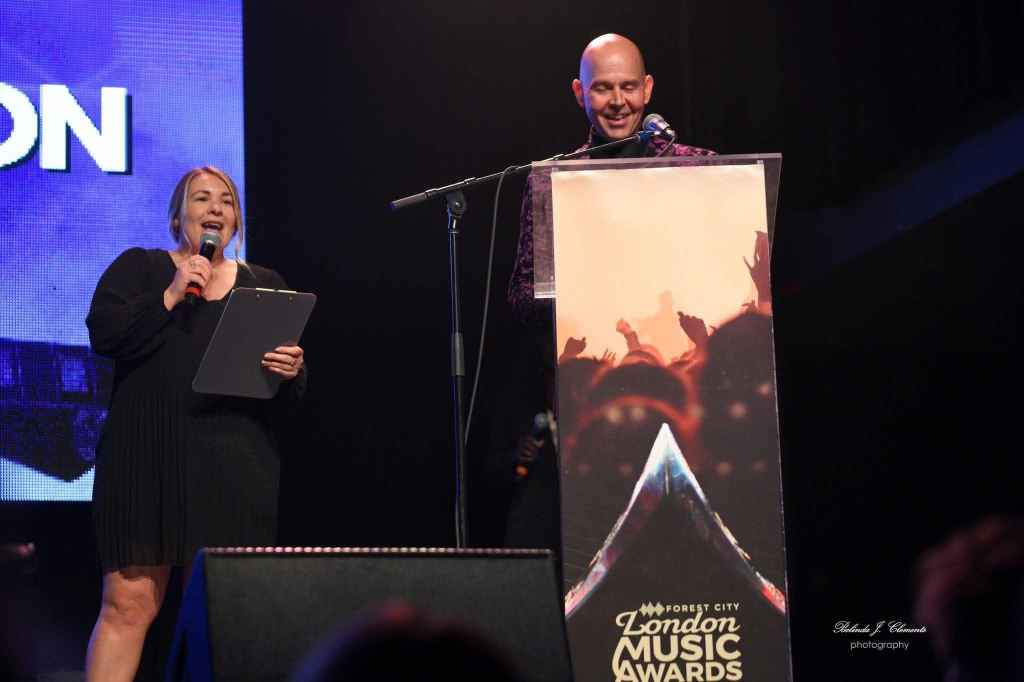
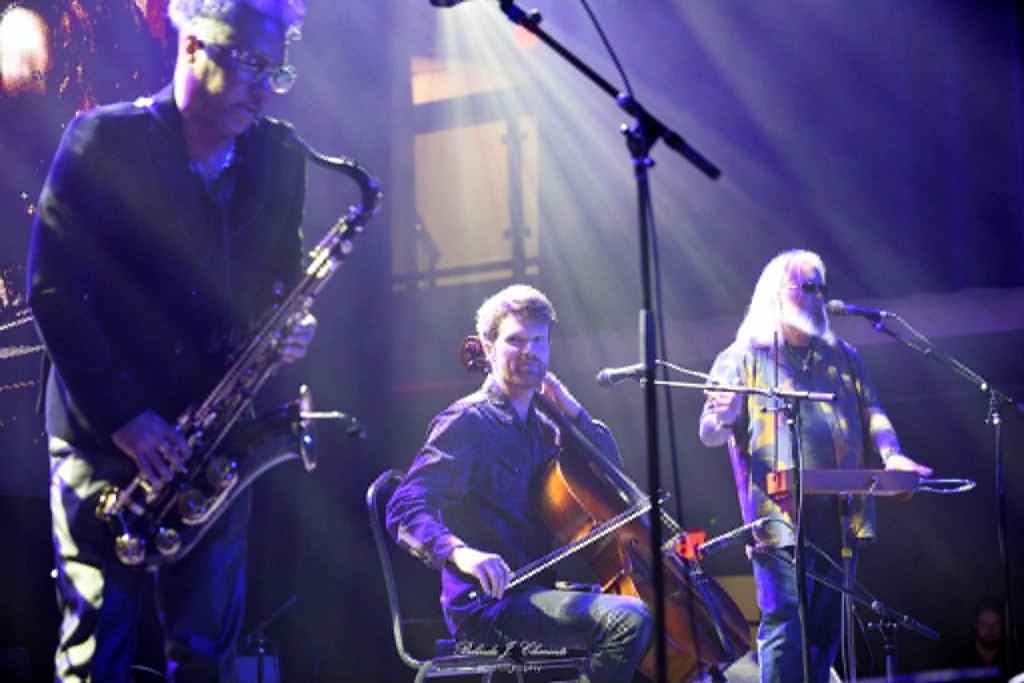
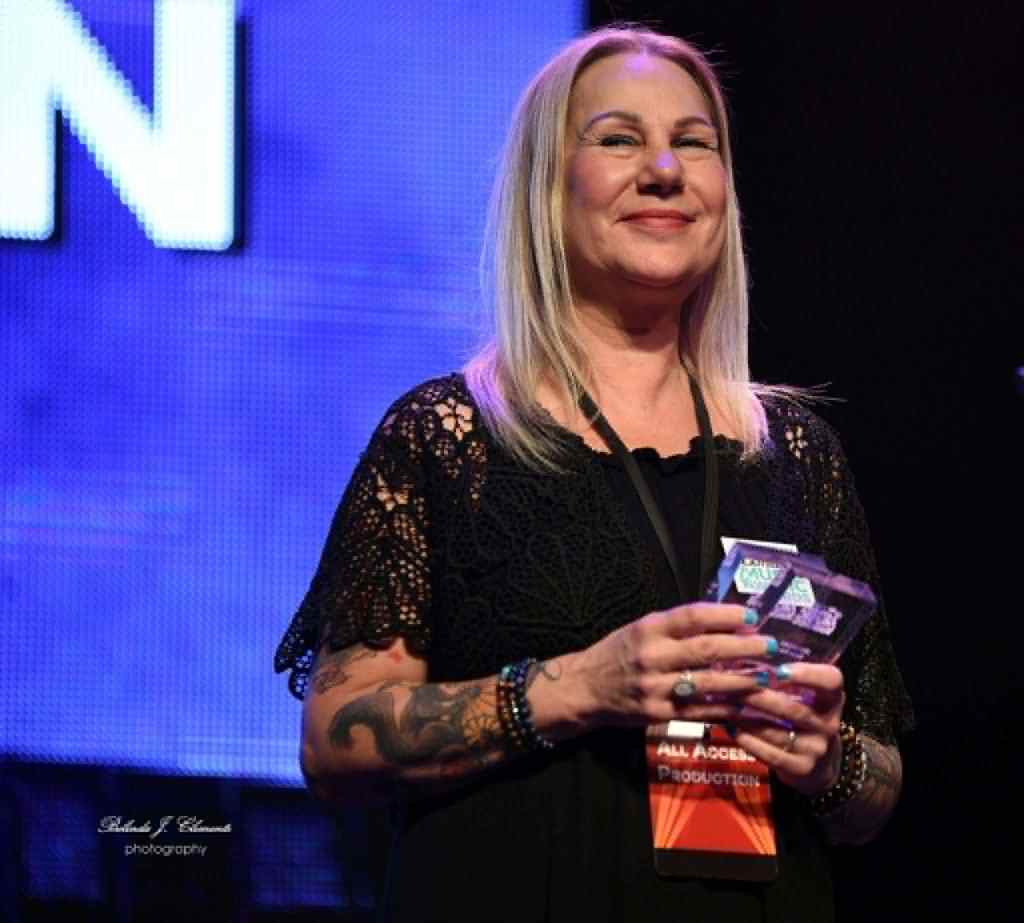
This is the first in a series of recurring photo features on The Beat Magazine 2025 website that we are calling “Local Arts & Culture Through the Lens of Belinda J. Clements.“
Each photo dump will feature photos Belinda has taken at London-area arts and cultural events.
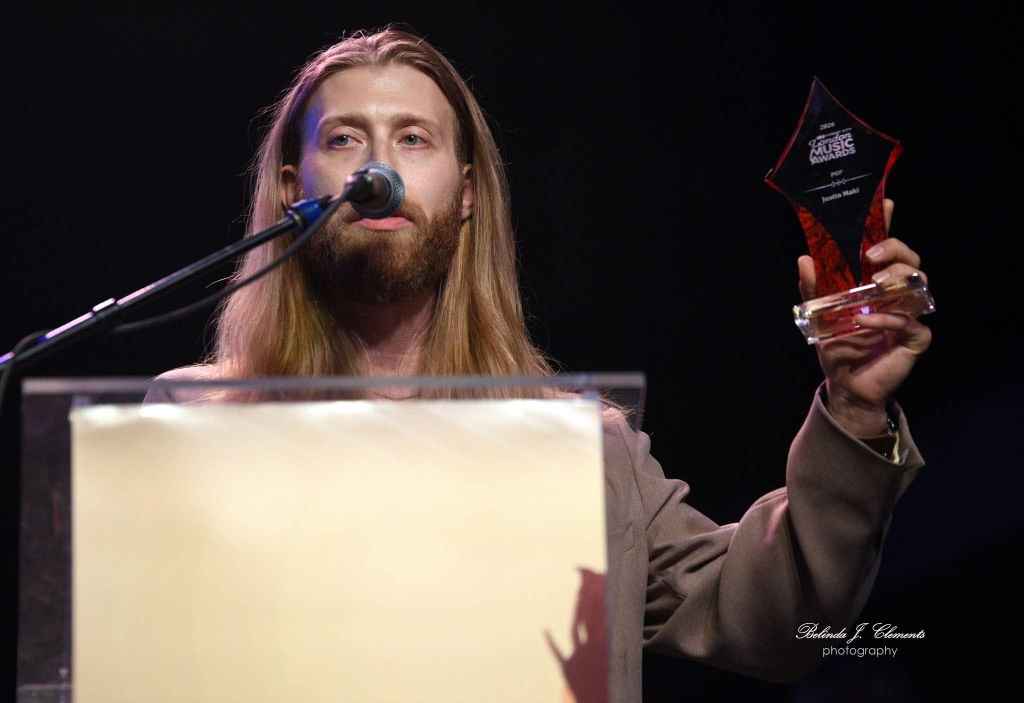
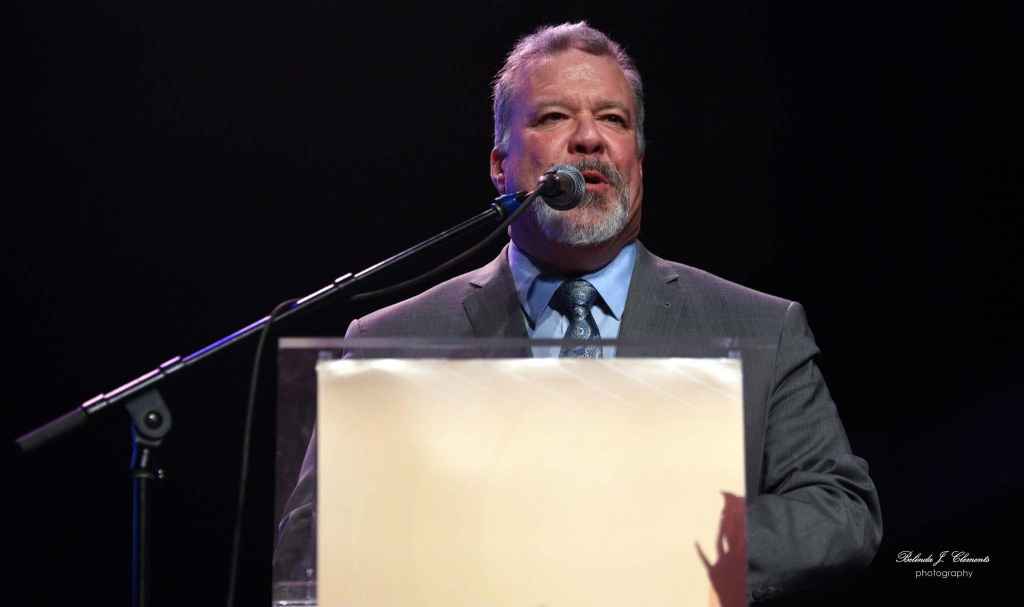
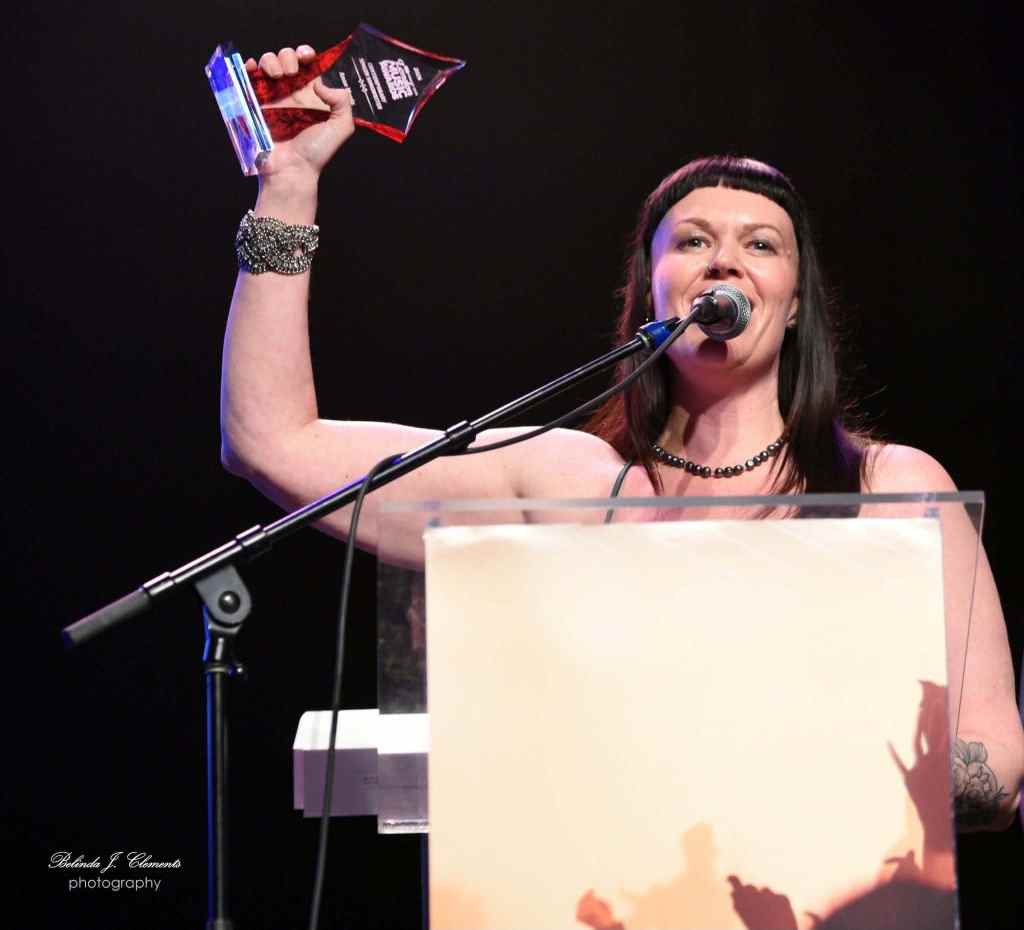
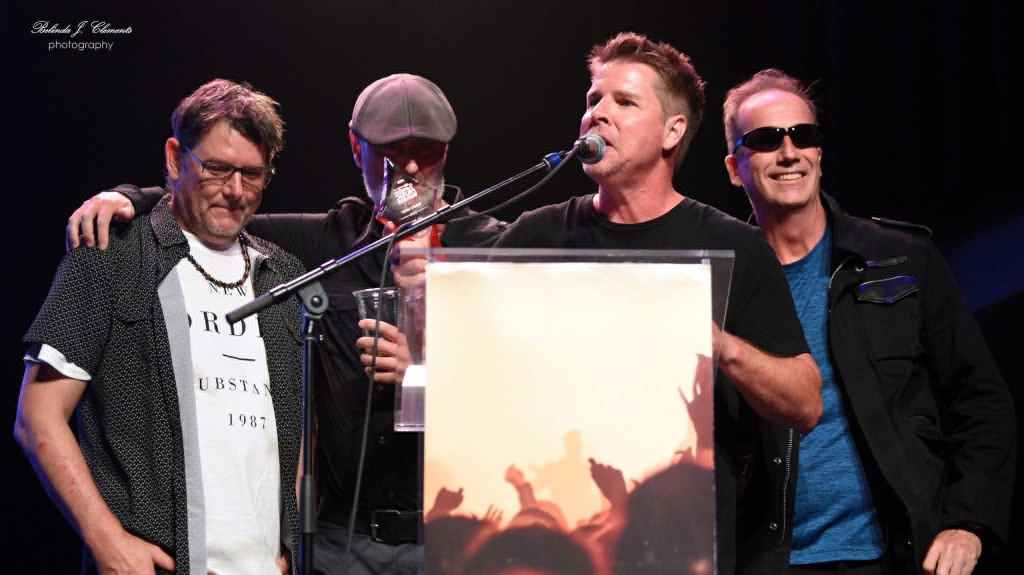
The first feature includes pics Belinda took during Forest City London Music Awards Week, June 6-14.
You should recognize many of the people and artists in the photos, including Mario Circelli, Anne Moniz, Leanne Mayer, Bev Camp, Justin Maki, Howie Kittleson, Don Jones, and many more.
Let us know if you would like Belinda to photograph your event. Contact Richard Young, The Beat Magazine Publisher & Content Manager, at richardyoung@thebeatmagazine2025.ca.
All Photos by Belinda J. Clements Photography
I have had some wonderful experiences as a photographer. I’ve written and photographed for many publications, several newspapers and a couple of magazines. I have been on and photographed some television programs and radio shows. I’ve photographed rock concerts, stage shows, parades, festivals, fairs, fundraisers, and many sporting and political events. I’ve had the opportunity to meet many fascinating people and celebrities along the way. I have volunteered my services for several nonprofit groups over the years.
I’ve been hired by a few companies and been put up in other cities to photograph their conventions and presentations. I was hired by a band and flown to London, England to photograph them at Abbey Road Studios. Snapping quieter stuff is also something that I enjoy. I like to photograph nature, families, and people in general. I’ve even snapped a couple of weddings.
My love for photography began when I was 15 years old, and a house fire took our lakeside home and everything we owned, including all of our photographs. Thankfully, my family and our pets were all safe. It happened just days before Christmas, and my Dad gifted me with a Kodak 110 instamatic camera.
Since that day, I’ve been a bit obsessed about recording memories with a camera and have several photo albums and external hard drives holding thousands of photos. I still enjoy photographing in nature, but shooting live events, especially music, is my greatest passion, and I hope to continue to pursue it for many years to come.
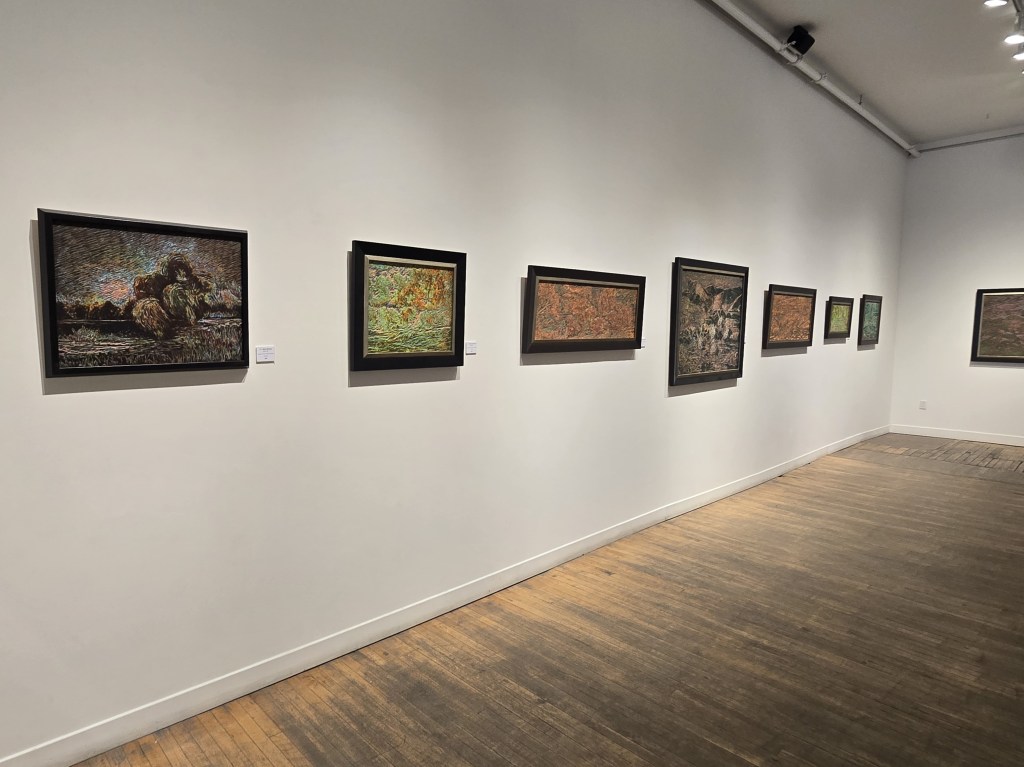
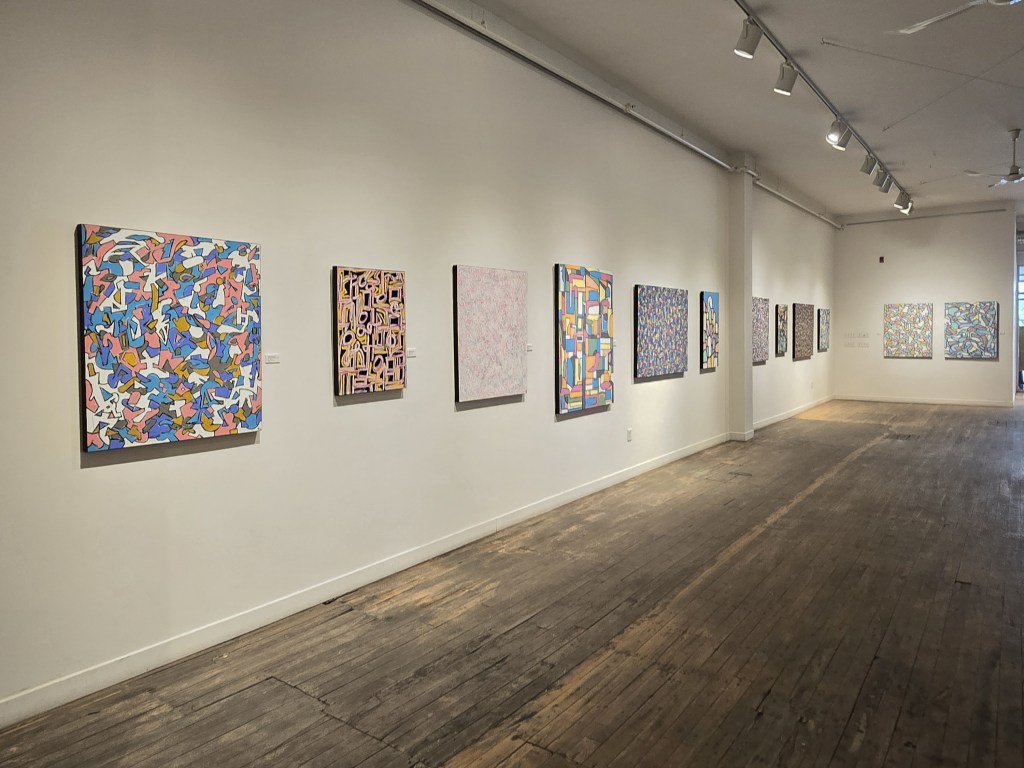
(Installation shot of the left side of the TAP Main Gallery. Photo by Beth Stewart.)
“Come As You Are” occupies the Main Gallery of TAP Centre for Creativity, 203 Dundas Street, from June 23 to July 4, 2026. An opening reception is planned on Thursday, June 25th, from 6 to 8pm with both artists in attendance.
The show juxtaposes work by Bijan Ghalehpartdaz with work by August Theodore.
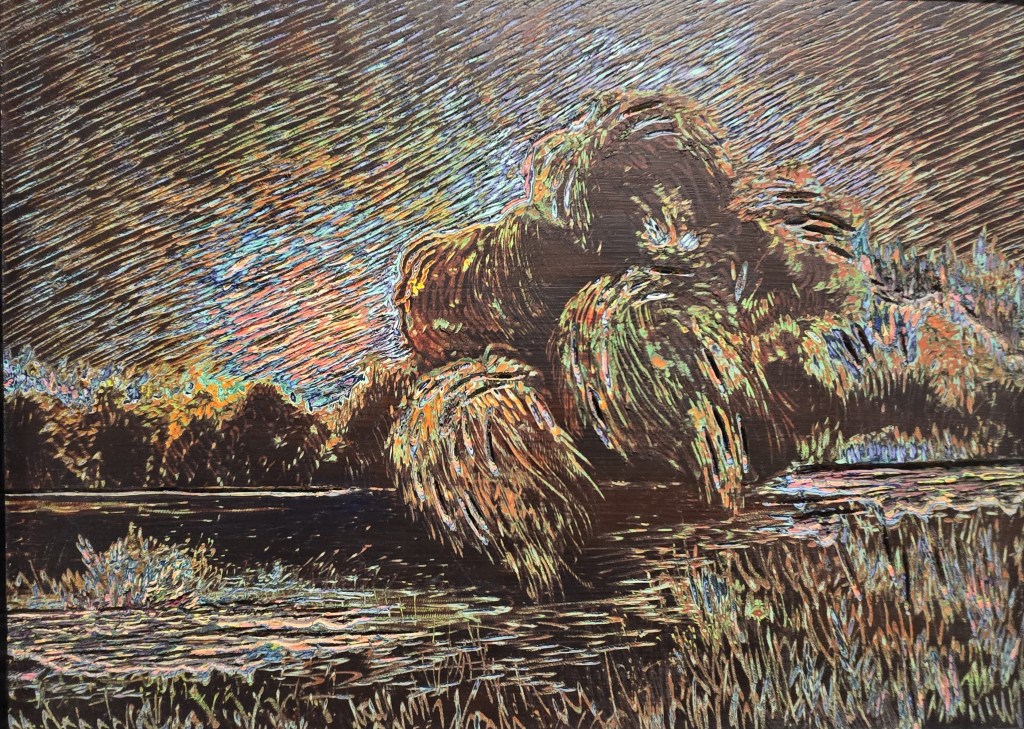
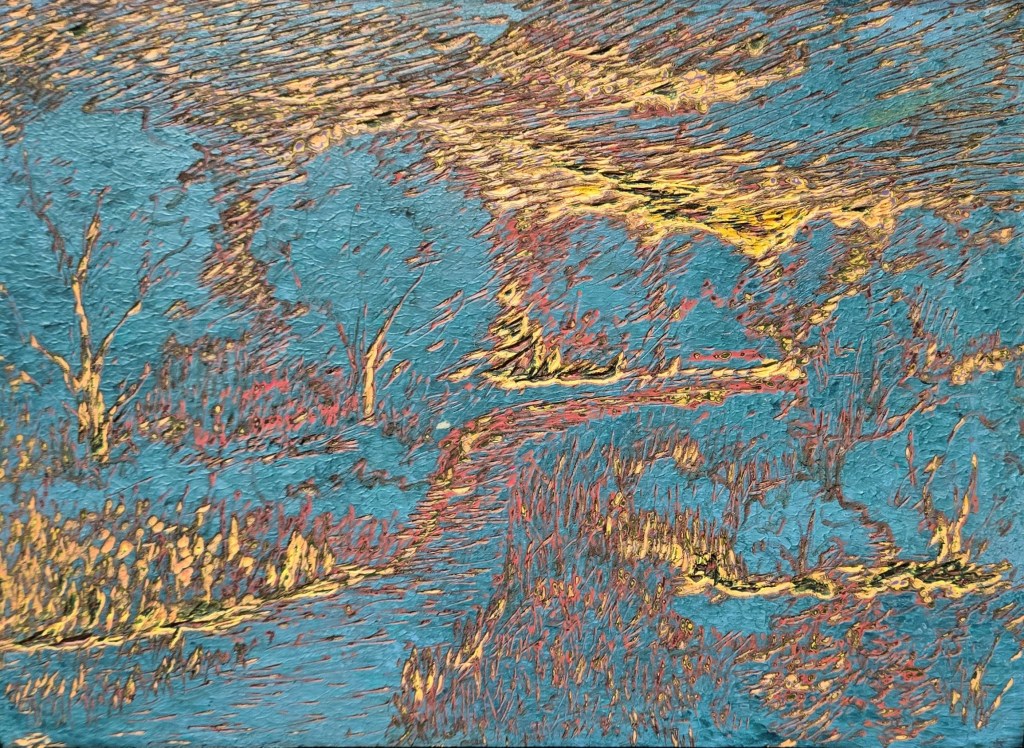
(Bijan Ghalehpartdaz, “Wild Willow” (plein air), engraved acrylic paint on board, 18 by 24 inches. Photo by Beth Stewart.)
Bijan Ghalehpartdaz needs no introduction to the local arts community. As the owner of Bijan’s Art Studio for over 30 years, a literal “candy store for artists”, he is familiar to all.
August Theodore, born in 1976 in the east end of Toronto, is a self-taught abstract painter. He relocated to the east end of London in 2016. A full-time artist, he works out of his home studio.
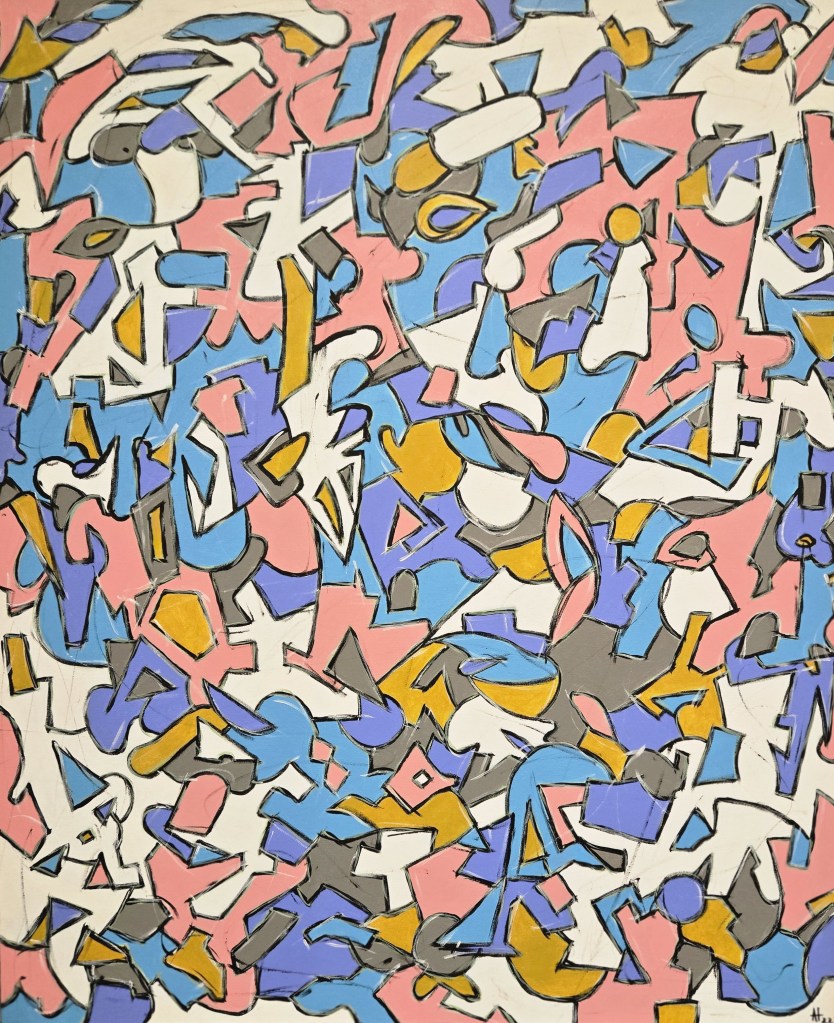
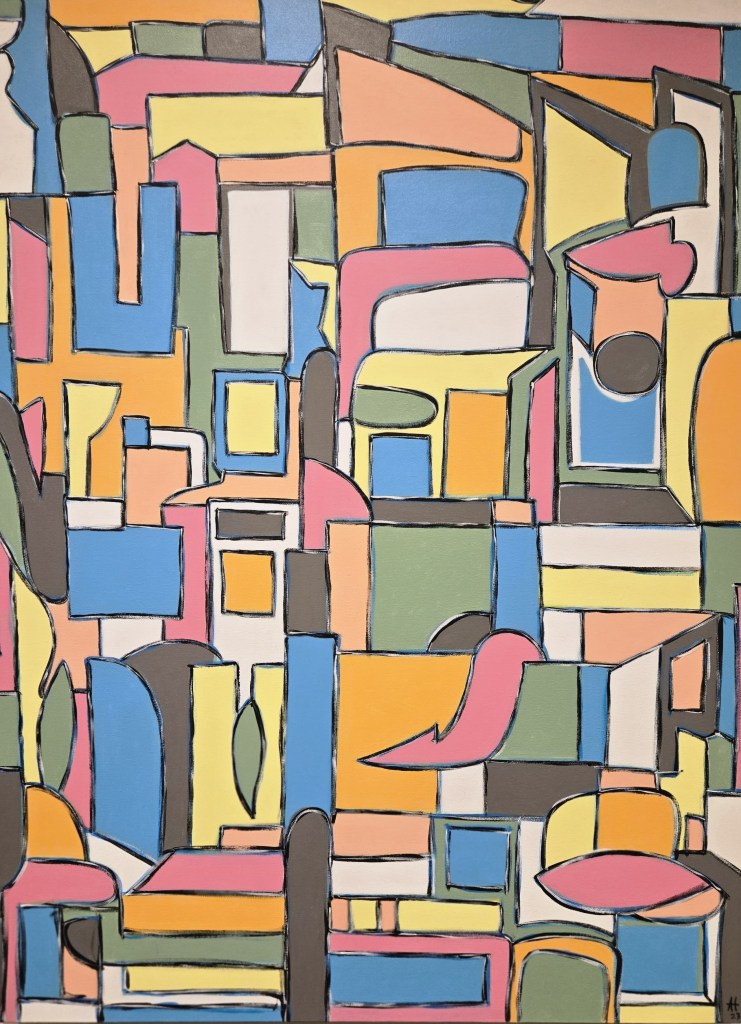
(August Theodore, “Eye Candy Modernist”, acrylic on canvas, 30 by 36 inches, 2021. Photo by Beth Stewart.)
The two met when Theodore became a customer at Ghalehpartdaz’s store.
Says Theodore, “Over the years, we had various conversations about art.” Through their mutual interest in art, the two became friends.
“About a year and a half ago, I invited Bijan to see my work. The next time I saw him, he said we should show together. I agreed, and here we are.”
Ghalehpartdaz recalls when he first visited Theodore’s studio, he was “blown away by his colours and intricate wallpaper pattern-like images.”
Ghalehpartdaz’s work follows two distinct paths. Along one, he uses layers of art resin and acrylic paint, a technique he describes as “super intense and time-consuming” but ultimately rewarding and which results in a realistic, three-dimensional painting.
(Bijan Ghalehpartdaz, “Memory of Home”, art resin and acrylic on board, 21 by 21 inches. Photo by Beth Stewart.)
Along with the others, he explores acrylic paint carving. Bijan applies up to 70 layers of thick, high-quality acrylic paint on a hard wooden surface in a process that may take up to six months. When all the layers are bone-dry, he carves into them using a Dremel power tool. The result is a one-of-a-kind three-dimensional painting.
Theodore self-describes as an observer of things with roots in graffiti who draws inspiration from both nature and from urban life. Over the past three decades, his work has graced galleries, shows, markets and sidewalks across Canada and in parts of Europe.
A specific style is not his goal. Theodore says, “Mainly, I paint abstract mosaics. However, I paint different series. I’m always at play … I paint whatever I feel.”
(August Theodore, “Metropolis Stacked”, acrylic on canvas, 48 by 36 inches, 2023. Photo by Beth Stewart.)
What about the show’s title? Does it reference Nirvana’s “Come as You Are,” a song that writer Kurt Cobain purportedly said was about non-conformity and acceptance.
Does its meaning predate Cobain’s use and allude to those spontaneous gatherings popular in the 1940s to 70s, where the concept of no preparation is embraced? Or is it rooted in theology and the concept of unconditional acceptance (Whoa, Nelly. Did that just go full circle?)
Theodore says the title was indeed borrowed from Cobain. He explains, “The title refers to two artists, with different backgrounds, bringing what they do together.”
Upon entering the gallery, the dichotomy is evident and purposeful. The space is divided into two distinct exhibits; Ghalehpartdaz’s work occupies the left-hand walls, and Theodore’s the right.
(Installation shot of the right side of the TAP Gallery. Photo by Beth Stewart.)
The artists arrived at the gallery with the idea of the split, says TAP Team Member Connor Mackinnon.
When the two bodies of work are placed together, it serves to highlight their disparate physical and conceptual qualities. That, then, creates new meaning.
And it works, says Gallery attendant Bill Lee, who helped hang the show.
Ghalehpartdaz’s work is dark, moody and requires close examination. His sgraffito pieces burst with detail, texture and pattern. Their exposed underlayers glow like gold. This can be readily seen in “Harmony in Turquoise.”
(Bijan Ghalehpartdaz, “Harmony in Turquoise”, engraved acrylic paint on board, 11 by 14 inches. Photo by Beth Stewart.)
Ghalehpartdaz’s pieces have a timeless elegance and speak to an appreciation for history and quality. They sport frames that, while not ornate, are heavy and formal in appearance. His art resin pieces appear to be topped with glass (they’re not).
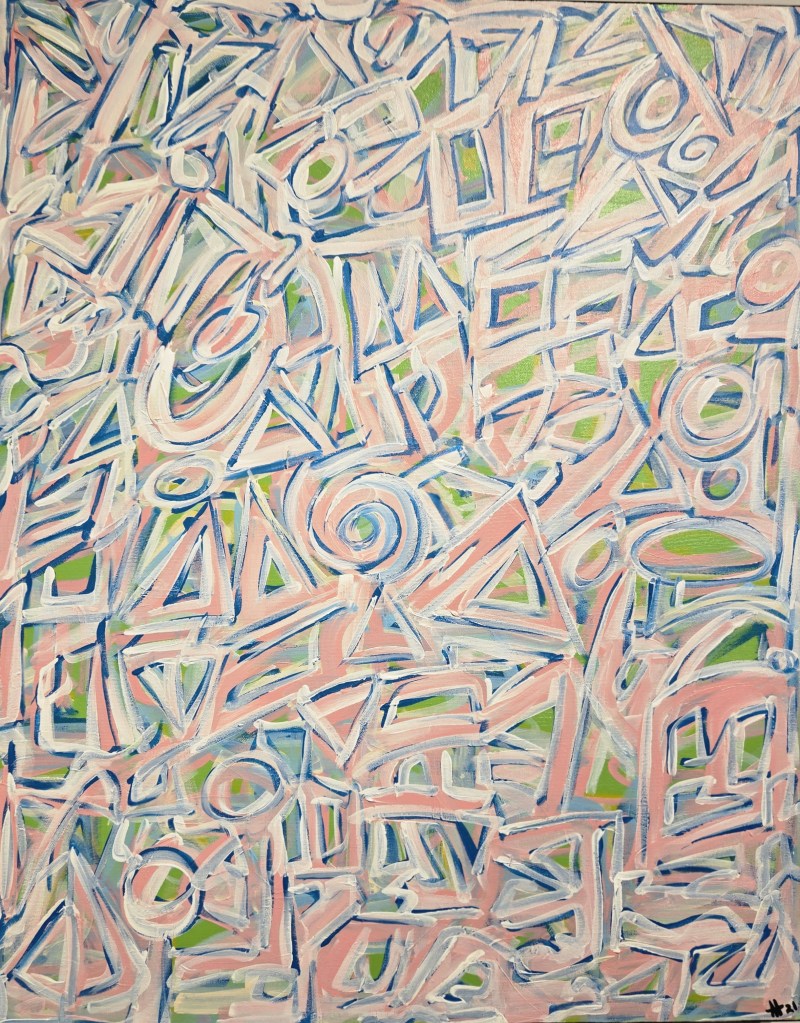
In contrast, Theodore’s work is bright and permits distance. He eschews representation to emphasize colour, composition and emotion. “Watermelon,” which graces the half-rotunda on the theatre level, is all about colour and form. It dazzles and then drags the viewer’s eye on a carousel-like journey.
(August Theodore, “Watermelon”, acrylic on canvas, 38 by 22 inches, 2021. Photo by Beth Stewart.)
Theodore’s pieces have a minimalist vibe and are appropriately left unframed.
Ghalehpartdaz’s pieces present the sublime power of nature. Theodore’s pieces are decidedly contemporary. Most of Ghalehpartdaz’s pieces are recent (Where does he find the time?); Theodore’s include a bevy of earlier pieces.
So, what connects their work? Theodore says it is the sheer passion they both have for what they do.
Beth Stewart is a writer, educator, and visual artist. She has a B.A. and a B.Ed. from the University of Windsor and a Diploma in Art Therapy from Western University. Beth has worked as an Art Therapist with Canadian war veterans and as a Secondary School Teacher of art and English for the TVDSB. She retired in 2024.
Beth was the arts editor at Scene Magazine from 2004 to 2006. She founded Artscape Magazine in 2006 and served as its editor until 2008. In addition, Beth wrote on the arts for Lifestyle Magazine from 2006 to 2017 and served as the copy editor for The Beat (in print) from 2009 to 2013.
As a visual artist, Beth works mainly in dry media and favours coloured pencil. Over the past decade, Beth’s focus has been on wild and domestic birds. Beth is a member of the Coloured Pencil Society of America, the Gallery Painting Group, the Eclectic Collage Collective, the Lambeth Art Association, and a founding member of the Coloured Pencil Artists of Canada group.
What follows is a Q&A Interview with Page Graham, co-founder of The Inside Outside, a popular recurring series of “salons” that brings together the music and visual art communities in a common setting.
The Interview was conducted by The Beat Magazine’s Publisher & Content Manager, Richard Young.
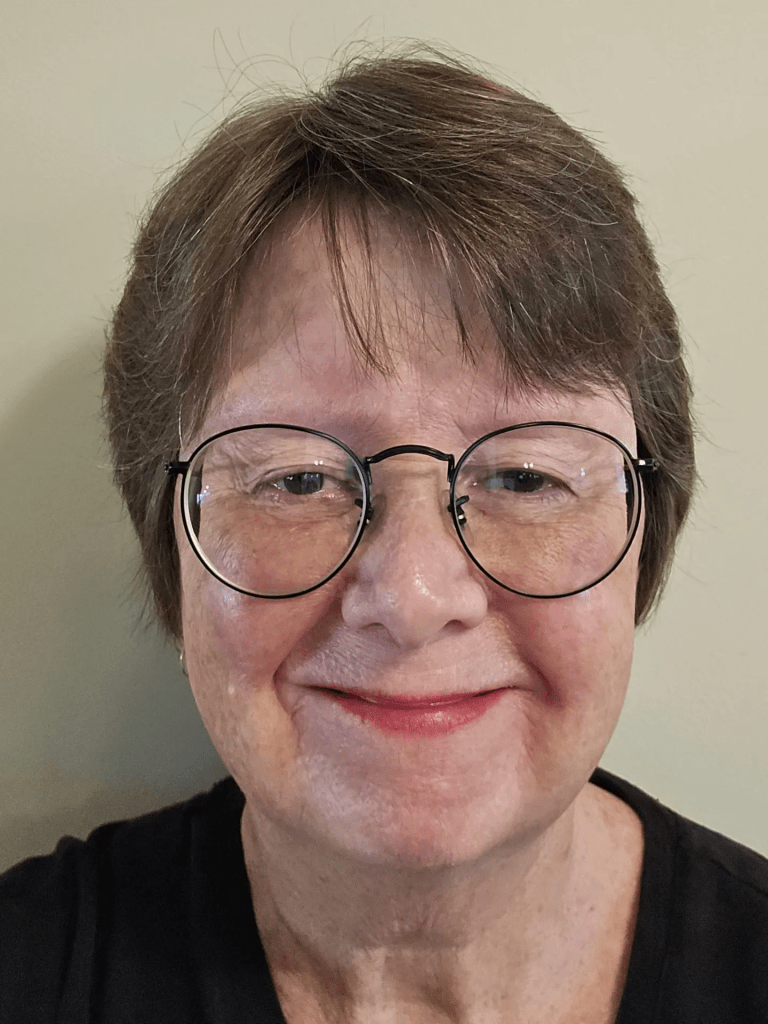
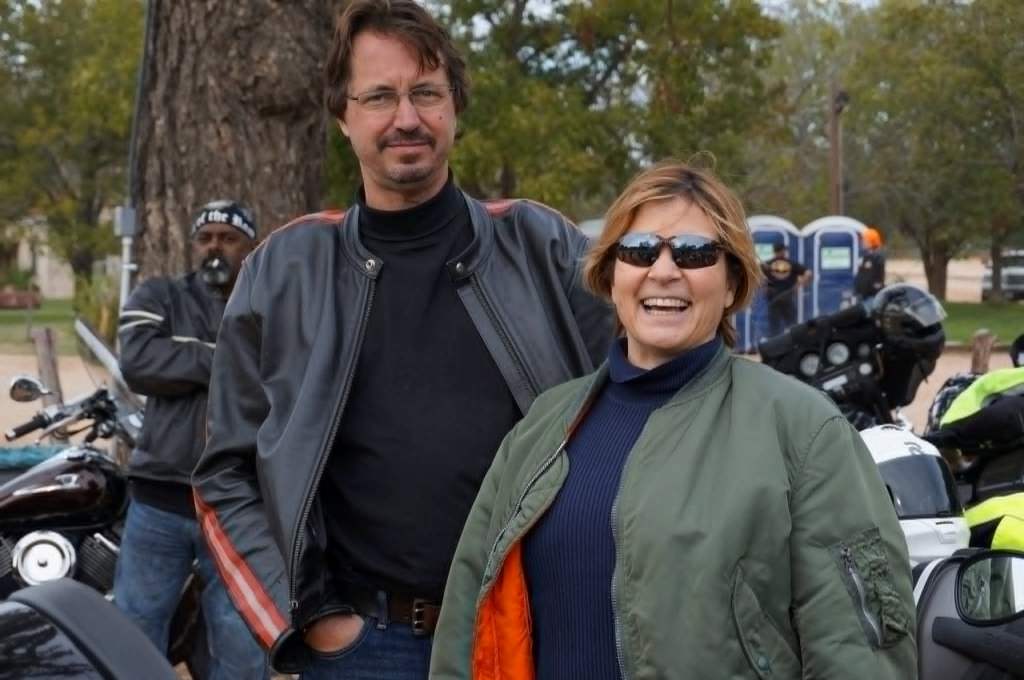
(Pictured: Page Graham and Tami Kegley, co-founders of The Inside Outside.)
Q. When was The Inside Outside founded, by whom, and why?
The Inside Outside was formed in 2025 by husband-and-wife team Page Graham and Tami Kegley. We saw a need to bring the music and visual art communities together in a common setting. A “salon,” if you will. Our shows consist of live music performances and arts discussion (interviews)
Q. What do each of you bring to the project?
Page takes care of the technical and production aspects. Since she is an artist herself, Tami acts as host and interviewer. Both collaborate to develop ideas and people to invite to participate in the show.
Q. What demographic does The Inside Outside serve?
Although unintentional, our events tend to attract a more mature audience, and all ages are certainly welcome. Not only do music and art find themselves siloed in terms of disciplines, age also plays a factor. For example, there are old-school punk bands in London as well as younger acts, and they aren’t at all integrated.
Q. In what venues do you hold your events?
Our events are held at the Richmond Tavern, London’s finest dive bar. People who would like to come to our events should be aware that it’s clean, well-run, and safe. Oh, and the drink prices are quite fair! We don’t charge a cover, but we do pass the hat. Pay What You Can (PWYC).
Q. How often do you hold events?
We are currently holding our events quarterly, on the 3rd Thursday of March, June, September, and December. I guess we’re roughly tracking the solstices.
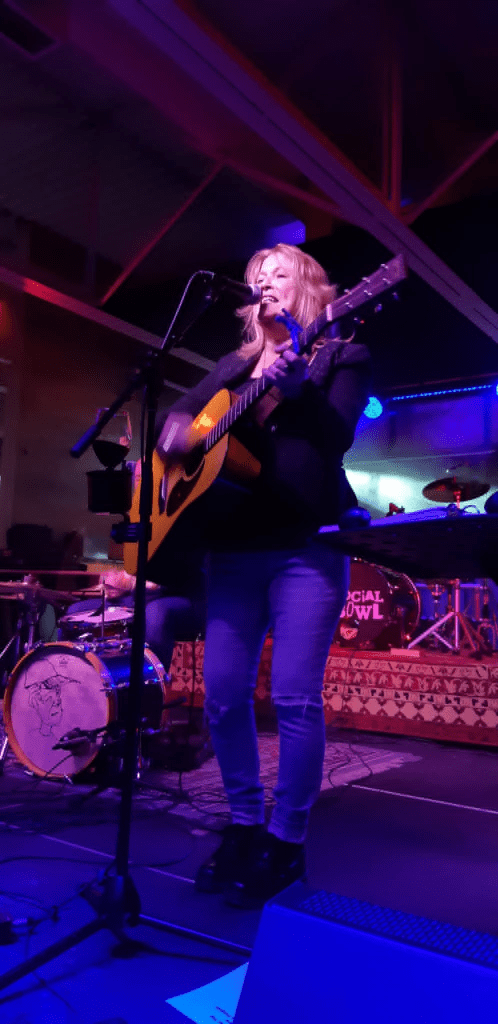
(Pictured: Carol MacQuarrie. Photo by Jim Capel.)
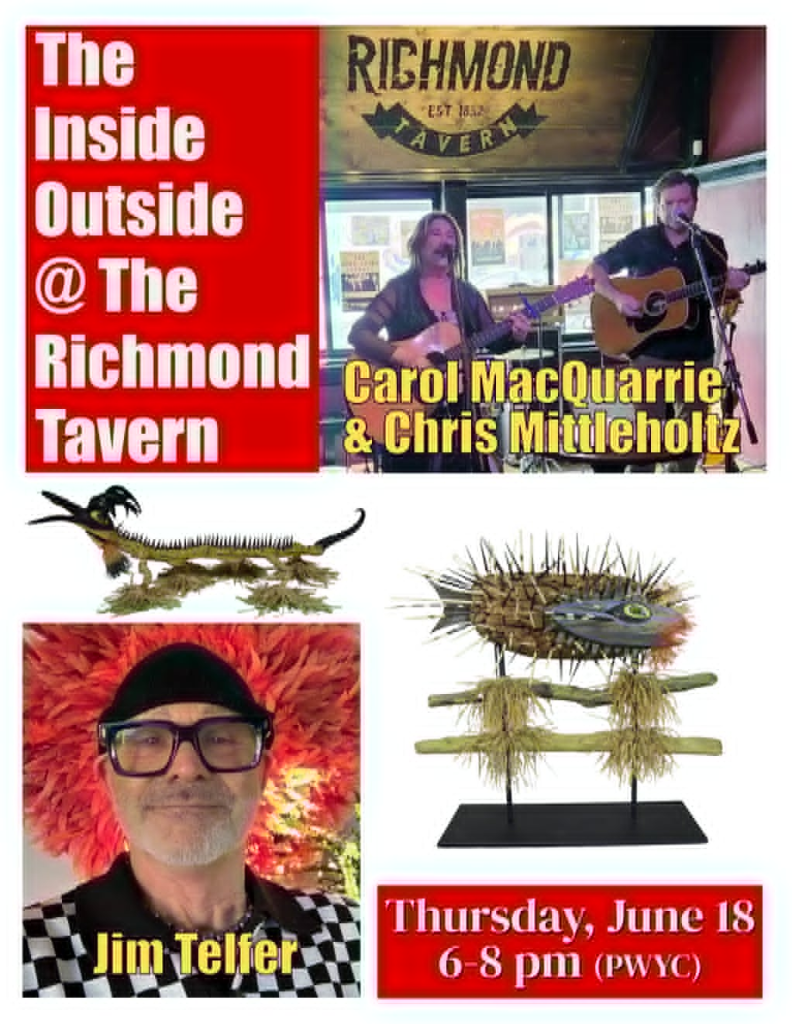
Q. What can attendees expect from your Thursday, June 18th event at the Richmond Tavern?
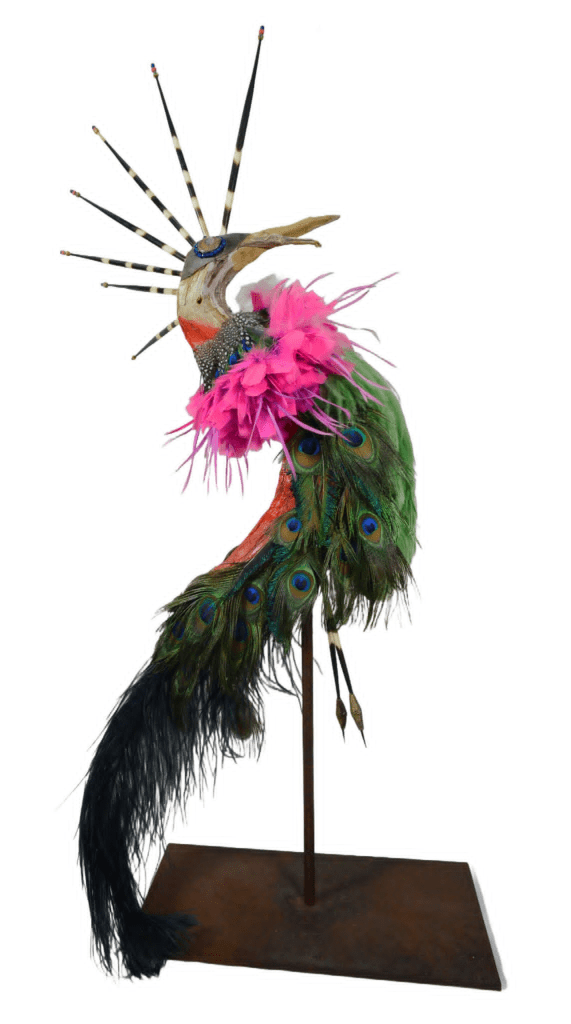
Our musical guests are Carol MacQuarrie and Chris Mittleholtz, who represent one half of folk group Myrtle Earle. Chris is also a renowned punk guitarist, but this will be an acoustic show. Local artist and gallery owner Jim Telfer will be our interview guest. He runs Splash Fine Art and Jewelry Gallery on Richmond Street, just south of the CN railroad tracks. There will be a visual display of his artworks; he specializes in larger-format abstract representations of animals, primarily sea creatures, and he uses mostly found objects such as driftwood. In September, our musical guest will be Allison Brown, who will likely bring another performer to join her. Our arts guest is still TBA.
(Pictured: Jim Telfer’s “Toulouse Peacock”. Photo by Page Graham.)
Q. How can our readers learn more about The Inside Outside?
Currently, the best option is to follow our Facebook page (insideoutsidelondon.ca). We have a website of the same name, but it is currently dormant.
Q. Do you have any general thoughts about London’s arts and culture scene/community you would like to share?
That’s an easy and difficult question to answer all at the same time. Since I’m a Western grad from decades ago and then went abroad for many years before returning, I find that Londoners tend to be overly negative about our city, and that includes the arts.
That simply isn’t true. This is a fine city. People should take pride in it. How many other cities have a Music Week with awards shows, for example? On the other hand, the music community gets much more attention than the visual arts because it’s out of balance. Our music situation is just fine, but instead of continuing to focus on it constantly, the spotlight needs to be shared with the visual arts and literature. In addition to being known as a “City of Music”, we should also be known as a “City of Arts”.
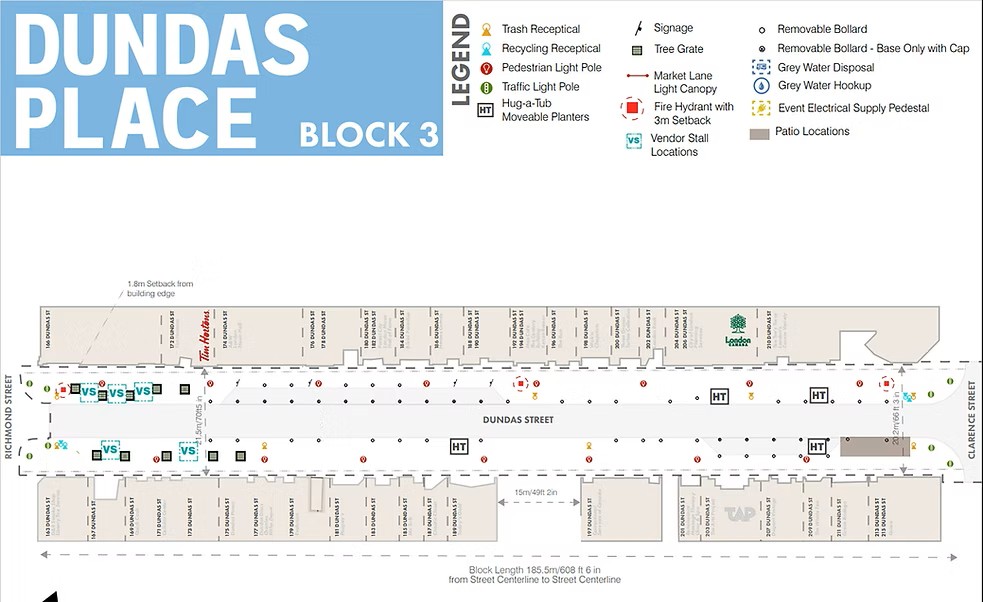
Kick off the month with a Community Art Crawl on Thursday, June 4, 2026. From 6 to 9pm, art lovers can discover makers, creators, and performers all along Dundas Place (between Richmond and Clarence streets).
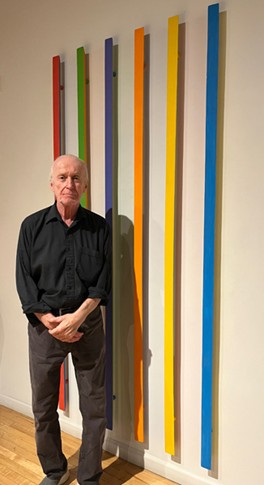
(Doug Mitchell in front of “Ambient Sticks”, acrylic on basswood, 2012. Photo courtesy of Michael Gibson Gallery.)
In conjunction with Art Crawl, Doug Mitchell is doing an Artist Talk at Michael Gibson Gallery, 157 Carling St, from 7-8pm on his Recent Works show. The London, Ontario, artist works in painting, sculpture, sound, and photography. His current pieces investigate the colour spectrum and were influenced by his extended observation of light reflecting through prisms in his studio. Also on display is Mitchell’s multi-panelled “map” of the forks of the Thames River in which he layers images, maps, and text. Recent Works is at MGG until June 26. For more info, visit: http://www.gibsongallery.com/
Art Crawl is a recurring event on the first Thursday of the month, from April to November. If you are an artist who is interested in participating, visit https://www.tapcreativity.org/community-art-crawl for guidelines. There is no cost to participate and no registration required.
Museum London’s Summer Launch Party, 421 Ridout St. N., is on June 11, 2026, from 7 to 10pm. At this pay-what-you-can at the door event, visitors can explore all three floors of the Museum, meet featured and visiting artists and curators, and dive into some hands-on creative activities. There will be food, a cash bar, and a live set with DJ Harina of OA(SIS).
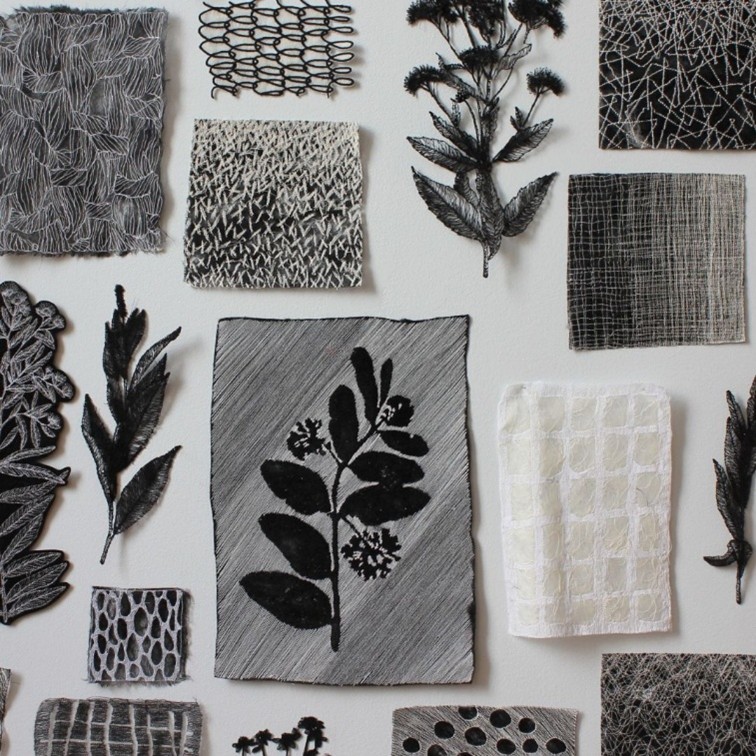
(Amanda McCavour: Double Shadow, 2025-26, thread, digital embroidery, free-motion machine embroidery, appliqué, hand stitching, nuno felting, pins. Photo courtesy of Museum London.)
While there, be sure to see Double Shadow, a site-specific installation by Toronto-based textile and embroidery artist Amanda McCavour. Bringing together more than 400 stitched elements, the installation transforms the Museum’s Atrium into a field of lace-like forms. Double Shadow continues at Museum London to March 14, 2027. For more information, visit: https://museumlondon.ca
(Poster for the Community Art Installation Project. Image from Woven into Myself (2025) by Mackenzie Daniels.)
A Community Art Installation Project featuring work by Kristi White, Mackenzie Daniels, and Mike Cywink that highlights stories of Indigenous culture, history, and community takes place on June 12, 2026, from 11am to 12pm at RBC Place, 300 King Street. It includes live music and remarks from the artists and from City representatives.
Also, at RBC Place on June 12, 2026, is Murals in Motion. From 11:30am to 2pm, on the Encore Terrace, this one-of-a-kind summer lunchtime event will see four local artists transform blank boxes on wheels into vibrant murals. Watch their work unfold while enjoying lunch from local food vendors, drinks from the licensed bar, games from Downtown London, and summer beats from a guest DJ. For more information, visit: http://www.londonarts.ca
(Abel Gingerich and Mike Sloane, “Who Knew”, 2026, magazine clippings, 9 by 12 inches. Image courtesy of TAP Center for Creativity.)
The opening reception forDear Abel / Love Mike takes place at TAP Centre for Creativity, 203 Dundas St., on June 13 between 2 and 4pm. Focusing on the act of correspondence, the paintings, mixed media, and sculptures allow the public access to friendly dialogues and the inner workings of relationship building between artists.
“Able” is Abel Gingerich, a multi-disciplinary artist living and working in London, Ontario. His body of work includes paintings inspired by real-life scenes, including garbage, concert venues and liminal spaces, covering themes of consumption, self-destruction and third spaces.
“Mike” is Mike Sloane, who has published scholarly articles and book chapters on topics ranging from trash to veganism.
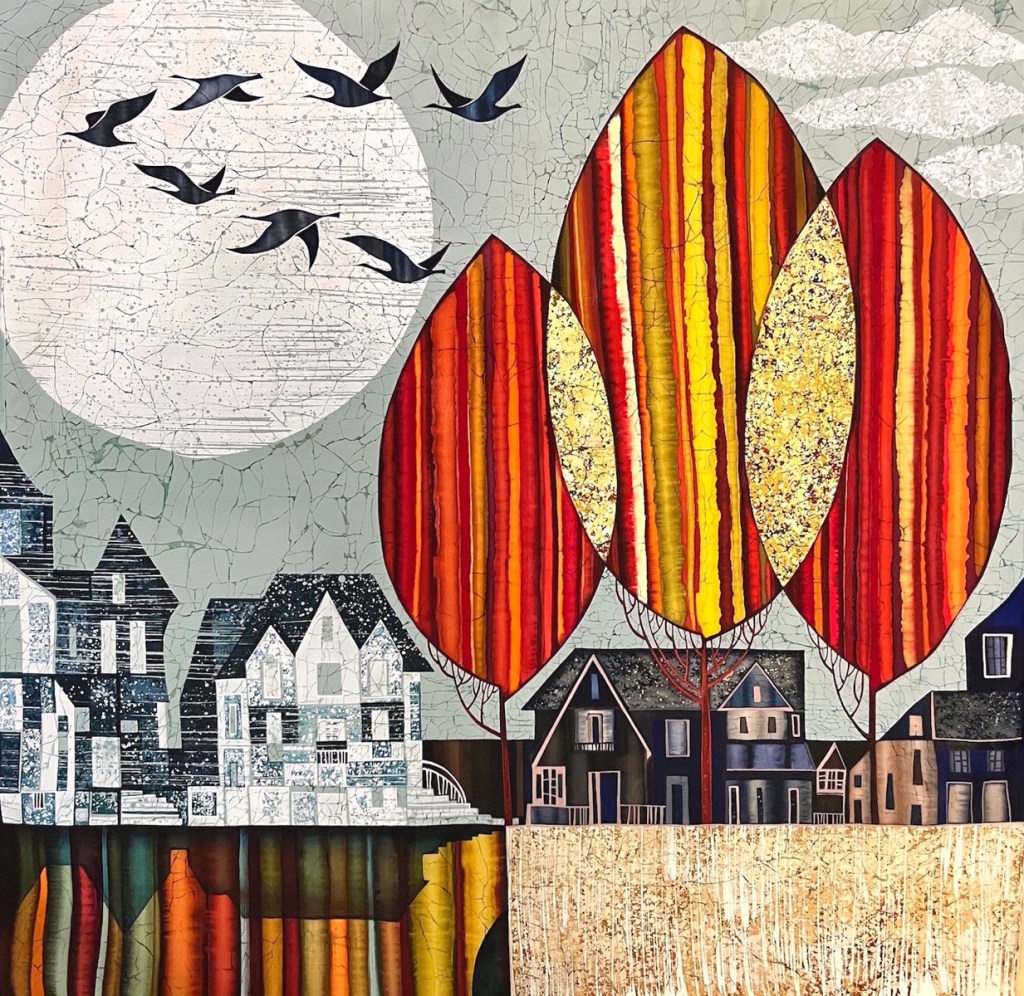
(Julia Ismambetova, “High Above I”, 30 x 30”, acrylic on silk. Image courtesy of Westland Gallery.)
Where I Like to Be with Kim Atlin, Julia Ismambetova, and Tracy Bultje continues to June 20, 2026, at Westland Gallery. This show brings together works that feature places people like to be and includes cityscapes, riverside vistas and forests.
Need more land? Westland has Made in Canada, a group show celebrating Canadian landscapes by Canadian artists, from June 23 to July 18, 2026. For more information, visit: westlandgallery.ca/
(Natasha Beaudoin, “Wordle 1,208 5/6”, oil, airbrush, chalk pastel, and oil pastel on canvas, 203 by 203 cm, 2025. Image courtesy of McIntosh Gallery.)
At McIntosh Gallery, exhibitions by Natasha Beaudoin and Eric Allan Cameron continue to July 3, 2026.
Beaudoin’s Refracted Realities demonstrates how painting can engage the emotional and psychological conditions of contemporary digital life. The exhibition draws on the visual language of historical paintings and recontextualizes it through the cultures shaped by screens and social media. Natasha Beaudoin is an MFA candidate in the Department of Visual Arts at Western University. Refracted Realities is her MFA Thesis Exhibition.
Cameron’s Distant Sunbrings together new oil paintings that distill night skies, distant horizons, and bodies of water into restrained, atmospheric compositions. Eric Allan Cameron is an MFA candidate in the Department of Visual Arts at Western University. Distant Sun is his MFA Thesis Exhibition.
For more information, visit mcintoshgallery.ca/
(Promotional image from Michelle Wilson’s Those in Glass Houses. Image courtesy of Forest City Gallery.)
Michelle Wilson’s Those in Glass Houses continues to July 23, 2026, at Forest City Gallery, 1025 Elias St. In this exhibition, Wilson investigates an unusual component of colonial rule – the greenhouse – which was a crucial tool for transporting plants and people around the globe. Collaborating with family members, Wilson merges personal anecdotes with critiques of the British empire, the trade of exotic flora, and the abduction of children. For more information, visit: https://www.forestcitygallery.com/
Beth Stewart is a writer, educator, and visual artist. She has a B.A. and a B.Ed. from the University of Windsor and a Diploma in Art Therapy from Western University. Beth has worked as an Art Therapist with Canadian war veterans and as a Secondary School Teacher of art and English for the TVDSB. She retired in 2024.
Beth was the arts editor at Scene Magazine from 2004 to 2006. She founded Artscape Magazine in 2006 and served as its editor until 2008. In addition, Beth wrote on the arts for Lifestyle Magazine from 2006 to 2017 and served as the copy editor for The Beat (in print) from 2009 to 2013.
As a visual artist, Beth works mainly in dry media and favours coloured pencil. Over the past decade, Beth’s focus has been on wild and domestic birds. Beth is a member of the Coloured Pencil Society of America, the Gallery Painting Group, the Eclectic Collage Collective, the Lambeth Art Association, and a founding member of the Coloured Pencil Artists of Canada group.
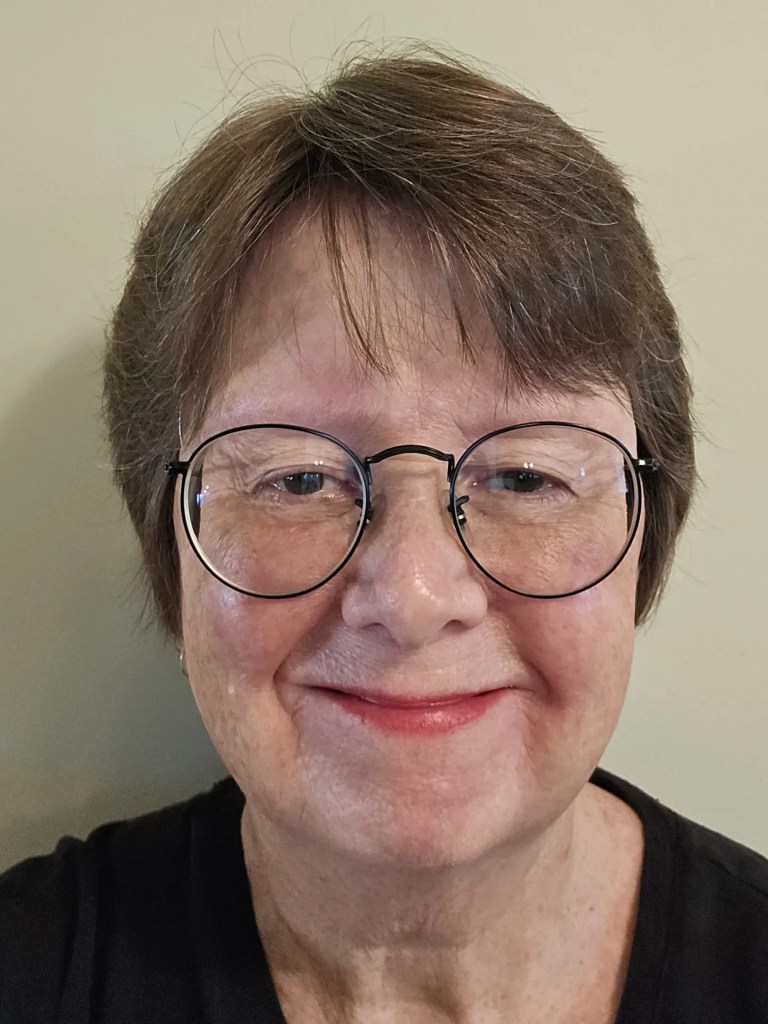
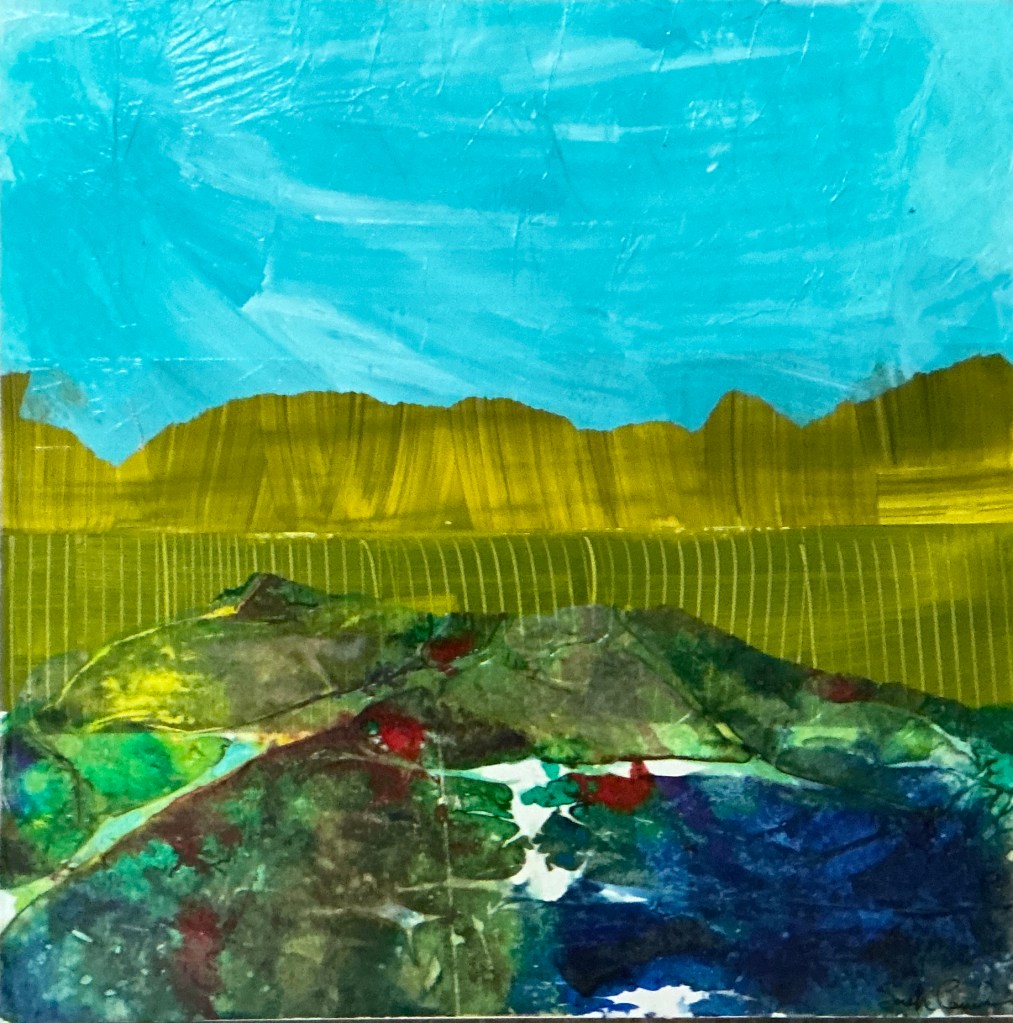
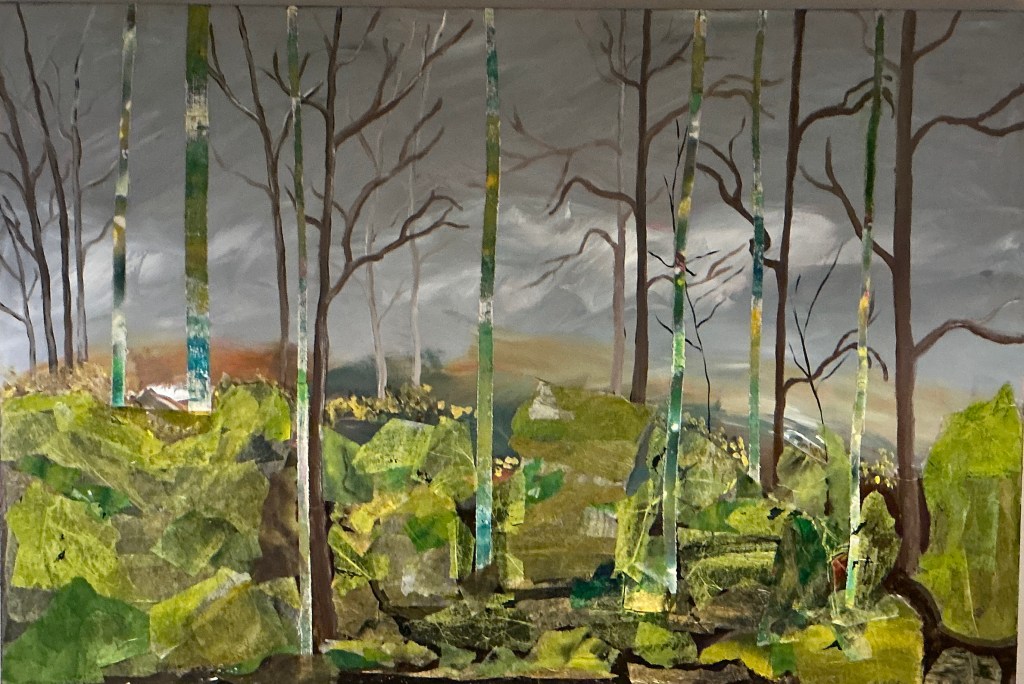
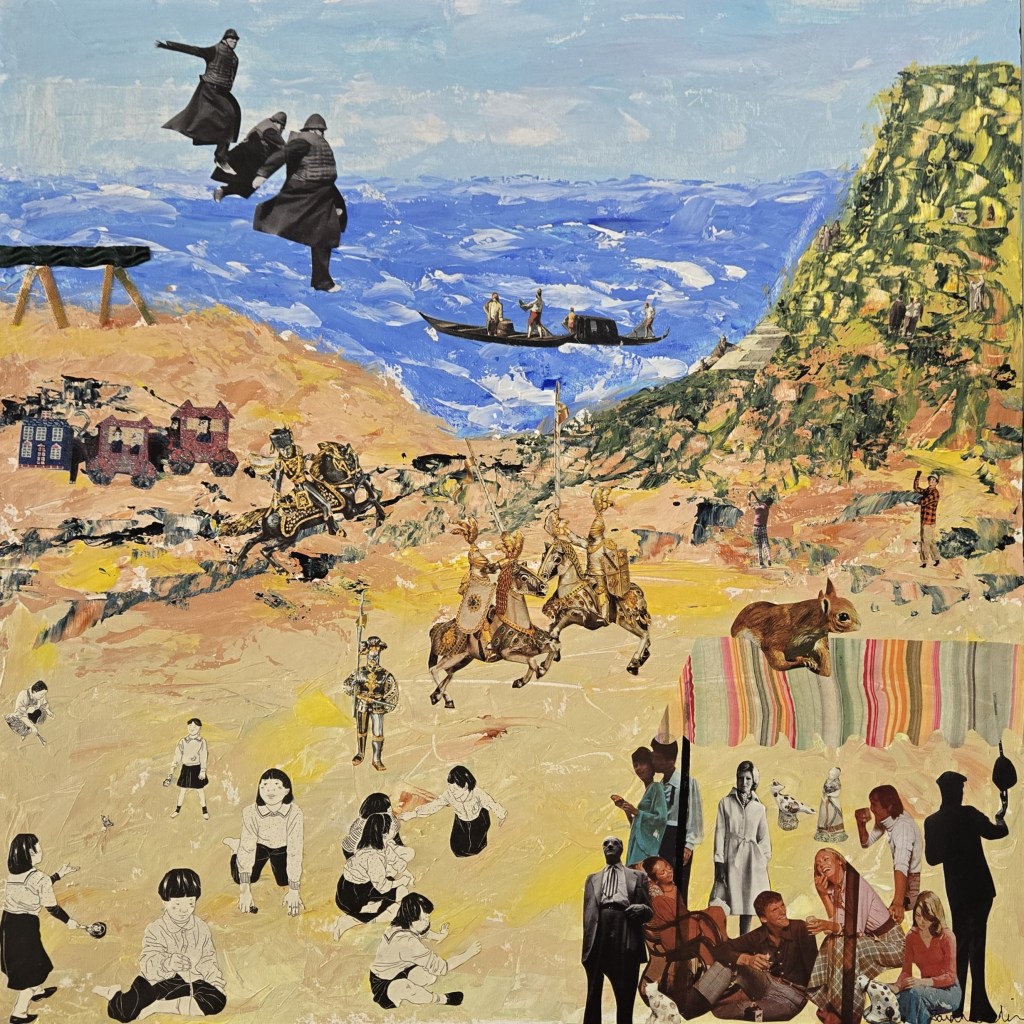
Sarah Cowling works in collage and in acrylic, and in some pieces, she combines the two.
Cowling describes the act of collage as “painting with paper”. It involves taking unrelated materials, usually paper-based, and combining them to create a new whole. Anything flat that can be glued down is fair game.
She uses premade Japanese and Thai papers, paper culled from old books and magazines, found paper, travel photos, and paper she herself has created.
She says inspiration often comes from a single piece of paper that has somehow caught her eye. Travel experiences often fuel her art as well.
Her self-created contributions are archival tissue papers or drawing papers that Cowling has painted using acrylics, brushes, and Gelli plates.
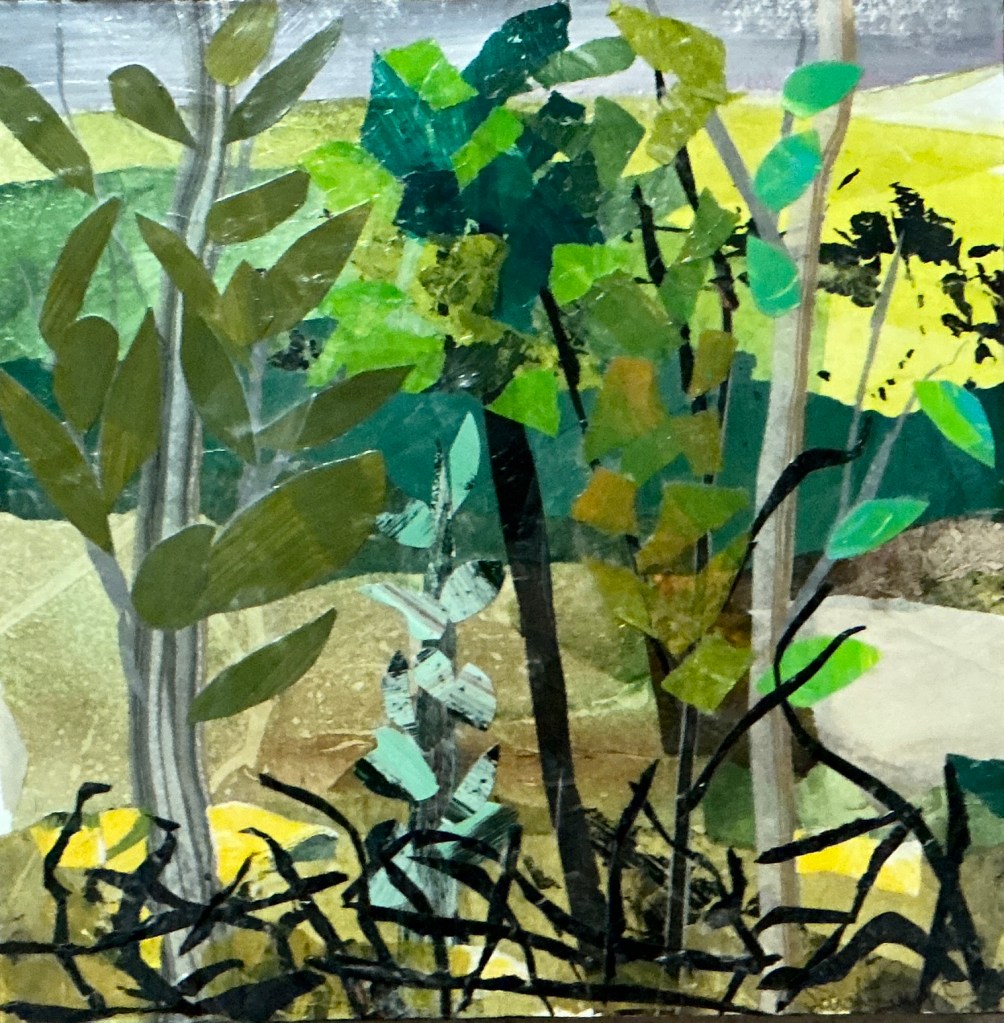
(Pictured: Sarah Cowling, “Behind St. Aidan’s”, collage with hand-painted papers, 12 by 12 inches.)
Much time is spent searching for or creating papers, often long before they are used. She describes the act of pulling together the pieces as meditative.
Cowling has an innate desire to create. She says, “It is something I need to do; a compulsion perhaps. I see a landscape or have a piece of paper that sparks an idea.”
She works both in-studio and on-location.
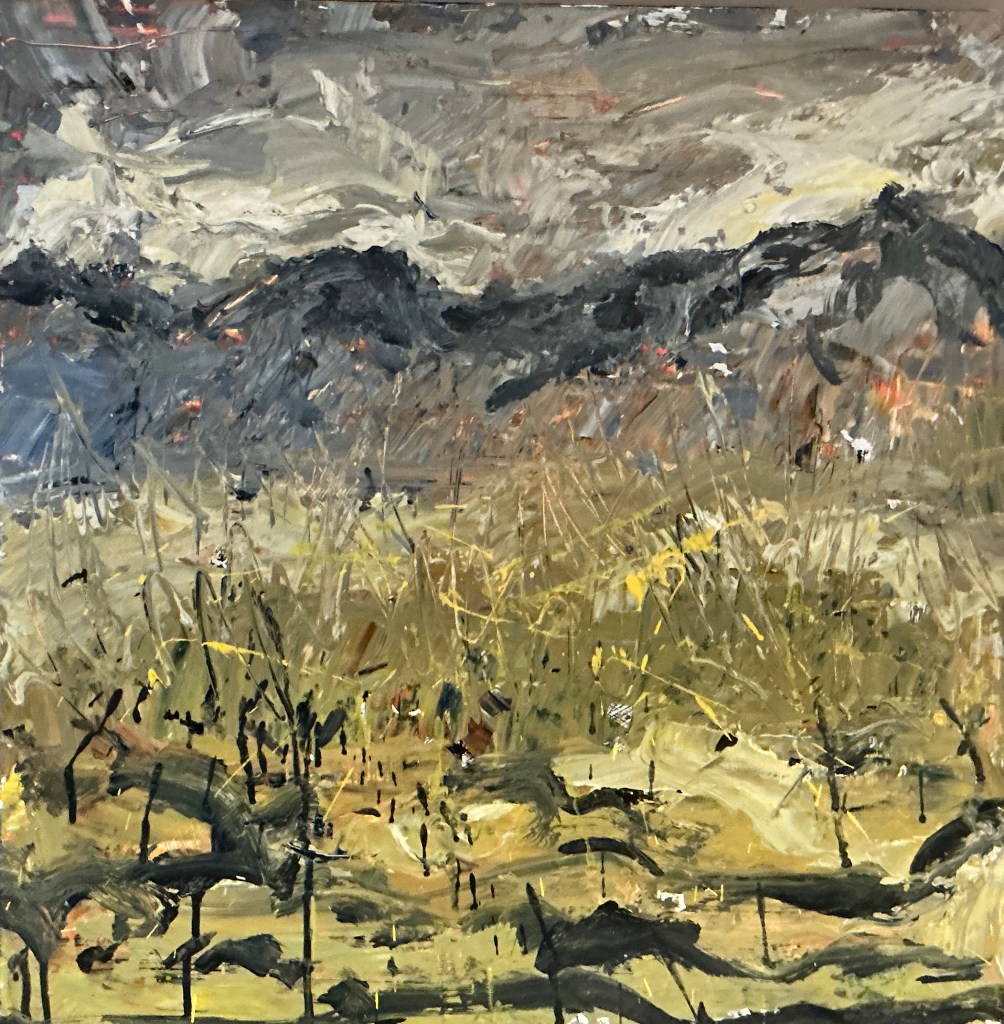
Cowling’s work ranges in size from 12-by-12 inches to 20-by-20 and up. While her collages offer bold chunks of colour that overlap and stack to create tactile line and form, her acrylic paintings combine bold brush strokes with intimate mark-making.
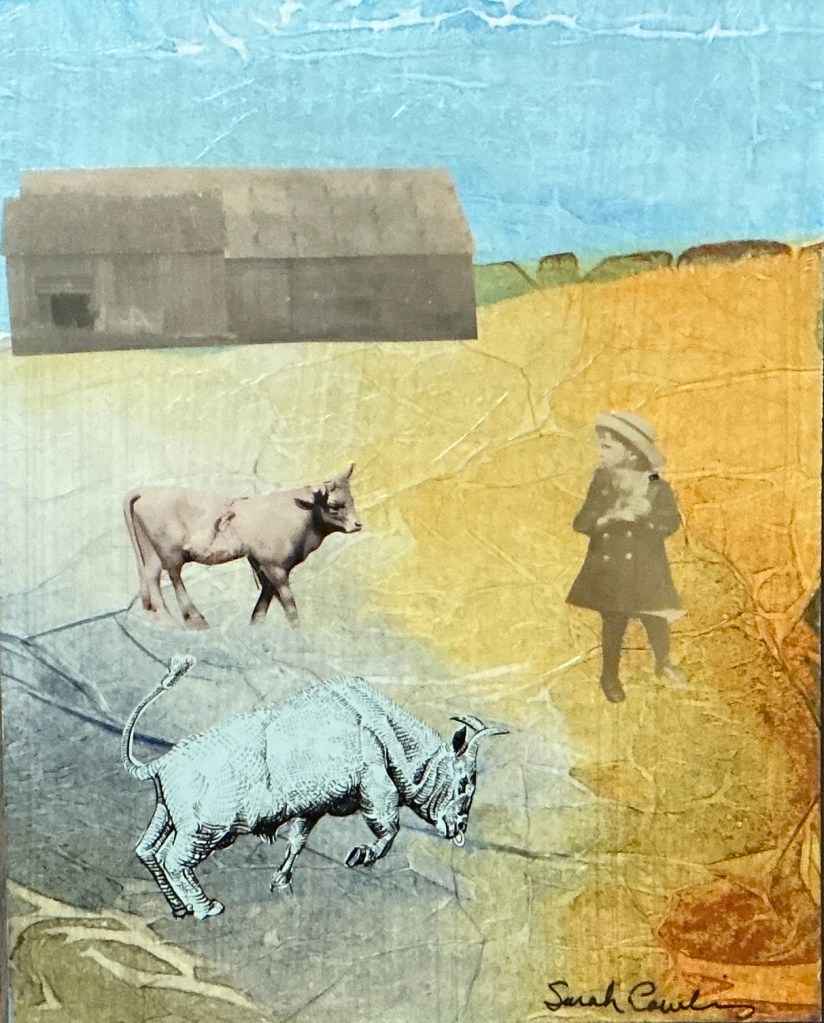
(Pictured: Sarah Cowling, “How Big is That Bull?”, collage with hand-painted papers, 8 by 10 inches.)
Cowling’s “Behind St. Aidan’s” shows the hard edges that appear on many of her collages. Yet another collage, “How Big is That Bull?” speaks to her love of storytelling. The latter is part of her ongoing exploration of family history in which she processes tales told by her mother and her aunt about family members.
In contrast, the acrylic on cradled board piece “Storm Coming” demonstrates her ability to suggest landforms and foliage as well as motion through bold brush work.
(Pictured: Sarah Cowling, “Storm Coming”, acrylic on cradled board, 20 by 20 inches.)
She credits this writer and artist, Jill Price, as being early providers of a gallery space for her (Axis Studios, Covent Garden Market). She thanks Al Stewart (Westland Gallery) for making space for local artists with the Miniature and Square Foot Shows. She is indebted to three local London art groups – the Brush and Palette Group, the Gallery Painting Group, and the Lambeth Art Association – for providing learning and exhibition opportunities as well as camaraderie and support. All of the aforementioned provided opportunities that are necessary for artists to succeed.
(Pictured: Sarah Cowling, “Utopia”, collage with hand-painted papers, 16 by 16 inches.)
Of late, Cowling has been involved in an ongoing project with the Kolaj Institute, creating collages based on folklore. To date, she has attended two folklore-focussed residencies with the Institute; one was in Scotland, and the other was in Knoxville, concentrating on this topic. She is grateful to Ric Kasini and others at the Kolaj Institute for their support.
(Pictured: Sarah Cowling, “Niagara Gorge”, collage with hand-painted papers, 40 by 60 inches.)
She currently has work in the Frankingstyle Gallery in St. Thomas and is looking forward to the 2026 London Artists’ Studio Tour, Friday, April 24 to Sunday, April 26. Cowling is #16 on the map at 180 Timber Drive. For more information, visit: https://londonstudiotour.ca/
2026 London Artists’ Studio Tour, Friday, April 24 to Sunday, April 26.
London has a richness of community art groups, including the Brush and Palette Club, the Gallery Painting Group, the Lambeth Art Association, and the London Community Artists.
While each occupies a unique niche, all provide camaraderie, education, and exposure.
The Brush and Palette Club (B & P), formed in 1972, grew out of painting sessions organized by artist and teacher Dorthy Heaven. By 1989, the small group had grown to 50; current membership is capped at 110 for practical reasons, and it has a healthy wait list.
B & P Publicity Convenor Marilyn Kidd says many artists join the club because art making can be an isolating activity. Membership allows them to be “stimulated, motivated and inspired.” She says members enjoy participating in art-related activities with the group and “growing together as they learn about new painting techniques.”
The club meets monthly, except for July and August, at Riverside United Church. Members enjoy presentations by invited speakers, trips, and seven hands-on workshops in a variety of media per year.
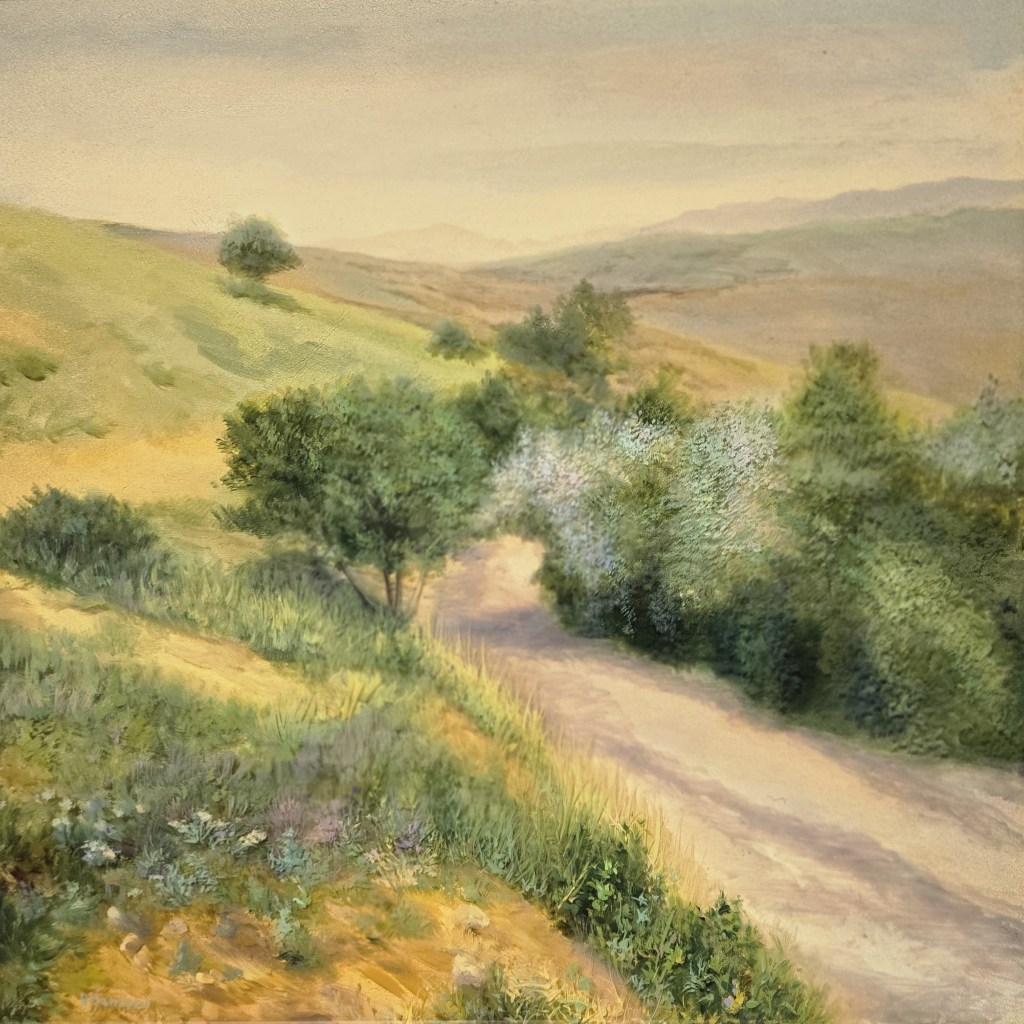
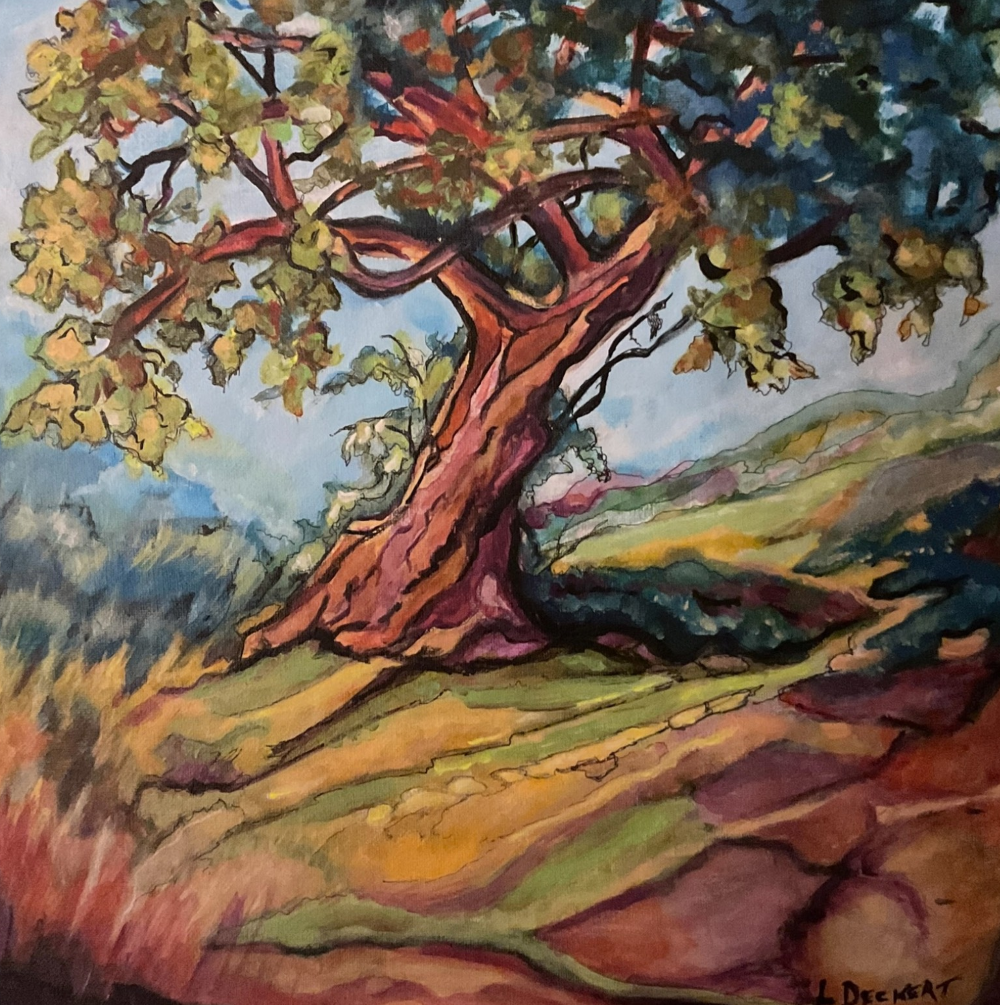
(Pictured: Brush and Palette artist Linda Deckert’s “High on a Windy Hill”, acrylic, 24 by 28 inches.)
The club strives to provide a supportive environment for members, to provide opportunities to broaden artistic skills, and to promote visual art in the community at large.
What differentiates the B & P Club from other art groups is the nature and quantity of its activities. Each meeting has an invited guest who speaks on a wide variety of topics relating to art. The meetings are also social occasions with time for friendly conversation and interaction during a coffee break. As well, there are two club luncheons each year.
An annual show and sale gives members a specific event to work toward. Working together at the show creates a deep bond as members all pull together to make the event a big success.
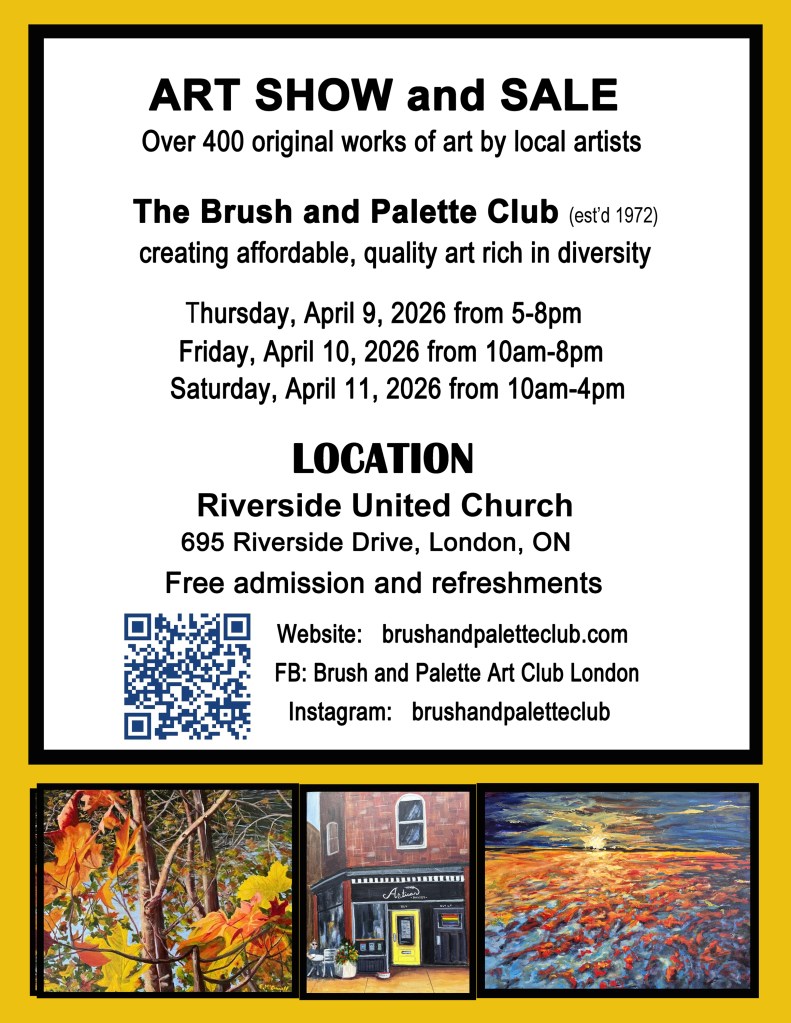
The Brush and Palette Club’s next Art Show and Sale is April 9 to 11 at Riverside United Church.
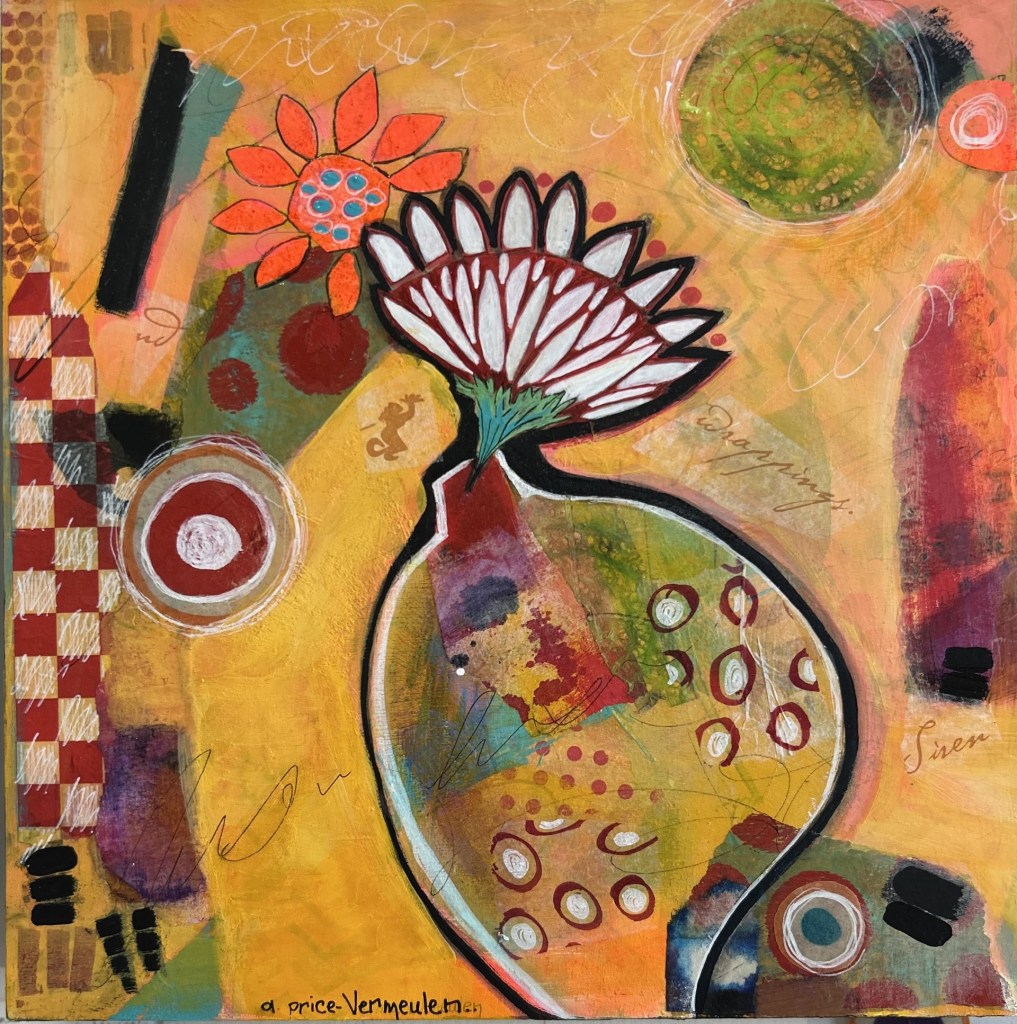
(Pictured: Brush & Palette artist Alice Price-Vermeulen’s “Palimpsest”, mixed media, 12 by 12 inches.)
Kidd joined the group in 2012. She says, “Being a member has encouraged me to persevere and to grow as an artist, and I have benefitted from the friendship and support of other members.” She is also a long-time member of the Gallery Painting Group, where she enjoys “plein air” work. She says, “Each group offers various advantages, and I would not give up either of them!”
The Gallery Painting Group (GPG) was formed in 1953 at the recommendation of the president of the Western Art League, which was founded in 1876 to promote art in London, Ontario
It includes 70 local artists who enjoy the plein air painting experience, which is the act of painting outdoors. From May to October, members of the group paint on location on Tuesday and Saturday mornings at various locations in and around the London area.
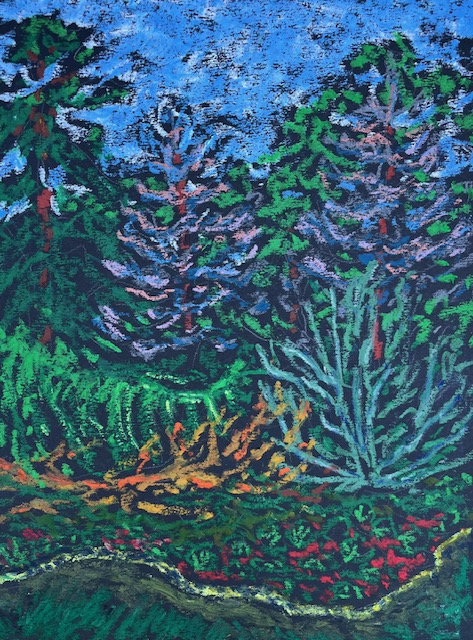
(Pictured: Gallery Painting Group artist Wendy Reid’s “Off the Trail”, oil pastel on black paper, 9 by 12 inches. From a plein air day at Springbank Park.)
As members interact frequently, official meetings are limited to two per year.
Marily Kidd says, while the group has fewer meetings, members interact frequently from May to October while painting together outdoors in and around London in “fascinating and diverse locations.” Because it’s a smaller group, the sense of community is strong.
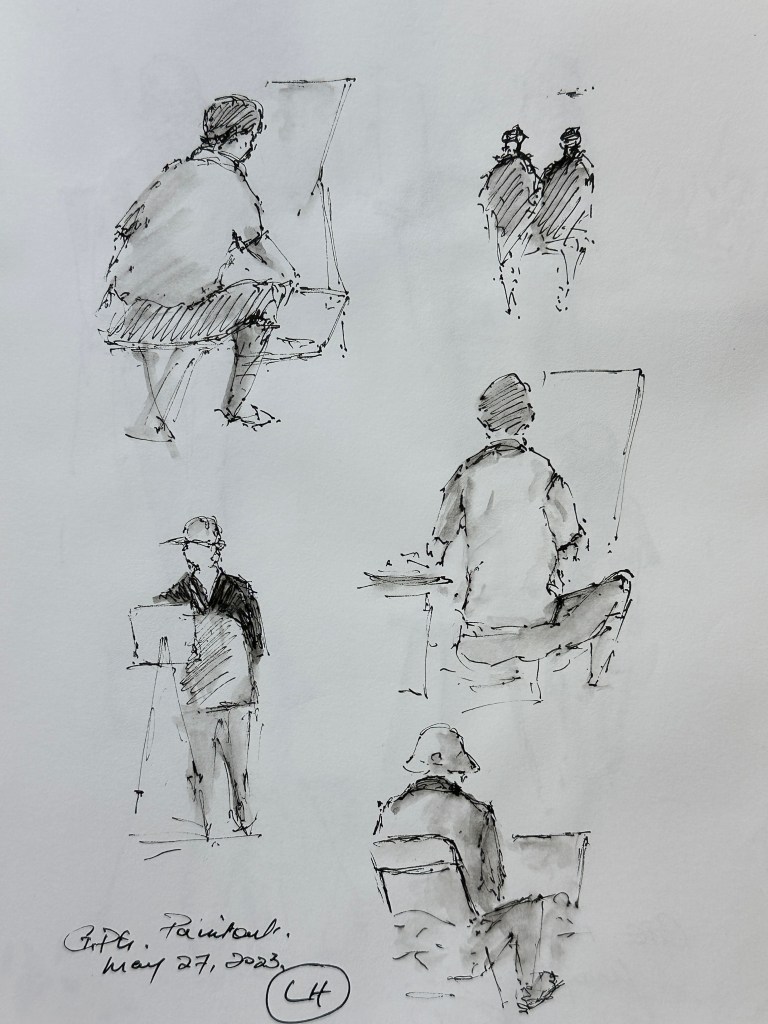
(Pictured: On location sketches by GPG artist Len Hughes showing members at work.)
Each fall, the GPG holds a show and sale of the paintings produced by its members throughout the summer. Their next show will take place at First Street. Andrews United Church, October 22nd to 25th, 2026.
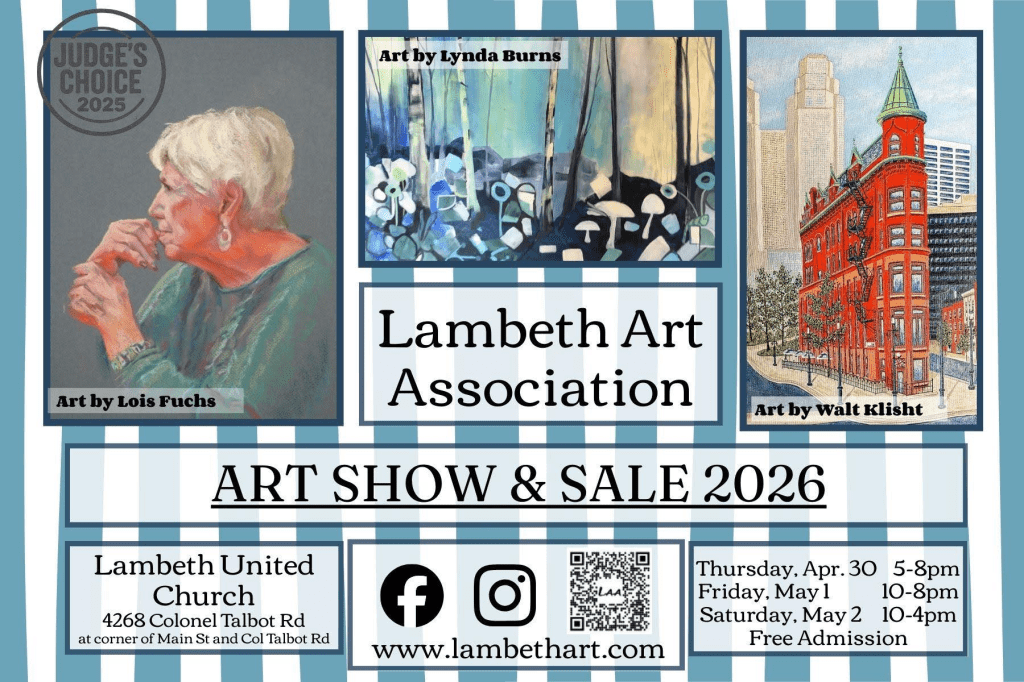
The Lambeth Art Association (LAA) provides support for established and emerging artists in the practice and appreciation of art. It fosters relationships, delivers educational opportunities, and offers exhibition opportunities.
Begun in 1972, with just five members, the Lambeth Art Association now boasts a membership of over 130 artists. LAA members work in oil, acrylic, watercolour, pastel, pencil, fibre, and mixed media. Members meet monthly, from September to May at Riverside United Church. All meetings feature a guest speaker or a hands-on activity. Each year, members enjoy six art-based workshops and community events. Members exhibit their artwork at the association’s popular Art Show and Sale held in the spring of each year.
The next show is April 30 to May 2, 2026, at Lambeth United Church, 4268 Colonel Talbot Road at Main Street. The show will include framed and unframed work in a variety of media. Styles range from traditional to abstract.
Sold work is taken home immediately by its lucky owners and the resulting vacant space is quickly filled with art that has been held in reserve. Savvy visitors come more than once to avoid missing that special piece.
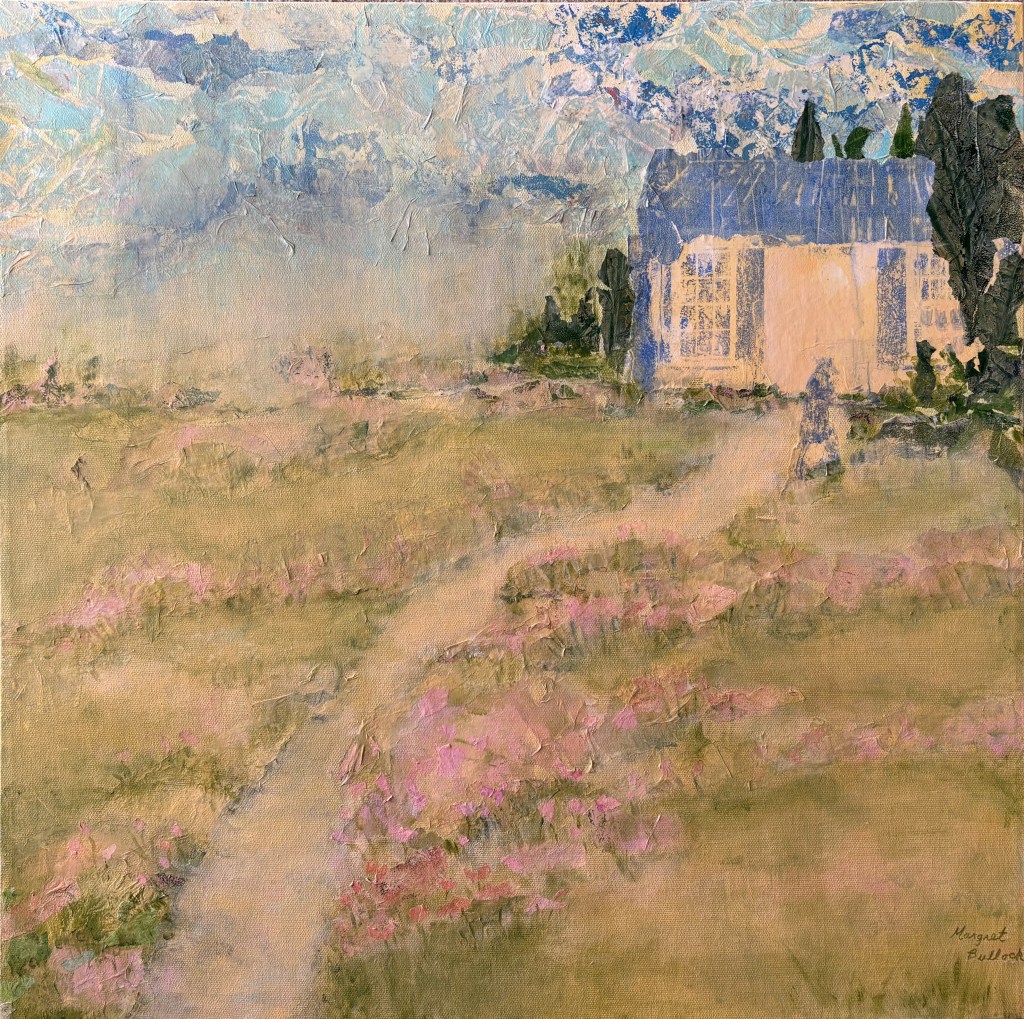
(Pictured: Lambeth Art Association artist Margret Bullock’s “Field of Dreams”, mixed media collage of an imaginary garden scene, 20 by 20 inches.)
Patricia Walker joined the LAA in 2025. She says, “I feel very lucky to be part of the Lambeth group.” When she moved back to southwestern Ontario in 1980, she enquired about joining, but the wait list at that time was years long, so she continued to work in isolation with not a whole lot of excitement about art. This, recalls Walker, resulted in a “period of non-productivity.”
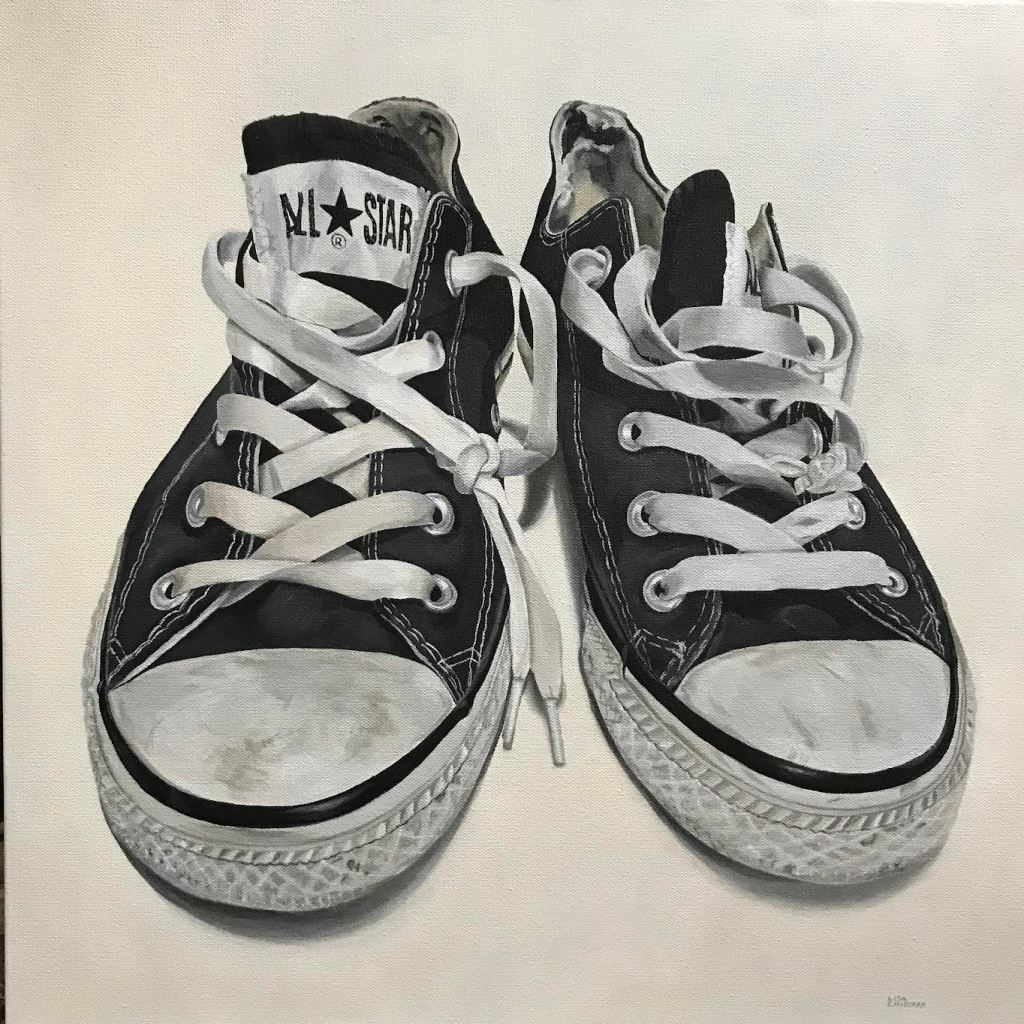
(Pictured: LAA artist Lisa Chiborak’s “Really Big Shoes”, acrylic, 20 by 20 inches.)
Walker says, “The group is friendly and willing to share their techniques, their journey and their frustrations with different mediums. It makes me want to keep creating.” In addition to the LAA, Walker belongs to the London Community Artists, the St. Thomas Art Guild, the Port Stanley Art Guild and the Creative Nomads.
The London Community Artists (LCA) is the new kid on the block. It was formed by Wendy Jennings in 2018 in response to the lengthy wait lists to join other clubs.
Membership was initially limited to 50 members, but this was increased to 75 in 2023. Even with the expansion in membership, LCA maintains a wait list of approximately 100 hopefuls. New members are accepted in January to fill any vacancies that have come about throughout the year.
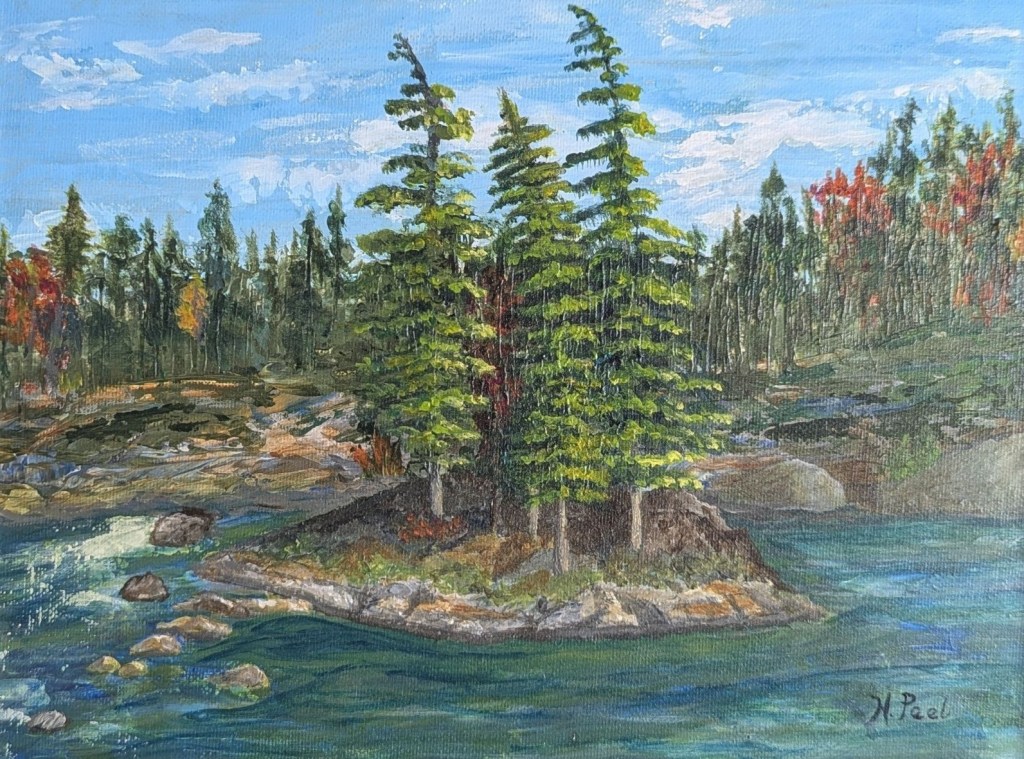
(Pictured: 09 London Community Artists’ Heather Peel, “Autumn Calm”, acrylic (mostly palette knife work), 11 by 14 inches.)
Members’ meetings feature speakers, and there are frequent “Paint Days” at Western Research Park, where members get together to paint and share some special times. The club also offers monthly art challenges in which members submit their best work in response to a specific topic. Entries are reviewed by their peers, and the first and second-place winners receive a gift card for art supplies.
In 2024, they began hosting workshops led by both internal and external experts.
The LCA has established long-term partnerships with Cherryhill Village Mall, Western Research Parks and the Children’s Hospital at London Health Sciences’ Victoria Campus. Members have art on display at each of these locations throughout the year. Their longest-running and most successful display is at the Cherryhill location, where member artists have sold over 140 pieces of art.
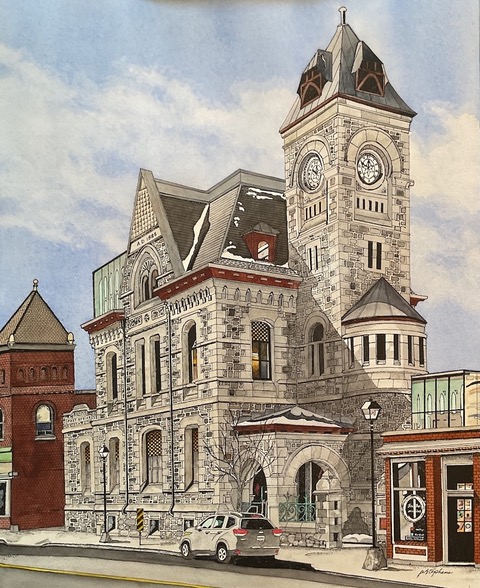
(Pictured: “Old Post Office (Cambridge)”, watercolour and ink, 16 by 20 inches, by LCA artist Bill Stephens.)
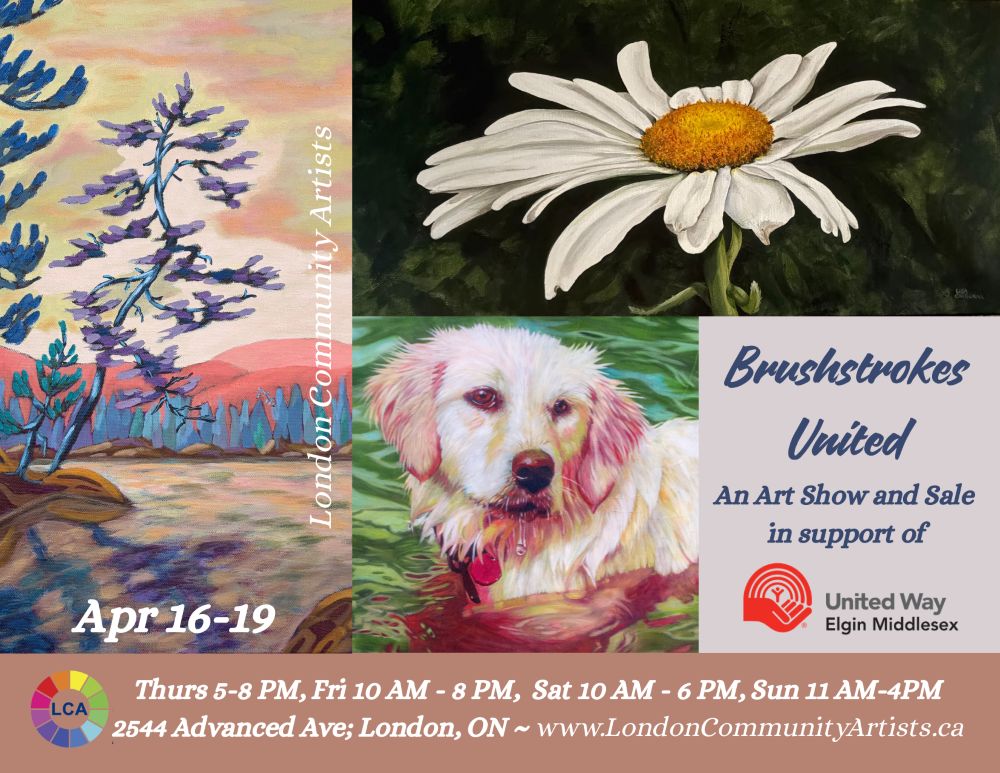
LCA hosts two major Art Shows each year: one in April and another in November. This year’s Spring Show is scheduled for April 16 to 19, 2026, at The Collider, located in the Western Research Park off Veterans’ Memorial Drive and Bradley Avenue.
Current president Bill Stephens joined in 2019. It is the only club he belongs to, and he has been involved in all the club’s activities.
Membership has served him well in his personal art journey. Stephens says, “I have learned so much from our talented members.”
Beth Stewart is a writer, educator, and visual artist. She has a B.A. and a B.Ed. from the University of Windsor and a Diploma in Art Therapy from Western University. Beth has worked as an Art Therapist with Canadian war veterans and as a Secondary School Teacher of art and English for the TVDSB. She retired in 2024.
Beth was the arts editor at Scene Magazine from 2004 to 2006. She founded Artscape Magazine in 2006 and served as its editor until 2008. In addition, Beth wrote on the arts for Lifestyle Magazine from 2006 to 2017 and served as the copy editor for The Beat (in print) from 2009 to 2013.
As a visual artist, Beth works mainly in dry media and favours coloured pencil. Over the past decade, Beth’s focus has been on wild and domestic birds. Beth is a member of the Coloured Pencil Society of America, the Gallery Painting Group, the Eclectic Collage Collective, the Lambeth Art Association, and a founding member of the Coloured Pencil Artists of Canada group.
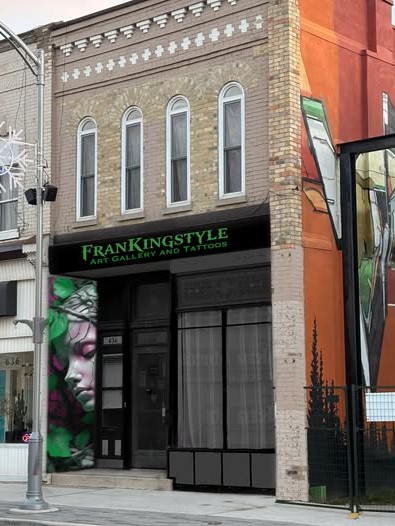
Frankingstyle Art Gallery and Tattoos, located at 632 Talbot Street in St. Thomas, self-describes as a “space where ink and imagination collide”. The gallery-tattoos combo is a place where art does more than hang on the walls. It “lives and breathes.”
(Pictured: Frankingstyle Art Gallery. Photo by Frank Pelsoczi.)
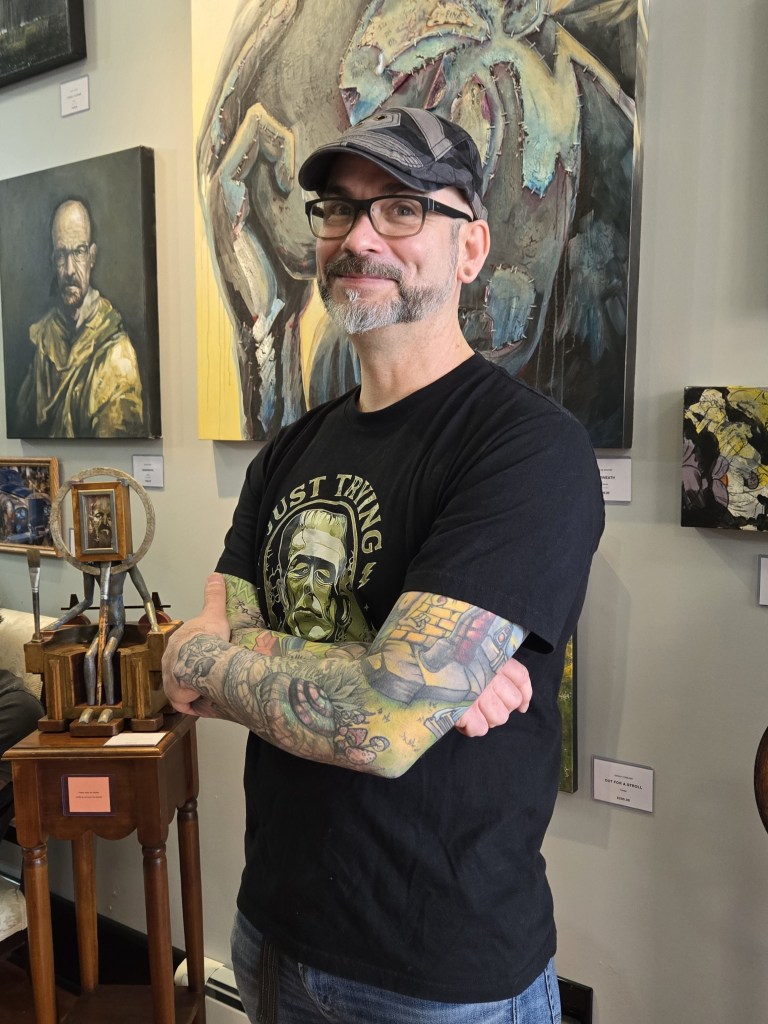
Unlike its namesake, this creation is not one to be shunned, especially by its creator, Francis Martin. It fits well into the local arts scene and offers a welcome infusion of exhibition space.
(Pictured: Francis Martin. Photo by Beth Stewart.)
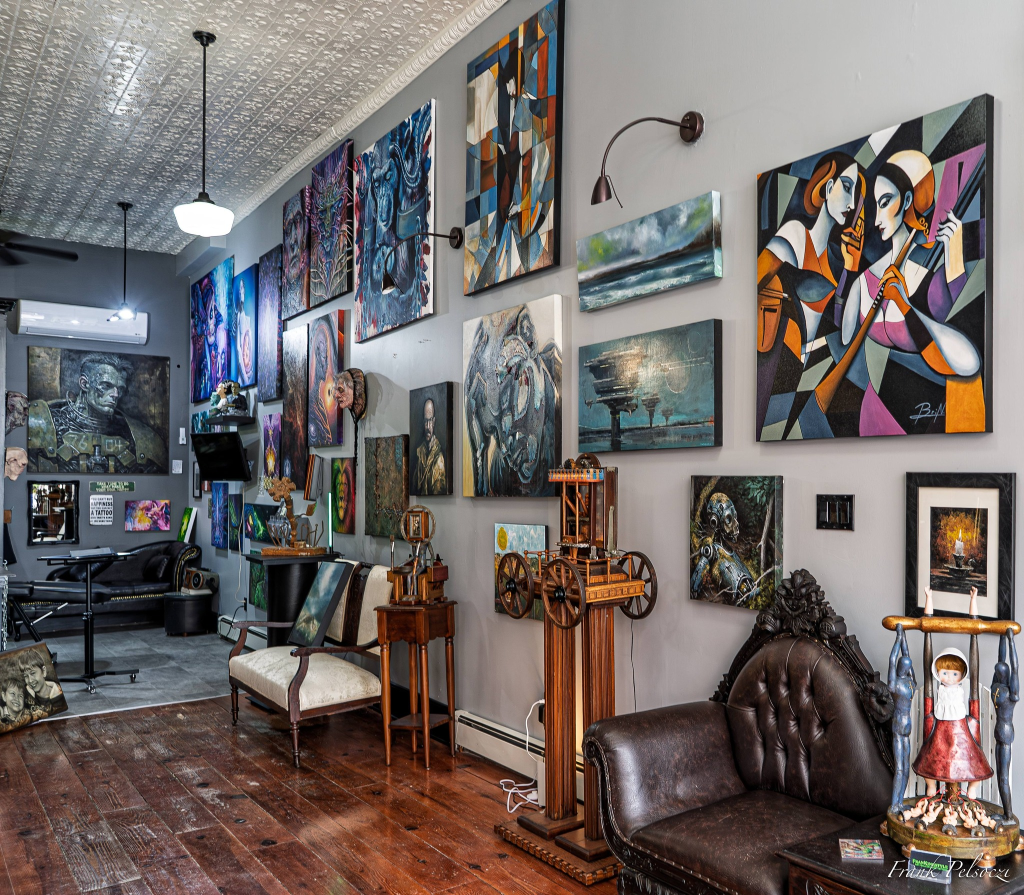
I dropped by the gallery on March 27 for a sneak peek at its inaugural show. I found it to be spacious, welcoming, and chock-a-block with art of every description.
(Pictured: Installation shot of left wall. Photo by Beth Stewart.)
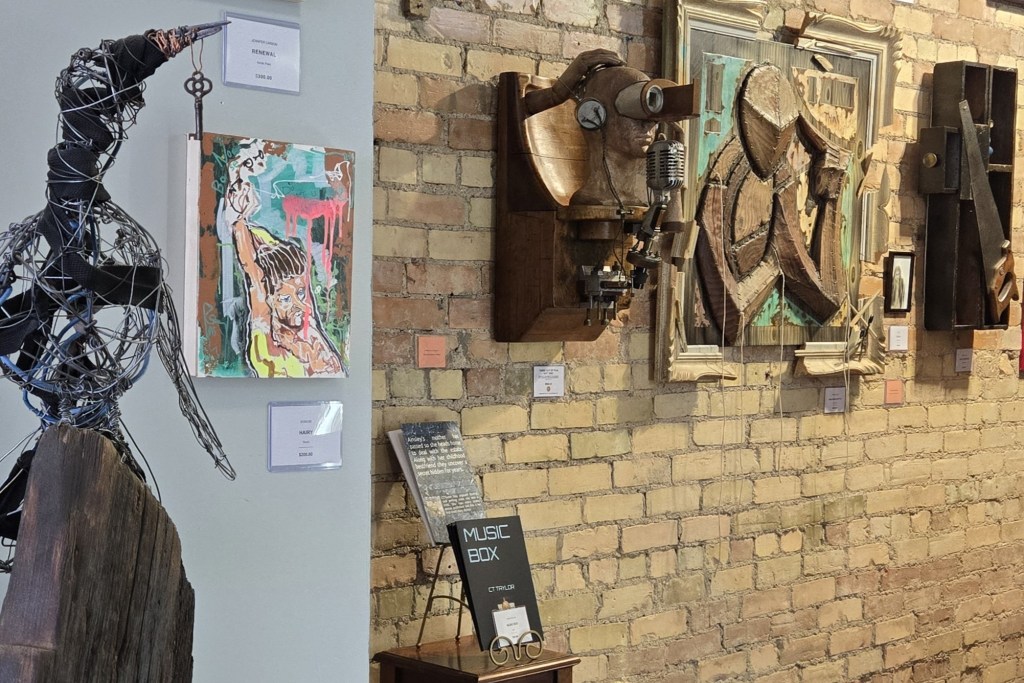
In addition to seeing pieces by Martin and his talented son Koen, I encountered work by many familiar artists – Sarah Cowling, Angela Hardy, Dennis Kalichuk, Brian Normandeau, Robert Ruby, Marijo Swick, Suzette Terry, and Laura Woermke – and enjoyed art by many other artists who were new to me.
(Pictured: Sarah Cowling, “Beside the Sea”, collage. Photo by Beth Stewart.)
Martin was raised in Elliot Lake and has been creating art in one way or another all his life. After landing in St. Thomas several years ago, he added tattooing to his creative repertoire. It complemented his art practice and gave him a steady gig. He says, “Tattooing funds the art gallery.”
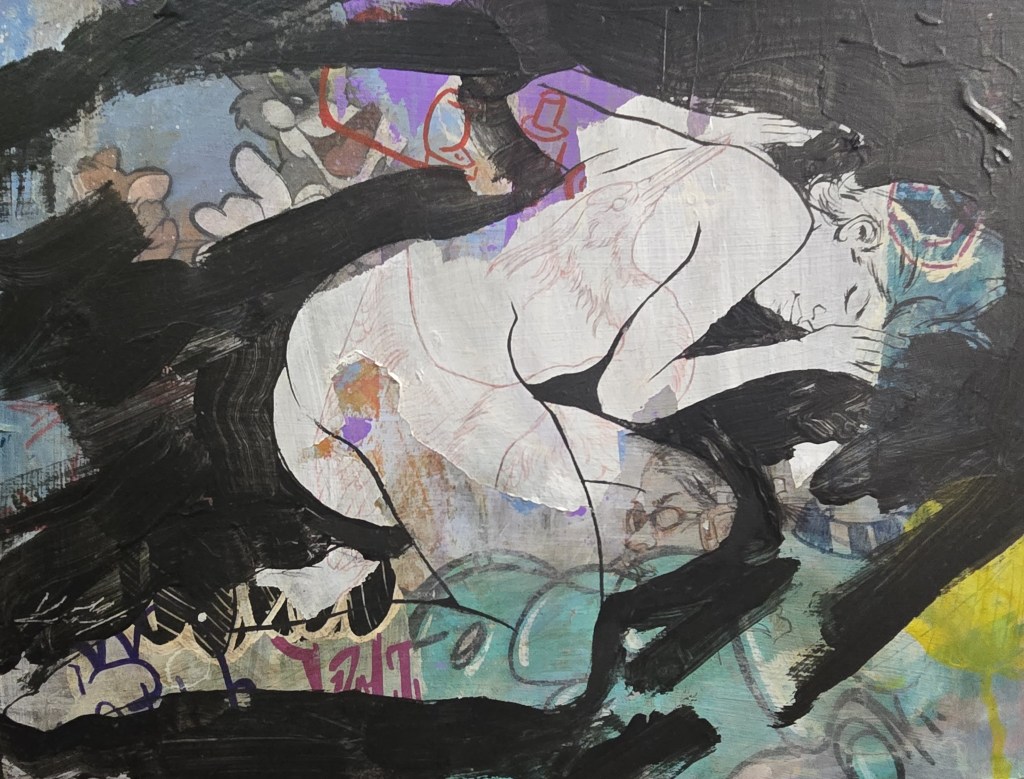
(Pictured: Koen Martin, Resting Place, acrylic on wood panel. Photo by Beth Stewart.)
Martin himself works in a variety of styles, including airbrushing, but says he loves playing with texture.
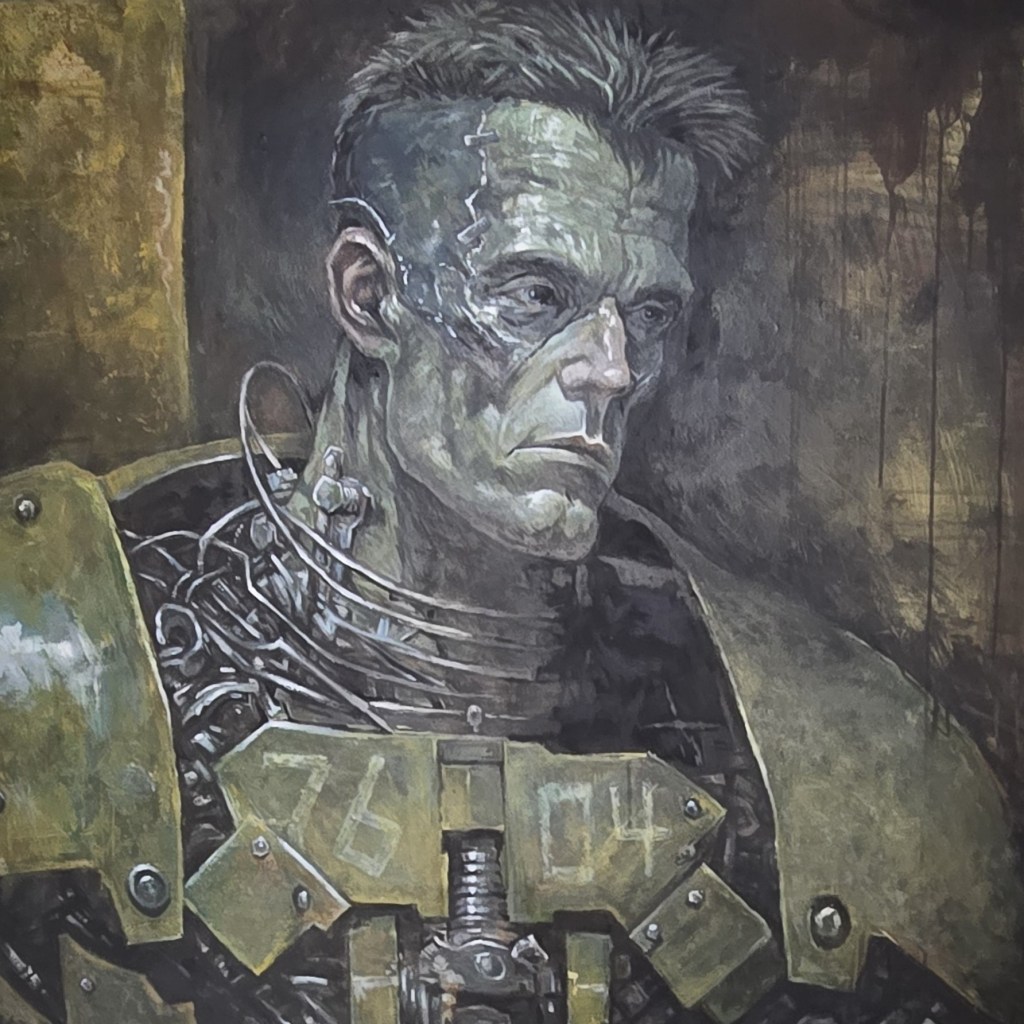
Speaking of play, Martin and his son Koen have created a hybrid persona, “Franko,” who has his own line of work. One such piece, currently on view, is the acrylic painting “Soldier of Creation Unit 76-04”.
(Pictured: “Soldier of Creation Unit 76-04” is a collaborative acrylic painting done by Martin and his son Koen working under the name “Franko”. Photo by Beth Stewart.)
Martin is an experienced teacher and, in the future, he plans to offer workshops through the gallery. He says he’ll likely focus on drawing and mixed media.
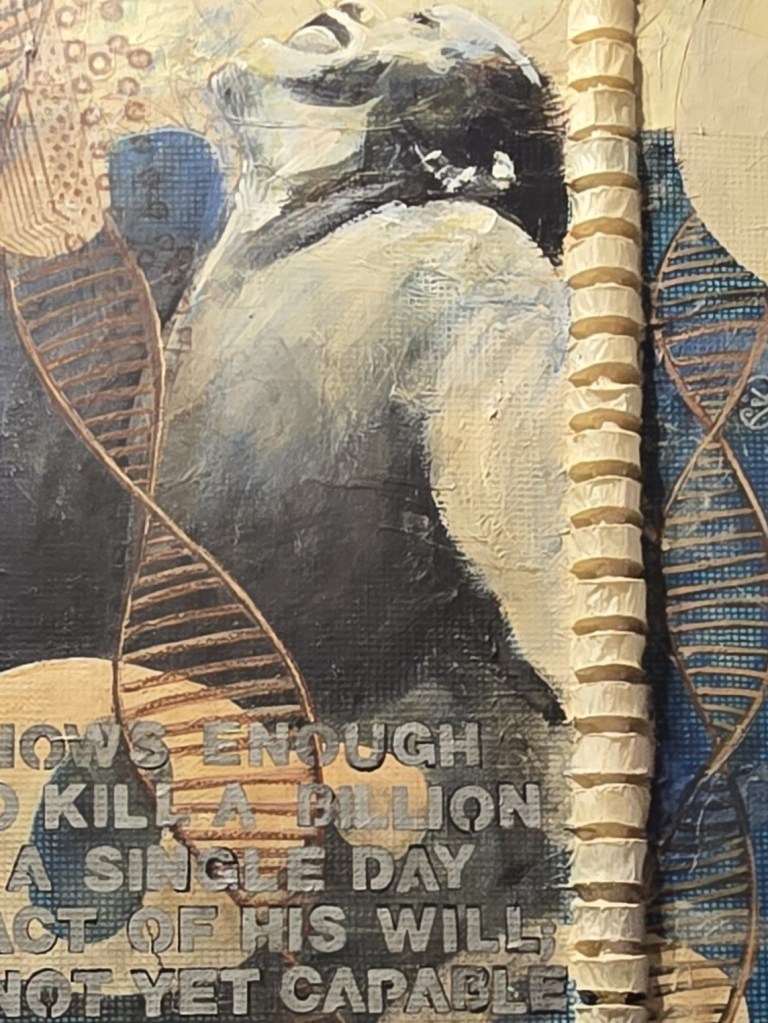
Other works and artists on exhibit include:
(Pictured: Angela Hardy, “Ignited. Come As You Are,” acrylic with silver leaf. Photo courtesy of the artist.)
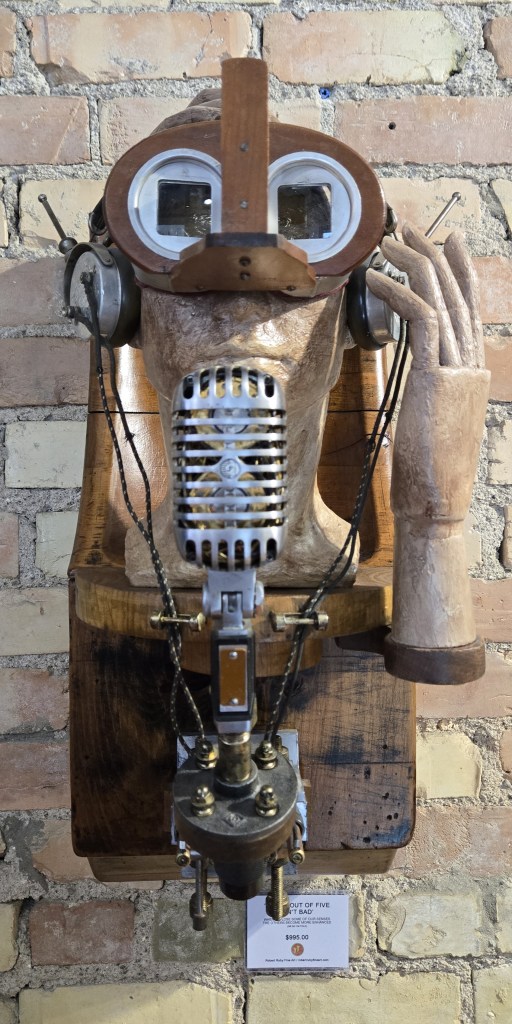
(Pictured: Robert Ruby, Three Out of Five Ain’t Bad”, assemblage. Photo by Beth Stewart.)
Beth Stewart is a writer, educator, and visual artist. She has a B.A. and a B.Ed. from the University of Windsor and a Diploma in Art Therapy from Western University. Beth has worked as an Art Therapist with Canadian war veterans and as a Secondary School Teacher of art and English for the TVDSB. She retired in 2024.
Beth was the arts editor at Scene Magazine from 2004 to 2006. She founded Artscape Magazine in 2006 and served as its editor until 2008. In addition, Beth wrote on the arts for Lifestyle Magazine from 2006 to 2017 and served as the copy editor for The Beat (in print) from 2009 to 2013.
As a visual artist, Beth works mainly in dry media and favours coloured pencil. Over the past decade, Beth’s focus has been on wild and domestic birds. Beth is a member of the Coloured Pencil Society of America, the Gallery Painting Group, the Eclectic Collage Collective, the Lambeth Art Association, and a founding member of the Coloured Pencil Artists of Canada group.
(Arrival at Museum London’s All Around Me, All Around You. Photo: Beth Stewart.)
During March break week, I revisited Museum London’s All Around Me, All Around You and experienced, for the first time, Tropi-X: Brazilian Art in Canada, 1970s-Now. I was accompanied by my eleven-year-old grandson Hunter.
All Around Me, All Around You features artworks and artifacts from Museum London’s permanent collection with an emphasis on the creative spirit of regional artists. It invites viewers to explore art at a sensory level as well as through memory, language, and symbols.
Hunter’s eye view was vastly different from mine, and I dutifully followed his lead.
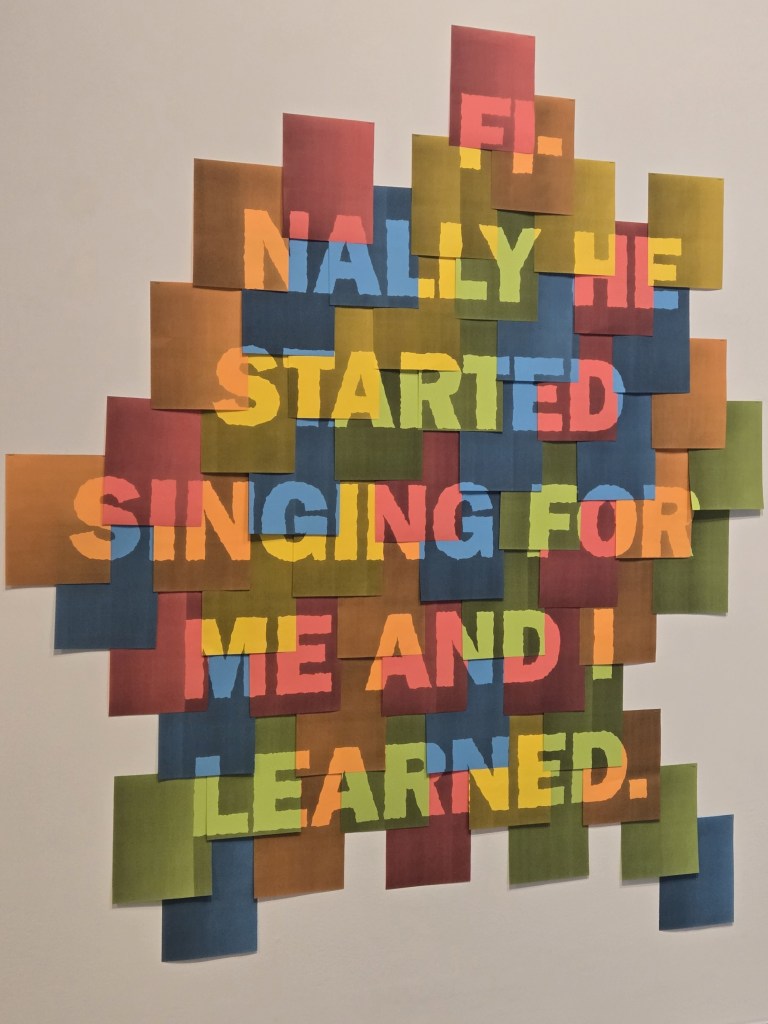
We began with the “All Around Me, All Around You” exhibition, and the first piece that grabbed Hunter’s attention was Raymond Boisjoly’s text-based “As it Comes (Started Singing).”
(Raymond Boisjoly’s “As it Comes (Started Singing)”, inkjet prints and staples on stock paper, 2023. Photo: Beth Stewart.)
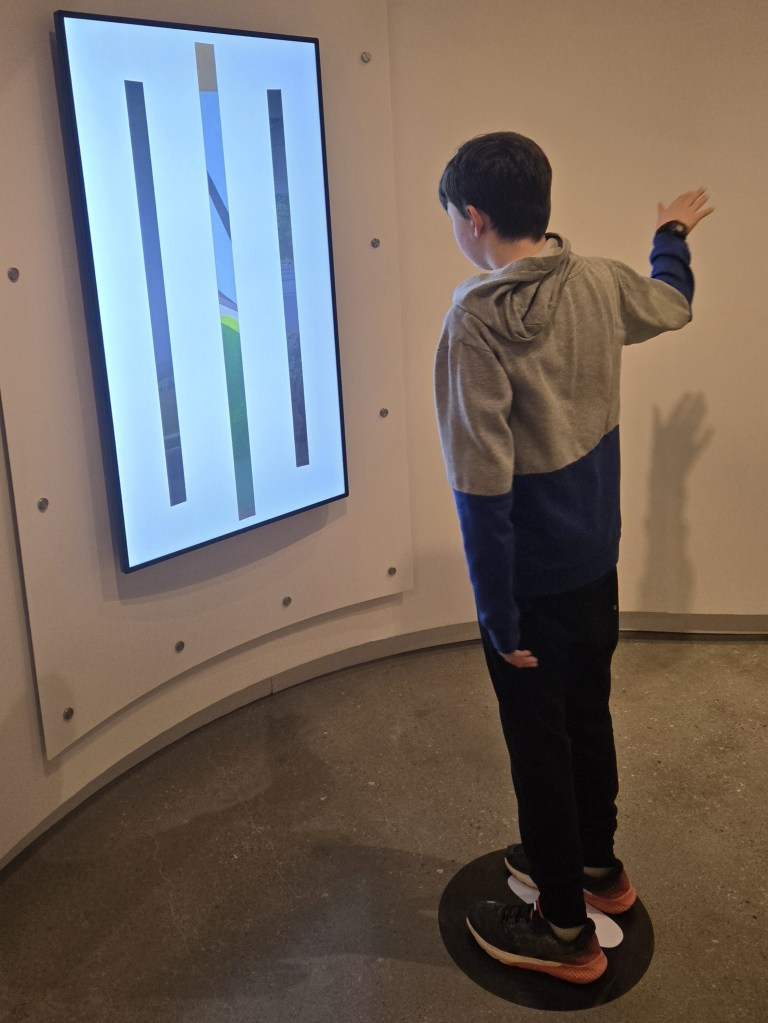
Next, he gravitated towards an interactive projection of Bernice Vincent’s “All Around Me, All Around You,” a piece that also gives the exhibition its name and embraces its joie de vivre.
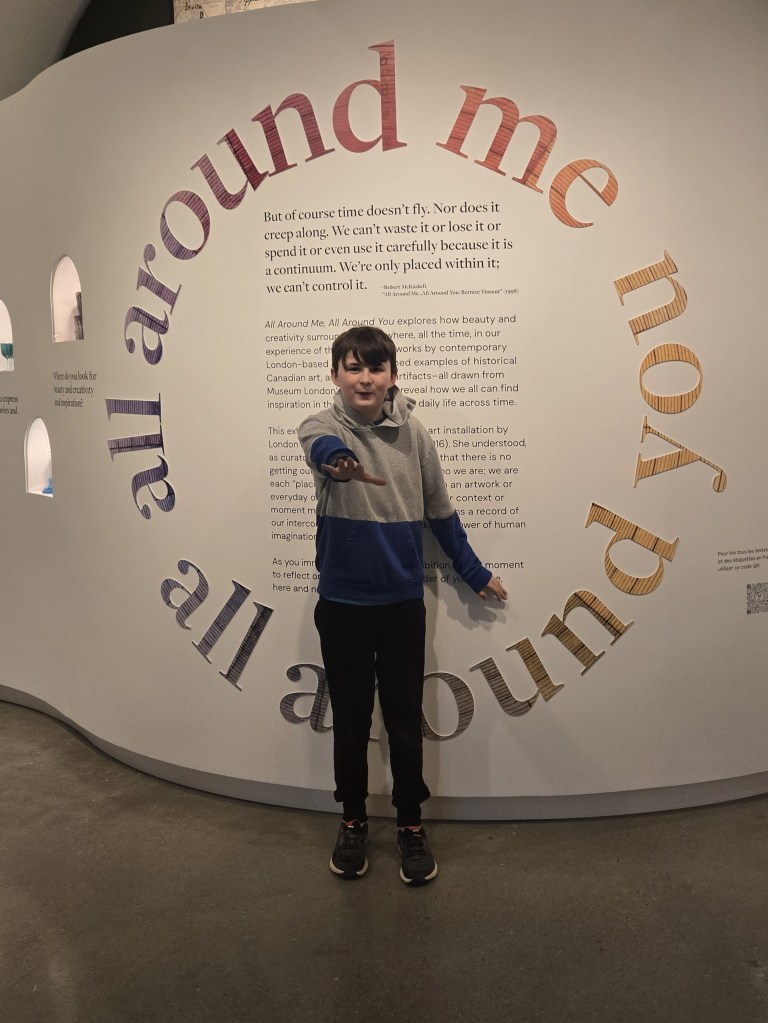
(Hunter interacting with the projection of Bernice Vincent’s “All Around Me, All Around You”. Photo: Beth Stewart.)
Hunter spent a great deal of time exploring it and following the instructions (“Wave arm right, left below waist to navigate between individual pieces. Raise arm up/ down to show or hide accompanying artist note. Wave arm in either direction to dismiss instructions and explore the artwork.”) and concluded, with much satisfaction, “The pictures are good, and you can move the thing by just moving your hand.”
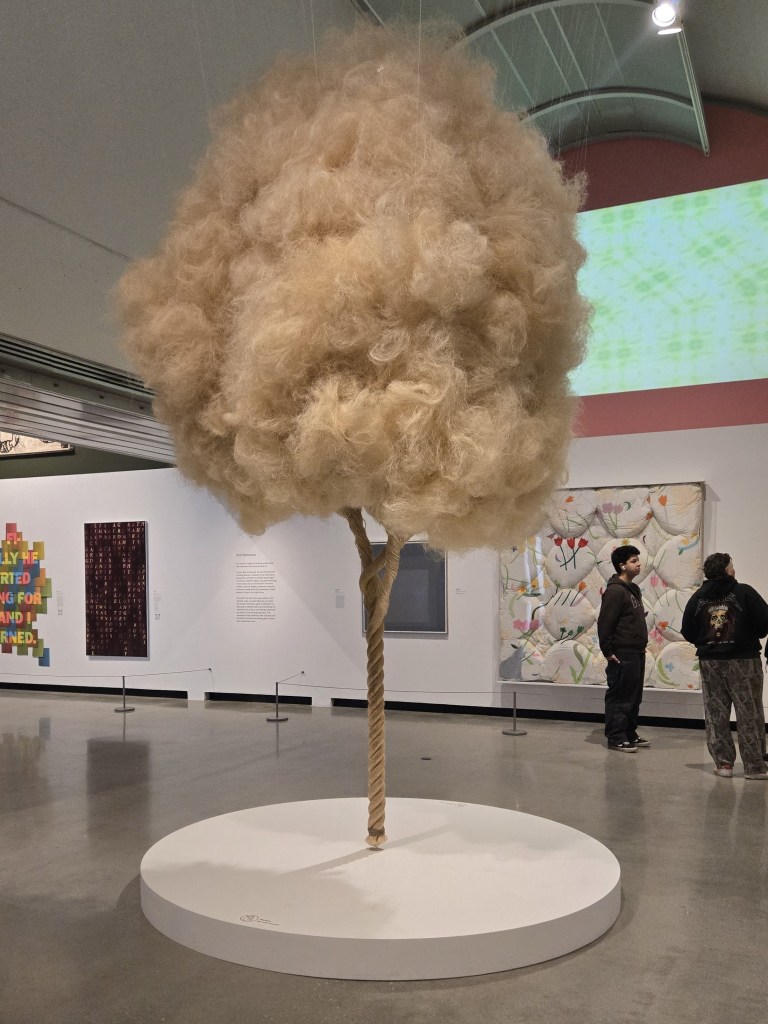
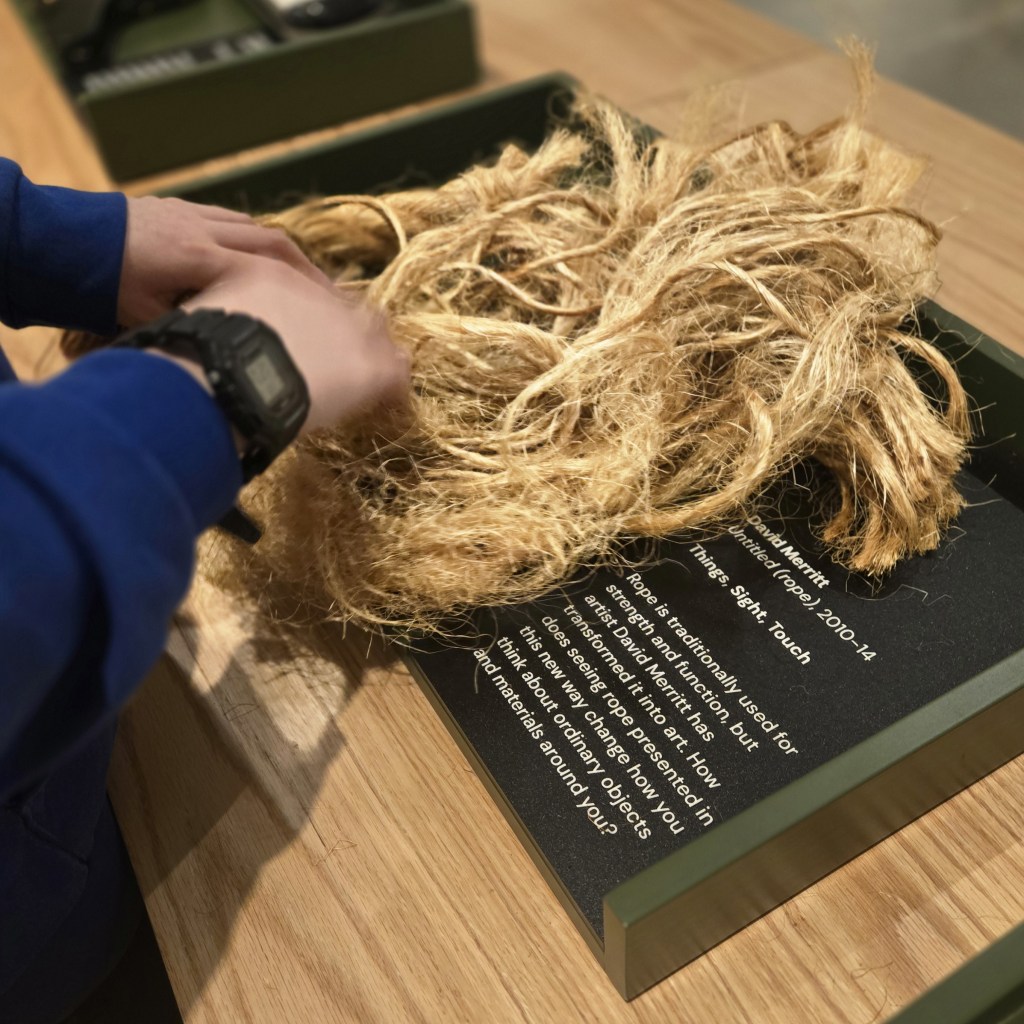
David Merritt’s “Untitled (rope),” was the next attention grabber. Hunter said, “It reminds me of The Lorax by Dr. Seuss because it looks like his fluffy trees. It also looks like chimney smoke that is going up in the air or like an explosion.”
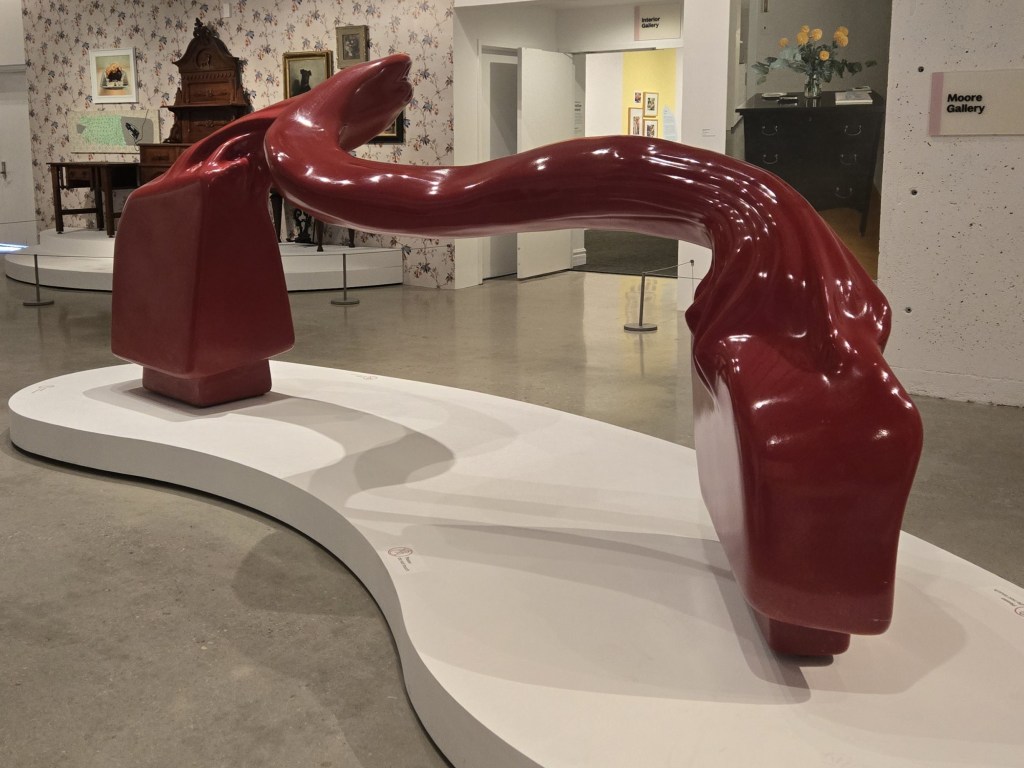
Walter Redinger’s large biomorphic piece, “Snake”, soon slithered into view. While Hunter saw it first as a snake, he then thought it looked more like an extension cord. He was impressed with how “nicely painted” it was.
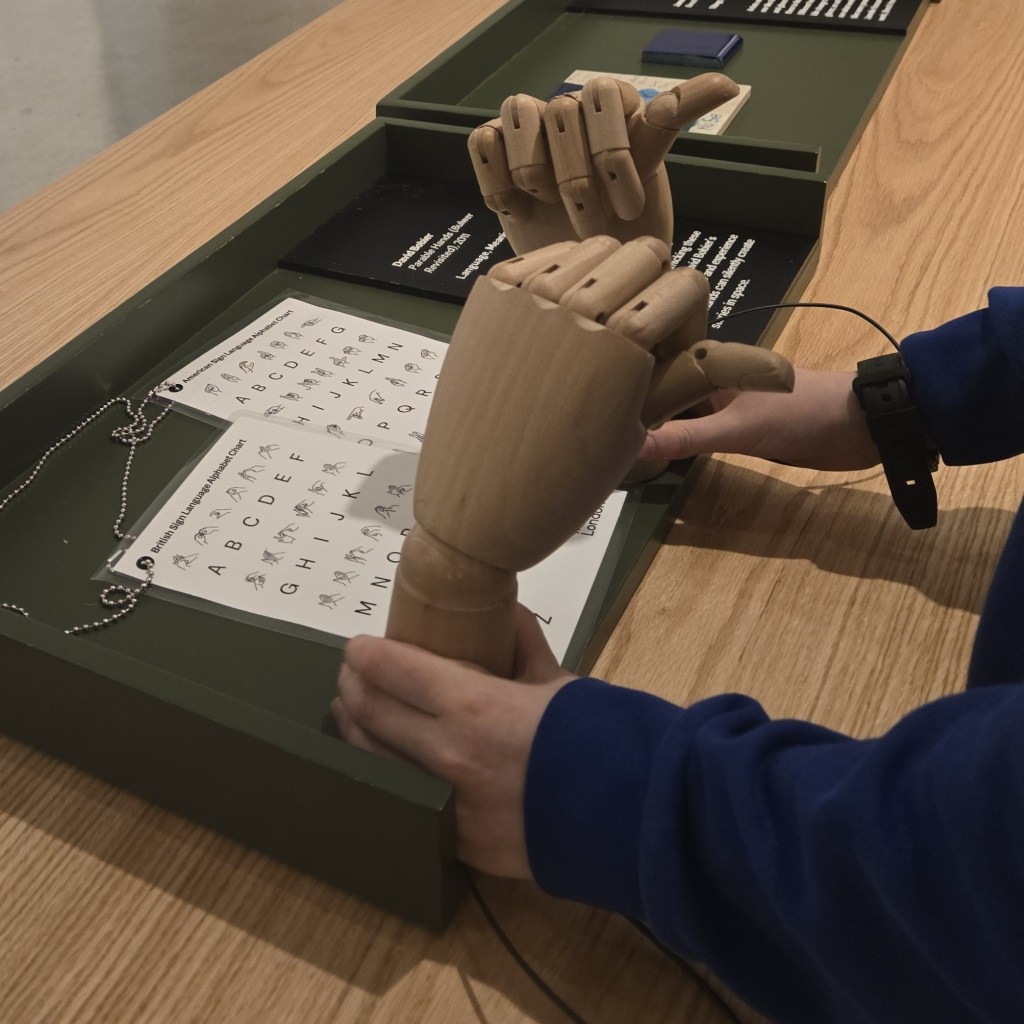
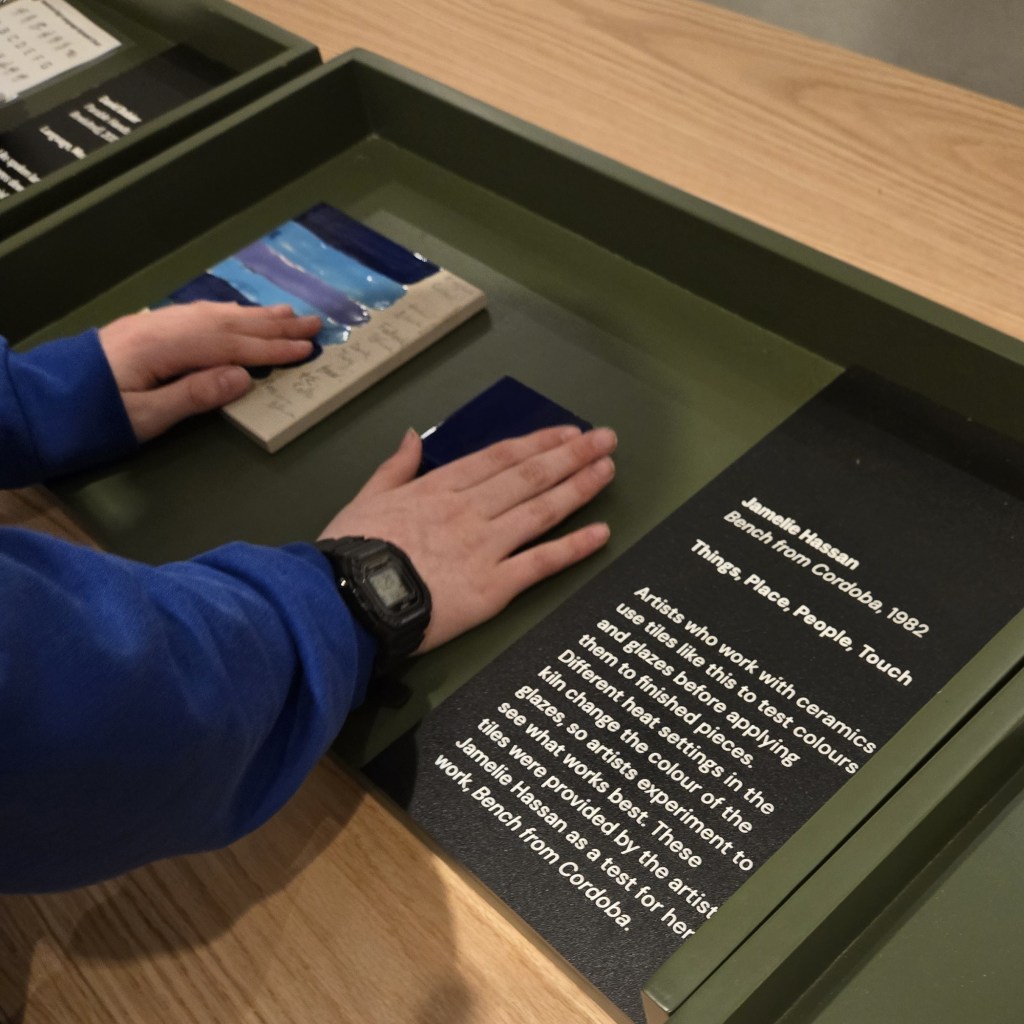
Next, Hunter was able to satisfy his tactile urges, a rare opportunity in most galleries, at a designated touch station. Each of the six displays is connected to pieces on display. Hunter was drawn to David Bobier’s “Parable Hands,” which uses articulated wooden hands to explore gestures and language.
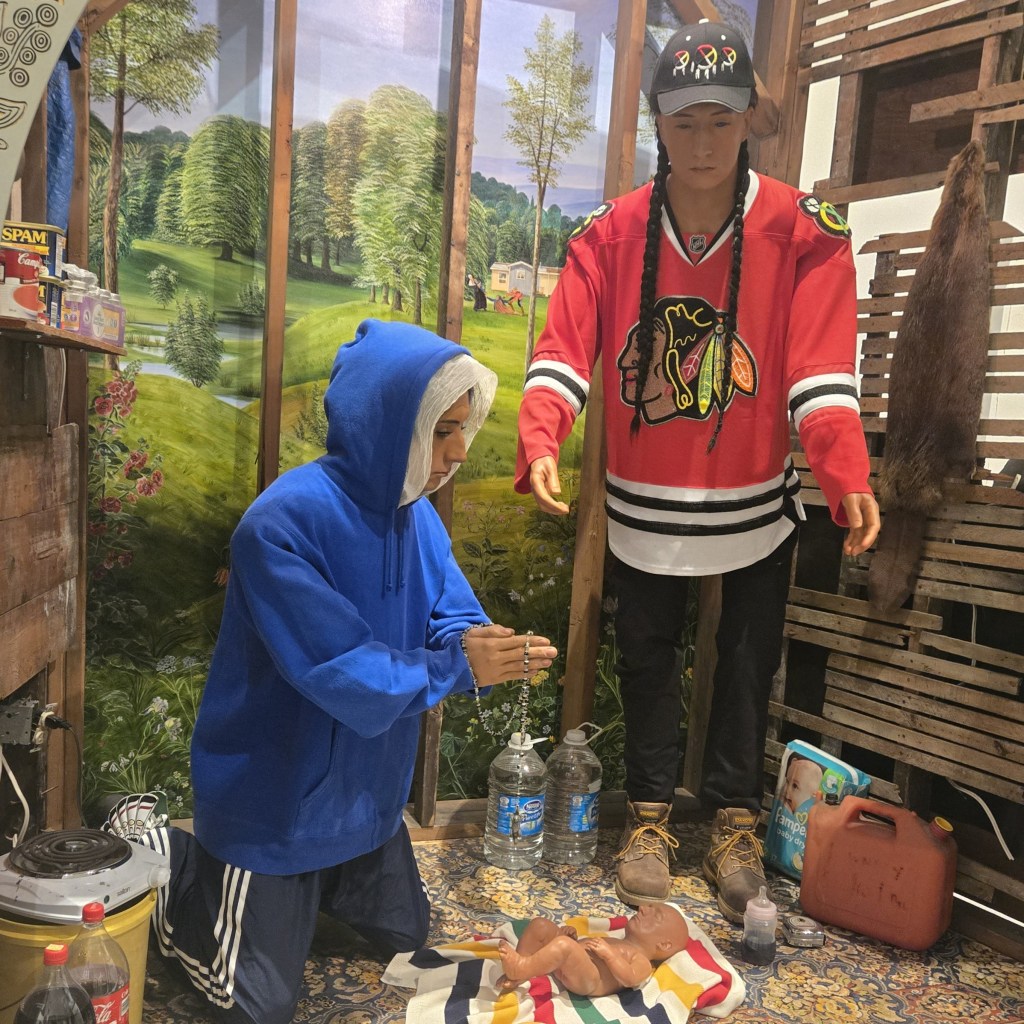
While he recognized some kind of Indigenous connection, Hunter didn’t see a “remagined Christian holy family”; he saw something else entirely. He observed, “Maybe it [the head] grew because of the enchanted necklace above it,” and concluded, “they are doing some kind of ritual.”
Leaving All Around Me, we entered Tropi-X: Brazilian Art in Canada an exhibit comprised of 70 pieces that explore the preservation of Brazilian culture in Canada. It juxtaposes paintings, sculpture, and textile pieces from the 70s with contemporary pieces.
First up was Vinicius de Agular Sanchez’s “The Power of Speech (Shock),” a stop motion film that Hunter described as “fascinating because it combines music and art.”
His attention then went to a textile piece called “The Jaguar.” He said, “I think the cat is cool – it looks very soft – I want to touch it.”
(Ian Indiano, “Between here and there”, acrylic on paper, 102 by 122 cm, 2019. Photo: Beth Stewart.)
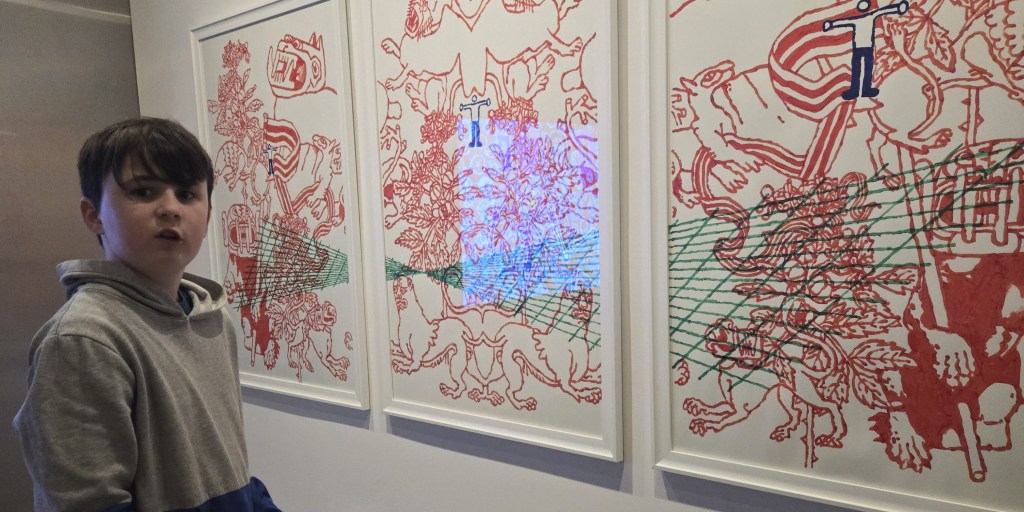
Three large acrylic-on-paper panels, “Between Here and There,” were next. Hunter liked that they seemed to tell a “continuing story,” and I introduced him to the word triptych. He noted there were three people, one inside each painting, and that the center panel was symmetrical (kudos to his art teacher). He liked how the side panels were mirror images of each other.
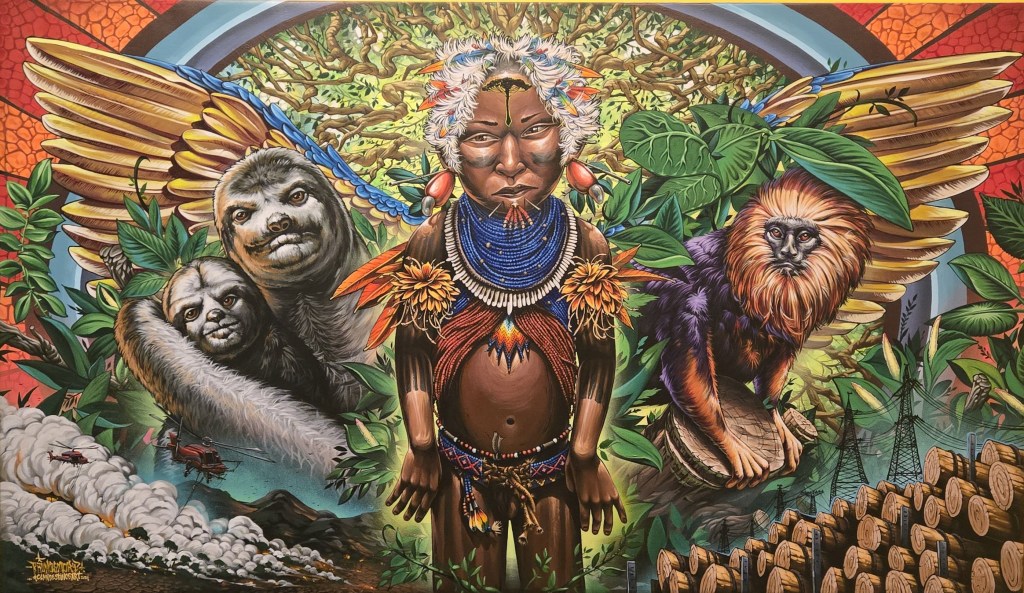
(Bruno Smoky, “Protect What We Have Left”, spray paint, acrylic, and airbrush on canvas, 165 by 287 cm, 2023-25. Photo: Beth Stewart.)
Bruno Smoky’s spray paint, acrylic, and airbrush on canvas painting “Protect What We Have Left” was a definite attention-grabber. Hunter liked that it had lots of colours and that it was so realistic. His favourite part was the two sloths. He commented on the solitary human: “I think it shows people rule; they are above everything else,” but then decided, “the person might be stranded and living with the animals.”
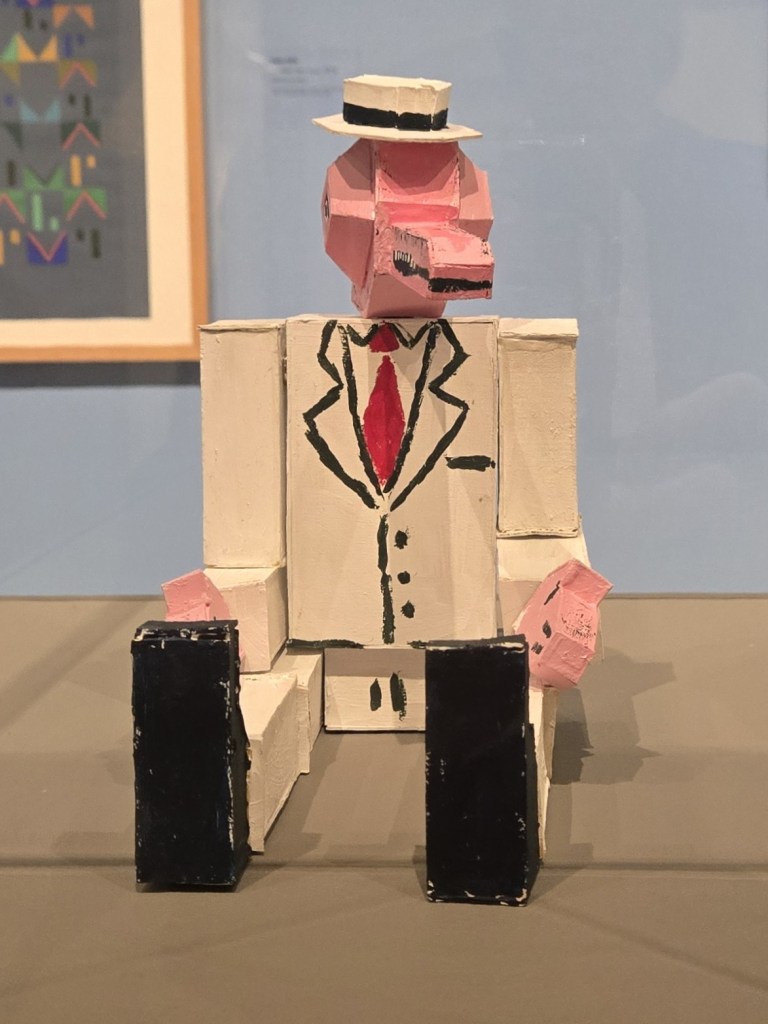
(Vinicius de Aguiar Sanchez, “Pink Dolphin”, balsa wood and wood paint, 2023. Photo: Beth Stewart.)
Vinicius de Aguiar Sanchez’s “Pink Dolphin” sculpture earned much admiration. Said Hunter, “I can relate to it because it looks similar to the stuff that I draw … really crazy things.”
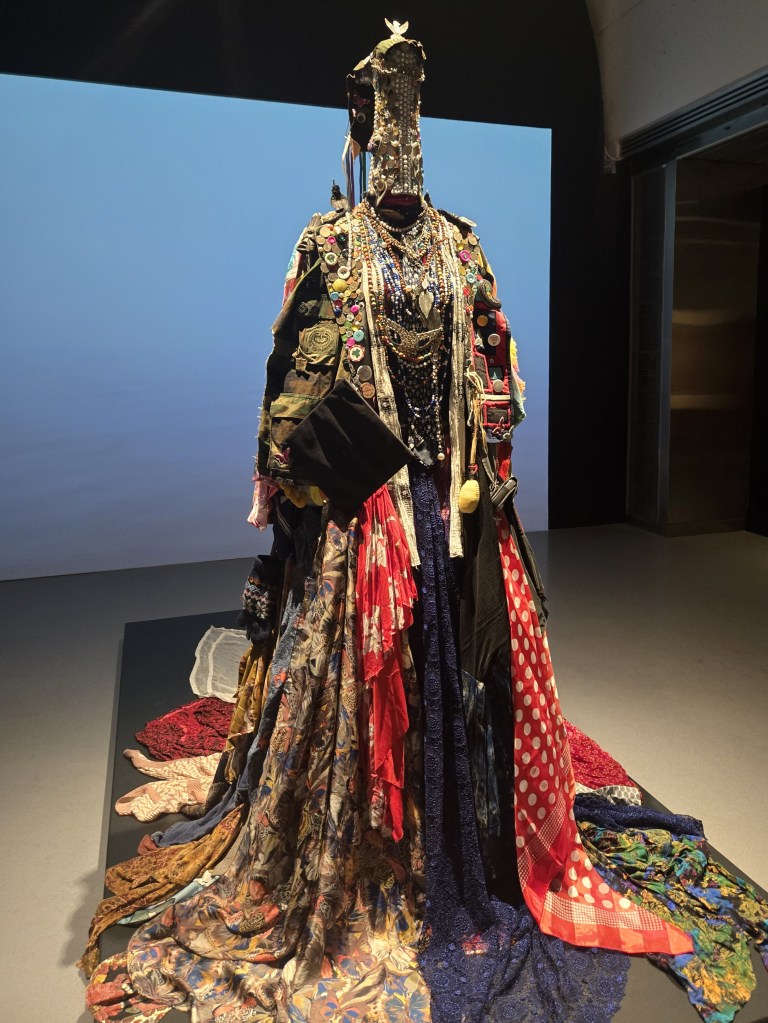
Our last piece of the day was Hélio Eudoro’ s mixed media installation “Mantle N° 5 – Battle Against Destiny – Moirai’s Fate Armour”. Hunter commented that it was “colourful and probably very heavy.” He liked that the artist had used a combination of “clothing, money, buttons, shiny stuff, and necklaces” in the piece.
Hunter said, “I first looked at the head, because someone’s head doesn’t look like that. I then noticed that the heart from the movie Moana is on it, so I think it might be a god.”
Visiting an exhibition with someone else adds another layer of exploration and understanding. Visiting with an eleven-year-old art enthusiast led me to look at pieces I might otherwise have passed and introduced me to unique interpretations. All in all, time well spent.
All Around Me, All Around You is located on the second level in the Volunteer/Moore Galleries and is ongoing. Tropi-X: Brazilian Art in Canada, 1970s-Now is also on the second level in the Ivey Galleries. It runs to April 19, 2026, so time is of the essence if you don’t want to miss it.
Beth Stewart is a writer, educator, and visual artist. She has a B.A. and a B.Ed. from the University of Windsor and a Diploma in Art Therapy from Western University. Beth has worked as an Art Therapist with Canadian war veterans and as a Secondary School Teacher of art and English for the TVDSB. She retired in 2024.
Beth was the arts editor at Scene Magazine from 2004 to 2006. She founded Artscape Magazine in 2006 and served as its editor until 2008. In addition, Beth wrote on the arts for Lifestyle Magazine from 2006 to 2017 and served as the copy editor for The Beat (in print) from 2009 to 2013.
As a visual artist, Beth works mainly in dry media and favours coloured pencil. Over the past decade, Beth’s focus has been on wild and domestic birds. Beth is a member of the Coloured Pencil Society of America, the Gallery Painting Group, the Eclectic Collage Collective, the Lambeth Art Association, and a founding member of the Coloured Pencil Artists of Canada group.
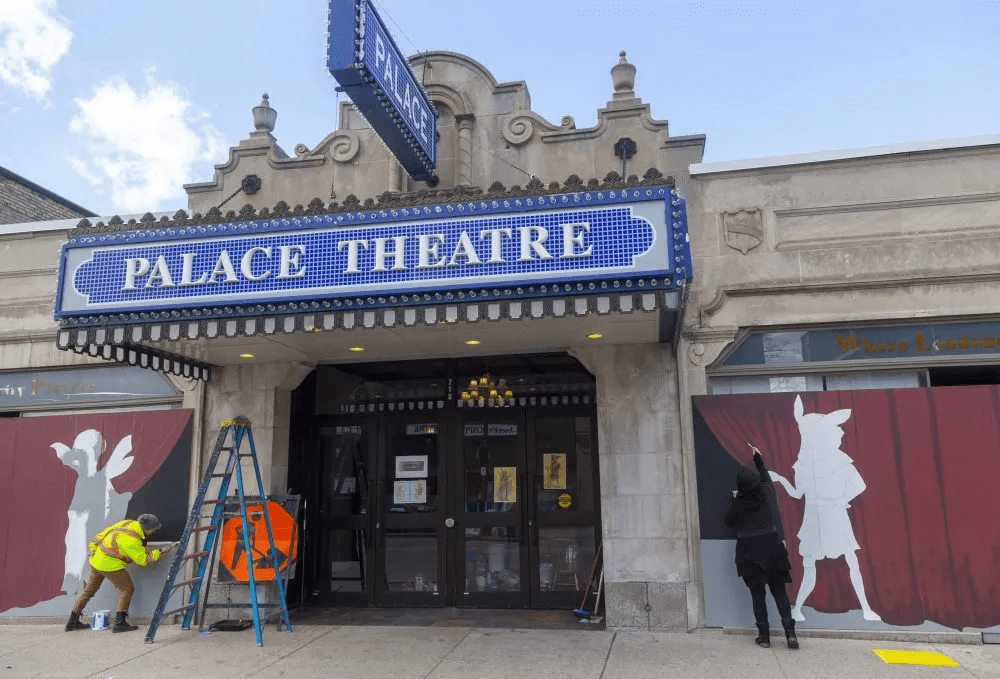
The Palace Theatre, constructed in 1929 as a venue for silent movies and designated by the City of London in 1991 for its historic or architectural value or interest, remains a focal point in London’s Old East Village for quality theatre. It is the home of London Community Players, London Youth Theatre Education & London Fringe.
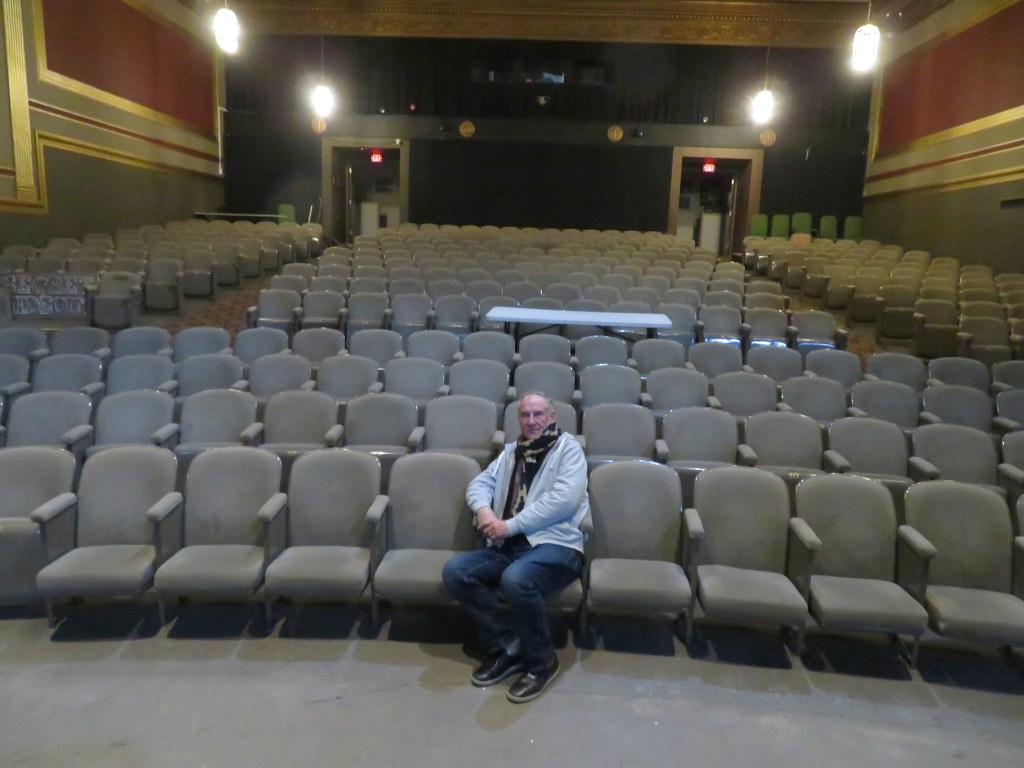
This historic venue is divided into two stages, the 75-seat Procunier Hall and the 350-seat David Long Stage.
Often, a stage is named after a beloved but deceased benefactor, actor, producer, or director. However, David Long is still with us, with a 47-year history associated with the London Community Players.
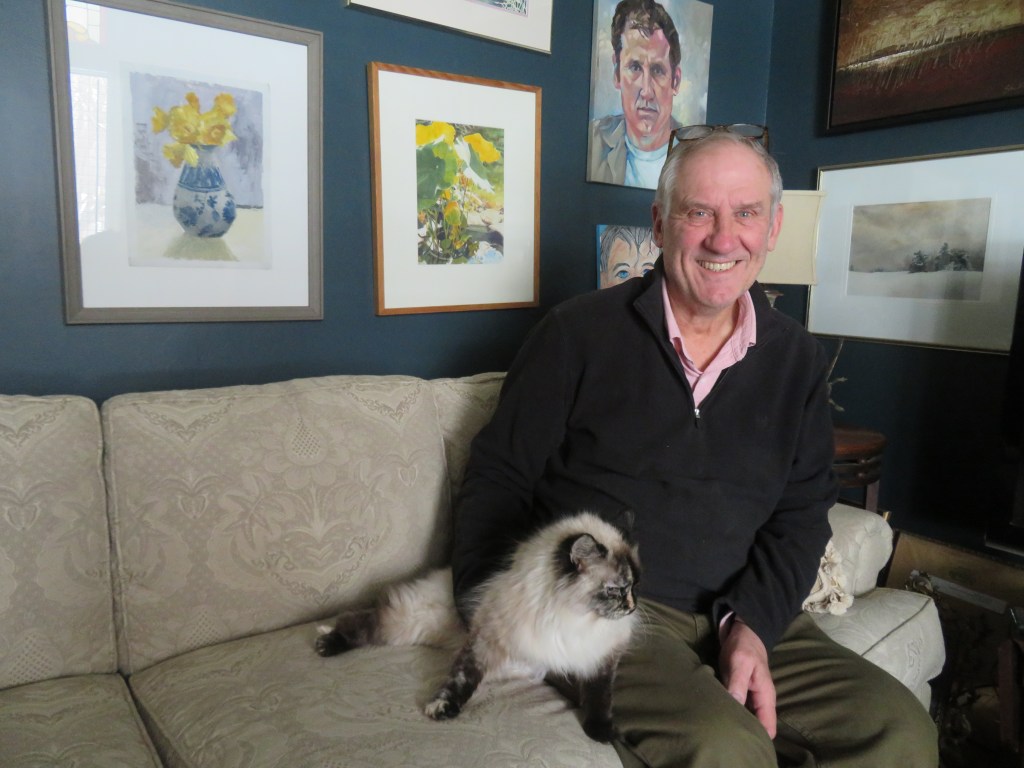
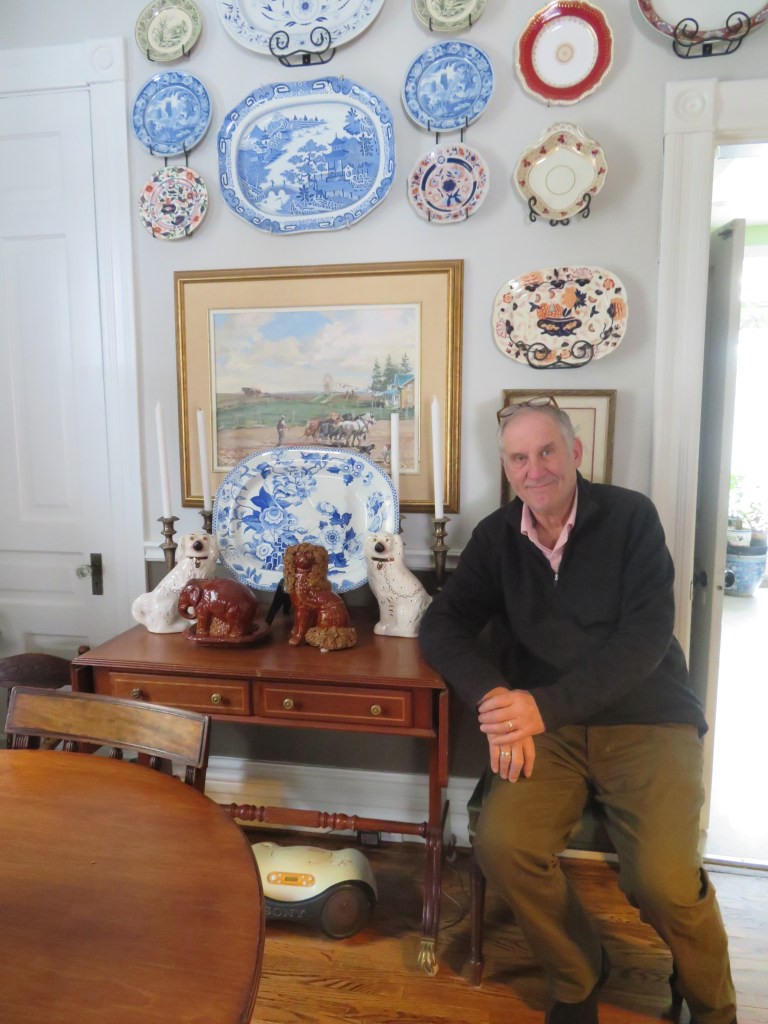
I recently met up with David at his home in East London. Over coffee and banana bread and surrounded by a lifetime’s collection of artwork and plates, we discussed the trajectory of his life.
(Pictured: David Long.)
The Long family’s ancestry in London dates back to 1850. At some point, according to David, family members “dispersed around the city.” David’s great-grandparents purchased land in the vicinity of Commissioners Road and Andover Drive. His father established Wood Lynn Farm Market, with various venues in the city. The Longs owned 300 acres of apples alone.
Wood Lynn Farms would become the first ‘pick your own’ orchard in Ontario. A pre-teen David was conscripted to wait at the gate and hand out a flyer to incoming customers, offering smiles as well as both prices and the ‘rules’ of the orchard. No overfilling, and there were trunk checks. At the time, a bushel of apples cost $1.50. This was long before ‘controlled atmosphere storage’ of apples, and so three generations of the Long family were involved during the narrow apple picking season, which would run from September into the Thanksgiving weekend of October. David proudly adds, “They were lined up on Oxford Street.”
David Long stayed true to his original neighbourhood, where his family home was established in 1935, just three houses from the Brick Cemetery. In 2010, ‘Friends of Brick Street Cemetery’ was established to provide guardianship to the eternal home of over 750 souls, and David Long got on board. The first burial occurred in 1813, 13 years before the City of London was established.
The organization researched the names of those under the soil and began repairing and re-erecting tombstones. According to David, “one third of the stones were on the ground, one third were leaning, and one third were still standing.” David was dubbed with the nickname ‘Jigsaw’ as it was his task to reassemble broken tombstones with both cement and epoxy. There was also the painstaking effort to clean the fronts of the stones without diminishing the lettering.
It was at York University in the 1970’s that David enrolled in a theatre program. . His desire to study theatre was built upon his drama experience in high school, which included a role in a production of the classic “Arsenic and Old Lace.”
But a year in university was enough, and he eventually returned to London after a bit of a tenure working in a paint store in Stratford.
It may or may not have been a synchronistic moment, but David’s return coincided with the beginnings of the London Community Players. He had invested a year’s worth of training in drama, and now a new theatre back home was opening.
The genesis of the London Community Players began with former members of ‘London Little Theatre’ as well as some passionate and earnest local actors. Productions began at the Gallery Theatre established at 36 York St. Their focus was Canadian-written plays, and 35 were performed between 1974 and 1978.
David leapt in and was cast in “Norman, Is That You?’ London’s first ‘gay’ play, a work David regards as a “bit of fluff,” but an important piece of theatre in recognizing and accepting London’s gay community. This was 1977, and London Free Press theatrical reviewer, Doug Bale, who could run roughshod over a local production, answered the question “Is London ready for gay plays?” with a resounding “Yes”.
David’s talents were also recognized in his ability to design and create sets. “My one grandfather built houses, and my other grandfather painted houses. I think I get my building skills from one and my painting skills from the other. The theatre discovered that I could build sets, and so that was the end of my acting career.”
As David was settling back into the theatre in his hometown, ‘HALO,’ the Homophile Association of London, Ontario, was establishing itself as a community club at Colbourne and Pall Mall streets. When David came out as a gay man in the late 70s, he had the support of his family, specifically from one of his grandfathers, who stated, “I knew people like that at Beal in the 1920s, and it didn’t bother me then, and it doesn’t bother me now”.
(Pictured: HALO Building, Colborne and Pall Mall Streets, London, ON.)
David eventually became president of the HALO club at a time of social intolerance of homosexuality. He was often the subject of homophobic slurs as he entered the front door, as well as dealing with vandalism in the form of broken windows, which were eventually boarded up. He recalls, “The music didn’t stop, and the dancing didn’t stop, so the club persevered and survived.”
This was a time when the former mayor of London, Diane Haskett, refused to proclaim ‘Gay Pride’ at City Hall as it was against her Christian values. She was eventually overruled by the Ontario Human Rights Tribunal, and the gay pride flag was flown over city hall. The HALO centre was the hub of the largest gay community in Canada, struggling yet surviving.
David recalls, “There were always lineups to get in. We had double-door security to protect our patrons. We always had Western (referring to the University of Western Ontario). The thing with the gay community at UWO was that everyone was here for four years. They would arrive, they came out, came to HALO, and they left when they graduated. There was always this kind of turnover.”
By the early 90s, within the gay community of London, HIV/AIDSwas creeping in. This disease was largely ignored by the media as well as American President Ronald Reagan. made its impact in London.
John Gordon was the first man in London to come out about his diagnosis of AIDS in South Western Ontario, and his death and legacy were the cornerstone of the creation in 1992 of the `John Gordon Home’, a Victorian-style residence on Dufferin Ave, which became a hospice. Tenants were cared for by a team of 30 volunteers (myself being one). The bedrooms of the building were remodelled, offering an individual design to each of the eight. David Long coordinated the renovation. He eventually found himself on the board of the John Gordon Home and was the representative of JGH to the Aids Committee of London. David knew the first residents, the first to arrive and the first to go to spirit.
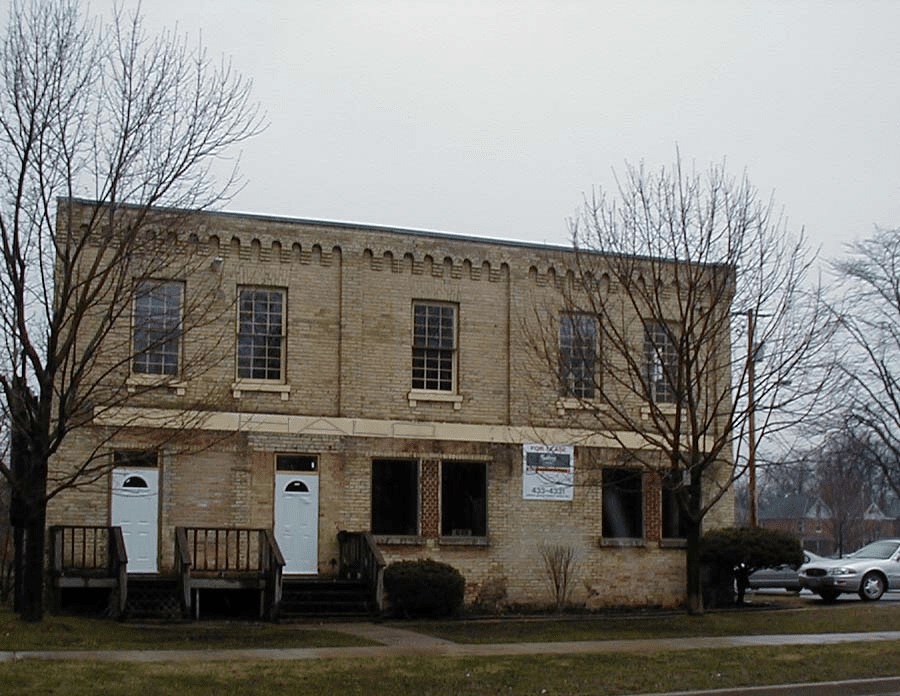
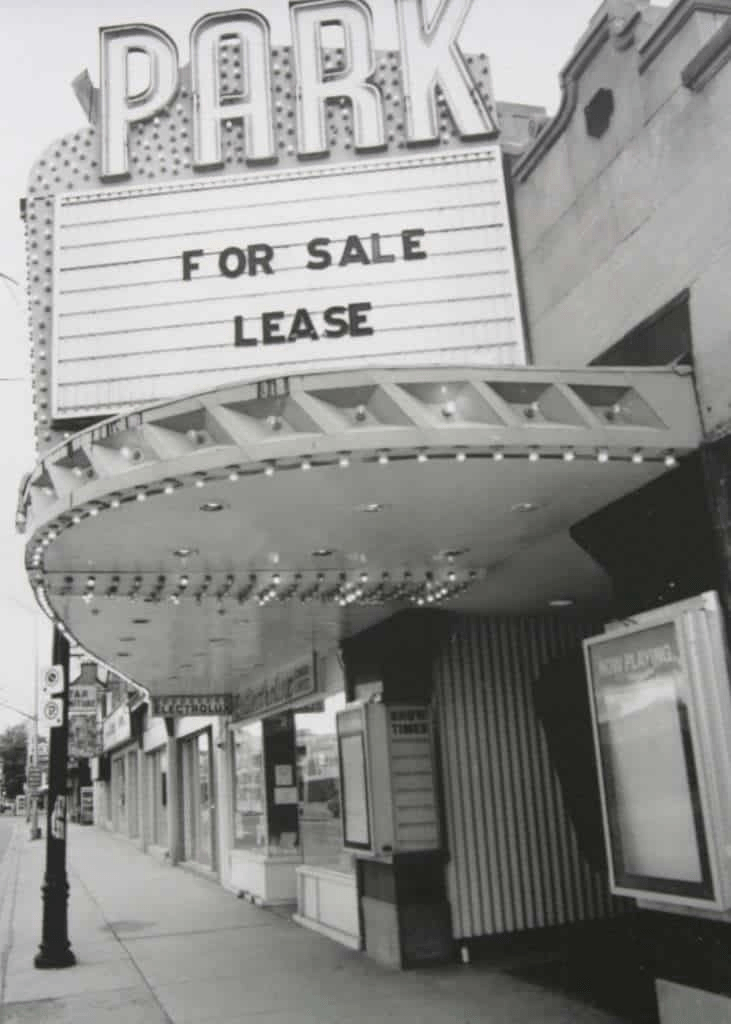
During the same period, the London Community Players were growing. With his long-standing work with the theatre, David became part of the Board of Directors. There was this notion to physically expand the theatre as it grew, but it was David Long who noticed the ‘For Sale’ sign at the Park Theatre in East London. There was an existing stage as well as seating for up to 400 people, and in short order, the deal was closed, and the Park Theatre was purchased in December of 1990.
Renovations happened quickly, with backstage areas including dressing rooms being constructed, with the first play opening in July of 1991.
David reflects. “Looking back over the years, some of the plays we have done there have been mind-boggling.’ He adds, “It is community theatre, but you balance the events. You have people who want the light entertainment, and you have people who want to be entertained, challenged, and educated.”
Now in its 51st season, The Palace Theatre continues to present engaging theatre to the London public. But community theatre has always had its challenges.
There is the issue of operating on tight budgets and high production costs. There is a reliance on volunteers, who may come and go. Casting actors has its own issues of scheduling conflicts as well as finding actors with the right skills. You also have to find a balance to produce safe and popular shows which guarantee the sale of tickets up against bringing in challenging and thought-provoking work. Every town and city which has a community theatre is always under this threat.
The Palace Theatre has had its share of added challenges. London has a homeless population of over 2000, and the 700 block of Dundas Steet as David Long calls it is ‘ground zero’ for the problem of homelessness. The plight of vagrancy in London carries the issues of addiction, mental health problems and vandalism, which directly affects the Palace Theatre.
Windows have been broken, as well as break-ins and theft. There is open drug use on the block, which is a deterrent to potential theatre goers.
Providing security is expensive, as hundreds of dollars are required to secure each production, protecting the building as well as safely ushering patrons in and out.
David adds, “The social services provided here are overwhelmed, and the foot patrol can only do so much,” adding, “Theatre used to be in the parks and on the streets, and we just can’t do that now.”
(Pictured: The Palace Theatre’s David Long.)
What is the future for Community Theatre?
“The future is challenging. There are theatre companies always closing down as they cannot adapt, change and survive. We need young people to get involved in theatre in multiple layers,” says David. He adds, “We used to sit and talk on breaks during rehearsals. Now everyone is on their phones. Cell phones are the worst invention which creates distractions from real communication.”
“There is this perception that we are an elite group of people. No, we are just trying to pay the rent and are open to any and all ideas for the stage. Give us something challenging, and we would love to do it. Let’s use Procunier Hall to do create something very ambitious.”
And what would be the ideal piece of theatre?
“Something in Procunier Hall, about 90 minutes long with no intermissions, no breaks, and no lapses with the actors and their connection to the audience”.
He slyly adds, “We shut the door for 90 minutes, and you can’t get out.”
David’s lifelong commitment to Community Theatre is reflected not only in the productions selected for the stage but also in the sets he thoughtfully designed and created. The David Long Stage that proudly bears his name stands as a fitting and enduring tribute to his dedication, creativity, and lasting impact.
J. Bruce Parker is a retired oncology nurse. As an avid cyclist, he crossed the country by bicycle in 1991 and still explores Ontario’s north via canoe trips. He has published a short story based on his camping experiences.
For over 20 years, as a citizen scientist, he was involved with Monarch Watch, an organization that monitors the annual migration of the Monarch butterfly. He has written about this species and other articles on nature for The Cardinal, Nature London’s quarterly magazine.