This is the twelfth in an ongoing series in which The Beat Magazine 2025 takes readers “Behind The Scenes” to meet the talented creative individuals who make the London area such a vibrant arts and culture community.
In this segment, Bob Klanac profiles Tami Kegley and Page Graham, co-founders of the popular Inside Outside recurring “salons” that bring together the music and visual art communities in a common setting.
(Pictured: Page Graham and Tami Kegley. Photo provided by Page Graham.)
It took a couple of Texas-based outsiders to spot a need in London’s cultural landscape.
Tami Kegley and Page Graham, expats 40 years living in San Antonio, Texas made their home in London a few years ago and knew they wanted to be involved in London’s growing arts and music scenes.
“When I came back, it felt like the visual arts were playing a secondary role in our community” says Kegley “and there is so much emphasis being placed upon music.
“It seemed like there was no intermingling between the visual arts and the music communities in the city.”
Graham observed in San Antonio a very vibrant arts scene intertwined with the music community.
“I really missed those wonderful artist talks. I would go to a show, and invariably there would be an artist panel discussion.”
Both Kegley and Graham came by their various passions honestly. Kegley is an acclaimed jewelry artist and Graham, a onetime CHRW 80s-era radio host had a long career in television production in San Antonio. Both were very involved in their San Antonio community and came to London looking to do the same.
“Page and I moved to London and became enchanted with the community,” Kegley explains. “We volunteered for the Close to the Edge Festival and things like that and just found ourselves wanting to be more involved.
“My career is as an artist. Page and I have both done arts journalism. That was in our tool kit, and we were looking at how we can make a positive impact on London. It occurred to us that real life conversations were important and had been left by the wayside because of COVID.
“It seems like people are more in their silos here. There are efforts that are facilitated by the city and other groups to try to break out of that but we really wanted to have an arts conversation.”
So Kegley and Graham batted some ideas around their dining room table and decided on something they would call the Inside Outside.
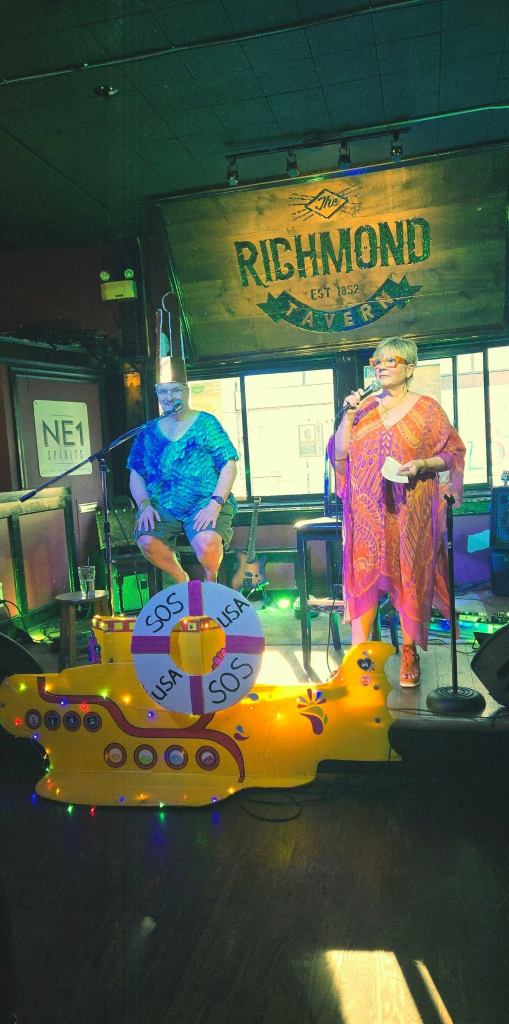
Kegley would be the host of the event interviewing the artists and Graham the producer, ensuring the music and staging goes according to plan.
It would meld music with discussions on the arts in a kind of colloquium setting with one crucial difference from other events of that type.
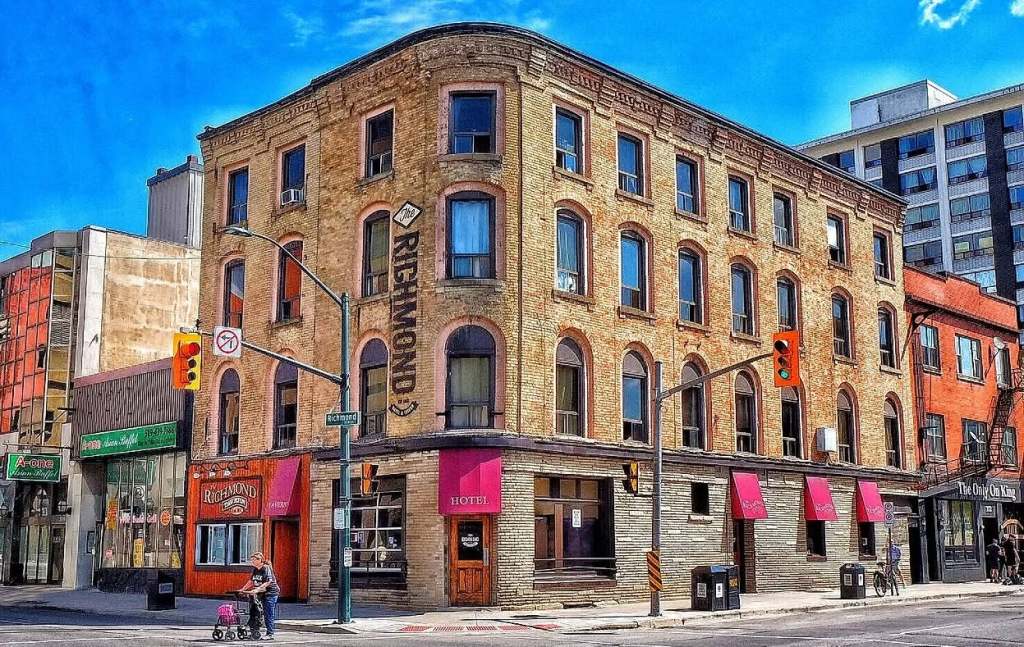
Key to the concept of the event is that it would take place in a bar, London’s legendary Richmond Tavern.
Why the gritty Richmond Tavern? To listen to Graham the answer is a resounding ‘why not’.
“It’s so cool and so real,” he says with a chuckle. “It’s like our version of the Horseshoe Tavern and that’s what makes it so special. You got the regulars in the back room around the round table, so to speak. It’s not exactly the Algonquin Hotel.
“The authenticity of that place makes it special. And that’s why, for us, it’s the venue of choice. It’s intimate. And intimacy is part of the basis of our concept.”
Kegley agrees, adding “It’s a non-intimidating space. It’s not a rarified space.”
Since it bowed in on May of 2025, Inside Outside has hosted talks by Jamie Fenton of Museum London, Graham Henderson, CEO of the London Chamber of Commerce, gallerist Jonathan Bancroft-Snell, local raconteur / legendary dancer Bev Camp, Jim Capel the former co-owner of City Lights Bookstore, artist Jim Telfer, as well as readings by Pete Tangredi and Howie Kittleson.
(Pictured: Tami Kegley with local performance artist John Erb at a recent Inside Outside. Photo by Vera Kittleson.)
Musicians featured have included Steve Sinclair, Jaron Camp, Galea and the Galvanizers, Anne Moniz with Daniel Oniszeczko, Brent Jones, Adam McNeill, Carol MacQuarrie with Chris Mittleholz, Jeffrey DP and Jordan Buck.
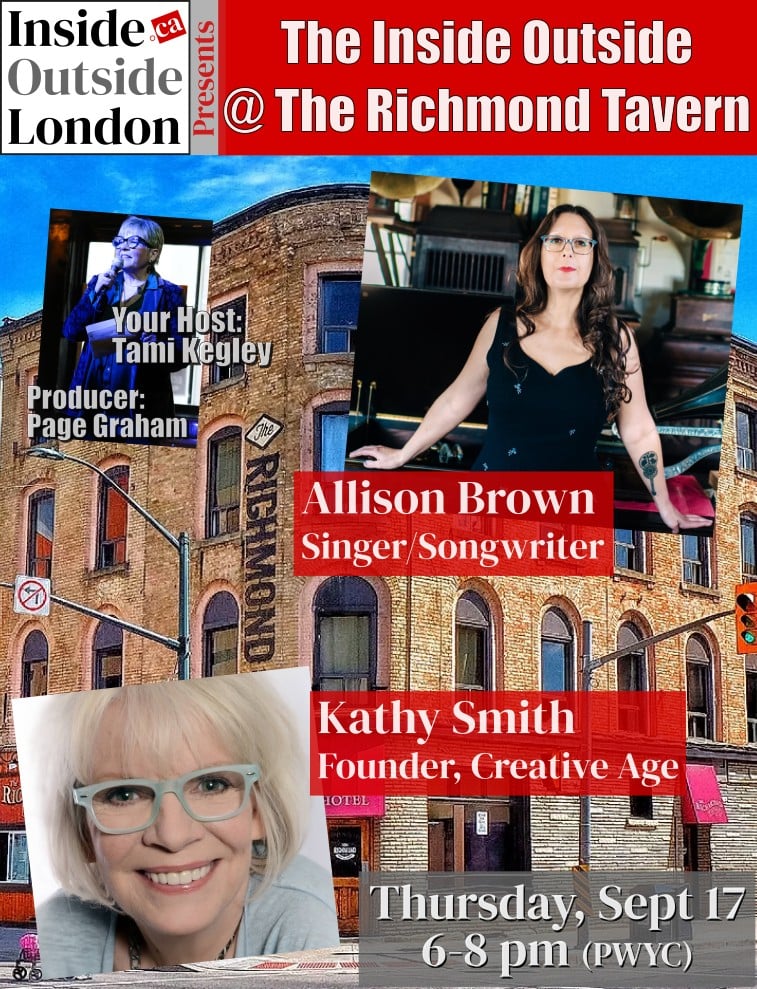
For the next edition taking place Thursday, September 17, Kegley will be interviewing Kathy Smith, the creator of an Over 55 visual arts, dance and writing program called Creative Aging executed in conjunction with the London Public Library.
Allison Brown will also take the stage celebrating her return to London after stints in other Ontario locales.
“Allison Brown is a fantastic singer songwriter,” Graham says excitedly, “she’s just recently come back to London, and we thought she’d be a fantastic choice.”
Kegley beams as she describes the sight of “a crowd of people sitting in there listening and taking it in and focusing.
“And sometimes the best part of the show is after it’s over, because people hang around and chat, and they’re energized intellectually.
“The Inside Outside is an attempt to bring the two scenes together, which is really something new. Absolutely, one feeds the other. It’s really kind of a nice symbiosis I think we’ve landed on. And people seem to like it.
“And so, we keep doing it!”
By Bob Klanac
Bob Klanac is a London-based music journalist who has penned hundreds of reviews and interviews. He was a juror for the Polaris Music Prize, a member of the Slaight Family Polaris Heritage Prize Jury and a Juno Awards juror. Bob has also penned two books, Promo Man about London’s late music legend Nick Panaseiko and Shooting Stars, Telling Tales, about photographer to the stars photo-journalist John Rowlands.
To Culbert’s eyes, it all started with a confluence of almost simultaneous changes in London’s theatre community.
“In the early 2000s the Drama Workshop at Western closed down, and if you wanted to do theatre, you either looked at established groups like London Community Players or you started doing your own run,” he explains.
“There weren’t a lot of companies that just picked up original writers, so producing your own do-it-yourself theatre became the way things got done.”
“One person inspires another person, so you had people like Jason Rip and Jayson McDonald writing new plays. Those were the two leading the charges.”
“They wrote like crazy. They just had it in them, and that inspired a lot of people. And one thing feeds on another.”
That was part of it, according to Culbert. The other was space for these new plays and productions.
(Pictured: Jeff Culbert.)
“Phil Arnold created the Old Factory Theatre over on Ann Street, and there were a lot of people who had their first plays put on there because it was relatively cheap and simple. When I started and did my first shows, the Forest City Gallery was in the basement of Aeolian Hall.”
“Then the Arts Project had a space, and the McManus at the Grand Theatre became available to rent and were fairly reasonable in their pricing.”
“There had to be space and plays, and there has to be writers and actors, and somehow it started. And once the ball was rolling, it was really rolling.”
Culbert knew that festivals were another linchpin to encourage and sustain the fledgling theatre writers and performers.
“Festivals started popping up. You had The Fringe Festival around 2000, the London One Act Festival and Purple Shorts, which was up at Western where students were writing original plays.”
“And then there was the Playwright’s Cabaret at the Grand, which encouraged people to write 10-minute pieces. All that happened in the space of a few years.”
As Culbert put it, one thing led to another and the energy of the new scene started to inspire others to jump into the fray.
“It was contagious. I remember Jonathan D’Souza coming back to London. He saw what was happening and said, ‘ Wow: theatre seems to be what this town is about right now,’ so even though he was a music guy, he just jumped in and started writing.”
“He did a piece at the Fringe Festival, and nobody knew him in my circles, and he just blew everybody away. They all said, ‘Who the hell is that guy?’ But again, he just saw what was happening and said this is an art form that is taking off in London. And one thing feeds another thing.”
It was an inspiring time in London’s long theatre history, and Culbert was not only a part of that, but he also documented it in a few local publications regularly.
“Theatre Boom Town consists of columns that I wrote in those times: the first one for The Londoner was in 2002, and the last one for the London Yodeller was in 2015.”
“The focus of the book is what was coming out at that time, but also I would do a historic look back to somebody every once in a while like Richard Barry Harrison, who came from London, became the toast of Broadway, and was on the cover of Time Magazine. But mostly I was covering what was happening in live theatre in London.”
It was a thriving scene, but it had a narrative arc. Some performers moved on to different cities and some of the venues went dark.
“Covid, of course, sent everybody scattering, and some never recovered. The Fringe as we knew it is gone, The Playwrights Cabaret at the Grand is gone, the London One Act Festival is gone.”
The July 16 event also celebrates 25 years of the Theatre in London website.
Started by Culbert in the early 2000s, it became more than he could handle with his other role in the burgeoning theatre scene, so he asked around for someone to take it over. Peter Janes put up his hand. An avid theatre fan and supporter, Janes had a solid tech background and saw a lot of potential in the site to support the growing theatre community in London.
“Jeff’s version of the site was entirely static. My idea was to put a database behind it so we’d have a record of the history of these things. But I also wanted to make it possible to do a calendar of upcoming things, so not just the past, but keeping the future stuff happening on it as well,” he explains.
“It’s been in the midst of an overhaul since 2008, but in the last six or seven years, I realized that it’s really outgrowing the platform that I got it on, and I want to put a proper database behind it.”
“None of that stuff should be visible to anybody who’s using the website, but if anything, it’ll get faster. Eventually, when I have to pass this on to somebody else, there will be a better basis for them to kind of continue working on it.”
Janes’ goals for the site overhaul were twofold.
Most importantly, it has to be a place to let people know what’s going on in London theatre. Janes himself uses it for that reason.
“It’s a site that I use to find out what things are going on. Otherwise, I wouldn’t know that Little Theatre Company is doing a production of something at the Wolf Performance Hall and Original Kids are doing something or AlvegoRoot Theatre has something coming up,” he admits.
“The secondary value of it is the continuum. It’s like the six degrees of Kevin Bacon. I don’t have all the stuff in yet, but eventually it will be able to tell you that, for example, Adam Holowitz adapted a play by James Reaney. One of his shows was on at Central, which was directed by this person who was in a show at London Community Players and through London Community Players back to the London Little Theatre, which goes back to Victor Garber or even Hume Cronyn at some point.”
“I want to have the entire casts and crews and everything, but it’s impossible to do all that, because a lot of that information doesn’t exist anymore.”
The site’s celebration at the July 16 event doesn’t mean Janes can rest anytime soon. “I’ve been updating it at least five days a week for 27 years!”
“I now have just shy of 3,000 productions on the website. Most of those are since about 2008. There’s so much research that remains. I even have events going back to the 1800s,” he says.
Author’s Note: Since this story was published in The Byron Villager a few years back, I was commissioned by the City of London Culture Office to prepare an Interpretive Sign that visually tells the history of Wonderland Gardens from 1935 to its rebirth as Springbank Gardens. The plaque will be unveiled on Sunday, June 21, at 1:30 pm at The Guy Lombardo Pavilion in Springbank Gardens.
Mention the name Wonderland Gardens today, and most Londoners will probably respond, “Wonderland what”?
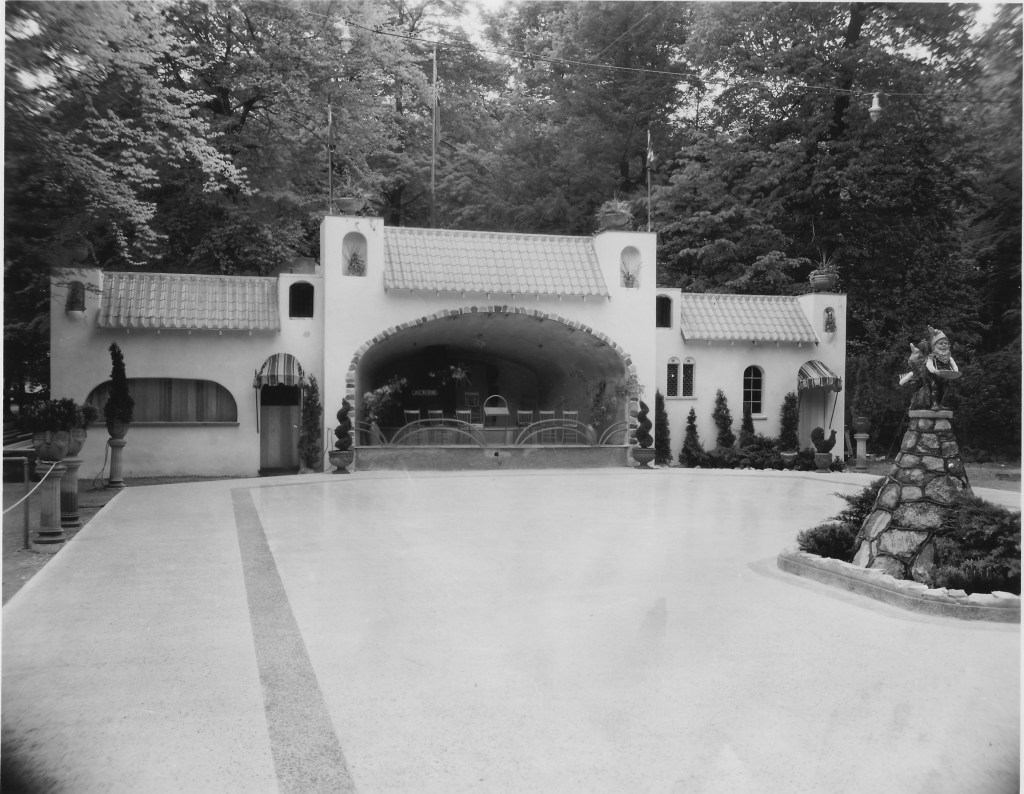
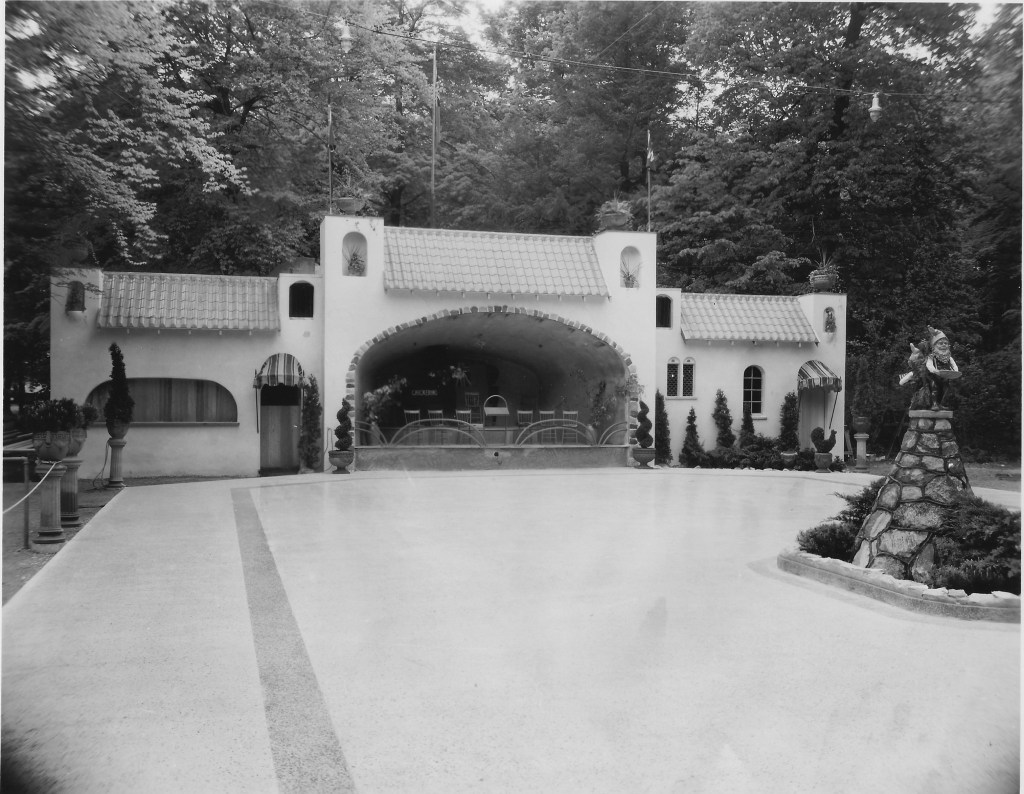
The site of the legendary dance hall, which burned down in 2005, is now called Springbank Gardens, and all that remains of the original venue is the outdoor bandshell.
(Original Outdoor Bandstand)
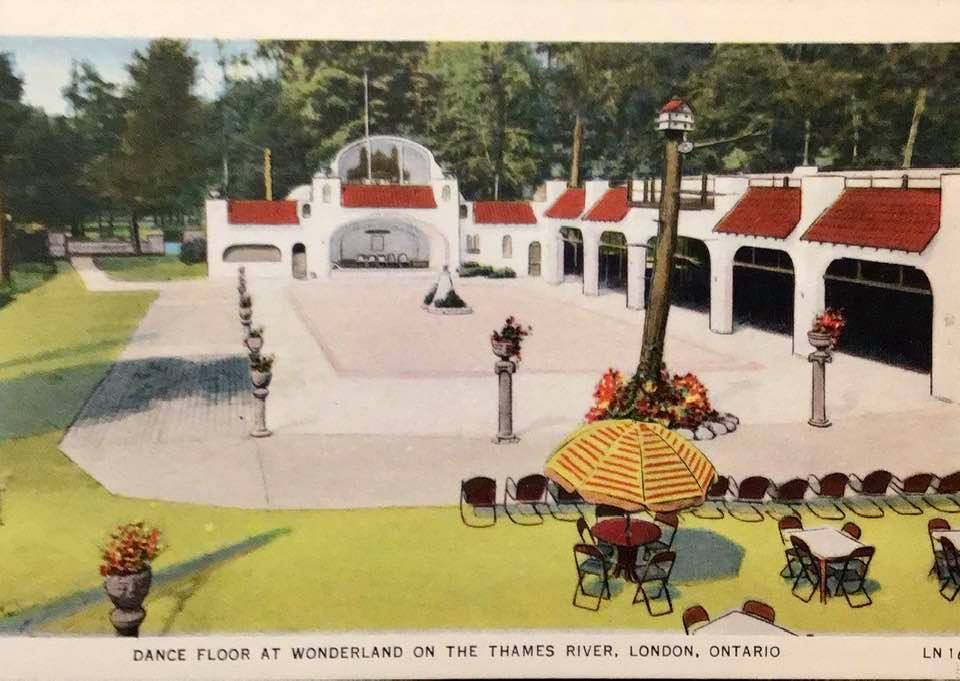
The story of Wonderland Gardens begins in the early 1930s, when Charles Jones signed a long-term lease for a small lot in Westminster Township, adjacent to the Thames River. His plan was to build a series of gardens, fountains, woods, ponds, and footpaths, including a luxurious swimming pool, all surrounding a 550-square-metre, open-air dance floor with a bandstand and Spanish Colonial-style pavilion.
(Wonderland Pool.)
Wonderland Summer Gardens opened on May 24, 1935, featuring Mickey McDougall and His 10-Piece Orchestra. It quickly became one of the city’s hot spots. Big Bands like Guy Lombardo and his Royal Canadians and those led by Glenn Miller, the Dorsey brothers, and local musicians like Johnny Downs and Lionel Thornton all graced the venue’s bandshell. Generations of Londoners danced and canoodled under the stars on the venue’s open-air dance floor.
A covered pavilion was built in 1941, and in 1959 it was fully enclosed and insulated to serve as a ballroom, enabling the venue to remain open year-round.
(Mickey McDougall and His 10-Piece Band opened Wonderland on May 24, 1935.)
As the decades passed and musical tastes changed, the venerable dance hall changed with the times. By the 1960s, Wonderland was London’s favourite concert/dance hall for the thousands of London area Boomers who flocked there to see major acts like Sly and the Family Stone, Deep Purple, The Mandala, Grant Smith and the Power, and many others too numerous to list.
(Grant Smith.)
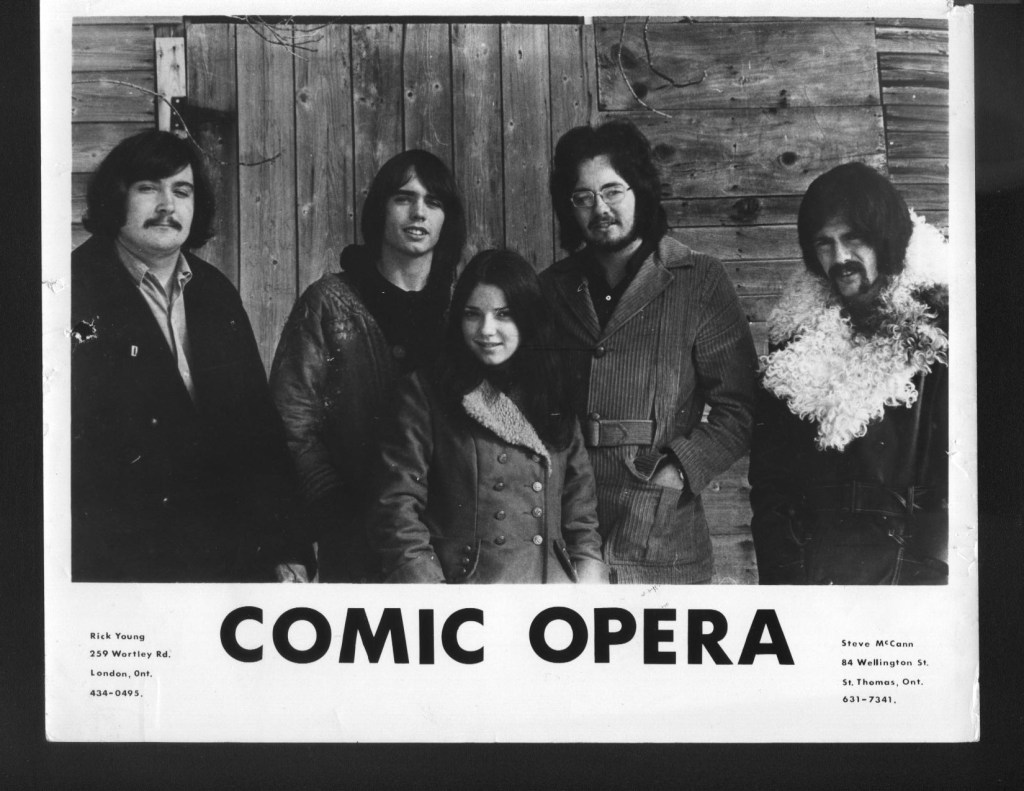
Wonderland was also a jumping-off point for local bands like The Bluesmen Revue, A Small Experience, The New Set, and The Comic Opera, who mostly opened for the headliners.
For the late John Sharpe, The New Set’s former drummer, Wonderland held a special place in his musical career.
“A group could play any number of teen towns or private events, but everyone knew you had not really ‘made it’ until you played Wonderland,” recalled John. “It was a magical place that attracted hundreds of teens to its weekly rock ‘n’ roll shows, so every group in the area wanted in on the action.”
Jim Chapman, former bassist for The Bluesmen Revue, a very popular London R&B group, remembers headlining at Wonderland many times.
“The room had excellent acoustics both on the stage and in the hall. In those days, that was the exception rather than the norm,” Jim recalls. “And it had one of the smallest dressing rooms I ever saw in a venue that size. How the multi-person big bands ever managed to get their people dressed for a gig I cannot imagine!”
Ken Thorne, of A Small Experience, another London band that regularly played Wonderland, remembers the venue’s dressing rooms, too.
“The original dressing room walls were scrawled with the signatures of many of the artists who performed there. Whenever we played there, we used to try and find the new additions while waiting to go on stage,” says Ken.
On August 13 – 14, 1969, Wonderland hosted a two-day Pop Festival featuring Frank Zappa and the Mothers of Invention, Alice Cooper, Cat Mother & The All Night News Boys, George Olliver & The Natural Gas, and others for the whopping price of $7.00! The event preceded the much larger Woodstock Music Festival that took place in New York State, August 15 – 18.
Apparently, Zappa was asked why he wasn’t playing Woodstock. His reply? “Because we don’t want to.”
Rumour had it that after his set, Zappa waterskied on the heavily polluted Thames River, which flowed behind Wonderland! The rumour was recently confirmed during an interview I did with Chuck Jones.
As the years progressed, touring acts moved to other venues in town, and Wonderland became more of a location for special events like company parties, conventions, rallies, and receptions.
“In its final days, the City of London had an active interest in Wonderland, but the council would not invest the money needed to refurbish it and keep it a top live performance venue,” Jim laments. “When Wonderland burned down, there was a lot of talk that something political and fishy had gone on, though I have no way of knowing if that was the case. Like many people, when I heard news of the fire, I shed a tear for all the great days and memories gone by.”
So next time you pedal or walk through Springbank Gardens, take a pause to see if you can hear some of the strains of great music that was once played on the site.
by Richard Young
Richard Young is a retired History teacher who taught with the Thames Valley District School Board for thirty years. Richard published The Beat Magazine, an independent print arts magazine, from 2009 to 2013. In 2025, he revived the magazine as an online publication. He is currently a member of the London Public Library Historic Sites Committee.
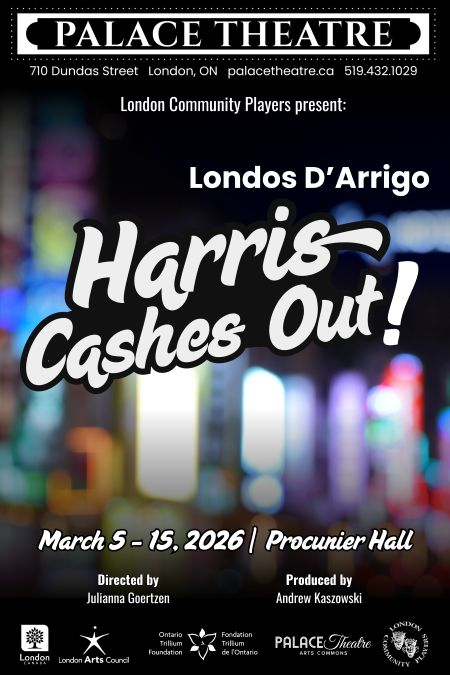
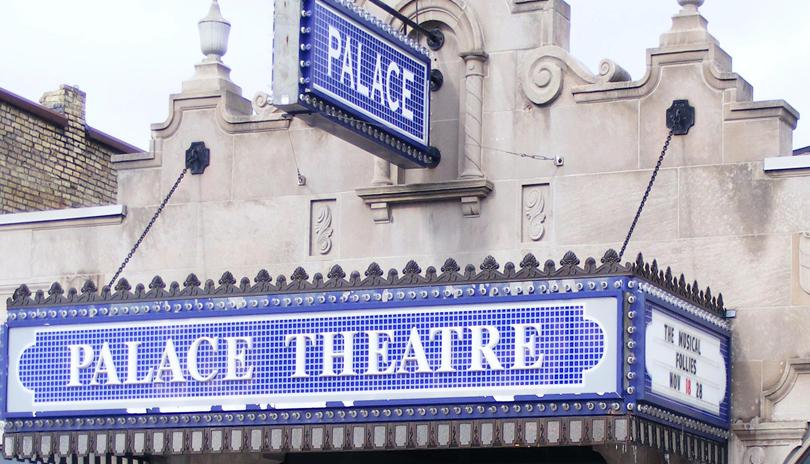
London Community Players’ production of Harris Cashes Out! plays on the Procunier Hall stage at the Palace Theatre from March 5 – 15. Director Julianna Goertzen talks about the production in this Q&A interview with Richard Young.
Q. What is the basic premise of Harris Cashes Out? Could you provide a brief plot synopsis?
Harris Wellborn is an old, washed-up Broadway musical writer who didn’t make much money in theatre. After his wife passed away, he fell into despair, and his sister, Maggie, moved him against his will to Baltimore to be closer to her. She arranged for an eccentric dog walker, Kim, to check on him and his health, but Kim and her boyfriend, Jason, had other plans to take advantage of Harris and his musical writing past. It’s a comedy about relationships and the things that happen when very different people are in proximity to one another.
(Pictured: Harris Cashes Out! Director, Julianna Goertzen. Photo: Ross Davidson.)
Q. The description on the Palace Theatre website indicates that the play has a Broadway theme. Does it include any musical numbers?
The only musical numbers it includes are the little ‘soft-shoe humming’ songs that Harris (played by Tim Bourgard) makes up on stage every performance. You may also recognize famous musical numbers played during the intermission and changes in scenes.
(Pictured: Tim Bourgard as Harris Wellborn. Photo by Ross Davidson.)
Q. Why did you choose the Procunier Hall stage as opposed to the larger Palace Theatre stage?
With a play like Harris Cashes Out!, I believe it would be more appropriate for a smaller venue like Procunier Hall to hold. With only four actors and a simple rundown apartment set, you’re right up close to the action and can hear the quiet, sensitive scenes that you might not catch with a big stage.
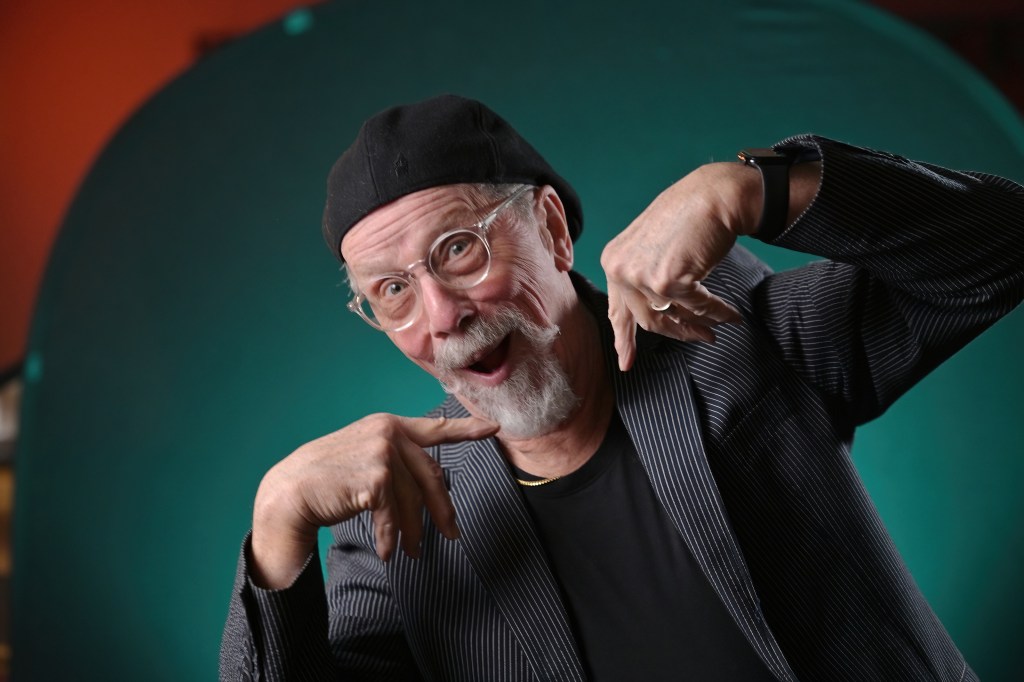
Q. Can you tell me about the playwright Londos D’Arrigo? I understand he’s Canadian and from around these parts. What other noteworthy plays has he written?
Londos was born, raised, and currently resides in Toronto. We have the privilege of having him coming to see our production of Harris Cashes Out! and we are very excited. Londos says that Harris Cashes Out! is a favourite of his. Other comedic plays he has written include Spreading it Around, which the London Community Players produced in 2009 at the Palace Theatre. He has also written a play called Vicki’s Back!, which sounds very similar to Harris Cashes Out!, written with a female lead in ‘show biz’.
(Pictured: Playwright Londos D’Arrigo.)
Q. Can you tell me something about yourself in terms of your involvement in community theatre, things such as other plays you have directed, produced or starred in?
I have always been involved in theatre from a young age. Most of my theatrical career was with Aylmer Community Theatre (ACT). In 2007, I started out as a makeup artist and dresser for those quick changes backstage. My acting debut on ACT’s stage was a comedy called Not Now Darling by Ray Cooney and John Chapman, where I played Sue Lawson. I was required to act drunk and walk around in my underwear on stage. Since then, I have been a part of many productions, whether as a stagehand or stage manager. My specific role was not of primary importance; what mattered most was that the cast and crew enjoyed a positive experience while producing the show. I have only directed two one-act shows with ACT in the past, so this is also my first full-length show.
In regard to my London community theatre experience, this is my directorial debut. A year ago, I was on the Palace Theatre stage as Dorothy Foxton in Murdered to Death, a comedy by Peter Gordon; before that, I was Dorothy in Stepping Out by Richard Harris in 2009.
(Pictured: Vivien King-Sherwood as Maggie Bellows. Photo by Ross Davidson.)
Q. What challenges have you encountered bringing this play to the Procunier Hall stage?
I have experienced very few challenges with bringing Harris Cashes Out! to Procunier, although the set and lighting crew may disagree since a set like this hasn’t been built in Procunier Hall for as long as anyone can remember. The biggest challenge about the play is the part of Harris. Harris’ lines amount to 50% of the dialogue. Tim Bourgard, who plays Harris, has been working very hard to recall every word, blocking, prop, and costume piece. The other actors have been very helpful and encouraging to Tim as we make our way through rehearsals.
(Pictured: Sam Didi as Jason Sernach. Photo by Ross Davidson)
Q. Is there anything else you think our readers should know about LCP’s production of Harris Cashes Out!?
This family-friendly show is full of laughs for all ages. Come out and enjoy live theatre up close and personal in Procunier Hall at the Palace Theatre. You won’t regret it.
(Pictured: Kim Sutton as Jasmine Gunkel. Photo by Ross Davidson.)
CAST & CREW: HARRIS CASHES OUT!
Director
Julianna Goertzen
Stage Manager
Alex Goertzen
Producer
Andrew Kaszowski
Assistant Stage Manager
Andrea Stevens
Light Design
Andrew Kaszowski
Sound Design
Alex Goertzen
Costumes
Julianna Goertzen & MJ Walzak
Props
Colin Arthur
Intimacy Coordinator
James Noonan
Set Build Lead
David Long
Harris Wellborn
Tim Bourgard
Maggie Bellows
Vivien King-Sherwood
Kim Sutton
Jasmine Gunkel
Jason Sernach
Sam Didi
IF YOU GO:
What: London Community Players present Harris Cashes Out!
When:Thursday, March 5 – 7:30 pm Friday, March 6 – 7:30 pm Saturday, March 7 – 7:30 pm Sunday, March 8 – 2:00 pm Thursday, March 12 – 7:30 pm Friday, March 13 – 7:30 pm Saturday, March 14 – 2:00 pm Sunday, March 15 – 2:00 pm
If you have a story idea or would like to become a Volunteer Writer for The Beat Magazine, you can reach Richard at richardyoung@thebeatmagazine2025.ca
London Community Players’ production of Urinetown: The Musical opens this week at the Palace Theatre. What follows is a Q&A Interview with the play’s producer, Ceris Thomas, conducted by Richard Young.
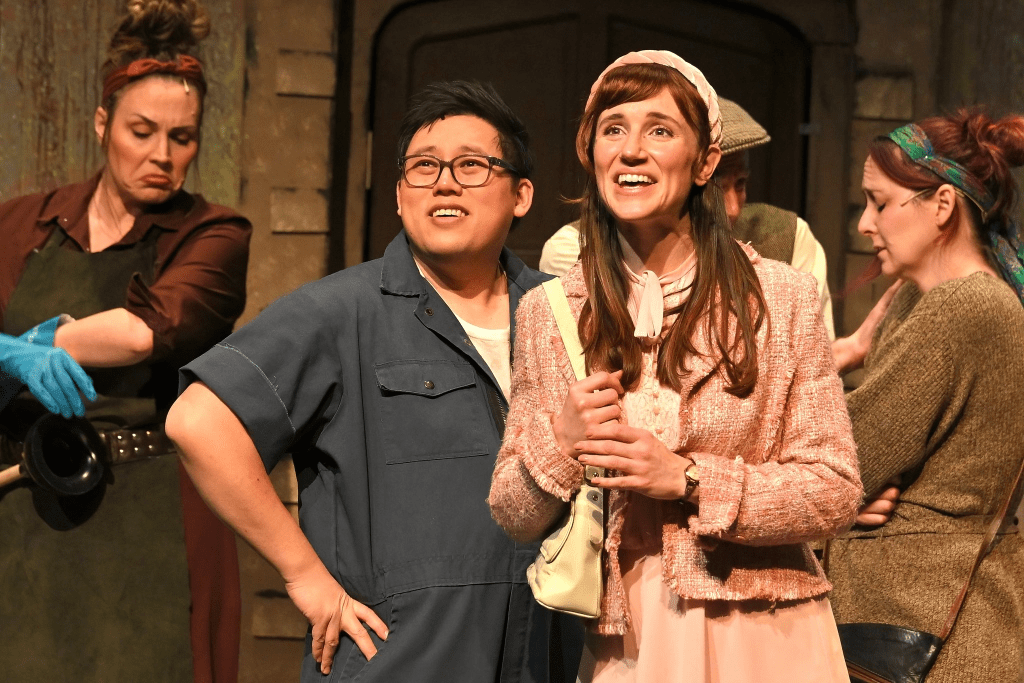
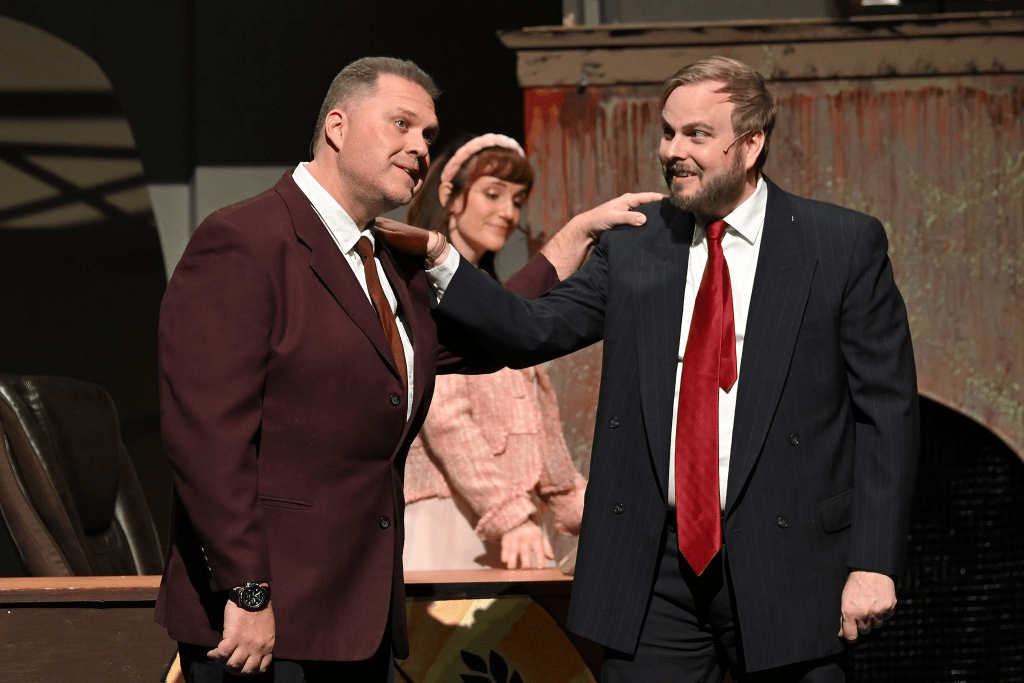
(Pictured: Laura Williams as Penelope Pennywise, Henry Truong as Bobby Strong, Jesslyn Hodgson as Hope Cladwell, and Allison Gold as Josephine “Ma” Strong. Photo Credit: Ross Davidson.)
Q. The description of Urinetown: The Musical found on the Palace Theatre website reads: “In a dystopia ruled by drought and corporate greed, public toilets are the law— and rebellion smells suspiciously like revolution. Equal parts absurd, poignant, and laugh-out-loud funny, Urinetown skewers capitalism, power, and musical theatre itself.” Could you break that down for our readers?
Urinetown: The Musicalis notoriously hard to describe, which is probably why so many explanations feel incomplete or confusing. Honestly, if it had a different title, people might find it easier to just shrug and say, “Sure—let’s go see this thing.”
At its core, Urinetown is a dystopian satire that imagines a world so devastated by water shortages that bathrooms no longer exist in private homes. To manage the crisis, business and government join forces and arrive at a “solution”: the public must pay to pee. It’s an intentionally oversimplified take on a massive environmental issue, designed to get the audience quickly and clearly into the world of the show.
As with many well-meaning systems in a capitalist society, the opportunity to profit from an unavoidable human need quickly curdles into greed and manipulation. That’s where we meet the people of Urinetown—some desperate to survive, others perfectly comfortable in their assumed wealth and eager to raise the fees even higher.
(Pictured: Kate Sepi as Officer Lockstock and Luke Bainbridge as Officer Barrel. Photo Credit: Ross Davidson.)
The absurdity, poignancy, and laugh-out-loud comedy come from how the story is told. One of the creators’ most delightful choices is the musical’s constant tribute to classic Broadway shows. One song clearly channels Fiddler on the Roof; the next explodes with unmistakable West Side Story energy. The first time I heard it, I actually laughed out loud in my car.
If you’ve ever seen a musical—any musical—you’ll catch the references and giggle along. And if you’re someone who doesn’t usually like musicals? This show lovingly invites you to laugh at all the ones your mom dragged you to see.
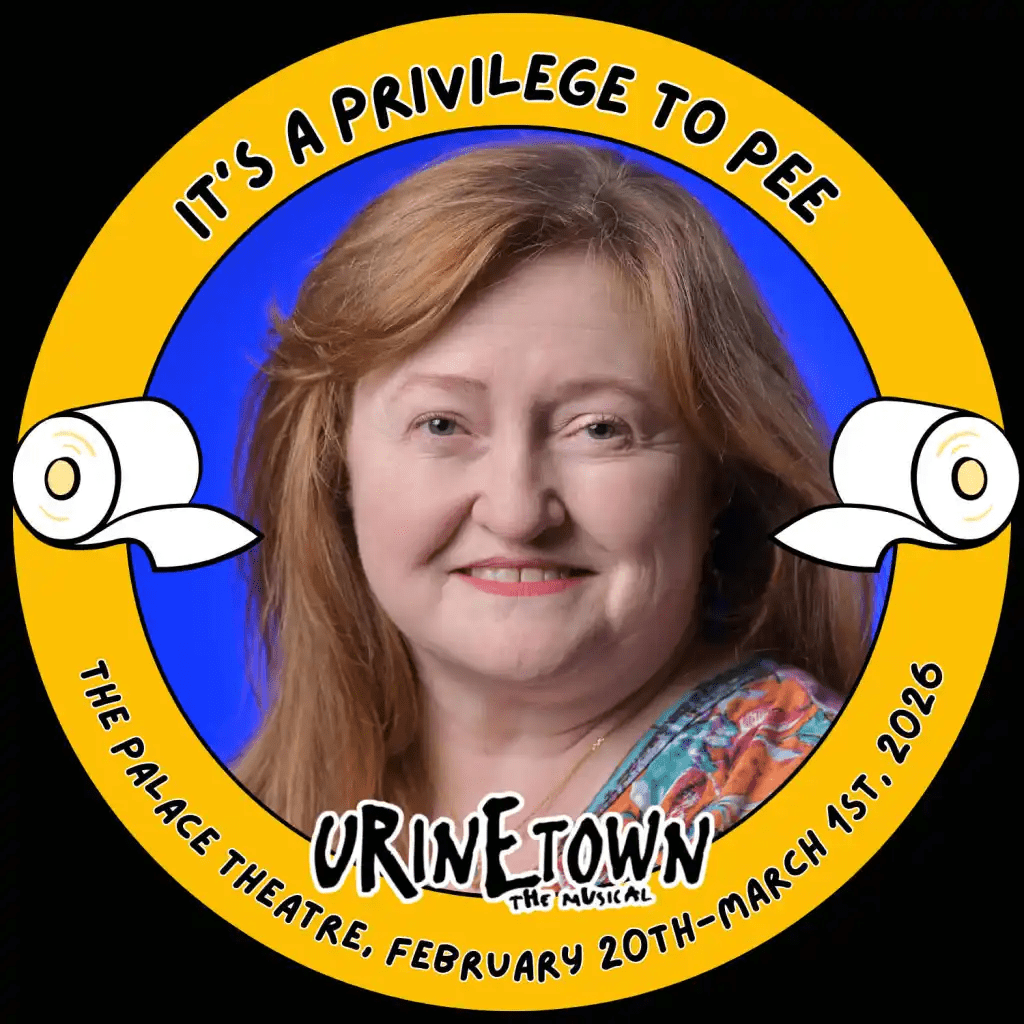
(Pictured: Ceris Thomas, Producer of Urinetown: The Musical.)
Q. It also reads: “No one is safe. Not even the audience. Bring your sense of humour — and your spare change,” implying audience members will be expected to participate in some way. Will they?
The fourth wall is very much broken in this production. Officer Lockstock serves as the show’s narrator, frequently conversing with Little Sally, a member of the “poor” who isn’t afraid to challenge Lockstock’s interpretation of events. Beyond that, the audience needs only to bring a sense of humour and a willingness to laugh out loud at the shenanigans of the players.
(Pictured: Ryan Starkweather as Senator Fipp, Jesslyn Hodgson as Hope Cladwell, and Sean Brennan as Caldwell B. Cladwell. Photo Credit: Ross Davidson.)
Q. Can you provide a brief Synopsis of the play?
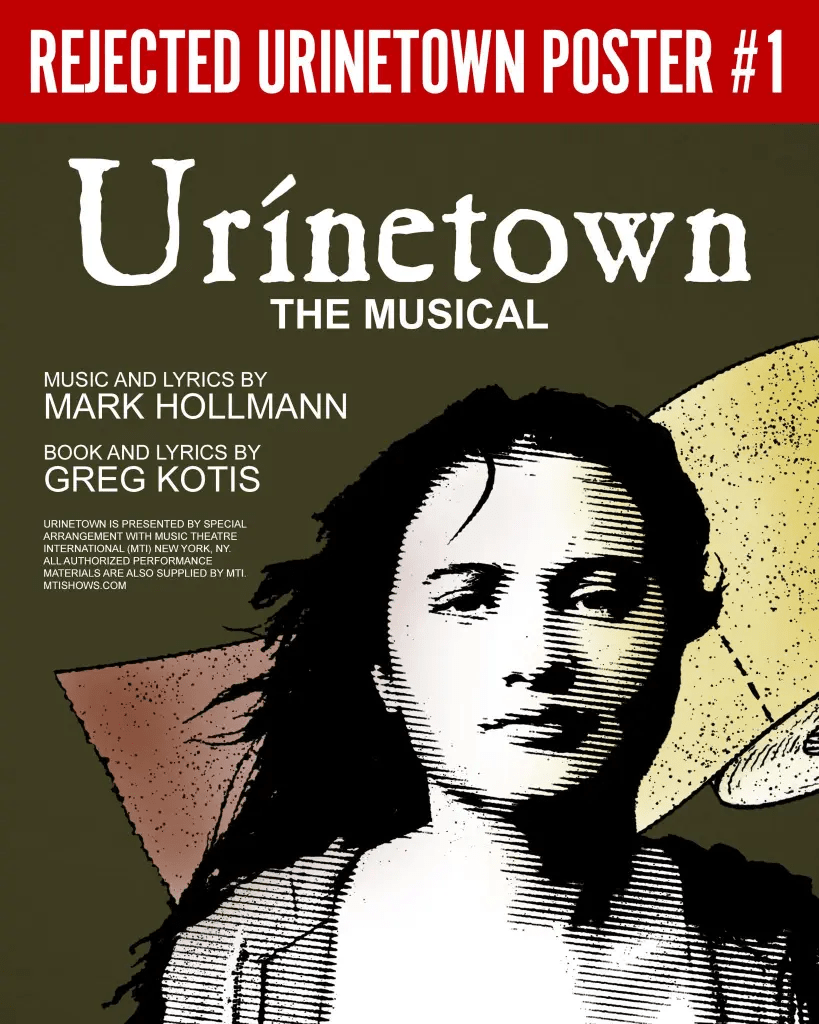
Our parody poster series—riffing on Les Misérables, West Side Story, The Producers, Wicked, and more—wasn’t just a marketing gimmick. It was a visual clue to the DNA of Urinetown itself. The show gleefully borrows familiar musical theatre tropes and iconic structures, reshaping them to tell its own absurd and pointed story.
At its heart, Urinetown gives us all the classics: a villain who controls the money, the police, and the government; a hero who controls nothing but works hard and dreams of a better future; and a beautiful daughter of the villain who becomes the catalyst for change when our hero falls instantly in love. His life is upended, his resolve hardens, and he sets out to fix a broken world—for love, for justice, and for the people he cares about.
What follows are the choices made by the citizens of Urinetown, and the consequences that come with them. It’s familiar, it’s twisted, it’s self-aware—and all of it is driven by music that is relentlessly fun.
(Pictured: Urinetown Les Misérables parody poster.)
Q. Do any of the play’s satirical situations and themes have local relevance?
Yes—and the relevance is immediate and unavoidable. The neighbourhood surrounding our theatre is routinely ignored by municipal leadership. The parking lot outside our doors has no public bathroom, and as a result, it becomes the only option for people who have nowhere else to go. That reality mirrors Urinetown so closely that it feels less like satire and more like lived experience.
In Urinetown, the poor are criminalized for existing. They are punished for meeting basic human needs, while those in power remain insulated from the consequences of their decisions. That dynamic is playing out here as well. When audiences say they are “afraid” to come to this area, that fear reflects the same distance and neglect that allow these conditions to persist.
We believe that is exactly why it is important to come. Showing up matters. Being present in this neighbourhood matters. Urinetown asks us to look at who we ignore, who we punish, and who we choose to care about—and invites audiences to step into a space that deserves attention, investment, and humanity.
Coming to this neighbourhood—choosing to be present, to witness, to engage—is not something to be afraid of. It’s something that matters. Urinetown asks us who we ignore, who we punish, and who we decide is worth showing up for. In this case, the question doesn’t end when the curtain comes down.
Q. Will the audience recognize any of the play’s musical numbers?
Even if audiences don’t know the specific musical numbers themselves, they will absolutely recognize what those songs are paying homage to. Urinetown is filled with stylistic tributes to iconic musicals—there are clear nods to Fiddler on the Roof and West Side Story, as well as The Fantasticks, among others. The familiarity isn’t about recognizing a tune, but about recognizing the style, which makes the jokes land and the storytelling even richer for theatre-literate audiences—while still being fun and accessible for everyone else.
Q. What challenges have you encountered bringing this play to the Palace Theatre stage?
The journey to bringing Urinetown to the Palace Theatre has been both unexpected and incredibly rewarding. London Community Players originally had a different production planned for this slot, but when royalties became unavailable, we had to pivot quickly. That shift led me to reach out to a talented artist I knew from other shows, and I was thrilled when she agreed to join us on the David Long Stage.
Choosing Urinetown turned out to be an inspired fit. There is a deep pool of artists in London who have been eager for the chance to tackle this show, and the auditions reflected that excitement. We welcomed many new performers into the room, which always brings fresh energy to a production. Rehearsals have been collaborative, joyful, and full of discovery.
As with any show, the real problem-solving began once we moved onto the stage. Urinetown asks us to create several locations within a single city, and the David Long Stage offers limited wing space. Rather than seeing that as a limitation, our team embraced it as a creative opportunity—finding smart, imaginative ways to build a complete world that could live in one place. As a first-time set designer, after taking a course in Stratford last summer, I’ve been supported by an incredible crew. I’m learning that a set is never truly finished; it simply reaches the moment where it’s ready to welcome an audience.
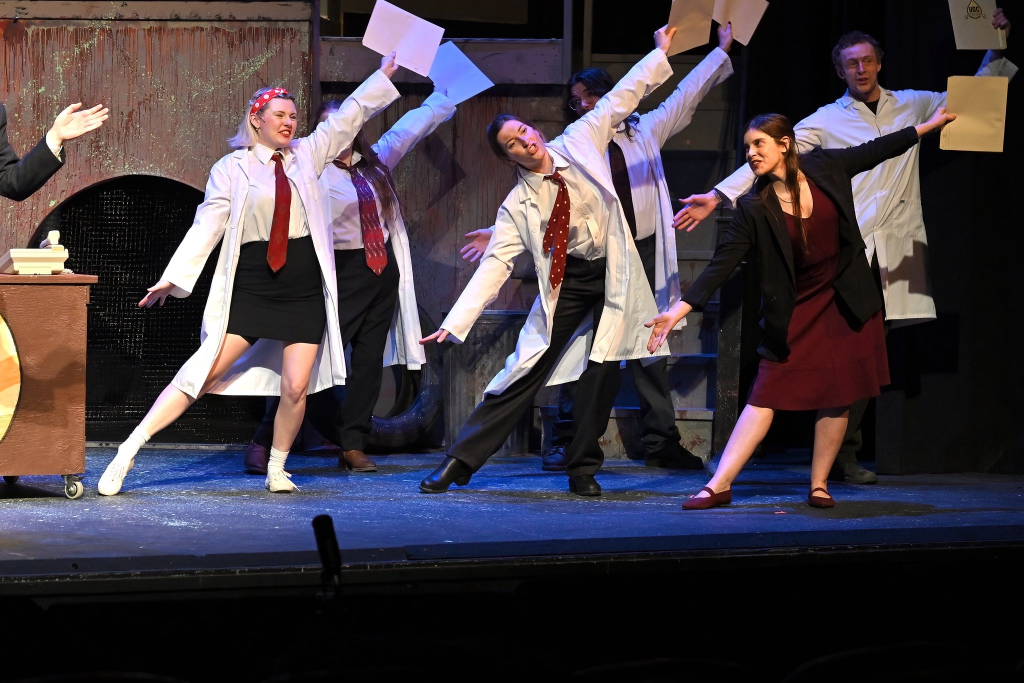
(Pictured: Leah Exley, Christine Varga, Luba Skyba, Nicholas McConnell, Amelia Armstrong, Matt deKort – Urine Good Company Employees. Photo Credit: Ross Davidson.)
Q. Your marketing/social media campaign for Urinetown has been nothing short of brilliant. Could you give a shout-out to those individuals responsible for it?
Thank you! We really appreciate your kind words and that you’ve been following our campaign.
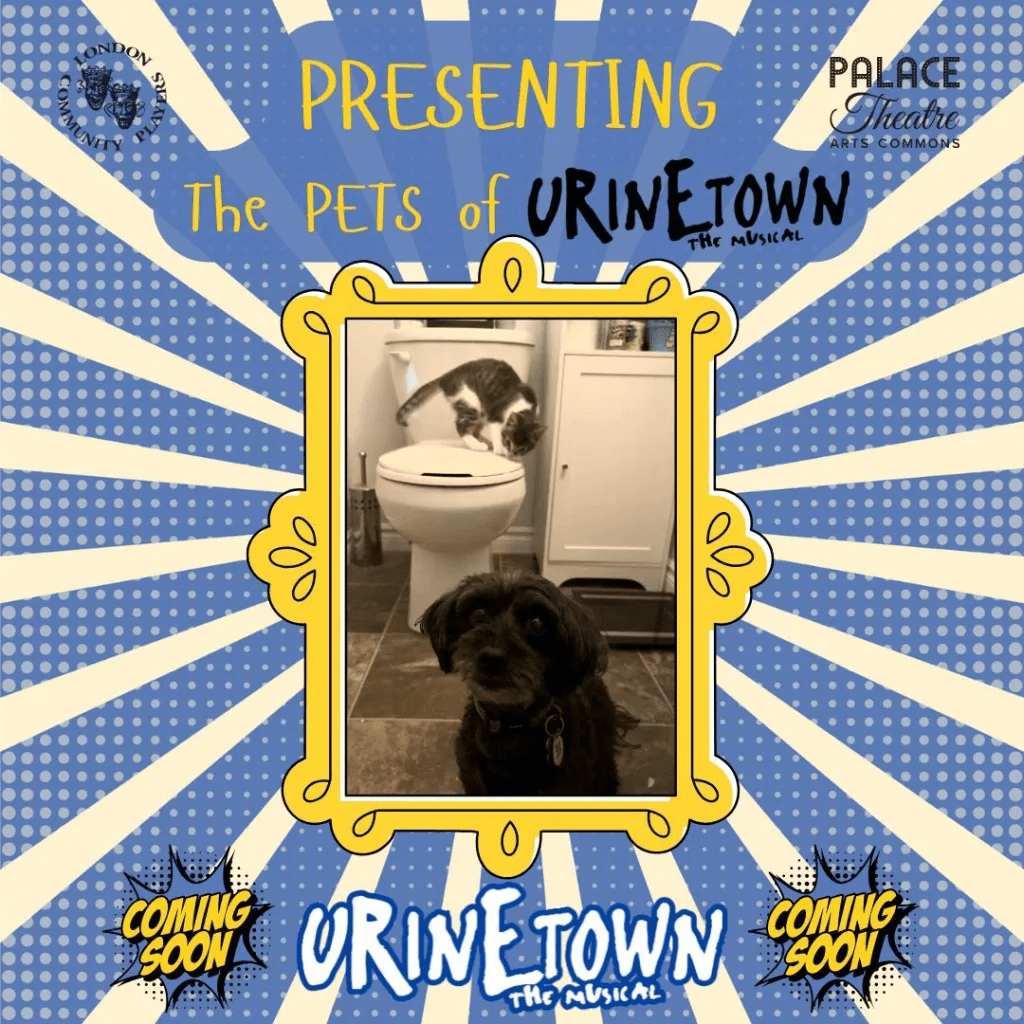
The “Pets of Urinetown” came about naturally because so many of our cast members have pets. Sharing stories and photos of their furry friends was a fun, comfortable way for the cast to connect—and I thought it would be a gentle, playful way to spark interest in the show.
(Pictured: Pets of Urinetown poster.)
The poster campaign, on the other hand, was entirely the brainchild of the brilliant Henry Truong, who also plays Bobby Strong, our hero. Henry came up with the imagery, collaborated with others to bring the visuals to life, and even wrote all the copy. It was a truly inspired creative effort.
Urinetown gives so many ways to engage with the material, from the music to the story to the little touches we’ve created for social media. I think that’s why people who love this show really, really love it—and our team’s creativity has made sharing that love so much fun.
Q. Is there anything else you think our readers should know about LCP’s production of Urinetown?
One thing to know: it’s not here long! Urinetown runs for just eight performances, from Thursday, February 19th through Sunday, March 1st. Both Sunday shows are matinees, and the second Saturday also offers a matinee to give those who might feel less comfortable in the area another chance to attend. That Saturday matinee will also be adjudicated for the WODL festival, with a public adjudication immediately following the performance for anyone who wants to stay and watch.
For peace of mind, LCP provides security at all of our productions, with patrolled entrances and monitored parking. And as a bonus, parking behind the theatre is now free at all times.
Don’t miss it—once it’s gone, it’s gone!
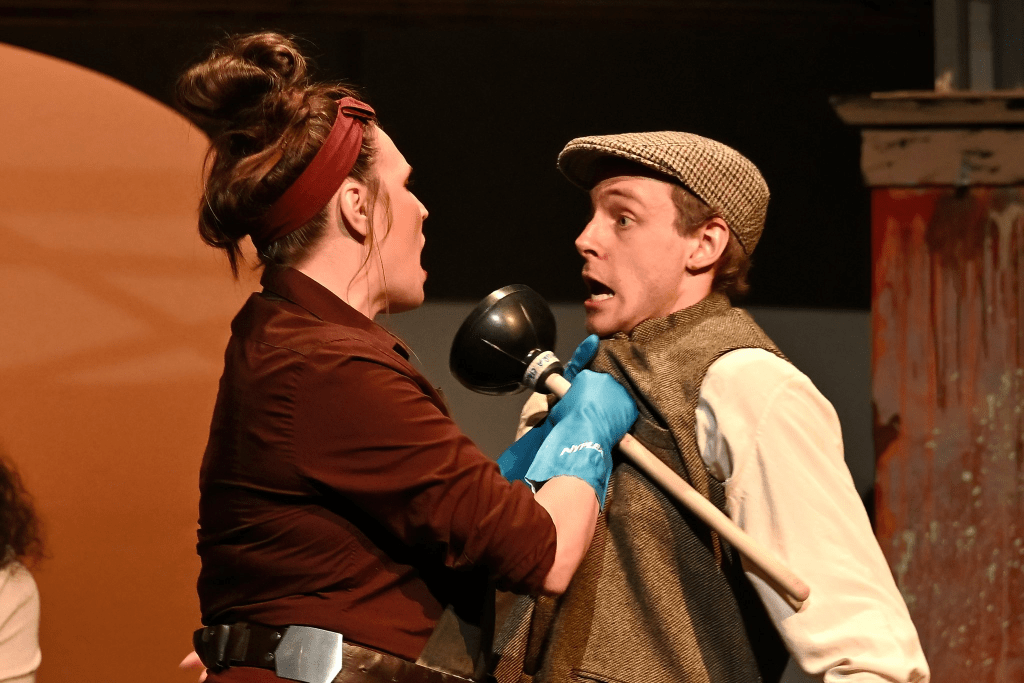
(Laura Williams as Penelope Pennywise and Matt deKort as Old Man Strong. Photo Credit: Ross Davidson.)
CREATIVE TEAM
Producer – Ceris Thomas
Director – Sydney Brockway
Stage Manager – Amanda Marshall
Musical Director – Steven Morley
Lighting Designer – Indrani Mahadeo
Sound Designer – Quinton Esquega
Costume Designer – Tannis Daoust
Costume Assistant – Chaaya Vy
Costume Assistant – Chloe Scripnick
Sound Operator – Doug Deschenes
Lighting Operator – Jenny Katkov
Assistant Stage Manager – Larissa Bartlett
Assistant Stage Manager – Jess Bohan
CAST
Kate Sepi – Officer Lockstock
Luke Bainbridge – Officer Barrel
Rae Ryder – Little Sally
Henry Truong – Bobby Strong
Jesslyn Hodgson – Hope
Laura Williams – Pennywise
Sean Brennan – Cladwell
Ryan Starkweather – Fipp
David Lu – McQueen
Cassandra “Cass” Allen – Mrs. M/Boy Cop #1
Skyler Gallagher – Dr. B/Cop
Jade Rogers – Secretary/Cop
Nicholas McConnell – Hotblades Harry/Boy Cop #3
Antonia Sidiropoulos – Little Becky Two Shoes/Cop
Matt deKort – Old Man Strong/Ensemble
Allison Gold – Josephine “Ma” Strong/Cop
Jennifer Groulx – Tiny Tom/Boy Cop #2
Christine Varga – Soupy Sue/Cop
Dustin Freeman – Robbie the Stockfish/Cop
Luba Skyba – Billy Boy Bill/Cop
Charlotte “Charlie” Camrass – Rebel Poor/Girl Cop #1
Amelia Armstrong – Ensemble
Leah Exley – Ensemble
IF YOU GO:
What: London Community Players present Urinetown: The Musical
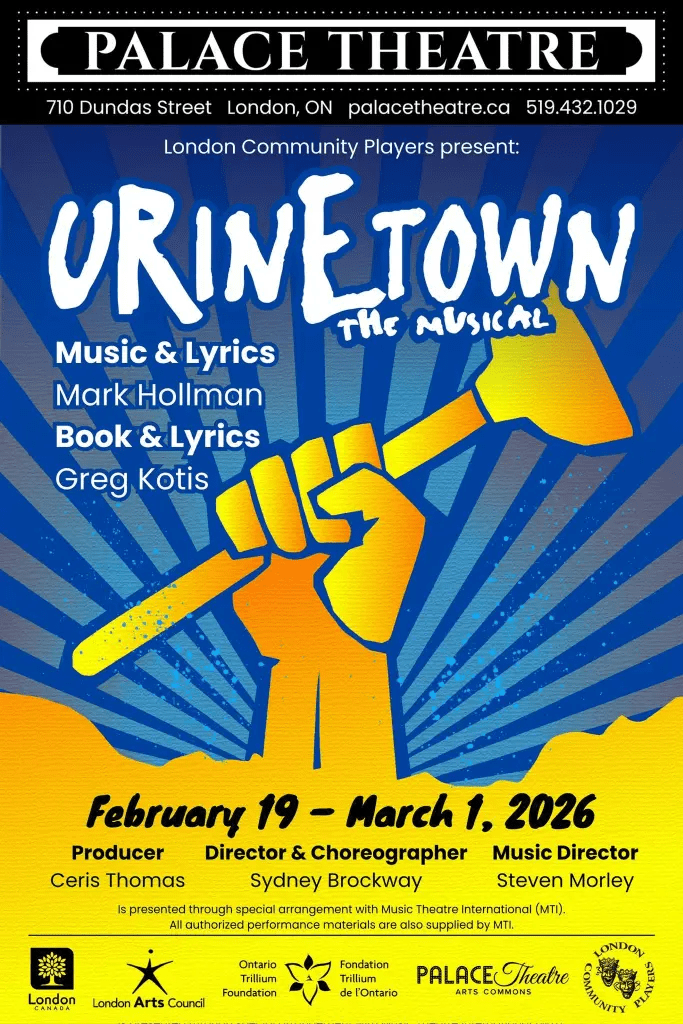
When: February 19 to March 1, 2026
Where: David Long Stage, Palace Theatre, 710 Dundas St., London, ON
Compiled by Richard Young, Publisher & Content Manager, The Beat Magazine 2025
This is the first in a series of weekly features highlighting selected arts and culture events in the London area. What better way to begin than with International Artists Day, celebrated annually on October 25th!
Continuing Art Exhibitionsin the London Area
There is a lot of great art being exhibited in London area galleries. Let’s take a look at some of it.
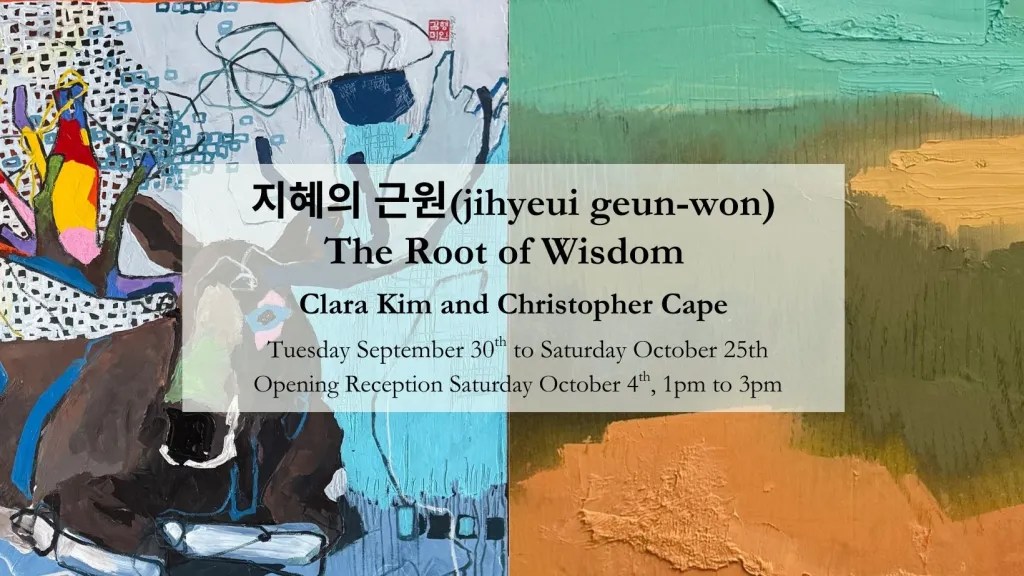
The Simple Reflections Art Exhibition continues at TAP Centre for Creativity until November 1, while over at Westland Gallery, The Root of Wisdom featuring works by Clara Kim and Christopher Cape closes Saturday, October 25. Maritime Minute, featuring works by West Coast artist Les Ramsay, continues to October 30 at Forest City Gallery,
The Vice-President’s Day Quilts Throughout the Years exhibition runs to November 1 at the Ingersoll Creative Arts Centre, while works by Lyn Carter and Aiden Urquhart are on display at the Woodstock Art Gallery. At Museum London, the new permanent collection exhibition All Around Me, All Around You still features Canadian artworks and historical artifacts from the museum’s collection.
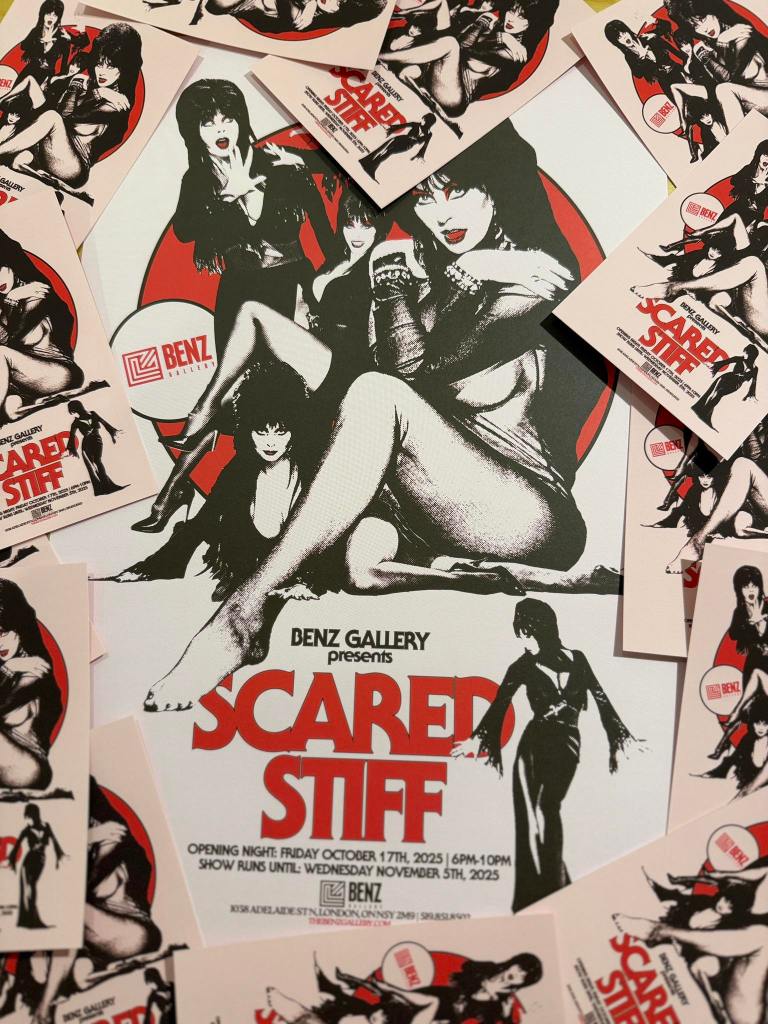
The Benz Gallery’s “Scared Stiff” Halloween Exhibition continues during our regular hours until October 31st. Stop by to collect or just get into the spirit!
The Gallery Painting Group’s Art Show and Sale opens tonight at 5 p.m. and continues to Sunday at 3 p.m. at First-St, Andrew’s United Church, 350 Queens Ave. in London.
(“Bridge Robin”, coloured pencil on Museum Board, 12 by 12 inches by Beth Stewart)
You can find Beth Stewart’s reviews of some of these exhibitions elsewhere on The Beat Magazine 2025 website.
You Want Theatre? We’ve Got Theatre!
If you are craving some live local theatre, there is lots to choose from this weekend.
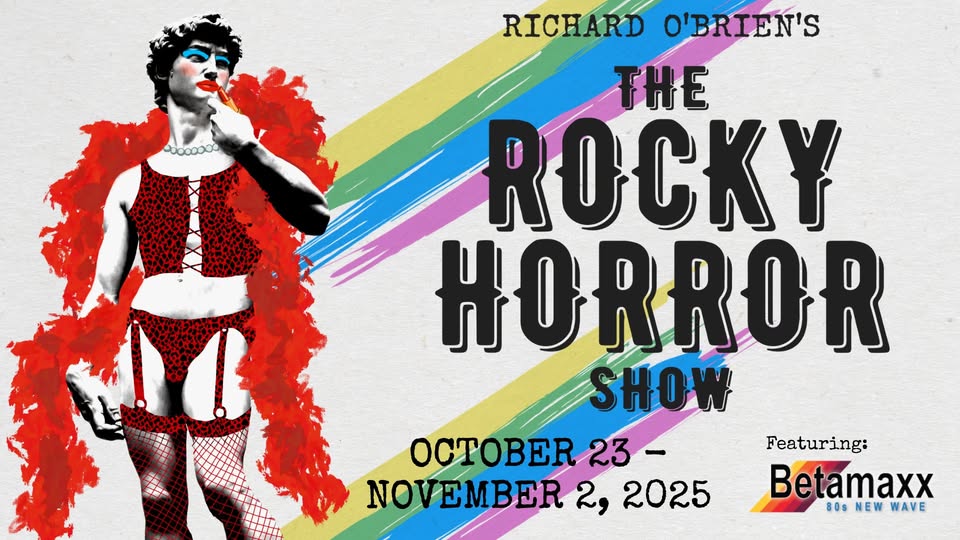
The hilarious The Play That Goes Wrong continues at the Grand Theatre until November 2, while sold-out performances of Infuse Productions’ The Rocky Horror Show continue at the Palace Theatre on October 25 and October 26. The show continues until November 2.
AlvegoRoot Theatre’s production of Sleigh Without Bells: A Donnelly’s Story has two additional matinee performances, scheduled for October 25 at 2:00 PM and October 26 at 2:00 PM at The Manor Park Memorial Hall in London.
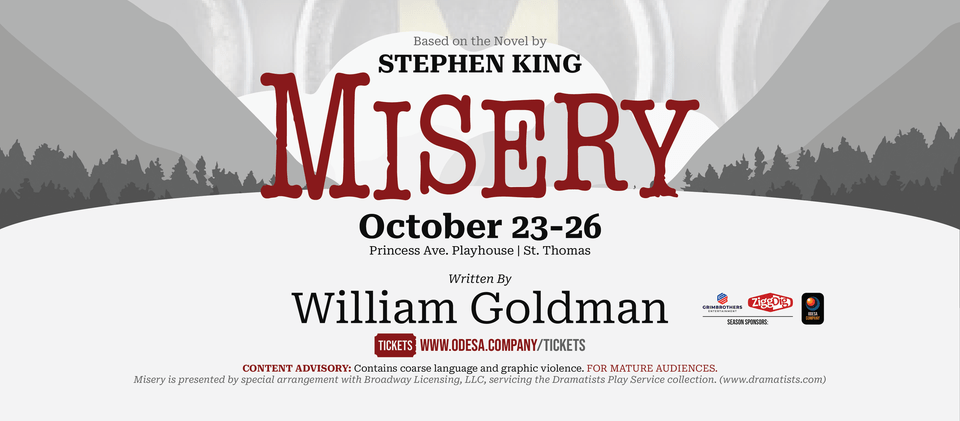
Over at the Princess Ave Theatre in St. Thomas, Odesa Company presents Stephen King’s Misery on October 25th and 26th, while the St. Marys Community Players present Norm Foster’s hilarious Hilda’s Yard until November 2.
You can check out Jo-Anne Bishop’s theatre Reviews elsewhere on The Beat Magazine 2025 website.
The Forest City Film Festival Celebrates Its 10th Anniversary
The Forest City Film Festival returns for its tenth year, hosting nine days of screenings and events at multiple venues in Downtown London. London creative, Donald D’Haene’s documentary, Interpreting Erik, is one of the award-winning films being screened.
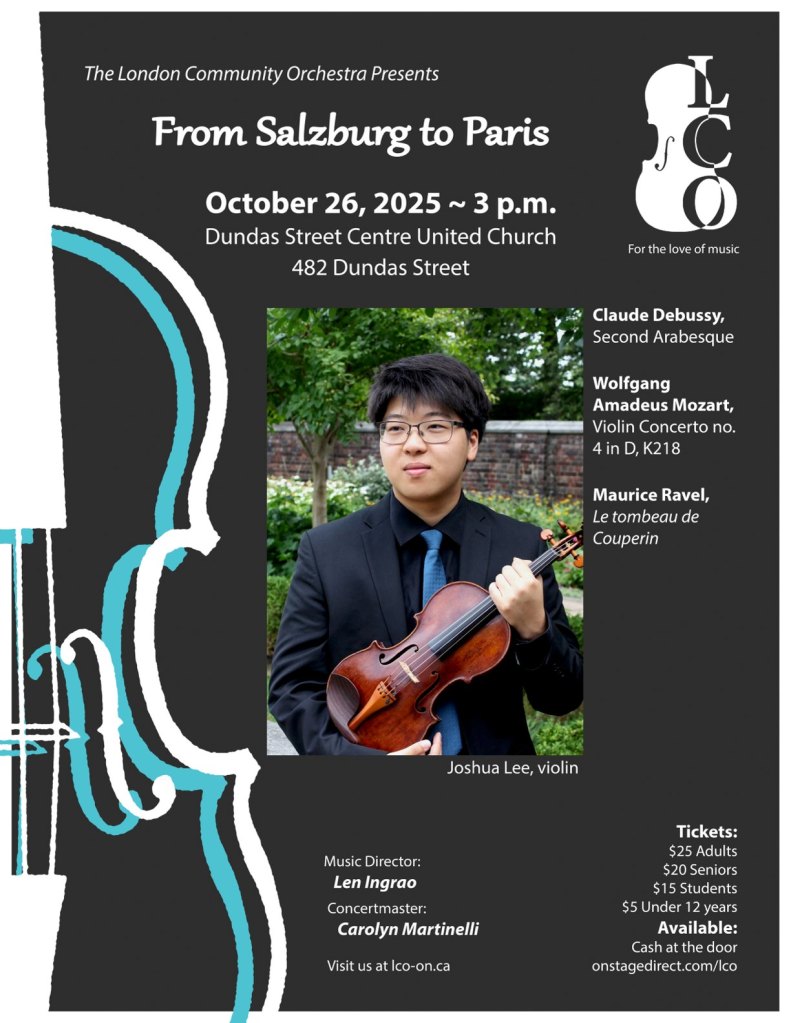
The London Community Orchestra presents From Salzburg to Paris on Sunday, October 26, 3:00 pm. at Dundas Street Centre United Church, 482 Dundas St., London, ON.
Featuring soloist Joshua Lee, performing Mozart’s Violin Concerto No. 4 in D Major, K218, composed by Mozart in his hometown of Salzburg in 1775.
The program also includes: Debussy – Second Arabesque Ravel – Le tombeau de Couperin
Experience the journey from Mozart’s classical elegance to Debussy and Ravel’s Parisian impressionism, a celebration of musical evolution from structure to atmosphere.
Tickets: Adults – $25 Seniors – $20 Students – $15 Children 12 and under – $5
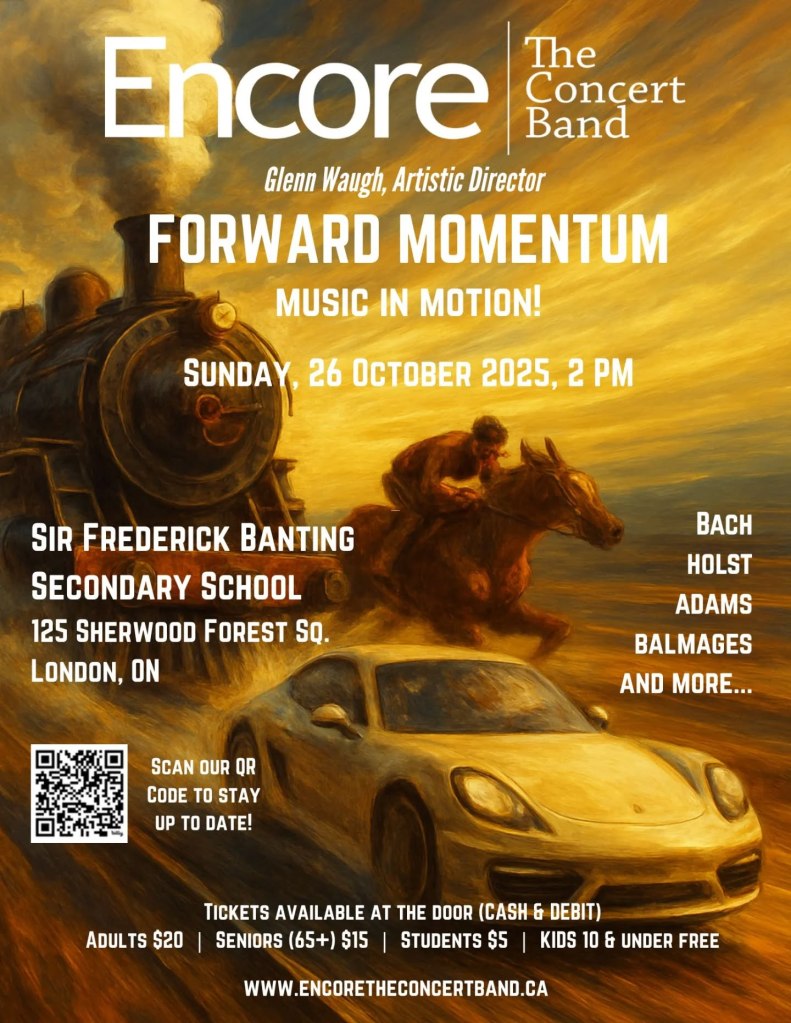
Encore The Concert Band holds it 2025 season opener, Forward Momentum, on Sunday, October 26 at Sir Frederick Banting Secondary School.
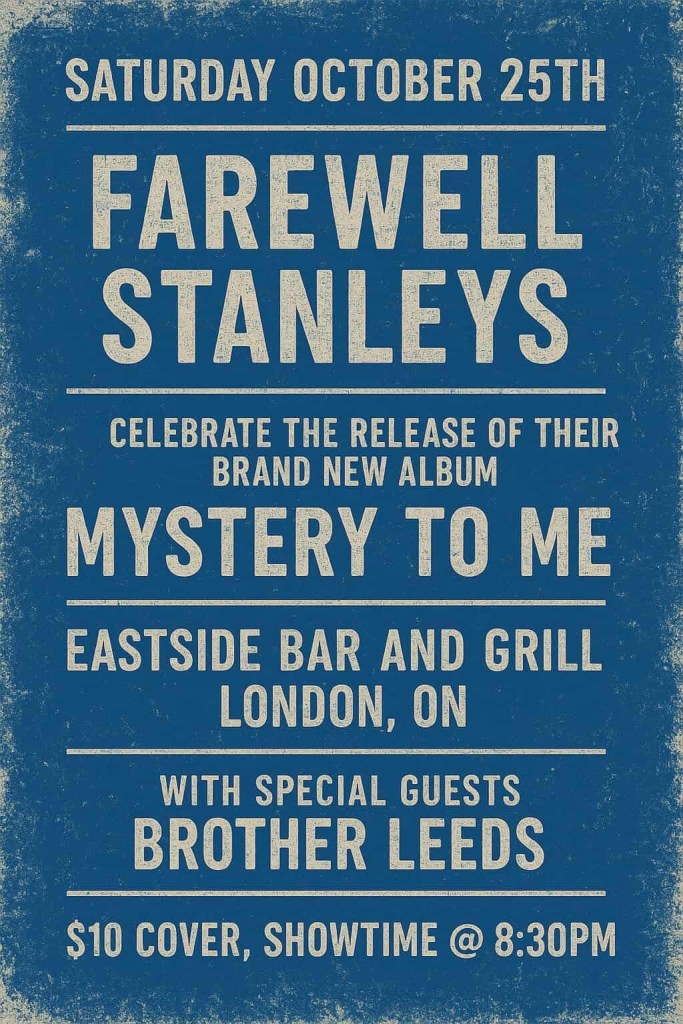
London’s Eastside Bar & Grill hosts Farewell Stanleys release of their brand new, fifth album Mystery To Me, produced by Moe Berg (of The Pursuit of Happiness & The TransCanada Highwaymen), with special guests Brother Leeds, on Saturday, October 25th. Showtime at 8:30pm, 10$ at the door. Copies of Mystery To Me will officially be on sale at this event, available on vinyl & CD. https://linktr.ee/FarewellStanleys
The Gavin Adcock Need To Tour concert takes place Saturday, October 25th, at the London Music Hall.
Over at the Palasad Socialbowl, 63’ MONROE is back to tear the roof off. Loud, raw, and unapologetic—London’s punk pioneers bring decades of sweat, snarls, and speed to the stage. They’re rolling in with the razor-sharp riffs of Limited of Approach and the outlaw rock’n’roll chaos of Jesse James Medicine Show. Expect snarling guitars, thundering rhythm, and a night of pure, high-voltage punk energy.
Licensed – All Ages – $5 Door.
That’s it for this weekend. If your venue has an event you would like featured next weekend, send the details to Richard Young, Publisher & Content Manager of The Beat Magazine at richardyoung@thebeatmagazine2025.ca
This is the twenty-first in a series of Q&A Profiles of London area theatre companies and groups. Today, we profile Shrew’d Business.
Q. When was your company founded? By whom and why?
We founded Shrew’d Business in 1998. Brian “Brock” Brockenshire and I were the Artistic Directors of the original Renaissance Festival in Ontario. That year, we were thinking of ways that we could use our skills outside of our regular theatre commitments and possibly develop some workshops/performances. We edited down Taming of the Shrew to be only Kate and Petruchio, and we performed that at the Renaissance Festival each weekend. We also performed it at the Parent Festival in Maryland later that summer. From that, we took the name to become Shrew’d Business.
(Pictured: Ceris Thomas, co-founder of Shrew’d Business.)
Q. Is your company best described as professional or not-for-profit community theatre? Or both?
We can fit in either category. We do a large amount of work in the community theatre scene and in high school in and around London, but since Brock is an Equity member, he has also done work with professional companies. Specifically, he has done nineteen shows for the Lighthouse Festival. Usually, one a season, depending upon pandemic influences, and it is due to them that we have a naval cannon in our home that we can fire for the trick-or-treaters on Hallowe’en.
Q. What venue(s) do you use to stage your productions?
We have staged two Fringe productions, The Fantasticks and [They Fight!]. These were both in the Spriet Theatre in the Covent Market Building. We also staged The Seafarer at TAP in 2016. We plan to remount that show in 2026.
(Pictured: Brian “Brock” Brockenshire, co-founder of Shrew’d Business.)
Q. Does your company have a Mission or Statement of Purpose?
We provide quality training for violence on stage. We do more than just violence of course, but that is our main focus. We have been instrumental in several exciting productions for Londo Community Players, Original Kids Theatre Company and Musical Theatre Productions, as well as multiple productions in high schools, and smaller community groups. We rent equipment and have accessed specialty items for specific shows. We are licensed pyrotechnicians, so we have helped shows like You Can’t Take it With You to blow up things on stage.
Q. Does your company have a Board of Directors and paid Staff?
We only have four company members, so we do not require a Board. Our members are paid for many productions, as violence is not something you should leave to the untrained. Depending upon the budget of the show, we can usually come up with a reasonable fee. It is more important to us that a show be safe than incredibly lucrative.
Q. Tell me about your 2025-2026 Season. Does it have any underlying theme?
We don’t have any specific productions for our company this year, but we are helping with Deathtrap, Urinetown, Misery, and The Three Musketeers for other companies.
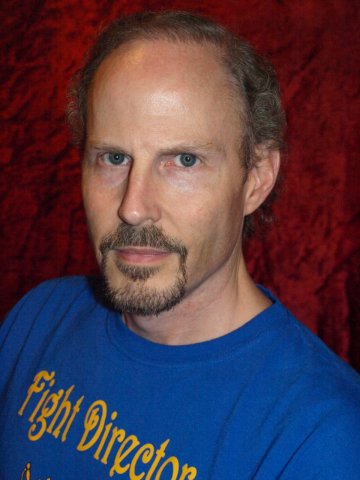
(Pictured: Apprentice Fight Director Kerry Hishon.)
Q. Do you have any thoughts about the London area theatre community and your part in it?
We moved to London from Toronto in 2005. The intention was for Shrew’d Business to be able to help a variety of productions and members of shows grow in their experience and training for dangerous stage movement. Even in professional theatre we have witnessed real slaps on stage, and this should never happen. The safety of performers and the comfort of the whole team and audience are paramount in our work.
Since I have a love of puppets, we have also been charged with building some interesting creations that have been used on a bunch of stages in and around London. Helping a show be the best possible version is always our goal. There are very few cases where we have said “no” to a team. This has only happened when the timeline was too short, the expectations were too high, or the team was deluded about their thoughts for their show. We’d always prefer to be helpful, but there just are sometimes when you know you can’t have your name associated with something, and safety is that line in the sand.
We’ve been working in London theatre for twenty years and many more years before that elsewhere. At some point, we will need to slow down and eventually stop because staging this specialized kind of work is very draining and becomes physically impossible as the body ages. Hopefully, when that time comes, London companies will realize that they will have to either choose shows without violence or hire them elsewhere to keep their productions safe.
This is the eighteenth in a series of Q&A Profiles of London area theatre companies and groups. Today, we profile Scooter Productions.
Q. When was your company founded? By whom and why?
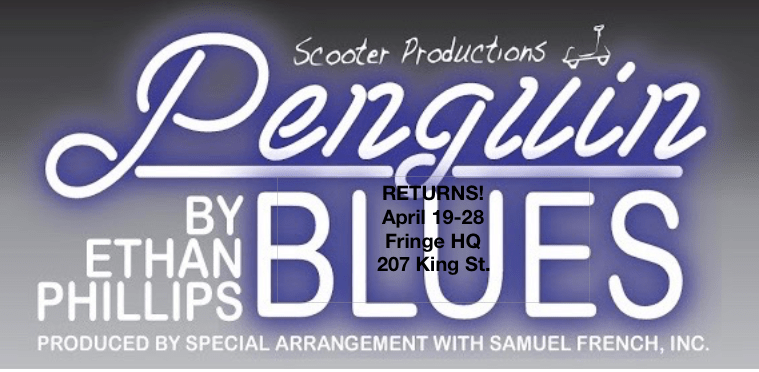
Scooter Productions was founded in 2017. The founding members are Phil Cal, Heather Rivet, Brian Speagle, and Sherine Thomas-Holder. We got together to produce serious drama with current social themes. Our first production, Penguin Blues, tackled addiction and isolation.
Q. Is your company best described as professional or not-for-profit community theatre?
We are a non-profit community theatre group.
Q. What venue(s) do you use to stage your productions?
Our last two productions have been staged at Manor Park Memorial Hall.
Q. Does your company have a Mission or Statement of Purpose?
“Scooter Productions strives to produce quality live theatre and to promote all of the arts in the Greater London Area.”
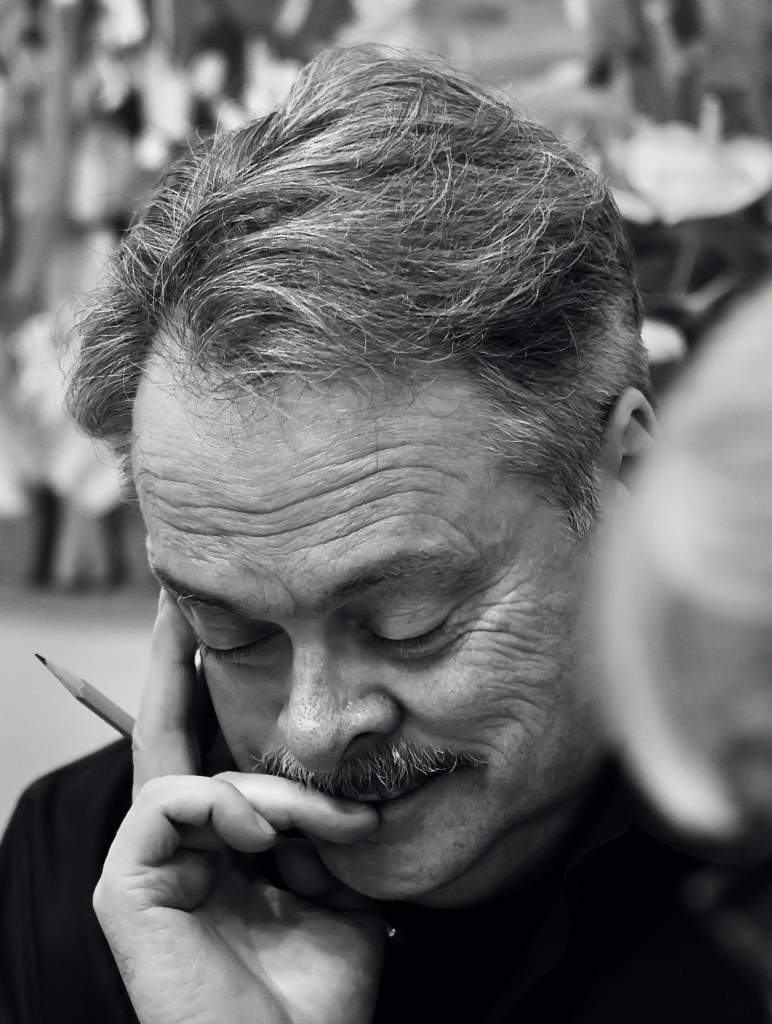
(Pictured: Brian Speagle, co-founder of Scooter Productions.)
Q. Does your company have a Board of Directors and paid Staff?
There is no board of directors or paid staff.
Q. Tell me about your 2025-2026 Season. Does it have any underlying theme?
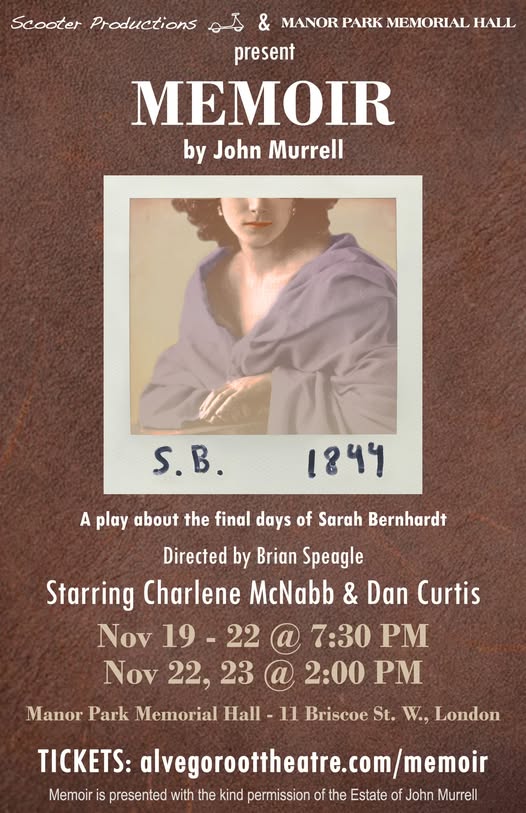
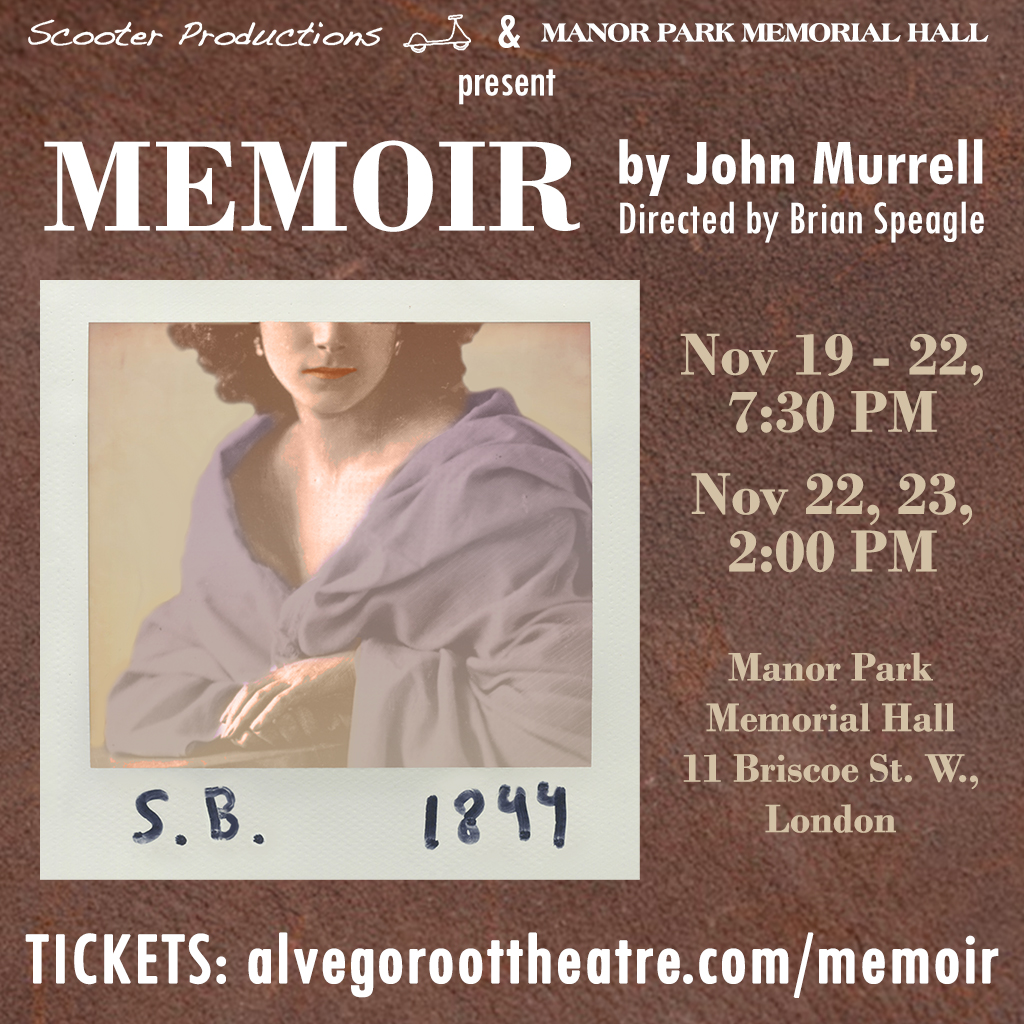
At the moment, our 2025-26 season consists of one production, Memoir, by John Murrell. Our next show is TBD.
Q. What show(s) will you be staging this fall (September to December)? Tell me a little bit about each.
Memoirwill run from November 19th to 23rd.
Plot summary: It is the summer of 1922; Sarah Bernhardt’s last at her beloved island estate off the coast of Brittany. With her erstwhile secretary, butler, and general dogsbody Georges Pitou, she attempts to write volume two of her memoir. Sarah enters a world of memories, spanning her entire life and theatre career. Many of her reminiscences are of her many accomplishments, but there are also memories of pain and trauma. However, she is The Divine Sarah, and she triumphantly rises above them and overcomes! John Murrell has created a moving and complex script that has touched theatregoers around the world.
Q. Do you have any thoughts about the London area theatre community and your part in it?
It is my belief that community theatre groups in London need to collaborate and support one another to grow an audience that will appreciate theatre and all the arts in London. In practical terms, we should be attending each other’s shows and helping to promote them. We are all in the same boat.
by Richard Young, Publisher & Content Manager, The Beat Magazine 2025.
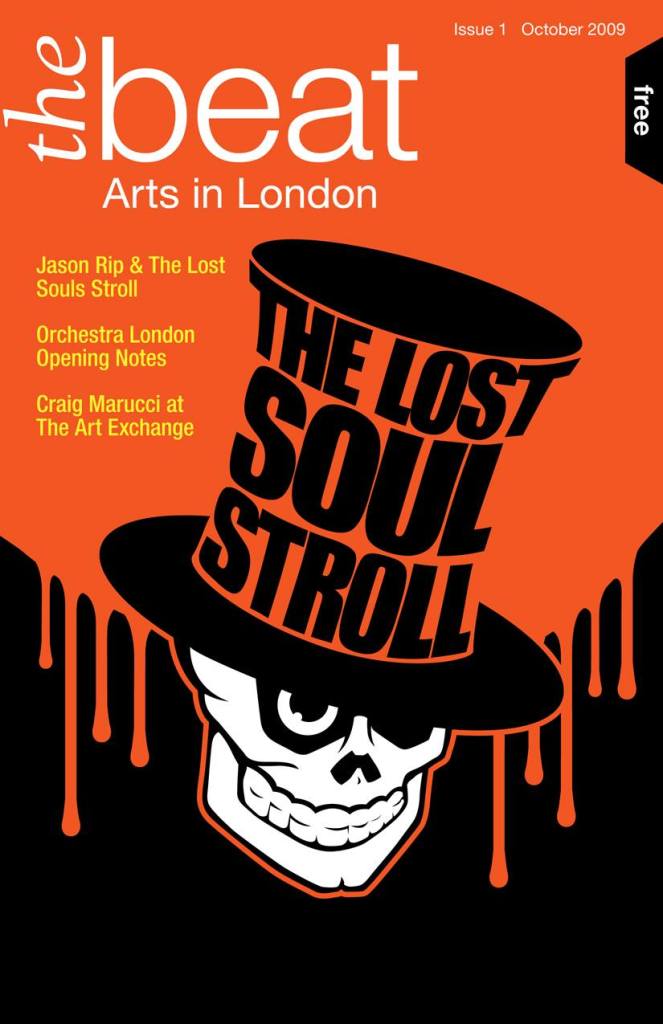
(Pictured: The Beat Arts In London, Issue 1, October 2009. Cover Art by Lionel Morise)
After a nine-year hiatus, I recently revived The Beat Magazine, an independent arts magazine I founded and published from 2009 to 2013, as The Beat Magazine 2025 website.
Since then, several of my peers and contemporaries have asked me one simple question: Why?
It’s a question I have asked myself many times over the last few weeks.
First and foremost, my reason for doing so is my humble attempt to make up for the lack of local arts and culture coverage in the mainstream media over the last several years. Frankly, I think this is criminal in a city the size of London. London and area creatives deserve better.
As one of our volunteer writers, Dawn Lyons, sums it up:
“London’s arts scene is alive with talent, creativity, and passion. It’s full of amazing artists across disciplines who continue to create, perform, and inspire, often without the recognition they truly deserve. I see The BeatMagazine 2025 as a way to showcase that energy and help connect people in the community with the incredible work happening around them.”
Much like the former print publication, the website provides timely, informed local arts news and commentary, and previews and reviews of local arts events. It also includes profiles of the area’s creatives and arts and culture venues. It is ad-free, and subscriptions are free.
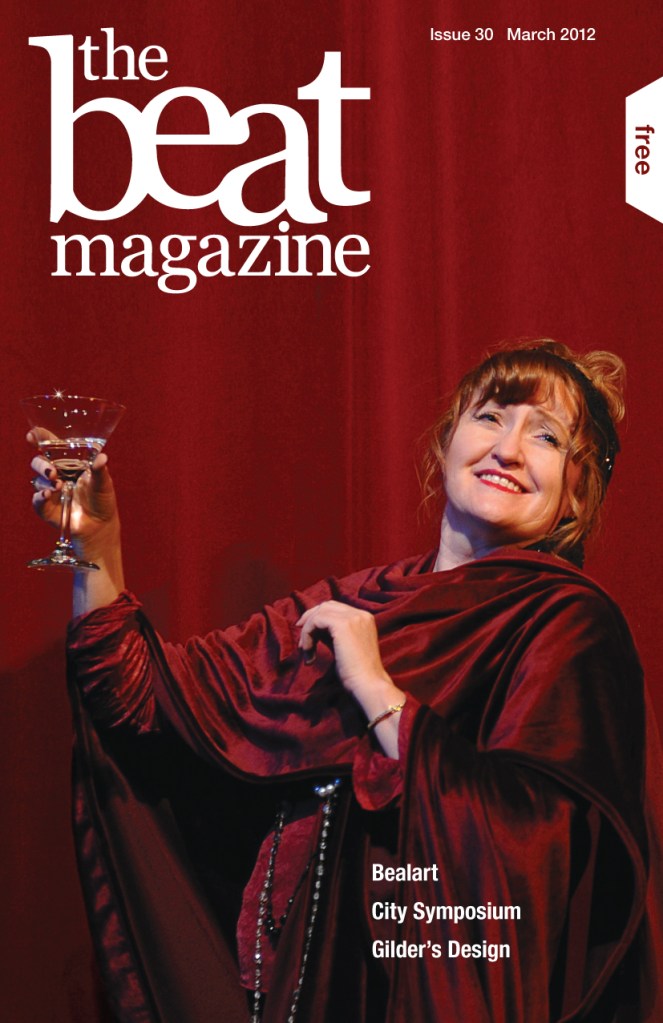
(Pictured: The Beat Magazine, Issue 30, March 2012. We featured Ceris Thomas on the cover. Ceris was appearing in The Drowsy Chaperone, then playing at the Palace Theatre.)
Second, simply because I want to.
Since the print magazine folded in the summer of 2013, I have kept myself busy doing many things.
I wrote freelance for a variety of local print publications, including Lifestyle Magazine, Business London, London, Inc., Professionally Speaking (Ontario College of Teachers), Scene Magazine, and the Villager Group of community magazines.
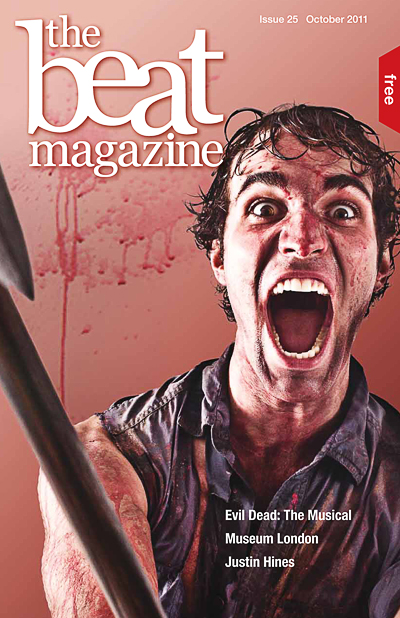
(Pictured: The Beat Magazine, Issue 25, October 2011. This cover, featuring a cast member from Evil Dead: The Musical, proved to be one of our most popular ones. We had difficulty keeping our stands stocked!)
I worked part-time/casually at a well-respected London Advertising & Marketing agency, writing copy about heavy industrial machinery. Talk about a learning curve! I thank owners Robert Adeland and Mina Thaler for their patience in teaching me the ins and outs of large cranes, dump trucks, excavators, and the like.
From December 2022 until August 2025, I was the Publicity and Program Department Head for Silver Spotlight Theatre, London’s theatre company that gives those 55 and older a chance to sing, dance, and perform on stage or backstage.
Most recently, I have served on the London Public Library’s Historic Sites Committee, the body that erects plaques around the city commemorating people and places of local historical significance. One project I take particular pride in is an Interpretive Sign Celebrating Wonderland Gardens’ Contribution to London’s Music History, which I prepared in collaboration with the City of London Culture Office. It will be officially unveiled on a date TBD.
(Pictured: The original Wonderland Gardens Outdoor Bandshell. Wonderland opened on May 24, 1935.)
That brings me up to the summer of 2025.
An unexpected medical diagnosis of Chronic Kidney Disease in July forced me to reevaluate many aspects of my life.
First and foremost, was changing my dietary and exercise habits. Gone are all processed foods, fast foods, and those with high levels of sodium and potassium. No more putting off going to the gym at least three times weekly.
Second, was relieving those things that cause me mental stress and unnecessary anxiety.
At my age (70-something), I decided that I want to fully re-engage with the local arts and culture community, rather than focusing on one aspect of it with my involvement with Silver Spotlight Theatre.
I also want to work at my own beck and call and not be accountable to others who may not always share my at times unbridled enthusiasm and relentlessness.
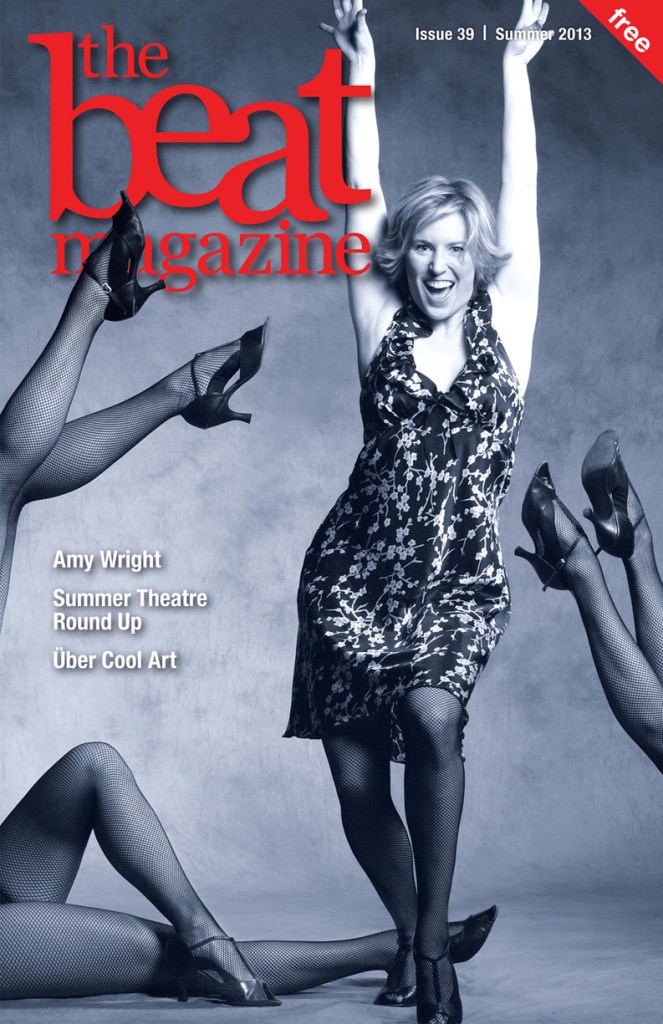
(Pictured: The final issue of The Beat Magazine, Summer 2013, featuring London dancer and choreographer, Amy Wright, on the cover)
In short, reviving The Beat Magazine seemed to be the best course of action to follow at this point in my life.
Has it taken up a lot more of my time than I thought? Hell, yes! But it’s my time and I love it.
Is there any financial return? Hell no! It’s strictly, to use the old cliche, a labour of love.
So, welcome to the new Beat Magazine in the form of The Beat Magazine 2025 website!
Let us know what you would like us to cover.
Let us know if you would like to volunteer some writing about the local arts and culture scene.
Let us know how we’re doing.
Let us know what’s working and what’s not working.
This is the thirteenth in a series of Q&A Profiles of London area theatre companies and groups. Today, we profile the Palace Theatre Arts Commons.
Q. When was your company founded? By whom and why?
London Community Players (LCP) were founded in 1974. London Youth Theatre Education (LYTE) in 2012. Palace Theatre Arts Commons (PTAC) was formed in 2020, and the London Fringe Festival joined us then.
Q. Is your company best described as professional or not-for-profit community theatre? Or both?
Non-profit community theatre
Q. What venue(s) do you use to stage your productions?
David Long Stage (350-seat auditorium) and Procunier Hall (75-seat backbox theatre)
Q. Does your company have a Mission or Statement of Purpose?
We believe everyone who wants to be entertained, provoked, inspired, or moved by theatre should be afforded the opportunity to do so.
We inspire and nurture individuals through volunteer and educational experiences in theatrical production and management.
We support and promote theatrical youth programs. In conjunction with our partners, we produce, present, and promote high-quality, affordable, entertaining theatrical experiences.
We provide extensive theatre resources for the broader community. We own and manage a heritage venue that is a destination of choice and is available to host a wide variety of cultural and community events.
We create opportunities in the performing arts for everyone in our community.
Q. Does your company have a Board of Directors and paid staff?
Board of 13 members and paid staff of 2 full-time and 2 part-time.
Q. Tell me about your 2025-2026 Season. Does it have any underlying theme?
London Community Players – Mainstage (David Long Stage)
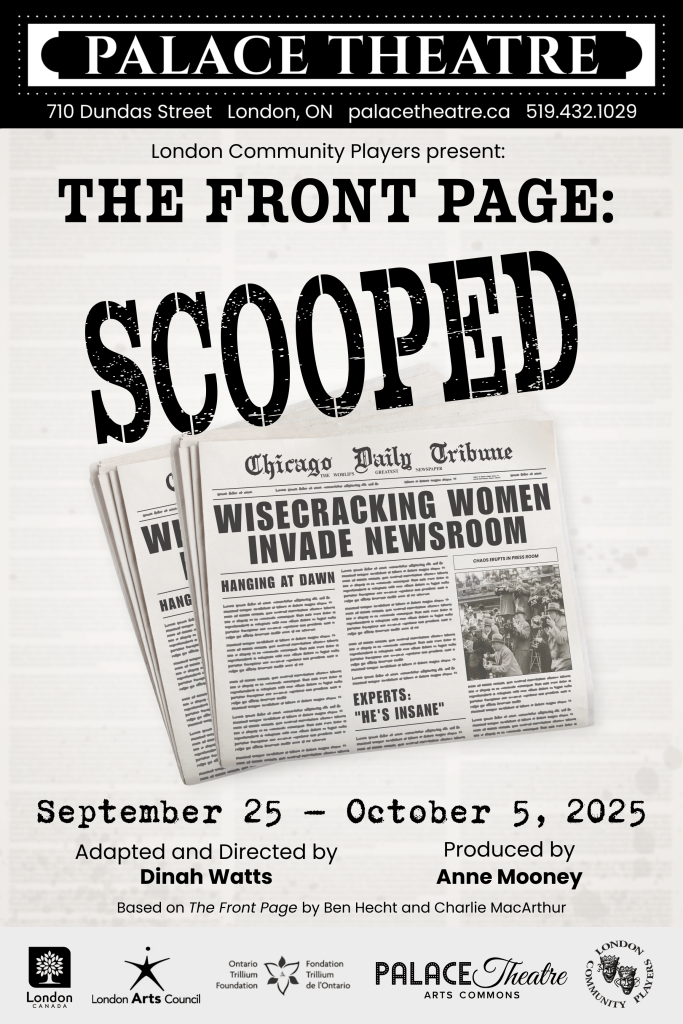
The Front Page: SCOOPED September 25 – October 5, 2025
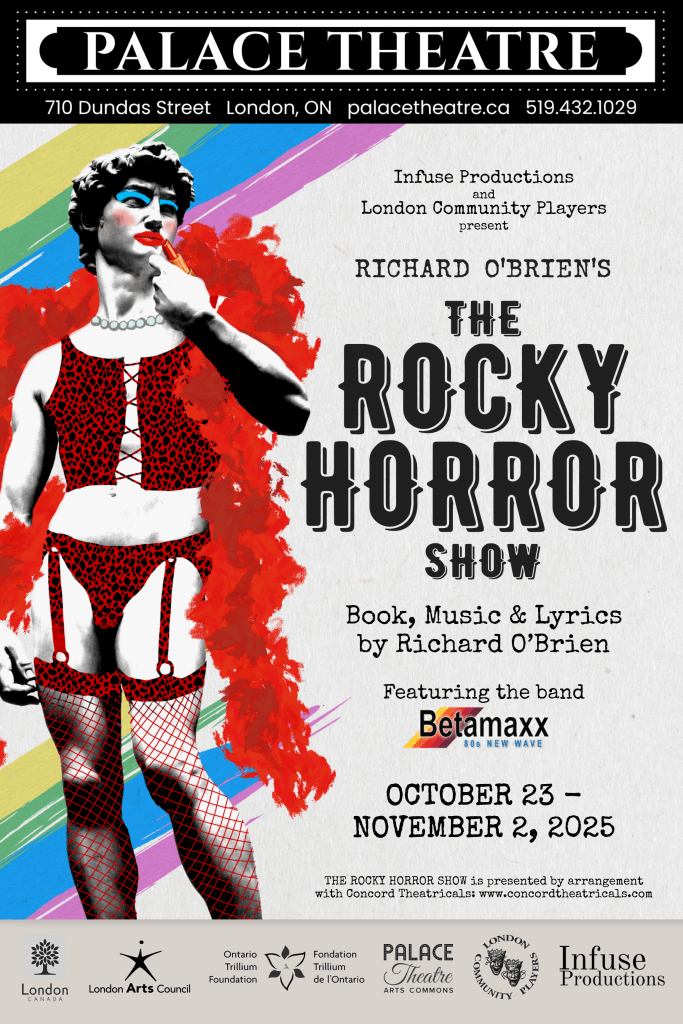
The Rocky Horror Show October 23- November 1, 2025 Co-production with InFuse Productions
Deathtrap November 27 – December 7, 2025
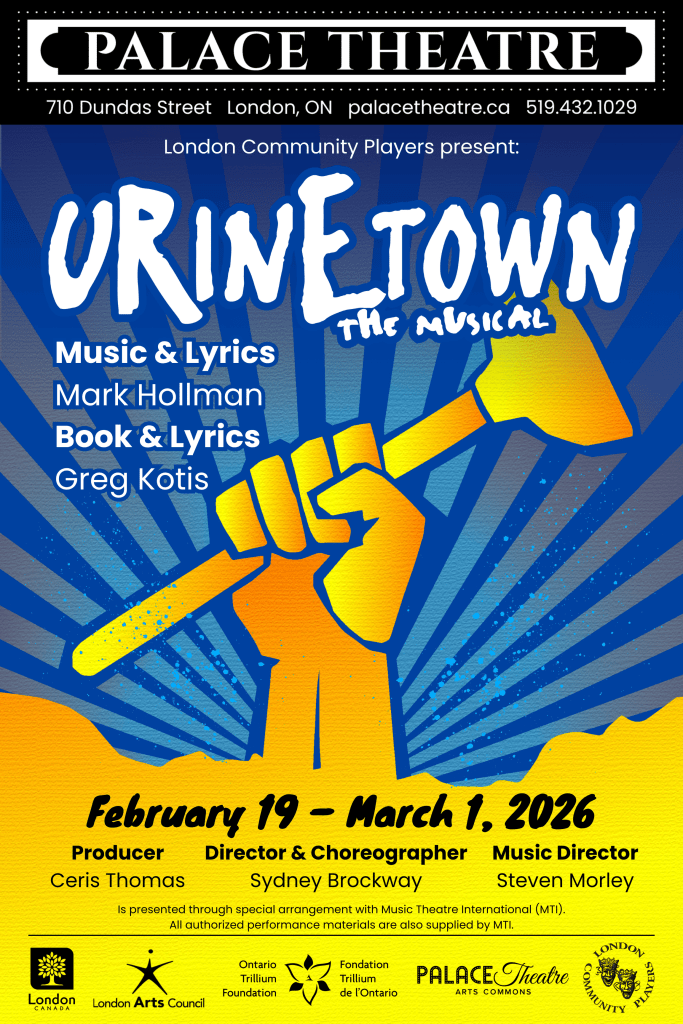
Urinetown: The Musical February 19 – March 1, 2026
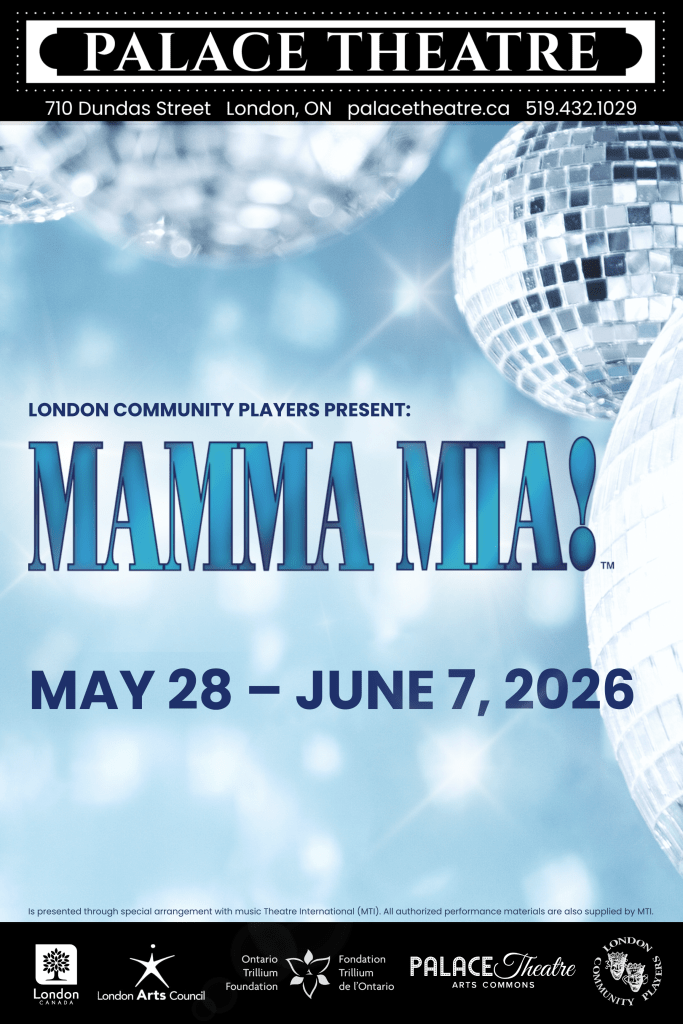
Mamma Mia! May 28-June 7, 2026
London Community Players – Procunier Hall (Black Box)
Three Tall Women October 16 – 26, 2025
Closer February 5-15, 2026
Harris Cashes Out March 5-15, 2026
The Family Creetin with Banished by the King Productions April 16-25, 2026
London Youth Theatre Education (LYTE)
Junior Musicals (ages 8–13)
Elf Jr. – December 19–21, 2025
Junie B. the Musical Jr. – January 2026
Senior Musicals (ages 14–18)
Mean Girls High School Version – March 2026
Anne of Green Gables: The Musical – March 2026
Q. Do you have any thoughts about the London area theatre community and your part in it?
No response was given.
For more information about the Palace Theatre Arts Commons and to purchase tickets, visit https://palacetheatre.ca/
























 Debussy – Second Arabesque